Deviant Desires: Erotic Grotesque Nonsense, Part VI: “Blind Beast”

Happy holidays, dear readers. After a brief hiatus, I’ve returned to continue with my ongoing series relating to the Japanese cultural phenomenon called “ero-guro-nansensu”, or erotic-grotesque-nonsense. This blog post comprises Part VI of the series. You can read all of the previous instalments in the Ero Guro Nansensu category of my blog.

This post shall explore yet another film adaptation of Rampo: Yusuzo Masumura’s 1969 pinky violence film Blind Beast.

9781840683004

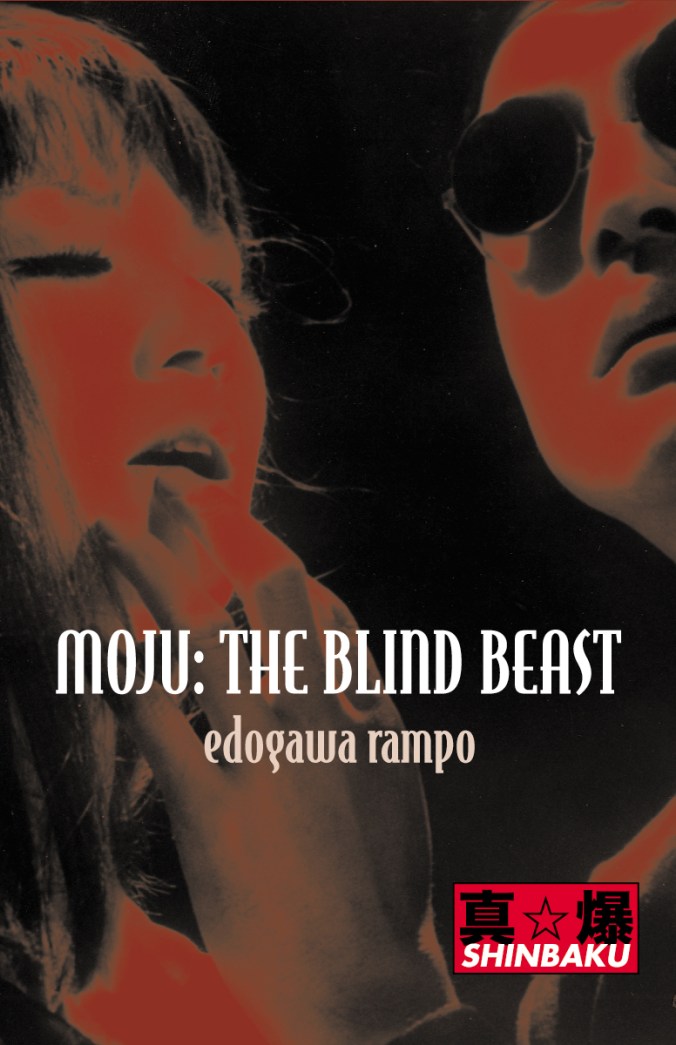
Blind Beast

In Edogawa Rampo’s 1932 novella, a psychopathic blind sculptor named Michio disguises himself as a massage therapist in order to gain access to young women, whom he abducts. He sadistically murders and dismembers his victims, using their body parts to form strikingly realistic sculptures. He is described by as “crippled, ugly, leering, and with a seemingly endless internal catalog of perversities”. In Masumura’s film, the plot is simplified from many captive girls to a single one, and most of the unsettling and grotesque elements in Rampo’s story are stripped out. The filmmaker maintains the necessary blindness of his “beast” sculptor, but depicts him as significantly less monstrous, opting to make him more sympathetic to his audience.

The film opens with a voiceover from a young artist’s model named Aki. She has arrived at an art gallery early in the morning for a meeting, and observes a lone gallery patron caressing a sculpted nude image of herself with a perverse intensity.

blindbeast01

Aki notes as the man fondles the sculpture that she experiences the sensation of being touched on her own body. This notion of a sculpted “copy” with an otherworldly connection to the “original” body upon which it was based may relate back to the Rampo story. In the novella, the blind sculptor used the actual, severed body parts of his victims to form his sculptures. Masumura’s sculptor is much less monstrous. To create his sculptures, he only needs to feel his model in order to replicate her form. For him, the woman and her sculpted “double” are one and the same.

In the guise of a massage therapist, Michio gains access to Aki in her apartment. Determined to have her serve as model for him, he chloroforms her and, with the aid of his creepily attentive mother, carries her off to their secluded warehouse.

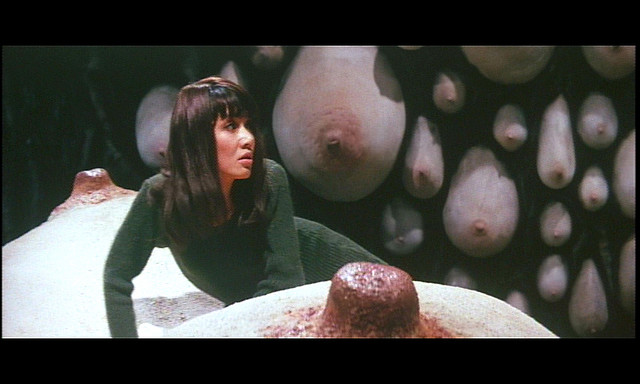
Aki awakens inside the dark interior of Michio’s cavernous studio. This is the scene that’s become emblematic of Blind Beast and, based on its set design alone, it’s easy to see why. As Michio delivers his lengthy backstory, director Masumura gradually reveals a surreal collection of sculpted body parts that adorn the walls of the studio.

2876236586_952cbcd0fb_z

The surreal body parts of Michio’s cavernous studio owe something of a debt to the famous set designed by Salvador Dali for Hitchcock’s film “Spellbound” (1945), although Dali’s set lacks the giant nipples.

After one failed escape attempt, Aki resigns herself to model for Michio, all the while seducing him in order to gain his trust. For his part, Michio is a naïve, child-like man whose knowledge of women is based solely on his relationship with his mother. Aki chides Michio for having “a baby’s view of women”, noting that his giant, recumbent female nude sculptures represent his very Oedipal view of Woman (suggesting a psychological urge to climb back into the womb). And, well, she does have a point.

740full-blind-beast-poster

Aki skillfully manipulates Michio and turns him against his mother, whom Aki accuses of having an incestuously tinged love for her son. This enrages Mom, and a scuffle ensues. During the fight, Mom strikes her head and is conveniently dispatched. Aki attempts another escape, but is thwarted by Michio who drags her back into the lightless interior of his studio.

At this point, Masumura’s film makes a significant tonal shift from quirky black humour to something much more sinister. In order to demonstrate his masculinity — which had been called into question previously by Aki — Michio rapes her over several days. Improbably, Aki confesses (by way of voiceover) to having developed a “slight affection” for her rapist over this period of time. How should we read this? That Michio can only become an adult by conquering Aki and punishing her for belittling his manhood? Are we to understand that Aki shares Michio’s rape fantasy? These are questions that arise often when discussing “pink films”, and require an entire blog series on their own to explore and critique. Since Masumura’s Blind Beast is not a film deeply anchored in reality, I’m just going to acknowledge Aki’s highly problematic conversion from rape victim to willing sexual partner and move forward with the discussion, though I felt that some mention of it was warranted.

In the latter third of the film, the couple remain in the complete darkness of Michio’s studio where, unable to see, they explore the limits of the other senses through sex and increasingly violent, sadomasochistic acts such as biting, whipping and piercing the skin with Michio’s sharp sculpting tools. In this regard, they remind us of Sada and Kichi from In the Realm of the Senses, having removed themselves from the rest of the world to exist solely in their own universe of pleasure/pain sensuality.

blindbeast09

Their sadomasochistic games culminate in extreme mutilation, when Aki requests that Michio amputate all of her limbs, rendering her a flesh-and-blood Venus de Milo much like the limbless female nude torsos that adorn Michio’s studio. Again, like Sada and Kichi, their exploration into the world of the senses cannot be perpetually sustained, and leads to their eventual demise. The world of the erotic-grotesque may provide a diversion from the real world and, for a time, a form of escape. It’s not a world, however, where one can set up a permanent residence.

My Alphabet of Anxieties & Desires, available at Blurb.ca

All twenty-six letters of the Roman alphabet are rendered in original illustrations, all of which address either an “anxiety” or a “desire.” While based on the format of a child’s alphabet book, this book is most assuredly for adults.

On sale at Blurb.ca. I have 5 copies already printed that I can sell at a discounted price ($20 CDN). Contact me in the comments below and we can work out shipping.

http://www.blurb.ca/b/1442928-my-alphabet-of-anxieties-desires

Someone asked me some questions about ero-guro, and here’s what I answered.

I recently received a message via my Facebook Page regarding some of the ero guro nansensu-themed posts on this blog. I felt that the questions raised were so pertinent to my ongoing discussion on the subject, that I should fashion a blog post around them. Many thanks to Christo KJ for the original message.

Q: Hi, I hope you don’t mind that I’m contacting you like this. I’ve been studying film and television science for the past five years here in Norway. I just read your posts about ero guro nansensu and I found it very interesting. But I do have some questions about the definition of what an ero guro film is.     

Both Italian Neorealism and German Expressionism have very specific rules for what type of movies that are and are not part those movements. Ero guro is of course not a film movement like Neorealism. But are there any similar rules when it comes to ero guro in film, which explains specifically what is and what is not ero guro?

A: That’s an excellent question. The short answer is: no, and yes.

No, in that ero guro nansensu emerged as a mass-media driven cultural phenomenon at a time when the film industry in Japan was still in its early years** and, as you so rightly pointed out, was not a film movement like German Expressionism — which, incidentally, emerged at roughly same time in Germany as ero guro flourished in Japan.

Ero Guro could be best described as a zeitgeist — or “spirit of the times” — that organically developed during the interwar years in Japan. It’s main devotees were the urban youth, artists, and other bohemians, although its influence was also felt outside of the cosmopolitan city centres. It was not a movement created by a group of artists, nor was it guided by a manifesto of any kind that outlined its common goals or philosophy.

Academics like Miriam Silverberg and Jim Reichert have proposed that ero guro formed a kind of collective reaction against the ultraconservative morality touted by the fascists who were rising to power in 1920s-30s Japan. This interpretation of cultural history does seem to carry credibility, and I wrote about this in my previous blog entry.

With all that said, there are some motifs and themes that I would identify as being strongly indictative of ero-guro. These are:

  • the circus, and the circus sideshow “freak”
  • the dangerous double, or doppelgänger
  • “something horrible hidden in plain view”
  • “deviant” sexualities: fetishes, paraphilias, shibari
  • grotesqueries such as malformed bodies, missing limbs, deformity
  • disguises and secret identities
  • a crime, especially a bizarre and excessively gruesome one
  • insanity, obsession
  • absurdity, nonsense, dark humour

Most of these motifs come directly from the writings of Edogawa Rampo, about whom I wrote in another blog entry. You simply cannot discuss ero-guro in any meaningful way without touching upon the work of Rampo.

Q: Are all pink films that contain torture or S&M ero guro?

A: I would argue no, though there does seem to be a lack of consensus on how best to apply the ero-guro label to films. In my opinion, the term ero-guro (sometimes shortened to simply guro) is thrown around too indiscriminately. Since Rampo and his literary contemporaries were so heavily influential in the shaping of ero-guro, I use their work as a gauge against which all work labeled ero-guro is measured. Whereas Teruo Ishii’s pinky violence film Horrors of Malformed Men is undoubtedly ero-guro — partly owing to the fact that it’s a very loose adaptation of at least five different Rampo stories — not all violent pinku-eiga can be categorized as ero-guro. In other words, even though sex, violence and gore are frequently elements found in ero-guro, their presence alone does not indicate a film that is ero-guro.

To confuse matters further, however, I recently stumbled upon this classification of ero-guro-nansensu in a book entitled Historical Dictionary of Japanese Cinema, written by Jasper Sharp:

“The term [ero-guro] resurfaced in the 1950s to describe the more macabre B-movie gangster, science fiction, and horror works by Shintoho, such as those directed by Ishii Teruo, as well as screen adaptations of writers like Rampo. From the 1980s onward, it has been most commonly used in connection with underground works featuring overt depictions of sex, violence, and grotesquerie…” — Sharp, pp. 60-61

Ultimately, it may come down to personal taste as to which version of ero-guro you prefer. I hold a greater affinity towards the artistry, complex plot twists and exaggerated theatricality of films such as Sion Sono’s Strange Circus (2005), versus the more straightforward softcore-meets-gore of Entrails of a Virgin (1986). Both films deliver on the sex, violence and gore, but Strange Circus does it with a lot more style and panache.

1319359__strannii.cirk.2005.xvid.dvdrip.avi_004476226

“Strange Circus”, 2005, dir. Sion Sono.

Q: The Guinea Pig movies by Hideshi Hino have been labeled as ero guro (Directory of world cinema: Japan p.251). The two first movies in this series have little to no plot, it’s just about an hour of torture. So what is the difference between ero guro and Japanese torture porn?

A: I strongly disagree  with the categorization of The Guinea Pig films as ero-guro. I would simply label them Japanese torture porn. As you point out, there’s little or no plot. Ero-guro films not only have plot, but they often have very elaborate, convoluted plots.

Q: Would you consider the movie Grotesque by Koji Shiraishi as ero guro?

A: I’m aware of that film, but have yet to view it.

Q: Would you consider some of Takashi Miike’s movies as ero guro, for example Ichi the killer, Gozu, Visitor Q?

A: Takashi Miike has created a couple of films that I would identify as being ero-guro, but not amongst the films you mention. There’s an excellent pan-Asian compilation DVD called Three…Extremes that came out in 2004 which featured a short film by Miike called Box. A dream-like, atmospheric story that’s uncharacteristically restrained for Miike, Box involves the story of twin girls who work with their father in a magic act. Their trick is to fold themselves into impossibly small boxes. There’s the hint of incest (deviant sexuality), bodies that do not conform to convention (the girls are contortionists), murderous revenge and blurred boundaries between the dreaming and waking world. It’s by far the most ero-guro flavoured film that Miike has done to date. You can get a taste of it here.

box

Q: Are there any non-Japanese films that you would consider as ero guro, like for example Pasolini’s  Salo 120 days of Sodom or A Serbian film?

 I haven’t seen either of those films, so I can’t comment. I tried watching Salo once, and found it impossibly boring. I know enough about A Serbian Film to know that I need never watch it.“Newborn porn”? No thanks.

Some ero-guro films that I would recommend:


**Interestingly enough, Japan was one of the first countries to develop a film industry, beginning in the latter years of the 19th-century.
Lady Lazarus’s “Ero Guro” Board on Pinterest

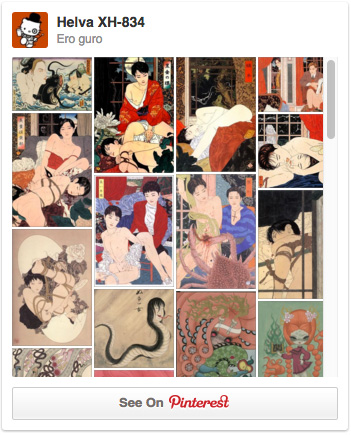
Hello, gentle readers. For those of you who are following my series of ero guro themed posts and can’t quite get enough, I have a special treat. Lady Lazarus has been collecting images on Pinterest for her Ero Guro board. Want to learn more about contemporary artists who work with ero guro themes and subjects? Are you a fan of artists such as Junko Mizuno, Takato Yamamoto, Suehiro Maruo, and Toshio Saeki? Then click on the image below and visit my Pinterest board.

NSFW, but of course you knew that. Nothing too porny, though. This is a classy operation.

eroguroboard


Deviant Desires: Erotic Grotesque Nonsense, Part V: “In the Realm of the Senses”

This is Part V of my ongoing series of posts relating to the Japanese cultural phenomenon called “ero-guro-nansensu”, or erotic-grotesque-nonsense. You can read all of the previous instalments in the Ero Guro Nansensu category of my blog. The previous post, which discussed Midori — The Girl in the Freak Show, can be found here.

Actors Tatsuya Fuji and Eiko Matsuda in Nagisa Oshima's controversial

Actors Tatsuya Fuji and Eiko Matsuda in Nagisa Oshima’s controversial “In the Realm of the Senses” (1976).

The next film I’d like to discuss in my ongoing series on ero-guro-nansensu is one of the most notorious Japanese films ever made,  In the Realm of the Senses (1976), directed by the “bad boy” of the Japanese New Wave, Nagisa Oshima.

“Japanese cinema’s preeminent taboo buster, Nagisa Oshima directed, between 1959 and 1999, more than twenty groundbreaking features. For Oshima, film was a form of activism, a way of shaking up the status quo. Uninterested in the traditional Japanese cinema of such popular filmmakers as Kurosawa and Ozu, Oshima focused not on classical themes of good and evil or domesticity but on outcasts, gangsters, murderers, rapists, sexual deviants, and the politically marginalized.”
— (Text excerpted from an essay written for the Criterion collection on Oshima)

This pedigree of Japanese cinema’s “bad boy” makes Oshima an excellent candidate to direct a film adaptation of the already lurid true story of the famous ero-guro era murderess Sada Abe. In 1936 Tokyo, Sada Abe worked as a maid in a restaurant owned by Kichizo Ishida with whom she became romantically involved. After a brief but intense sexual fling, Abe erotically asphyxiates Ishida, afterwards cutting off his penis and testicles and carrying them around with her in her handbag. Abe was eventually arrested and convicted of murder in the second degree and mutilation of a corpse. She was sentenced to six years in prison, and was released after five.

sada-abe-3

Newspaper photo taken shortly after Abe’s arrest, at Takanawa Police Station, Tokyo on May 20, 1936.

Pre-WWII writings, such as the text The Psychological Diagnosis of Abe Sada (1937) depict Abe as an example of the dangers of unbridled female sexuality and as a threat to the patriarchal system. In the postwar era, however, she was treated as a critic of totalitarianism, and a symbol of freedom from oppressive political ideologies (from Wikipedia). And thus enters the director Nagisa Oshima. The story of Sada Abe, and the persona that developed around her as a “symbol of freedom from oppression” would, of course, speak to the political aims of Oshima. In The Realm of The Senses uses sex as a radical act against the oppression of personal liberty.

If we recall the fascist propaganda poster I included in my introductory post on ero-guro, we can observe that it clearly promoted a very conservative morality of procreative sex between married couples for the purpose of begetting a new generation of Japanese (all for the purpose of ‘nation-building’). The sex we see depicted between the two main characters in Oshima’s film, Kichi and Sada, is the opposite of that. Theirs is not socially sanctioned sex. They are not husband and wife, and Kichi is already married with children. Once their romantic fling begins, they leave the restaurant and hole up inside a nearby inn – thus removing themselves from society and their prescribed roles within in. Their self-imposed exile, and Kichizo’s eventual death, can be see as the ultimate “opt-out” from the ultranationalist agenda and to Imperial Japan.

sense_strangle

Why was In The Realm of The Senses so controversial when it was released in 1976? The film features scenes of unsimulated sex between the two main actors, which is quite daring for a filmmaker who’s known as an auteur, rather than a pornographer. In fact, Oshima was charged in his native county with obscenity, and had to go to court to defend his film (charges were subsequently dropped in 1982). Oshima used the language of pornography, but did not create a purely pornographic film. If the aim of pornography is to titillate for the purposes of arousal, then In The Realm of The Senses does not function as pornography. We, the audience, may watch Sada and Kichi have sex, but the camera never places us within the action. We watch at a certain remove. Additionally, the actors in the film are never objectified, reduced to mere performers of sex for our voyeuristic consumption. We empathize with them. Unlike the objectified and dehumanized porn actors, these actors seem very real and very human to us.
The sex between Sada and Kichi is also very visceral. There is no gloss of romanticism or soft-focus lens here – this is real sex that results in the release of bodily fluids, with the resultant wet spots on the futon and funky smells which permeate the inn room in which Kichi and Sada temporarily reside (and which is commented on by the maids who have to clean their room).

sense_smell
At the beginning of the clip below, we see Sada departing from her meeting with her former school principal, with whom she periodically has sex for money as a means of support for herself and Kichizo. The principal (rather ungallantly) points out that she “smells like a dead rat”, which we could read as either relating back to the state of complete physical abandon that Kichi and Sada have entered, or could be foreshadowing of Kichi’s death. Later, when Sada reunites with Kichi, she is visibly shaken by the fact that the maids have cleaned the room in their absence. The inn room had functioned as their oasis from the world, but now the outside world was creeping back in and imposing its order and control.

We see Kichi step out from a barber shop and into an empty street. A platoon of soldiers approaches and Kichi walks in opposition (in the opposite direction) to the soldiers. The next instant, a crowd of flag-waving townsfolk materialize. We can only read this scene as symbolic. Kichi is isolated, walking on a different side of the street from the rest of Japan. There is no place for him in Imperial Japan, and he knows it.

The erotic-asphyxiation that Sada and Kichi engage in originates from their mutually shared desire to explore extreme sensory experiences. Eventually, of course, this co-mingling of death with sex leads to Kichi’s wish to transcend this world.

Next in this series of posts, Yasuzô Masumura’s “Blind Beast.”