Happy Hallowe’en from Lady Lazarus!

death_the_bride

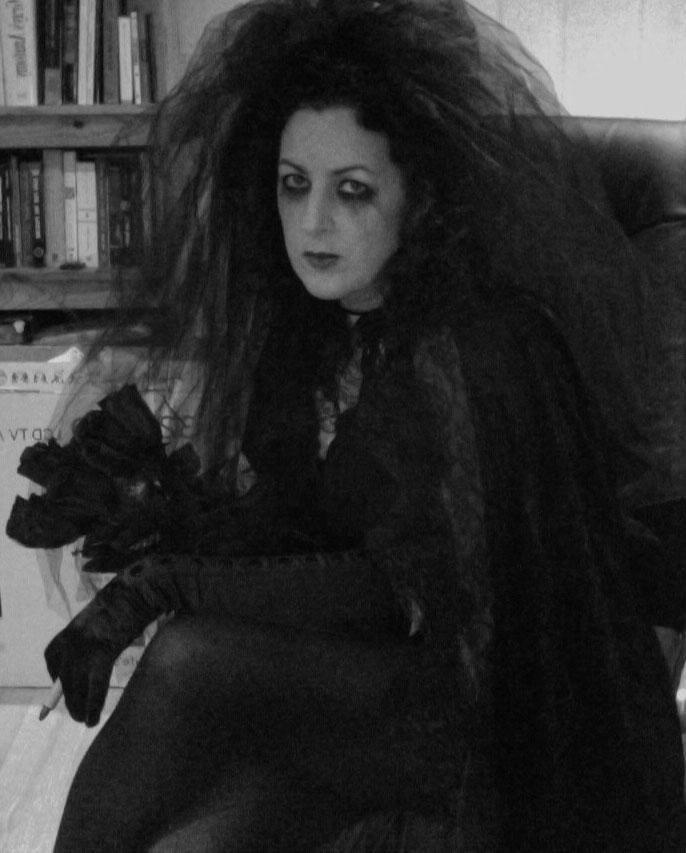
Myself dressed as “Death the Bride”. Halloween 2013.

My Hallowe’en costume this year is channelling the melancholic romanticism of a tragic, Edgar Allan Poe heroine*. On October 31st, I shall fall into a despair that leads to madness, succumbing to a death-like trance. This will prompt my bereaved loved ones to prematurely bury me in the family crypt. Afterwards, my restless ghost shall arise for revenge, and chocolate.

Happy Halloween, everyone!

*my costume is also channelling the morbid romanticism of the Pre-Raphaelite painter Thomas Cooper Gotch — a morbidity best captured by his 1895 painting entitled (as you may have guessed)  Death the Bride.

"Death the Bride" by Thomas Cooper Gotch. 1895. Oil on canvas

“Death the Bride” by Thomas Cooper Gotch. 1895. Oil on canvas

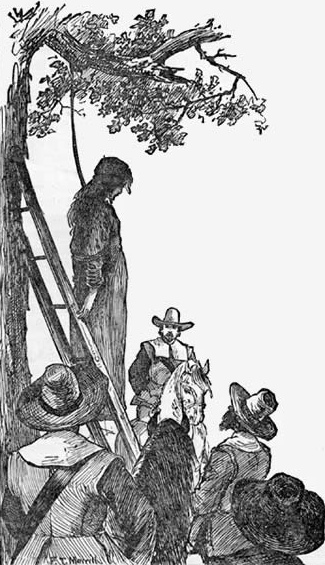
The Life and Untimely Death of Ann Hibbins.

“Execution of Ann Hibbins on Boston Common” Sketch by F. T. Merril, 1886.

During times of conservatism and religious fundamentalism it can prove difficult, if not downright lethal, to be an independent and outspoken woman. The recent case of Malala Yousafzai — the teenage Afghan activist who was shot by the Taliban for her vocal condemnation of their refusal to allow Afghan girls to attend school — reminds us that this danger still looms in many parts of the contemporary world.

The modern-day plight of Afghan girls like Yousafzai, and their systematic oppression by the ultra-conversative Taliban, recalls an earlier time in history when fervent religiosity ran rampant: the Salem Witch Trials.

The Salem witch trials were a series of hearings and prosecutions of people accused of witchcraft in colonial Massachusetts, between February 1692 and May 1693. They later became a notorious example of mass hysteria in American history, and highlighted the very real danger of religious extremism. The overwhelming majority of the people prosecuted for witchcraft were women. These women tended to belong to the poor and working class, and thus were disadvantaged in terms of economics and social status. The one exception was the wealthy widow, Ann Hibbins.

Ann Hibbins was executed for witchcraft in Boston, Massachusetts, on June 19, 1656. Her execution was the third for witchcraft in Boston and actually predated the Salem Witch Trials by thirty-six years. Twice-widowed, Hibbins was an outspoken and financially-independent woman, all of which tended to antagonize the local religious authority:

In 1640, Ann Hibbins sued a group of carpenters, whom she had hired to work on her house, accusing them of overcharging her. She won the lawsuit, but her actions were viewed as “abrasive”, and so she became subjected to an ecclesiastical inquest. Refusing to apologize to the carpenters for her actions, Hibbins was admonished and excommunicated. The church also cited her for usurping her husband’s authority. Within months of her husband’s death, proceeding against her for witchcraft began. — from Wikipedia.

It’s interesting to note that none of the evidence used to convict Hibbins of witchcraft remains. One of her supporters, a minister named John Norton, commented privately to another clergy that, “…[Hibbins] was hanged for a witch only for having more wit than her neighbors.”

So, here’s what I’m suggesting, my fellow XX-chromosome owners. Rather than wait for the religious extremists to ’round us up, let’s go git ’em first. They’d never see us coming till it’s too late. Lemme go grab my broomstick and pointy black hat [cackle].

VideoArt.net Selection of the Month (October)

videoart

My stop-motion animation Domestikia, Chapter 3: La Petit Mort is one of the Selections of the Month (October 2013) at Videoart.net, an international curated video-sharing network for video artists and experimental filmmakers: http://vlog.videoart.net/jennifer-linton-domestikia-chapter-3-la-petite-mort/

Founded in 2005, Videoart.net quickly positioned itself as the most popular video art and experimental film website in the world. Videoart.net attracts both art and film industry professionals by providing a gateway to an international network with a dynamic online curatorial community. By carefully curating thousands of video artworks by hundreds of artists all over the world, Videoart.net prides itself in providing the most rousing, thought-provoking, unprecedented, and significant works in film and video currently being produced. — from VideoArt.net web site.

Domestikia, Chapter 3: La Petite Mort

A tale of love, betrayal and one vengeful butterfly. This project was inspired by the surreal animations of Lenica, Borowyck and Svankmajer, Japanese tentacle erotica, and those strange, middle-of-the-night dreams one has after spicy food.

Story, artwork and articulated paper puppets created by Jennifer Linton.
Stop-motion animation by Carla Veldman.
Original musical score by Zev Farber.
Directed & edited by Jennifer Linton.

This animation was made possible by the financial support of the Toronto Arts Council and the Ontario Arts Council. Copyright ©2013 Papercut Pictures (Jennifer Linton). All rights reserved.

The Haunted Dollhouse, revisited.

Back in July of 2010, I wrote a blog post entitled The Haunted Dollhouse in which I briefly discussed this interesting and unconventional approach to the miniature house. Created by artists and hobbyists alike, the haunted dollhouse can range greatly from the kitschy, Halloween-themed miniature festooned with cotton-batting cobwebs and tiny jack o’ lanterns, to epic, post-apocalyptic landscapes created in miniature scale by a team of artists. Now, before I venture further in my discussion, I should define my use of the word dollhouse and explain that I’m employing it in the broadest possible sense. While the spooky Halloween-themed dollhouse can be more readily defined as a house, the post-apocalyptic landscape — while still miniature in scale — is less traditionally identifiable as such. Both, however, are miniatures that share a common link to the uncanny (see below).

So, with semantics out of the way, let’s continue with a quote taken from my earlier post on the dollhouse that links our enjoyment of the miniature with the experience of the uncanny:

There’s something inherently unnerving about a dollhouse. While we can easily admire and delight in its minuscule detail, this admiration is frequently accompanied by a sense of unease. This simultaneous intermingling of delight-with-unease is a manifestation of the uncanny — a sensation of anxiety experienced when one encounters “something familiar, yet foreign.” The dollhouse, with its miniaturized approximation of reality, recalls the familiar domestic setting of the home. At the same time, it falls short of appearing truly real. It’s the tension that exists within this disconnect — the miniature’s approximation of scaled-down reality with its inevitable failure — that contributes to our experience of the uncanny.

To reiterate, the uncanny is a sense of discomfort within the familiar setting of the home. I would argue that since the dollhouse is already imbued with an element of the uncanny, it’s not a far stretch to imagine and reconfigure the miniature as a nightmarish, dystopic space. This may have been the thought-process behind the Apocalyptic Manhattan (in an Apartment) project created by Swedish artist Magnus Johannson and his team when they designed and constructed the fifty miniature buildings of their mangled landscape. This extraordinarily-detailed, post-apocalyptic Manhattan was later featured in a Swedish music video in which the band members stomp through the model in Godzilla-like fashion.

A post-apocalyptic Manhattan, as envisioned by two artists from Sweden.

A post-apocalyptic Manhattan, as envisioned by two artists from Sweden.

My favourite artist working in miniature, however, remains American photographer and diorama-artist Lori Nix. Blending a canny mixture of black humour with dread, she creates such varied post-apocalyptic miniature scenes as a burnt-out, long-abandoned beauty parlor, a subway car that has been gradually reclaimed by the surrounding sandy beach, and the interior of an empty mall which has been invaded by flora. Through her constructed dioramas, Nix “…imagines a human-less world where Mother Nature has reclaimed our cities.” (source).

"Beauty Shop" by Lori Nix.

“Beauty Shop” by Lori Nix. 18″x12″x33″

"Mall" by Lori Dix, 92"x42"x100".

“Mall” by Lori Dix, 92″x42″x100″.

TAIS Showcase 2013

My paper cutout animation “Domestikia: The Incident in the Nursery” will screen at the upcoming TAIS Showcase on May 11th, 2013. Below is the press release from TAIS for the event:

may2_tais

TAIS Independent Animation SHOWCASE 2013

The Toronto Animated Image Society (TAIS) presents their annual Showcase and U.F.O. Anijam, Saturday May 11, 7 pm at CineCycle. Enjoy a diverse collection of animated films from local, national and international independent animators.

Presenting a great selection of diverse animation techniques such as paint on glass, scratch on film, computer 3D, puppet, hand drawn and more.

Come enjoy the films, party, and vote for your favourite!

What: TAIS Showcase 2013 and UFO Anijam screening
When: Saturday, May 11, 7 pm
Where: CineCycle (in the coach house, down the laneway)
Address: 129 Spadina Avenue Toronto, Ontario

CONTACT: Janice Schulman
Toronto Animated Image Society
1411 Dufferin Street, Unit B
Toronto, ON M6H 4C7
(416) 533-7889

(W) www.tais.ca

Life is hard, but animation is harder.

Hello gentle readers. It’s been over a month since I last wrote in this blog, and I felt that I should share with you what has been preoccupying my time. As some of you may know, I’ve been working in the medium of stop-motion animation these past few months. Animation has a tendency to devour time like a hungry little baby, and my new animation is a greedy baby, indeed. Now, before I get too ahead of myself, allow me to backtrack a bit.

Back in October, I lamented over the large amount of time and effort required to properly prepare a media artist grant application. I wrote that “[the grant application] is a long, tedious, and painful process that I submit to only grudgingly.” However, as the old axiom goes “you get out of life what you put in”, and this past exercise in painful tedium was no exception to this rule. I received both media artist grants to which I applied. There’s a reason why old axioms are old: they’re generally true.

Above is a “quick & dirty” test I worked on today for one of my new paper puppets. And by “quick”, I mean that it took me several hours to produce those 7 seconds. This is a rough, and by no means a finished work. Lots of pop and flicker in the lights. There is no audio.

Theatre of Blood: Le Théâtre du Grand-Guignol

"Crime in a Madhouse". Photograph by Hans Wilder, 1947.

“Crime in a Madhouse”. Photograph by Hans Wilder, 1947.

If you’re  a fan of horror and/or theatre, you will inevitably encounter the term grand guignol and, if you’re like me, wonder what it means and from where it comes. The French phrase grand guignol has been absorbed into the English lexicon as a term to describe any excessively gruesome and gory spectacle, but its origins are much more specific. Le Théâtre du Grand-Guignol was a theatre founded in Paris by Oscar Méténier in 1894. Operating for 65 years, it produced one-act plays, many of which focused on violent and erotic works of horror.

The theatre was opened by Oscar Metenier, a writer and police secretary, who created slice-of-life plays about the Parisian underlife and stories of true crime. Metenier was a follower of Naturalism: a movement in late 19th Century theatre that attempted to create a perfect illusion of reality. Naturalistic works often exposed the dark harshness of life, with themes of poverty, racism, sex, prejudice, disease, prostitution, and filth.

After a couple of years at the helm, Metenier handed the theatre over to Max Maurey, who saw the commercial potential of the theatre and, in particular, capitalized upon its darker side. Maurey incorporated melodrama into the Grand-Guignol’s acting style to heighten the emotion of the more sensational elements while keeping Naturalism as the guiding principle for characters and situations. It was under Maurey that the style of the Grand Guignol became renowned throughout Europe and, eventually, the world.

— text from Theatre of Blood web site.

Theatre-goers would be treated to five or six one-act plays in an evening’s performance, alternating between bawdy, Vaudevillian-style comedies, to violent tales of crime, madness, and bloody revenge. The gory special effects of the Grand-Guignol were world-renowned for their high degree of realism, and the theatre employed teams of propsmen who specialized in fake blood, severed limbs, and impaled eyeballs. Some of the more famous horror-themed plays staged included:

Le Laboratoire des Hallucinations, by André de Lorde: When a doctor finds his wife’s lover in his operating room, he performs a graphic brain surgery rendering the adulterer a hallucinating semi-zombie. Now insane, the lover/patient hammers a chisel into the doctor’s brain.

Un Crime dans une Maison de Fous, by André de Lorde: Two hags in an insane asylum use scissors to blind a young, pretty fellow inmate out of jealousy.

L’Horrible Passion, by André de Lorde: A nanny strangles the children in her care.

Le Baiser dans la nuit by Maurice Level: A young woman visits the man whose face she horribly disfigured with acid, where he obtains his revenge.

A scene from Grand Guignol.

A scene from Grand Guignol.

Le Théâtre du Grand-Guignol closed its door in 1962. Audiences had dwindled in the years following WWII, likely due to the fact that the staged horrors had now been eclipsed by the real world horrors of the war and the Holocaust. “We could never equal Buchenwald,” said its final director, Charles Nonon. “Before the war, everyone felt that what was happening onstage was impossible. Now we know that these things, and worse, are possible in reality.” (from Wikipedia).