The Artist in Horror Cinema.

We all have an idea in our minds of what constitutes the “Artist”: a tormented, misunderstood outsider, compelled by an almost otherworldly drive to create. We recall images like those of Vincent van Gogh’s famous self-portrait with bandaged head, concealing the wound that resulted from severing his own left ear, or we envision the distorted figure of Edvard Munch’s magnum opus The Scream, it’s creator checking himself into a private sanitarium later in life after hearing voices. While these biographical details of Van Gogh and Munch are true and verifiable, this notion of the Artist as a mad, tormented genius is a cultural construction originating from the 19th-century Romantics, as described by scholar Pamela Fletcher in her Victorian Studies text Rebels and Martyrs: The Image of the Artist in the Nineteenth Century:

[Michael] Wilson’s title essay traces the myth of the artist as a unique genius, alienated from society both by his own commitment to the demands of his art and a philistine public’s inability to value or understand it. Wilson rightly notes that the idea of the artist as a melancholic genius dates back to the Renaissance, but he locates the full flowering of the myth in the Romantic era. — excerpt from “Rebels and Martyrs: The Image of the Artist in the Nineteenth Century”, by Pamela M. Fletcher.

The Romantic era (approx. 1800-1850) reconfigured the artist as a tragic hero who, in the best case scenario, is a darkly brooding and cynical Byronic hero or, in the worst case, is a half-lunatic hermit who lives on the very fringe of society. Though most-assuredly a myth, this notion of the artist as a crazed — and possibly even dangerous — outsider has persisted even into the modern era.

The genre of horror is fed by our psychological and cultural fears. One of our collective fears is our fear of the Other: those individuals who, whether through a transgression of gender, physical deformity, or mental illness, deviate from the “norm” in terms of their appearance and/or behaviour. (See my previous series of posts on Deviance, gender and the ‘aberrant female’ in horror, which addresses the topic of women as the Other). These types of individuals tend to make the majority anxious, and therefore they are ideal to occupy the role of the “monster” in horror fiction. Given the Romantic notion of the “mad artist”, it’s hardly surprising that artists have served in this role of the feared Other in horror cinema. Below are a few examples of horror films that have featured visual artists in such roles.

Film still from "Blind Beast" (1969

Film still from “Blind Beast” (1969, dir. Yasuzô Masumura).

1. Blind Beast (1969, dir. Yasuzô Masumura) is a masterpiece of ero guro nansensu from Japan that is based on a story by Edogawa Rampo. A blind sculptor kidnaps a beautiful young model and takes her back to his home to act as his model and muse. He and his mother live in a warehouse which he’s transformed into a surreal sculptural installation of giant body parts, dedicated mainly to the female form. At first, the model only wants to escape from this bizarre scene, but eventually she succumbs to his strange vision and even surpasses his obsession. In true ero guro style, they develop a curiously erotic, sadomasochistic relationship that eventually leads to the crazy, horrific and over-the-top violent finale. Below is the entire film posted on Youtube, though regrettably it lacks English subtitles. Worth watching, if only for its beautiful and bizarre visuals — such as the two protagonists cavorting atop a giant (foam rubber) sculpture of a reclining female nude.

2. As an artist myself, I can fully understand the urge to find the exactly correct hue for a project. On many occasions I’ve paid a princely sum for tubes of Cadmium Red paint because, well, no other pigment is as brilliantly, intensely red (the toxicity of the metal cadmium notwithstanding). Hershell Gordon Lewis, the notorious exploitation-film director who singlehandedly created the splatter-gore film, used this notion of the dangerously obsessive artist to splatter his signature gore in Color Me Blood Red (1965).

"Color Me Blood Red" (1965, dir. Hershell Gordon Lewis.

“Color Me Blood Red” (1965, dir. Hershell Gordon Lewis).

Artist Adam Sorge struggles to find critical and commercial success when he accidently discovers that blood smeared across his canvas provides his paintings with the vibrancy they previously lacked. This discovery provides the rationale for Sorge (and Lewis) to bloodily dispatch a couple of bikini-clad beauties in this lesser offering from Lewis’s “Blood Trilogy”. Low-budget and poorly acted (Lewis often relied on non-actors), what this film lacks in craft, it makes up for with its campy, rough-hewn B-movie charm. You can watch the entire, uncut film on Youtube. Considering that it was made in 1965, it truly is subversively gory.

3. Cauldron of Blood (1970) is a terrible film. That said, I kinda have a soft spot for it. Also known under the title Blind Man’s Bluff, it was cobbled together over a few years, repurposing footage from different films. One reason for this cinematic mess is the fact that its star Boris Karloff was in very poor health, and couldn’t appear in a number of scenes (he died in 1969, before its release). Thus, its creators were obliged to pad the film with previously shot footage. Karloff appears frail and sadly diminished — but even a diminished Karloff is still pretty good. Here’s the short synopsis from IMDB: “A blind sculptor works on his magnum opus unaware that the skeletons he has been using for armatures are the remains of the victims of his evil wife and that he is the next target”.

Again, the entire film is available on Youtube (one assumes distribution companies don’t care about these older films). My advice is to forward to the 1:27 mark and watch the final showdown between Karloff and his gloriously evil wife, where she meets her comeuppance in a vat of acid.

Walking loop for Toronto Alice

Paper cutouts used in walking loop.

Paper cutouts used in walking loop.

Rough cut of a “walking loop” I created for my upcoming animated film “Toronto Alice”. Using the classical animation technique of a lightbox + peg-bar, I created 26 separate drawings that were then printed, coloured and cut-out. The sequence was then shot using the frame-capture software Dragonframe, swapping in the different cutouts frame-to-frame. The footage was exported into After Effects, where the background was keyed-out, and the walking looped using time remapping. A moving background will eventually be placed behind the walking character.

While all the preliminary work was time-consuming, the advantage is that the “walking loop” can be played infinitely, for as long as I need it in the scene.

Female Eye Film Festival, Toronto.

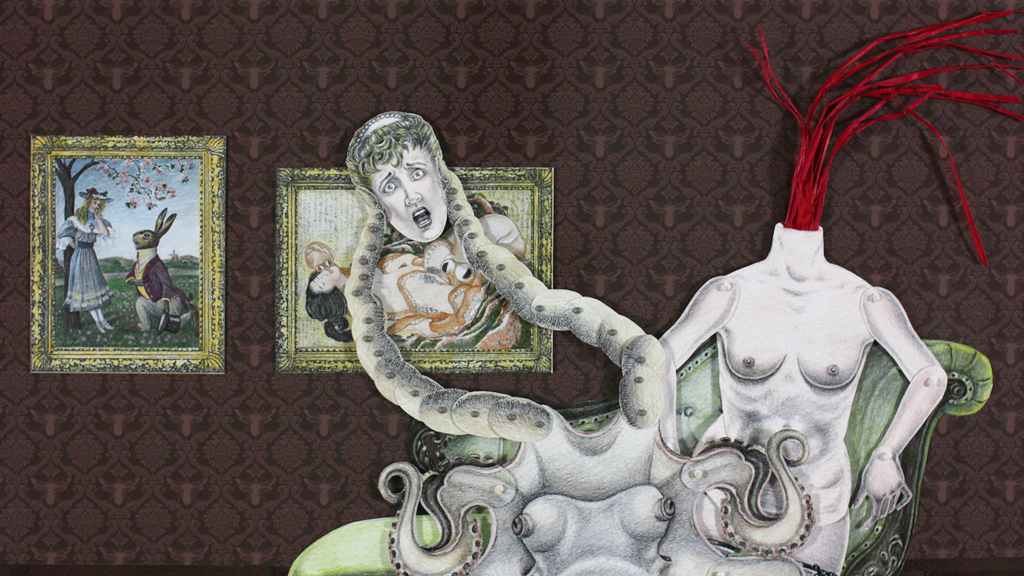
Video still from "Domestikia, Chapter 3: La Petite Mort", 2013. Directed by Jennifer Linton.

Video still from “Domestikia, Chapter 3: La Petite Mort”, 2013. Directed by Jennifer Linton.

The voice actors have already recorded, and the creative work is well underway for Toronto Alice. Thanks again for all your support!

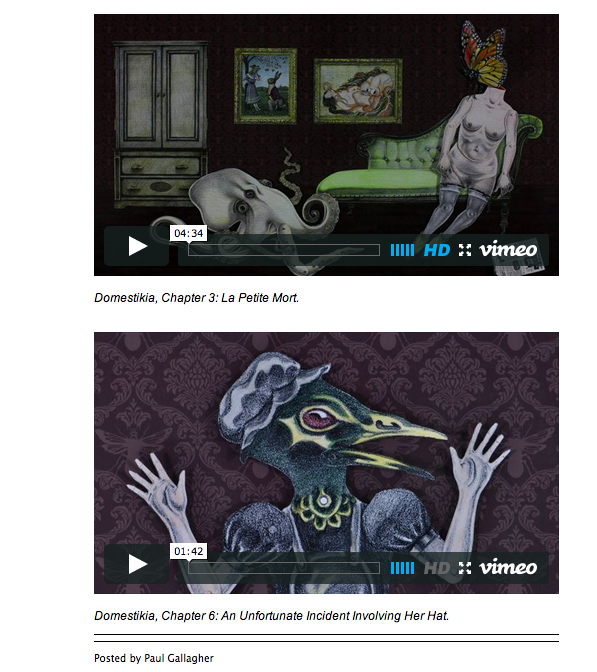
I’m delighted to announce that my previous animated short film Domestikia, Chapter 3: La Petite Mort will be screening in the Late Night Horror: Canadian Feature program at the Female Eye Film Festival in Toronto. Screening will be on Saturday, June 21st, 11 pm – 1 am. Q & A with directors to follow the program. Canadian horror directed by women — yes!

If you’re in the Toronto area, come check it out. The festival has a great line-up this year! http://www.femaleeyefilmfestival.com/#!sat-june-21st/c1vaa

The Dangerous Mind of Lady Lazarus

Hello, gentle readers. Many apologies for the fact that I haven’t been keeping up with my blog posting lately. As you can read in the previous two posts, I’m currently involved in a new animation project which is commandeering all of my “spare” time. Below is a screen capture from a lovely little write-up I received a couple of months back on the Dangerous Minds blog. I submit this for your reading pleasure. Enjoy.

dangerousminds_01dangerousminds_02

“Toronto Alice” is a popular girl, indeed.

alice_indiegogo

Toronto Alice has become a very popular girl, indeed. She’s received some love from the Toronto Film Scene blog, from the Canadian Animation Resources blog, and from the fun-loving culture-geeks at Boing Boing!

Many, many heartfelt thanks to everyone who contributed to my Toronto Alice campaign! In just twelve days, we’ve not only met my goal of $3,000, but surpassed it! If you’d like to get in on the “perks”, there’s still time to do so. You can get a private Vimeo link or Blu-Ray DVD of the completed film, Toronto Alice paper dolls and/or original artwork. This film won’t be released to the general public until after its run in the festival circuit, so this will be your only opportunity to see it till then.

Toronto Alice Indiegogo campaign.

Indiegogo Campaign for Toronto Alice

http://www.indiegogo.com/projects/toronto-alice/x/6519608

  • Are you a fan of the funny — and slightly creepy — animations of Terry Gilliam? Or perhaps you’re more of a devotee of Surrealist animation from Poland? Or maybe you just enjoy weird, off-the-beaten-path stuff? If you answered “yes” to any of these (or, like me, to all three), then you’ll probably enjoy the unique style of cutout animation I create at Papercut Pictures.
  • My name is Jennifer Linton, and Papercut Pictures is my production company. I’m an interdisciplinary visual artist working with animation, installation, drawing and printmaking. I have exhibited my art for the past 20 years in galleries across Canada, and internationally with exhibitions in the U.S. and Italy. My animated films have screened at festivals such as Animaldiçoados Film Festival 2012 in Rio de Janeiro, Brazil, the Toronto Animated Image Society (TAIS) Showcase 2013, and the Boston Underground Film Festival 2014. I’ve received numerous awards and grants from the Canada Council for the Arts, the Ontario Arts Council, and the Toronto Arts Council.
  • This campaign is to raise funds for my next animation project, entitled Toronto Alice. The character of Alice from Lewis Carroll’s famous children’s novels is transported to contemporary Toronto where, like many native Torontonians, she takes a ride on the streetcar. As with many trips on the public transit, she encounters a succession of strange characters who engage her in (equally strange) conversations. The dialogue is borrowed directly from Through the Looking-Glass, but given a fresh & funny new twist in this stop-motion animation.

What We Need & What You Get

  • I will create all of the visuals for this film: the artwork, the puppets, and the backgrounds. I will also handle all of the stop-motion animation. What I need help with is the audio component — and that’s where YOU come in!
  • I need three separate audio components for this project: musical treatments, ambient background sound fx, and voice actors. While I can handle all the visual stuff, I need to call in the professionals to create good quality recordings of ambient sound. Animation takes a great deal of effort and a very long time to create, so you don’t want great visuals to be undermined by inferior audio.
  • Listening to my voiceover in the pitch video should prove, without a doubt, that I should never, ever do voiceover work! Your contributions will allow me to leave this important task to the professionals!
  • I’m offering a range of “perks” to sweeten the deal, from DVDs to paper dolls to original, framed artwork! It’s win-win! You help me make this project the best it can be AND you get limited edition art in return!

Why contribute?

  • You’re a fan of animation. Specifically, you enjoy independent animation that advances the art form, or that simply stands out as different from everything else. There aren’t many animators out there working with paper cutouts and stop-motion. What I do is very boutique and kinda retro. Different is good.
  • You’re Canadian, or you have an uncle who lives in Canada (hey, maybe I know him). No, seriously. It’s good to see your own stories up there on the (big or small) screen. We gotta represent. I don’t know about you, but I’ve always wanted to see Alice wearing a Hudson’s Bay coat.
  • You’re a fan of Lewis Carroll and his Alice novels. There’s a timelessness and universality about Carroll’s characters that allow us to visit and revisit this wonderful material. Young and old, we all love to slip into Wonderland.
  •  You want that swag. A custom Toronto Alice jointed paper doll? Sweet.

Other Ways You Can Help

Spread the word!

  • Like what you see? Help get the word out by using the Indiegogo share tools! It’s good karma.

http://www.indiegogo.com/projects/705357/wdgi/6519608

“Blueprints”, group show at Centre 3

The Nutshell Studies of Unexplained Death

Dollhouse enthusiasts are frequently known for their slavish devotion to detail. Countless hours will be spent in replicating a miniature world, whether idealized or dystopian, in exacting detail. The nineteen dollhouse rooms created by Frances Glessner Lee, however, take this attention to detail to startling — and brilliantly macabre — heights.

Frances Glessner Lee was a Chicago heiress with a curious obsession. During the 1940’s, Lee was a volunteer police officer with a honorary captain’s rank, and she possessed a passion for forensic science. At her New Hampshire estate, she installed a workshop to fashion crime scene dioramas, which she dubbed her “Nutshells”. These dollhouse-sized rooms were designed as classroom tools to instruct detectives in crime scene investigation. Lee founded Harvard’s department of legal medicine, the first program in the nation for forensic pathology.

According to a New York Times article on Lee, the Nutshells now reside in the office of the Maryland state examiner in Baltimore, where they are still used in seminars. Each diorama is packed with small-scale clues such as blood-splatters, a pillowcase smeared with lipstick, and a bullet embedded in a wall.

Corinne May Botz published a book of photographs entitled The Nutshell Studies of Unexplained Death, that beautifully capture the details of Lee’s crime scene “nutshells”. Below are some images from Botz’s book.