
Quick & dirty snapshot of some of my articulated paper puppets.
Animated films and the art form of animation.
Quick & dirty snapshot of some of my articulated paper puppets.
Hello gentle readers. It’s been over a month since I last wrote in this blog, and I felt that I should share with you what has been preoccupying my time. As some of you may know, I’ve been working in the medium of stop-motion animation these past few months. Animation has a tendency to devour time like a hungry little baby, and my new animation is a greedy baby, indeed. Now, before I get too ahead of myself, allow me to backtrack a bit.
Back in October, I lamented over the large amount of time and effort required to properly prepare a media artist grant application. I wrote that “[the grant application] is a long, tedious, and painful process that I submit to only grudgingly.” However, as the old axiom goes “you get out of life what you put in”, and this past exercise in painful tedium was no exception to this rule. I received both media artist grants to which I applied. There’s a reason why old axioms are old: they’re generally true.
Above is a “quick & dirty” test I worked on today for one of my new paper puppets. And by “quick”, I mean that it took me several hours to produce those 7 seconds. This is a rough, and by no means a finished work. Lots of pop and flicker in the lights. There is no audio.

Video still from “Domestikia: The Incident in the Nursery” by Jennifer Linton, 2:01 minutes, 2012.
My short animated film Domestikia: The Incident in the Nursery will be screened next month during the 2nd Winter edition of the King Street Alternative Film & Video Festival. According to the festival’s blog, they’ve programmed over 35 films & videos over the 8th and 9th of February (2013), ranging from the very short to over 20-minutes in length. The event is held at Betty’s, that stalwart Corktown staple located directly across from the Toronto Sun building on an otherwise desolate stretch of King Street East. The beer and nachos at Betty’s are glorious, and the evening should prove fun and entertaining. Come on out and support your local, indie filmmakers!

Quick and dirty snapshot of the installation in-progress.
My installation The Disobedient Dollhouse will pay a visit to the Art Gallery of Peterborough, starting this month. This exhibition will also screen my 2-minute stop-motion animation Domestikia: The Incident in the Nursery. Exhibition runs from November 9 – January 6, 2013. The opening reception will take place Friday November 16, 7 – 9 pm. Visit the web site of the AGP for details and/or directions.

Trying different heads.
One of the activities that keeps me busy these days — other than teaching, of course — is applying to grant programs. This is a long, tedious, and painful process that I submit to only grudgingly. It’s also, unfortunately, a necessary one. As part of the application process, I’ve been forced to cobble together a storyboard for my proposed animation project. This is yet another ‘necessary task’ that I perform grudgingly — being a naturally lazy creature, I’ve never done one before — though the benefits of having a storyboard are immediate and the process certainly worthwhile.
I don’t want to reveal all of my storyboard just yet, but here’s a sneak peak. Below the storyboard sample is my artist’s statement/project proposal, which might prove insightful to those of you who follow the development of my animations.

My current series of stop-motion animations entitled Domestikia developed directly out of a previous sculptural-installation project, in which I constructed a three-dimensional dollhouse from paper and lithographic prints. This project, entitled The Disobedient Dollhouse, employed the setting of a Victorian-themed dollhouse as a means to critique the sentimentality of nostalgia, as well as the tiny, precious model of perfect domesticity that the dollhouse itself proposes. A dollhouse is a gendered space, one specifically codified as feminine – it is therefore a highly suitable space in which to focus attention on women’s roles within the home. Furthermore, the strange, hybrid creatures and giant insects that populated my Dollhouse hinted at a dark, secret fantasy world churning just beneath the veneer of domestic perfection.
As previously stated, the Domestikia animation series began as an expansion of the narratives that originally appeared in The Disobedient Dollhouse project. For instance, the bird-headed children and Nanny (a self-portrait) featured in Domestikia: The Incident in the Nursery first existed as a paper diorama inside The Disobedient Dollhouse. The medium of stop-motion animation enabled me to — quite literally — bring that nursery scene alive. In addition to the scenes and narratives, the look and style of my Dollhouse has also carried over into my animations. Like the hand-drawn lithographs I created for the Dollhouse, the paper cutouts and articulated paper puppets from Domestikia possess the same grainy, textured quality of the lithographic crayon.
Similar to the other Domestikia films, the proposed project Domestikia, Chapter 3: The Little Death will employ the technique known as ‘cutout animation’, one of the earliest forms of stop-motion that uses flat characters and backgrounds cut from paper. The technical limitations of paper puppets, with their characteristically stiff and unnatural movements, make cutout animation particularly well suited to animations whose themes involve fantasy, surrealism, dreams, and that which otherwise lacks realism. Rather than being a technical limitation, the anti-realism of the paper cutout serves to amplify the strangeness of the events that happen throughout Domestikia – which is precisely why I’ve chosen to work with this technique. In Domestikia, Chapter 3: The Little Death, my plan is to further expand the technical and aesthetic possibilities of the paper cutout.
The storyline of Domestikia traces a series of strange, otherworldly events that take place within an imaginary dollhouse. The connecting thread between each narrative is the continual appearance of a butterfly, a creature that acts as a sort of ‘agent of chaos’, disrupting the daily domestic routines of the miniature household. In Domestikia, Chapter 6: An Unfortunate Incident Involving Her Hat, the appearance of the butterfly in the opening scene foreshadows the strangeness of subsequent events, in which the morning routine of dressing goes terribly wrong when a hat decides to grow out of control. The butterfly departs the scene, and in Domestikia: The Incident in the Nursery, it appears once more to disrupt the daily proceedings – this time, rousing an infant recently rocked to sleep by the Nanny, creating a cacophony of screams. The butterfly is once again featured in my proposed project, entitled Domestikia, Chapter 3: The Little Death. In this latest installment of the Domestikia series, the ‘little death’ of the title refers simultaneously to the metamorphosis process of the butterfly, as well as to ‘la petite mort’ of orgasm, as the butterfly is shown to have originated from an amorous encounter between Madelaine and her octopod lover. The ‘little death’ also refers to the literal building up, and subsequent dismantling of the Madelaine paper puppet when she is ‘lovingly dismembered’ by the octopus. Ostensibly, Domestikia, Chapter 3 is about shifts in identity that occur as one’s role in life changes: from individual, to couple, to parent. In short, sometimes it is necessary to ‘die’ in order to reinvent oneself.
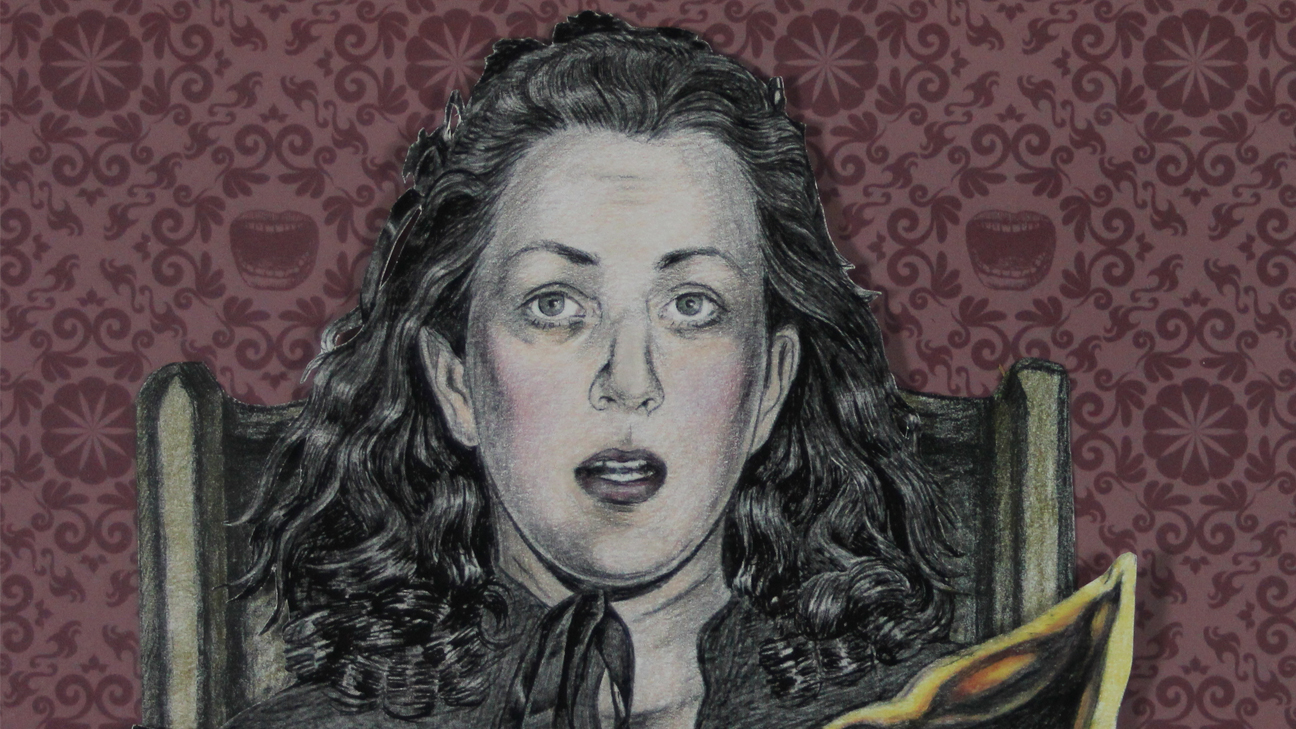
Film still from “Domestikia: The Incident in the Nursery”, 2012, stop-motion animation done with paper cutouts and puppets.
It’s official. My animated short film Domestikia: The Incident in the Nursery has been selected under the International category for Animaldiçoados/Animacursed 2012, a film festival in Rio de Janeiro that features horror, suspense, and “other cursed” genres of animation. Mine is probably under the “other cursed” or possibly the “WTF” category, should they have one of those.
Visit the festival web site (in Portuguese, of course) and check out the selected films. Pretty solid programming! Amazingly enough, I’m sharing screen time with Julia Pott (see my last blog entry When I grow up, I want to make films like Julia). Not sure how that happened.
No, seriously. This animated short film by Julia Pott, entitled Belly, is a phenomenal achievement. Visually stunning, disturbing, and poignant. I could continue slathering on the superlatives, but you can see for yourself. Official Selection for the 2012 Sundance Film Festival.
Belly from Julia Pott on Vimeo.
Domestikia: The Incident in the Nursery. from Jennifer Linton on Vimeo.
At last, I’ve completed my second stop-motion animated short film. Domestikia uses paper cutouts and articulated paper puppets in a stop-motion animation to explore the strange, dreamlike and uncanny realm of the Domestic Gothic. With a healthy dose of black humour, it tackles the anxieties and challenges experienced by parents of young children. The ‘Domestic Gothic’ as a motif developed through the writing of 19th-century women Gothic novelists, such as the Brontë Sisters, and dealt specifically with the horror of confinement felt by women who were ‘imprisoned’ within the home and unable to move freely in Victorian society. With contemporary women still predominantly acting as primary caregivers to their children — and thus financially penalized by either remaining at home or opting for employment that allows for ‘family friendly’ work hours — this sense of confinement is still present. The realm of the domestic has become infiltrated by strange creatures — a giant butterfly, an octopus, and bird-headed children — whose presence suggest a level of discomfort within the home. These creatures are the physical manifestation of Freud’s das Unheimlich (translates to English as ‘the uncanny’), a term which literally means ‘unhomely.’
All images and animation were done by me, in my basement.
I recently discovered the stop-motion work of French-Canadian animator Co Hoedeman. One of his earlier animations, Charles et François, made use of paper cutouts mounted upright in a fully 3-dimensional set. He employed the technique of “substitution” — where different paper drawings are swapped in, frame to frame, to indicate movement — rather than rely on jointed or “articulated” paper puppets. The effect is quite breathtaking.

"Charles et François", by Co Hoedeman, 1987, 15 min 24 s.
Here is the synopsis as it is given in French on the NFB/ONF web site, followed by a predictably clumsy Google Translate English version:
Film d’animation dévoilant le récit d’une relation hors de l’ordinaire, toute de tendresse et de complicité. Ce film témoigne des bouleversements physiques et psychologiques qui se vivent, pour un grand-papa et son petit-fils, au fil des ans. Voilà ainsi posée une douce réflexion sur le caractère changeant des choses et de la vie.
Animation revealing the story of an extraordinary relationship, full of tenderness and complicity. This film reflects the physical and psychological changes that live for agrandfather and his grand-son, over the years. This is a gentle and laid reflection on the changing nature of things and of life.
Unfortunately, I can’t embed the video from the NFB web site. However, if you click on the following link you can view this animation: http://www.nfb.ca/film/charles_et_francois/embed/player
My latest creative project is “Domestikia: An Account of Some Strange Disturbances”. Continuing my interdisciplinary approach to artmaking, I have created jointed, movable paper cutouts from my lithographic prints for use in a series of stop-motion animations. This project will include several short stories linked together by an overarching narrative, all taking place within an imagined dollhouse. The narrative is non-linear, so scenes are not “shot” in sequence.
I’ll readily admit to being a complete neophyte when it comes to animation, but thus far I find the process a rewarding one. Painstakingly tedious and laborious, but rewarding nonetheless :-)
 Lady Lazarus