Domestikia: An Account of Some Strange Disturbances. The Incident in the Nursery.

Domestikia: The Incident in the Nursery. from Jennifer Linton on Vimeo.

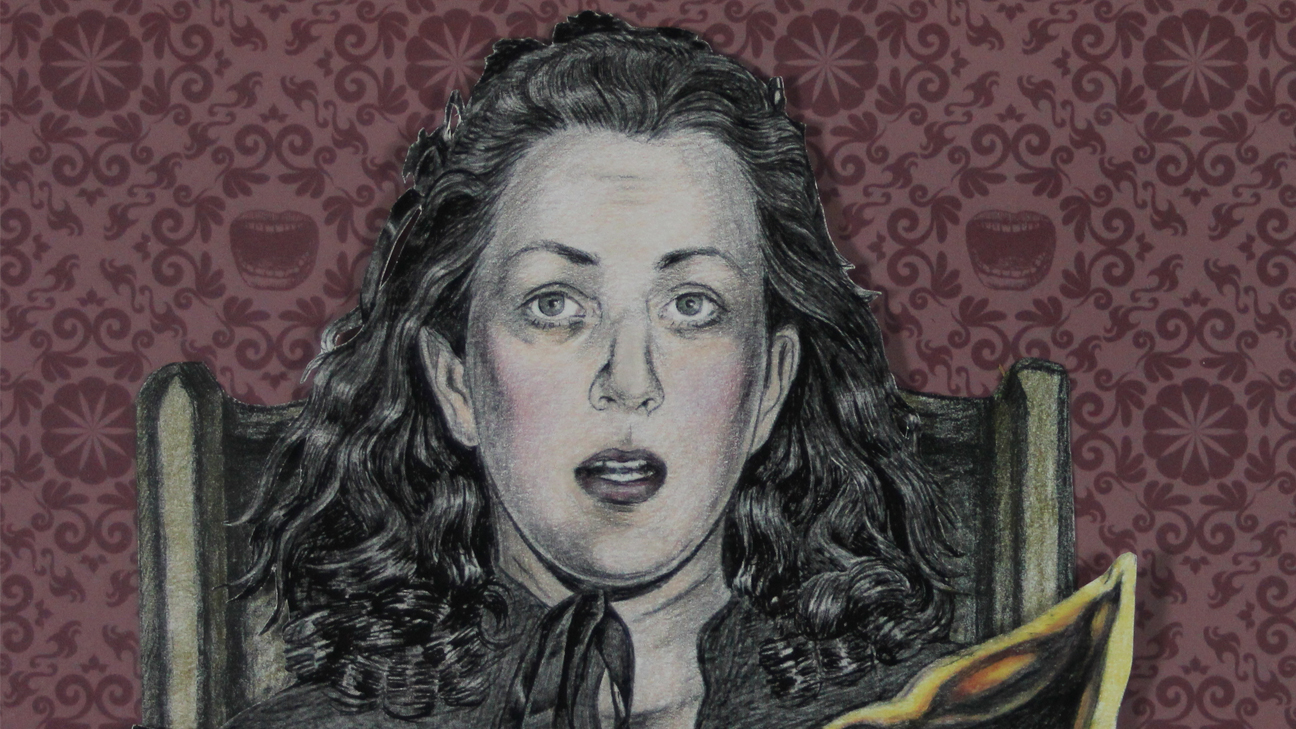
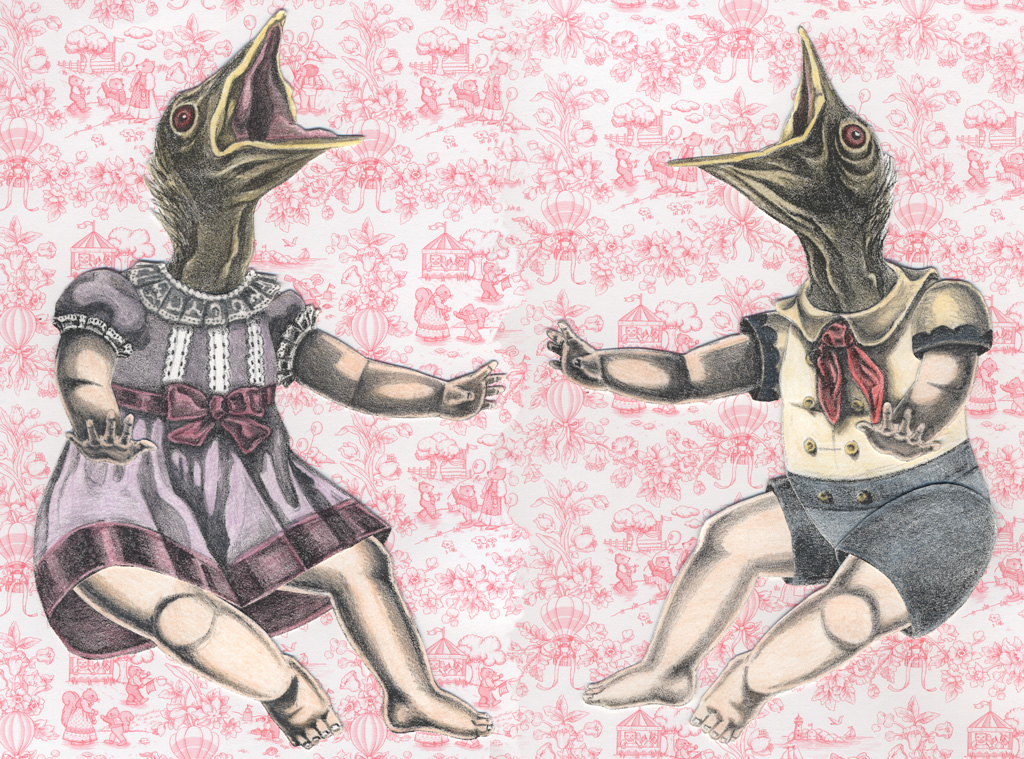
At last, I’ve completed my second stop-motion animated short film. Domestikia uses paper cutouts and articulated paper puppets in a stop-motion animation to explore the strange, dreamlike and uncanny realm of the Domestic Gothic.  With a healthy dose of black humour, it tackles the anxieties and challenges experienced by parents of young children. The ‘Domestic Gothic’ as a motif developed through the writing of 19th-century women Gothic novelists, such as the Brontë Sisters, and dealt specifically with the horror of confinement felt by women who were ‘imprisoned’ within the home and unable to move freely in Victorian society. With contemporary women still predominantly acting as primary caregivers to their children — and thus financially penalized by either remaining at home or opting for employment that allows for ‘family friendly’ work hours — this sense of confinement is still present. The realm of the domestic has become infiltrated by strange creatures — a giant butterfly, an octopus, and bird-headed children — whose presence suggest a level of discomfort within the home. These creatures are the physical manifestation of Freud’s das Unheimlich (translates to English as ‘the uncanny’), a term which literally means ‘unhomely.’

All images and animation were done by me, in my basement.

“Domestikia: An Account of Some Strange Disturbances” begins February 24th, 2012.

"The Brood" (2012) by Jennifer Linton. Work-in-progress photograph of a shadowbox assemblage, which includes hand-coloured lithographs that are cut out and pasted into paper dolls.

If you live in the Toronto area, then drop by Open Studio to view some of my recent creative efforts. My latest exhibition “Domestikia: An Account of Some Strange Disturbances” is an exploration into the interdisciplinary possibilities of printmaking. I’ve created articulated paper puppets from lithographic prints, which are then arranged into strange, dream-like shadow box tableaux. These same paper puppets are brought to life in a stop-motion animation, all taking place within an imagined dollhouse.

Opening reception is Friday, February 24th at 6:30 – 8:30 p.m. Join me for wine, conversation and general frivolity. Show runs from February 24 – March 31, 2012. Open Studio is located on the ground floor of 401 Richmond, at the corner of Richmond and Spadina in Toronto. For more information on this show, visit the Open Studio web site.

My Demon Lover: the mythology of the incubus.

“Inkubus” (photograph, 2005) by contemporary German visual artist Michael Hutter.

The incubus is a demon in male form — the female equivalent is called a succubus — who, according to different mythologies and legends throughout the world, lies upon women whilst they sleep in order to have sexual intercourse with them. In the Middle Ages, belief in demons who sexually preyed on humans assuaged a sleeping person’s shame and guilt over nocturnal emissions and other physical evidence of erotic dreams. Primarily, however, the incubus legend functioned as a convenient means to conceal incest and other types of sexual assault upon girls and women who had no unchaperoned access to men outside the home, but had nonetheless become inexplicably pregnant.

In contrast to the sleeping rape victims of medieval yore, the women that populate the photographic work of contemporary visual artist Michael Hutter are both wide awake and engaged in consensual coupling with their respective incubi. In the sepia-coloured photo-collage entitled Inkubus, a nude woman sporting a 1920’s flapper-style bob receives an amorous lick from the tiny demon lover perched on her shoulder. In The Alien Nurse, the erotic-grotesque combines with Victorian fetishism as a blindfolded “wet-nurse” offers up her breast to a curious intestinal/tentacled alien blob. In subsequent photo-collages, the wet-nurse discovers new and even more intimate uses for the alien tentacle, recalling shokushu goukan or ‘tentacle erotica’ of contemporary Japanese hentai.

“Die Alienamme (The alien nurse)”, photograph, 2006 by Michael Hutter.

The work of German artist Michael Hutter ranges from ink drawings on paper reminiscent of the Victorian kinkiness of Aubrey Beardsley’s Lysistrata, to the retro-inspired photo-collages you see here.  Visit his online gallery to see for yourself, though perhaps not whilst at the office.

“Domestikia: An Account of Some Strange Disturbances”, stop-motion animation project.

My latest creative project is “Domestikia: An Account of Some Strange Disturbances”. Continuing my interdisciplinary approach to artmaking, I have created jointed, movable paper cutouts from my lithographic prints for use in a series of stop-motion animations. This project will include several short stories linked together by an overarching narrative, all taking place within an imagined dollhouse. The narrative is non-linear, so scenes are not “shot” in sequence.

I’ll readily admit to being a complete neophyte when it comes to animation, but thus far I find the process a rewarding one. Painstakingly tedious and laborious, but rewarding nonetheless :-)

A Diabolical Decadence: Charles Baudelaire, Félicien Rops and the “Flowers of Evil.”

Come on my heart, cruel and insensible soul,
My darling tiger, beast with indolent airs;
I want to plunge for hours my trembling fingers
In your thick and heavy mane;

In your petticoats filled with your perfume
To bury my aching head,
And breathe, like a faded flower,
The sweet taste of my dead love.

I want to sleep, to sleep and not to live,
In a sleep as soft as death,
I shall cover with remorseless kisses
Your body beautifully polished as copper.

To swallow my appeased sobbing
I need only the abyss of your bed;
A powerful oblivion lives on your lips,
And all Lethe flows in your kisses.

I shall obey, as though predestined,
My destiny, that is now my delight;
Submissive martyr, innocent damned one,
My ardor inflames my torture,

And I shall suck, to drown my bitterness
The nepenthe and the good hemlock,
On the lovely tips of those jutting breasts
Which have never imprisoned love.

— Geoffrey Wagner, Selected Poems of Charles Baudelaire (NY: Grove Press, 1974). English translation of the poem Le Léthé by Charles Baudelaire from Fleurs du mal (1857).

Mysterious occult rituals, orgiastic parties and experiments with hallucinatory drugs: sounds like one of the notorious “acid test” road trips by Ken Kesey and the Merry Pranksters, right? While this does neatly summarize the wild merry-making of the Pranksters and the 1960’s hippie counterculture, what I’m describing above is instead the naughty behaviour of a much earlier group of non-conformists and bohemians: the Decadents of the late 19th-century.

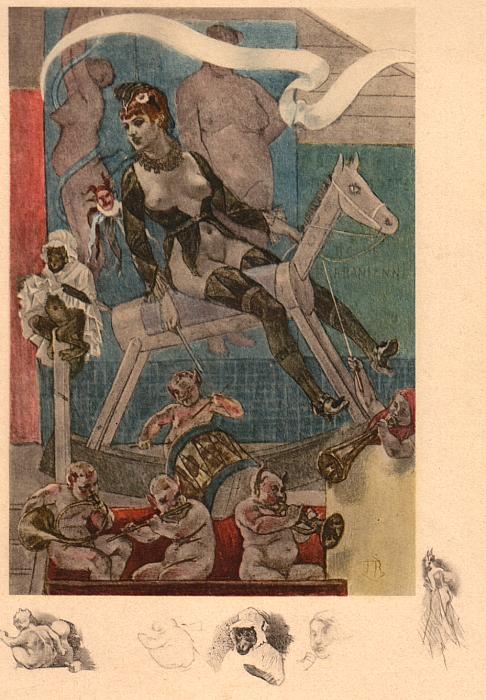
Etching & aquatint by Félicien Rops (1896).

The Decadence Movement was a fin de siècle artistic and literary style of Western Europe, primarily France. Fin de siècle or “end of the century” refers to the latter two decades of the 19th-century that were characterized by boredom, cynicism, and pessimism as well as an anxiety over the change that is inevitable in the ending of a century. While the term “decadent” was originally applied as a pejorative by critics of the style, writers and artists such as Charles Baudelaire and Félicien Rops eagerly adopted this label as a further act of defiance against the restrictive social mores they perceived in contemporary European society. For the most part, the Decadents were influenced by the tradition of Gothic novels and by the poetry and fiction of Edgar Allan Poe, and were associated with (but distinct from) Symbolism. The progenitor of Decadence was Baudelaire, and his poetry collection Les Fleurs du mal (‘The Flowers of Evil’, 1857) is considered by literary historians as a seminal work of Decadent writing. Steeped in a fashionably brooding melancholia and an almost morbid eroticism, Baudelaire’s poetry was targeted by French censors for its bold lasciviousness:


The author and the publisher were prosecuted under the regime of the Second Empire as an outrage aux bonnes mœurs (trans. “an insult to public decency”). As a consequence of this prosecution, Baudelaire was fined 300 francs. Six poems from the work were suppressed and the ban on their publication was not lifted in France until 1949. These poems were “Lesbos”, “Femmes damnés (À la pâle clarté)” (or “Women Doomed (In the pale glimmer…)”), “Le Léthé” (or “Lethe”), “À celle qui est trop gaie” (or “To Her Who Is Too Gay”), “Les Bijoux” (or “The Jewels”), and ” Les “Métamorphoses du Vampire” (or “The Vampire’s Metamorphoses”). These were later published in Brussels in a small volume entitled Les Épaves (Jetsam). — from Wikipedia.
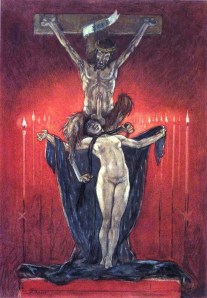
Lithograph known alternately as “Black Mass” or “Calvary”, by Félicien Rops.

The Belgian visual artist Félicien Rops met Baudelaire towards the end of the poet’s life, and this meeting had a great impact on the career of the young artist. An accomplished printmaker, Rops illustrated many literary works including Baudelaire’s Les Épaves, a selection of poems for which he created the frontispiece. Like the works of the authors whose poetry he illustrated, Rops work tends to mingle sex, death, and Satanic images. He held a lifelong fascination with the femme fatale, an image of womankind that served as a dark and sinister Muse to that generation of Decadent artists. Of his views of Woman, Félicien Rops wrote: “Therefore it is his era, the end of the 19th century, that he [the artist] expresses through his graphic work, structured mainly around the themes of love, suffering and death, with the central unifying theme of the woman, la femme fatale in the full meaning of the word. Through her he portrays his vision of his era. Woman is Satan’s accomplice, and becomes the supreme attraction which provokes the most extreme vices and torments in Man, a mere puppet.” (an English translation of a quote taken from the Museum of Félicien Rops web site.)

Counting myself amongst the legion of “Satan’s accomplices”, I can easily admire the lewd and grotesque aspects of Rops, even as he does occasionally verge on a kind of vulgar kitsch. The unabashed sexuality of Rops lends a quality of surprising modernity to the work and gives it a contemporary feel, even as it dates from well over 100 years ago.

Cannibals, werewolves and tentacles: The web searches that bring you here.

Blog statistics are a fascinating gateway into the collective unconscious. While the identities of those who’ve visited my blog remain anonymous, their mouse clicks remain on record and provide an insight into the topics that interest them most. What occupies people’s thoughts during those moments of procrastination when they are not writing that report for their boss or essay for that class? Cannibals, apparently. More specifically, Ruggero Deodato’s 1980 horror film Cannibal Holocaust, a film that’s still considered controversial after 32 years and, likely due to its continued notoriety, received the most “hits” on my blog. If they’re not seeking information on cannibal films, people are looking into the Canadian teenage werewolves of Ginger Snaps which, as far as I’m concerned, is a much better use of their time.

Periodically, I will write about topics other than horror films, though these topics are as equally strange and macabre. Heinrich Hoffmann’s darkly comedic children’s book Der Struwwelpeter (1845) has garnered a great deal of interest on my blog, as well as the eroticized anatomical art of Jacques D’Agoty and anatomists of the 18th-century. The mythological vagina dentata and Japanese ‘tentacle erotica’ draw a fair amount of interest, as one might expect.

Celebrities and famous artists predictably top my statistics tally. People have searched on marquee names from art history including Marcel Duchamp, Max Ernst, Odilon Redon, and Hannah Wilke (though the latter is lesser known), as well as contemporary visual artists Loretta Lux, Marcel Dzama and Shary Boyle. And, 45 years after her death, Jayne Mansfield still attracts a large amount of attention. I only wrote about her in a post last week, and she’s #22 on the list of “all-time” top searches. Of course, her story is a ‘perfect storm’ for achieving immortality on the Internet: a beautiful, buxom starlet, who reportedly dabbled in Satanism, died young and in most grisly manner (depending on which account you read, she was either scalped or decapitated in a car accident). We are, as a species, a ghoulish bunch.

Here’s the top 30 searches, according to WordPress:

cannibal holocaust 577
ginger snaps 287
holocaust 279
struwwelpeter 253
loretta lux 247
odilon redon 246
max ernst 246
vagina dentata 184
daguerreotype 123
tentacle erotica 109
cannibal 97
jennifer linton alphabet series 94
walerian borowczyk 91
max ernst collage 84
der struwwelpeter 78
hannah wilke 70
contes immoraux 67
drag me to hell 56
agoty angel 49
anatomical art 46
jayne mansfield 45
marcel dzama 43
the descent 40
macabre art 37
drag me to hell old lady 37
best animated movies of all time………… 33
holocaust pictures 33
redon 33
irreversible 28

Now, get back to work…

p.s. One of the funniest web searches I’ve seen to date would be this one: “horror movie with a women who seducing and kill men with her vagina.” Hey, who am I to judge? Incidentally, there is such a film — not surprisingly, it’s Japanese and called Killer Pussy. You’re welcome.

Nightmarish visions at 24 frames per second.

The startling fantasy world of Jan Lenica’s “Labyrinth” (1963) owes a stylistic debt to the earlier Surrealist colleges of Max Ernst.

Like the majority of moviegoers, I’m often bedazzled by the computer-generated worlds created by Pixar and Dreamworks. While it would be difficult to dispute the technical virtuosity of these animation mega-giants, I must admit to having a soft spot for the low-fi underdog that is stop-motion animation. Perhaps because it involves a fully manual approach that relies more heavily on materials than pixels, I feel a greater affinity for it. One of the most basic and “low-fi” of stop-motion techniques is the paper cutout which, as the name suggests, involves drawings or prints on paper that are cut out and manipulated to simulate movement. The high degree of artifice and theatricality associated with the paper cutout makes this technique particularly well suited to animations which are fantastic, dreamlike and surreal. Its relative simplicity enabled many visual artists not typically known as animators to use this technique to create time-based work. Polish filmmaker Walerian Borowczyk, who had received a very classical training in painting at the Academy of Fine Arts in Kraków, used paper cutouts to great effect in his animated short films Les Astronautes (1959) and Les jeux des anges (1964). Borowczyk capitalized on the anti-realism of the cutout to produce his surreal and frequently nightmarish worlds.

https://www.youtube.com/watch?v=UzXnHTVtlvQ

Borowczyk’s compatriot and sometimes collaborator Jan Lenica used paper cutouts for his masterful Labyrinth (1963), an animation that, through its incorporation of 19th-century illustrations, closely recalls the eerie beauty and surrealism of a Max Ernst college novel. Eastern European animators such as Borowczyk, Lenica, and the Czech stop-motion master Jan Švankmajer, were highly influential on the work of contemporary animators/filmmakers Tim Burton and Terry Gilliam.

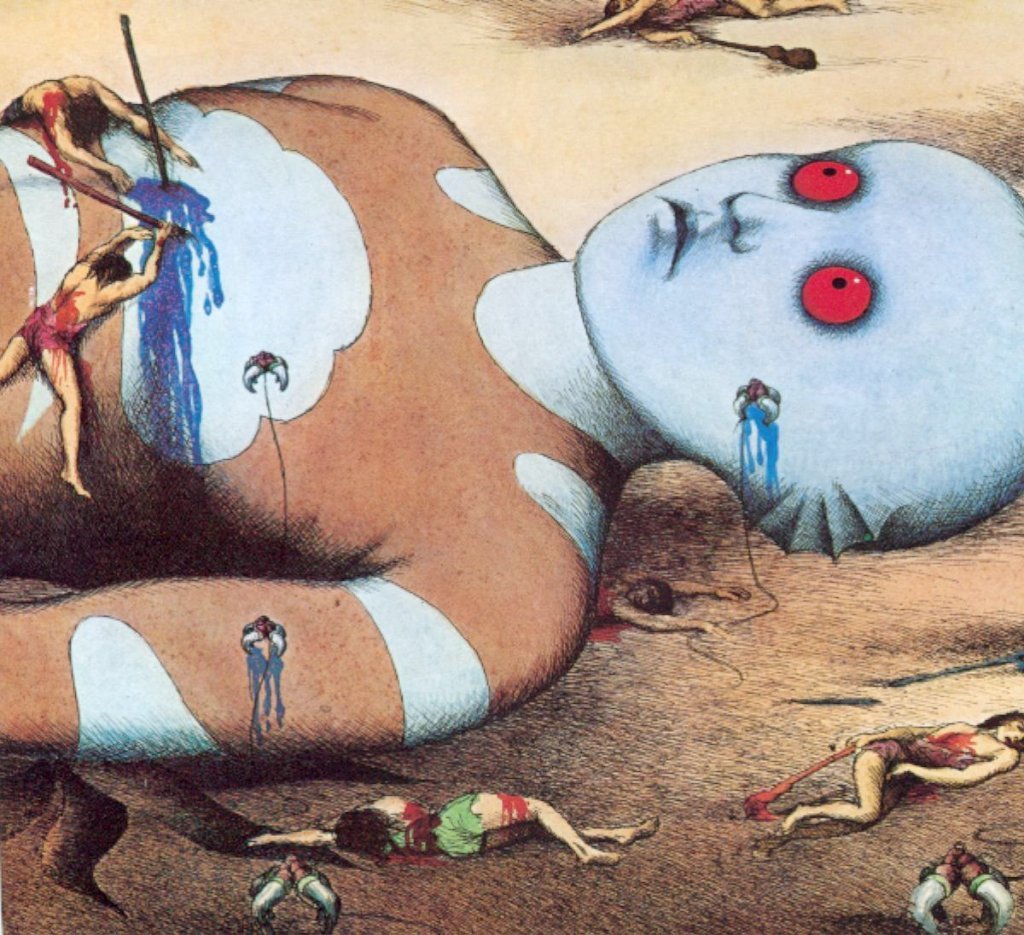
The Oms take down a giant Draag in Laloux’s surreal animated feature “Fantastic Planet” (1973). A joint production between France and the former Czechoslovakia, it’s Cold War politics are neatly embedded in the science fiction tale.

One of my earliest exposures to the technique of paper cutout animation was the feature-length science fiction film La Planète Sauvage, (“Fantastic Planet”, 1973), a collaboration between the French director René Laloux, writer/artist Roland Topor and a team of Czech animators at Jiří Trnka Studio. The sophistication of the paper cutout technique is astounding, and the visual style unique and thoroughly memorable. There’s quite a good synopsis of this film, accompanied by several screen shots, at the Twitchfilm blog which I would recommend. The author of this blog ends her/his post with a paragraph about the “adult” content of this film. It is, most assuredly, aimed at an adult audience, and I particularly enjoyed this author’s summary of the many and varied deaths the Oms faced in Laloux’s La Planète Sauvage:

In case you didn’t suspect it yet: this is not exactly a children’s film. Eureka (or rather the BBFC) rates this DVD “PG” but the film was clearly made with adults in mind. Some Draags wear very revealing outfits while the humans are naked, half-naked or wearing rags. Mating rituals of both humans and Draags are shown, but far more disturbing is the seemingly unending variety in which the tiny humans keep getting eaten, squashed, shredded, poisoned, radiated and stomped on by both Draags and the local flora and fauna. — Twitchfilm blog

Classical mythology revisited: the shrewd ecofeminism of Shary Boyle.

The last (I promise) of the grad school essays I shall inflict upon you. In this one, my task was to compare my work with that of another contemporary visual artist. I chose Shary Boyle. The astute among you will recognize a passage or two from my Master’s thesis in this essay. Hey, it’s not plagarism when you cannibalize your own writing.

Fig. 1. Shary Boyle, "Untitled", pencil and gouache on paper, size unknown, 2003.

Throughout history, visual artists have fleshed out mythological subjects and generated images based on traditional, time-honoured stories. Myths supply an accessible and universal narrative to which the artist can attach a personal story. Renowned scholar and mythologist Joseph Campbell describes one of the goals of myth as “…effecting a reconciliation of the individual consciousness with the universal will.” Similarly, in his essay “The Expressive Fallacy” Hal Foster cites Nietzsche’s discussion of an artist’s use of myth to express an interior world: “The whole notion of an ‘inner experience’ enters our consciousness only after it has found a language that the individual understands – i.e., a translation of a situation into a familiar situation…” The “language” to which Nietzsche refers can be interpreted as “mythology” which provides a universal narrative to which all cultures, no matter how disparate, have access. The “inner experience” may be read as the personal, psychological or emotional world that the artist seeks to materialize through the use of myth. In short, myths connect us to each other by anchoring the idiosyncrasy of the individual to a universally shared point of reference.

In my own art practice, I frequently make use of myths and archetypes as cultural ready-mades into which I insert my own personal history and meanings. Myths are reinterpreted in my work from a feminist perspective that considers gender representation in these mythological narratives. Another contemporary Canadian artist who employs a similar creative, feminist tactic is Shary Boyle. A commonality in our work is the use of female mythological subjects that evoke the traditional, allegorical link between women and nature. Rather than simply offer a critique of the feminized concept of nature, however, both Boyle and myself use motifs derived from nature in a subversive manner that transform our female subjects in strange, fantastic ways. The transformations and mutations that our mythological heroines experience provide the visible, external evidence of their inner psychological and emotional world.

In her work prior to 2008, Boyle’s use of fairytales and mythological subjects tended to be global rather than specific. Her phantasmagoric imagery suggested the realm of dreams and myths without representing a particular legend or cultural tradition. Her two pencil and gouache drawings that we shall examine, both dating from 2003 and simply called Untitled, are evidence of her generalized incorporation of myth. Both drawings involve remarkable incidents in which a single female figure, isolated on the white void of the paper, quietly experiences a magical transformation. In Untitled (fig. 1) we are confronted with a woman in a bright red dress sitting contentedly in the grass, hands resting peacefully in her lap. The drawing is linear and economical; the grass on which the woman sits is minimally drawn. Two long, yellow plant stalks topped with white blossoms grow outwards from the eye sockets of the woman, a strange phenomenon that has not managed to disturb her serenity. The very fact that the woman appears unconcerned by this fantastic event seems to suggest that this transformation is metaphoric as the flowers are a manifestation of an interior psychological state. Equally, the woman may have simply acquiesced to the inevitability of this strange transformation. The subject of Boyle’s second drawing Untitled (fig. 2), a prepubescent girl whose rigid stance and sideways glance suggests that she’s somewhat more alarmed by the tangled bush growing out from her mouth, nevertheless seems to accept the strangeness of this event as normative.

Fig. 2. Shary Boyle, "Untitled", pencil and gouache on paper, 30.5 cm x 30.5 cm, 2003.

In her essay entitled “Ornamental Impulse”, art writer Josée Drouin-Brisebois comments on Boyle’s surreal transformations as a manifestation of the emotional and psychological worlds of her subjects. “Boyle’s [figures]”, says Drouin-Brisebois, “express the inner life of the emotions materially.” Drouin-Brisebois cites the review of art critic Robin Laurence for Boyle’s paintings Companions (2004), wherein Laurence states: “Boyle’s portraits suggest that what looks outwardly freakish in others is the metaphorical equivalent of inward aspects of all our characteristics and circumstances.” Thus, the plant life that blooms from the bodily orifices of these female subjects is emblematic of their interior states, though what precisely those states would be remain vague and mysterious.

The mythology to which Boyle attaches her idiosyncratic narratives serves to anchor the work in tradition and provide the viewer with visual clues as to how one might interpret her dream-like imagery. For instance, the otherworldly flora of these drawings reference allegorical and mythological associations of women to nature. Rather than challenge the traditional dichotomy of women and nature, Boyle embraces it in a subversive manner. According to Drouin-Brisebois, Boyle’s women “become…nature in unsettling ways – verdancy out of control or a parasite that takes over the body…” Boyle acknowledges the allegorical tradition while at the same time engaging a sinister playfulness that alters it.

Fig. 3. Jennifer Linton, "An Abundant Supply of Milk", drypoint and etching, 38 cm x 30 cm, 2006.

Similar to Boyle, otherworldly flora plays a prominent role in my 2006 intaglio print entitled An Abundant Supply of Milk (fig. 3). Whereas Boyle rarely identifies her female subjects as aspects of herself, my work makes frequent use of self-portraiture and is characterized by an autobiographical content. This particular self-portrait shows myself standing in profile, naked save for a pair of underwear. With my hands I squeeze my breasts and produce an exaggeratedly large spray of breast milk. This cloud-like spray of breast milk, in turn, blossoms into a soggy mass of flowers. Like the drawings of Boyle discussed earlier, this print recognizes the mythic association between women and nature, and in particular the concept of a nurturing “mother nature”, while at the same time subverting it. The nourishing food that is breast milk has transformed into a bizarre floral mass that, rather than natural, appears inexorably alien. Created in the months that followed becoming a first-time mother, this image addressed my response to the strange transformations enacted upon my body as a result of pregnancy and childbirth. The milk-flowers that spring forth from my breasts represent an externalization of the estrangement I felt from my own body.

A second, earlier self-portrait speaks not to a feeling of estrangement but to the human impulse towards creation, both in art as well as in procreation. The coloured pencil drawing entitled Genesis (fig.4) illustrates the growth of a leafy, magenta and orange plant stalk out of my opened mouth. This fanciful stalk terminates in a perfectly round, ripe pomegranate fruit. Similar to the heroines of Boyle’s drawings, my visage appears untroubled by the unconventional growth of this fruit as if this were the result of a natural, internal process. In contrast to Boyle’s 2003 Untitled drawings, however, the magical vegetation of Genesis recalls a very specific mythological story while at the same time evoking the women-nature dichotomy. The appearance of the pomegranate in this drawing is highly significant as it is a direct quotation from an earlier body of work in which I assumed the role of Persephone, a tragic heroine from Greco-Roman mythology. This role-playing allowed for the insertion of personalized content within the larger context of a universal narrative. Or, as Nietzsche expressed, the myth of Persephone provided “…a translation of a situation into a familiar situation.” We will return to this discussion of Persephone after an introduction to Boyle’s latest works, one of which, coincidentally, deals directly with this same myth.

Fig. 4. Jennifer Linton, "Genesis", coloured pencil on Mylar, 38 cm x 28 cm, 2004.

As previously stated, Boyle’s work is frequently characterized by a global adoption of mythology, her imagery an amalgam of different mythic traditions synthesized with her own idiosyncratic symbolism. The recent unveiling of Boyle’s latest porcelain sculptures at the 2008 grand reopening of the Art Gallery of Ontario, however, provides an exciting and atypical exception to this aspect of her work. Boyle was commissioned by the AGO to create work that responded to the gallery’s permanent collection. She selected two 18th-century Italian bronze statuettes by Giovanni Battista Foggini with which to engage in a conversation across history. The subjects of Foggini’s sculptures are two commonly depicted Greco-Roman myths: Perseus slaying Medusa and The Rape of Proserpine. Boyle’s porcelains offer feminist reinterpretations of these myths while simultaneously maintaining her characteristic surreal imagery that hints at the internal, psychological world of her subjects.

Boyle’s response to Foggini’s The Rape of Proserpine re-imagines the Greco-Roman myth upon which it is based and addresses the violent and sexually problematic subject matter of the original Baroque bronze. Her delicate porcelain sculpture entitled The Rejection of Pluto (fig. 5) casts the titular deity as a hideously yawning monster and not the sinewy, handsome abductor of Foggini’s statuette. In her 2008 interview with art critic Sarah Milroy featured in The Globe and Mail, Boyle discussed the responsibility she felt as a feminist artist in rendering an alternate version of this classical myth: “I guess I just felt that this subject matter had to be engaged. I had been asked inside the museum, and I felt a kind of responsibility to interrupt some of those narratives, to propose some other kinds of stories.”

Proserpine is the Roman goddess of springtime, wife of Pluto and mythological equivalent of the Greek goddess Persephone. Her story is one of great emotional power: an innocent maiden abducted by the lustful god of the Underworld and forced to become his bride. In the Globe and Mail interview, Boyle related the version of this Greco-Roman myth that inspired her reinterpretation:

“…Pluto, the Lord of the Underworld, fell in love with Proserpine, the beautiful daughter of the harvest goddess. Lust incarnate, he emerges from Hades through a pond in the glade of the water nymph Cyane, wreaking havoc on this sacred sylvan spot and seizing Proserpine by force, making her his bride in Hell. Cyane, who protects the natural realms, weeps tears over this loss, so much so that her tears replenish the landscape Pluto has devastated.”

Fig. 5. Shary Boyle, "The Rejection of Pluto", mixed media porcelain sculpture, 2008.

The scene of Boyle’s The Rejection of Pluto is the idyllic glade of the water nymph Cyane, decorated with exotic flowers, seashells and fairytale toadstools. The monstrous head of Pluto emerges from the water, his cavernous mouth yawning open as if to swallow his intended victim. Bright red-orange light, suggestive of the flames of Hell, flickers inside the mouth and eyes of the hollow, chasmal head. The water that immediately surrounds Pluto’s head appears brown and putrid and the vegetation bleached white, all vitality having been drained out by its proximity to the god of the Underworld. The female characters of this story – the girl-child Proserpine, her mother Demeter, and the nymph Cyane – are all gathered in a group at the opposite end of the glade. The amphibious water nymph Cyane glowers fiercely at Pluto, defending Proserpine whom Boyle has cast as a small child wounded by mirrored shards. According to Boyle, these three female figures “represent emotional, mental and physical resistance under siege.”

The crucial role that nature plays in The Rejection of Pluto can be likened to that of Boyle’s 2003 Untitled drawings, although the correlation between women and nature in the sculpture have been further strengthened. The landscape of The Rejection of Pluto reflects the violation suffered by Proserpine through its transformation from lush verdancy to polluted wasteland. This transformation of the landscape symbolizes Proserpine’s psychological and emotional turmoil in much the same manner as the mirrored shards that have pierced her flesh represent her physical violation. Boyle’s shrewd interpretation of the Proserpine/Persephone myth emphasizes the allegorical link between women and nature in her analysis of the mistreatment of both women and nature in the world.

The tragic heroine Persephone has also been depicted as a prepubescent girl in my 2000 mixed-media drawing entitled The Bitter Seed. In this drawing, I combine an image of myself as a child with the myth of Persephone as a means to address the difficult territory of childhood sexual abuse. By adopting the role of the mythological heroine, I translate and universalize my personal experience. Through the use of this metaphor, I strive to make an emotional state palatable and thus more easily approachable by the viewer.

The Bitter Seed takes its name from the pomegranate seed that Persephone was forced to eat, thus sealing her fate as the goddess whose annual death and rebirth would usher in the changing seasons:

“Persephone was the daughter of Zeus and Demeter, the goddess of agriculture. Hades, the lord of the Underworld, surprised Persephone one day while she was picking flowers and carried her off to be his bride. Demeter, the distraught mother, threatens to destroy all mortal men by causing an endless drought unless her daughter is returned. Zeus, who is the king of the gods at Olympus, commands Hermes to fetch Persephone from the realm of Hades. The wise Hades chooses to obey the command of Zeus; however, before Persephone is returned, he tricks her into eating a seed from a pomegranate. This deception is later revealed when Demeter asks her daughter “…have you eaten any food while you were below? If you have not, even though you have been in the company of loathsome Hades, you will live with me and your father…but if you have…you will return again beneath the depths of the earth and live there a third of the year; the other two-thirds of the time you will spend with me…”

To the ancient Greeks, the myth of Demeter and Persephone served to explain the death and regeneration of plant life each year. The metaphoric link between women and nature is quite overt: Persephone personifies the cycle of the seasons through her annual sacrifice.

In The Bitter Seed, my childhood self stands thickly outlined in black against a brightly coloured background reminiscent of a stained-glass window. One of my hands holds aloft a pomegranate, above which hangs the phrase “dirty girl.” I stare quizzically at both the fruit and the phrase, my child mind unable to fully grasp their meaning. Like the pomegranate in the Persephone myth, the fruit I hold represents violation and entrapment. Similar to the girl-child Proserpine in Boyle’s sculpture, who displays her wounded arms for the consideration of the viewer, my child-self in The Bitter Seed holds the pomegranate up as a symbolic manifestation of inner “wounds”.

Fig. 6. Jennifer Linton, "St. Ursula and the Gorgon’s Head", coloured pencil and drawing ink on Mylar, 62 cm x 80 cm, 2002.

The victimization of the girl-child Persephone in The Bitter Seed is later redressed in my 2002 drawing St. Ursula and the Gorgon’s Head (fig. 6) in which I assumed the role of the Catholic Saint Ursula, the patron saint of schoolgirls. In a manner similar to The Bitter Seed, this drawing blended autobiographical elements with mythological role-playing in order to universalize personal experience. The heroine of St. Ursula and the Gorgon’s Head assimilates two divergent mythological traditions: the hagiography of the Catholic saint with the Greco-Roman myth of the Gorgon Medusa. More avenging angel than saint, St. Ursula is shown adorned with angel wings and holding aloft a sword and the severed head of Medusa. The mouth of the snake-haired Medusa gapes open in a silent scream while a magical bloom of red flowers bleed from the wound of the severed neck. In the background, graphic and highly stylized red flowers also appear to bleed. Much like the strange, sinister flowers of Boyle’s 2003 Untitled drawings, these violent blossoms subvert the traditional woman-nature dichotomy and the association of women with a passive and nurturing feminine principle.

Women are frequently cast as the prize at the end of the hero’s quest but are seldom depicted as the active, adventurous hero themselves in mythology. This gender-biased tradition was best summarized by Joseph Campbell in his 1982 interview with Rozanne Zucchet from his collected writings entitled “The Hero’s Journey”:

“I was teaching these courses on mythology and at the end of my last year there this woman comes in and sits down and says, ‘Well, Mr. Campbell, you’ve been talking about the hero. But what about the woman?’ I said, ‘The woman’s the mother of the hero; she’s the goal of the hero’s achieving; she’s the protectress of the hero; she is this, she is that. What more do you want?’ She said, ‘I want to be the hero!’ So I was glad that I was retiring that year and not going to teach any more [audience laughter].”

While Campbell’s anecdote evidently amused his audience, it also underscores the gender discrimination inherent in mythological models. The sword-wielding heroine of St. Ursula and the Gorgon’s Head constitutes my feminist response to Campbell and this gender-biased tradition. My heroine adopts the stance traditionally occupied by the male hero Perseus who, as the Greek myth tells us, beheaded the female monster Medusa. Additionally, the gender of Medusa in my drawing has been switched from female to male as the image of the severed gorgon’s head my heroine holds is, in fact, a direct visual quotation of a painting by Caravaggio where Medusa is uncharacteristically portrayed as male.

Fig. 7. Shary Boyle. "To Colonize the Moon", mixed media porcelain sculpture, size unknown, 2008.

The representation of gender also plays a crucial role in Boyle’s second porcelain sculpture commissioned by the Art Gallery of Ontario. Entitled To Colonize the Moon (fig. 7), this sculpture encapsulates her response to Foggini’s bronze statuette Perseus Slaying Medusa as well as to the traditional Greco-Roman myth that she “has interpreted in light of both her environmentalist and feminist ideas.” Boyle’s reinterpretation of the myth views Medusa as a “very misunderstood monster” who suffers a number of indignities and violations resulting from the capricious cruelty of the Olympian gods. The severed head of Medusa lies atop a funeral pyre comprised of dead bats and bees, the expression on her lifeless face one of sad resignation to her tragic fate. In stark contrast to the heroic romanticism of Foggini’s Perseus, Boyle’s version of the Greek hero is a lily-skinned, rosy-cheeked effeminate boy who sits in quiet repose while he wipes the blood from his sword. This traditionally triumphal moment has been undercut by the calmness of the scene and soft, unheroic body of Boyle’s Perseus. The violence of the story is not celebrated, but merely represented in an anticlimactic manner. The death of the monster Medusa and the death of Nature – embodied by the dead bats and bees – are seen as being synonymous. There is a mournful aspect to this sculpture, as Boyle challenges the viewer to consider the violence enacted both upon women as well as upon the natural world.

Contemporary feminist artists such as Shary Boyle and myself are mining the past, revisiting the universal narratives of mythology and, as Boyle succinctly stated, “propos[ing] some other kinds of stories.” Inspired by the second wave feminists, who coined the phrase the personal is political, we disrupt the problematic, gender-biased narratives of traditional myths by inserting our own personal, idiosyncratic content into the larger framework of these universal stories. This personalized content adopts the symbolic vocabulary of myth and, through creative tactics such as role-playing, re-imagines these stories from contemporary feminist perspectives. Mythological motifs traditionally associated with women – namely the allegorical link made between women and nature – is wielded as a deconstructive weapon that knowingly acknowledges this association while at the same time playfully subverting it. The female subjects that populate our work ache, bleed, bloom and otherwise manifest their interior worlds in a number of strange and wondrously magical ways.

Some girls are more lethal than others: that deadly ‘vagina dentata’ grin.

The wonderful closing shot of an empowered Dawn from Mitchell Lichtenstein's "Teeth." Incidentally, Mitchell is the son of famed American pop artist Roy Lichtenstein.

The vagina dentata is the myth of a woman that possesses a castrating ‘toothed vagina‘. This myth exists across many different cultures and seems to address a global anxiety amongst men over the ‘otherness’ of women’s bodies and sexuality. In the Freudian psychoanalytic model, the vagina dentata is emblematic of castration anxiety amongst very young boys who, upon their awareness of the biological difference between male and female genitalia, develop an unconscious and irrational fear that their own penis will be ‘removed.’ Of course, Freud’s theories have fallen out of favour in therapeutic practice over the past decades, owing to the fact that his views of both women and homosexuality are antiquated and obviously problematic. And yet, the myth of the vagina dentata continues to be pervasive in contemporary culture, albeit in a much more symbolic manner.

Mitchell Lichtenstein’s 2007 horror-comedy film Teeth employs the vagina dentata myth as a mischievously playful plot device. The main character Dawn unknowingly possesses a ‘toothed vagina.’ The reason for her biological abnormality is never explicitly given, although several panning camera shots of a power plant looming in the distance behind Dawn’s house — not to mention the cancer that plagues her sick mother —  suggest a mutation due to environmental pollutants. An unfortunate succession of events, including date rape and sexual abuse by a gynaecologist, transform the teenage Dawn from a virginal spokesperson for Christian abstinence to a sexual vigilante who wields her vagina dentata as a weapon of revenge. Although the premise feels a bit weak to carry a feature-length film, there’s still gory-fun to be had as the number of severed body parts predictably rise. Men will find this film squirm-inducing, for obvious reasons. Cross your legs and enjoy.

Kate Kretz. "Vagina Dentata Purse", 2002, hand sewn, hand dyed velvet, wire, thread, shaped shells, purse frame, 10 x 14 x 7".

Enhanced by Zemanta