Domestikia: An Account of Some Strange Disturbances. The Incident in the Nursery.

Domestikia: The Incident in the Nursery. from Jennifer Linton on Vimeo.

At last, I’ve completed my second stop-motion animated short film. Domestikia uses paper cutouts and articulated paper puppets in a stop-motion animation to explore the strange, dreamlike and uncanny realm of the Domestic Gothic.  With a healthy dose of black humour, it tackles the anxieties and challenges experienced by parents of young children. The ‘Domestic Gothic’ as a motif developed through the writing of 19th-century women Gothic novelists, such as the Brontë Sisters, and dealt specifically with the horror of confinement felt by women who were ‘imprisoned’ within the home and unable to move freely in Victorian society. With contemporary women still predominantly acting as primary caregivers to their children — and thus financially penalized by either remaining at home or opting for employment that allows for ‘family friendly’ work hours — this sense of confinement is still present. The realm of the domestic has become infiltrated by strange creatures — a giant butterfly, an octopus, and bird-headed children — whose presence suggest a level of discomfort within the home. These creatures are the physical manifestation of Freud’s das Unheimlich (translates to English as ‘the uncanny’), a term which literally means ‘unhomely.’

All images and animation were done by me, in my basement.

Lady Lazarus’s 2011 Halloween Party Movie Night: Scary Films for Kids.

OK, I admit it. It’s not even October, and I’m already planning out Halloween costumes for myself and my kids in eager anticipation of our favourite festive occasion. For the little ones, it’s all about spooky ‘make-believe’ and a prolonged sugar buzz. For the adults — those with and without children — it’s a culturally-acceptable opportunity to play masquerade and temporarily assume a different persona. And for those of us who revel in the macabre on a regular, year-round basis, it’s a chance to geek-out and make our ‘expert’ horror film recommendations for Halloween-themed movie nights.

Much like adults, children can vary widely in their tastes for, and tolerance of, scariness in films. Their reaction to such material can sometimes be unpredictable, but below I’ve listed a few spooky classics that should be age-appropriate for most children.

Scary films for kids:

1. Scooby-Doo And The… (series of DVDs, dating from the 2000’s-present). There are a number of direct-to-DVD, 90-minute movies featuring that super-sleuth canine Scooby-Doo and the Mystery Gang that even the youngest child in your family will enjoy. Some of the better spooky capers include Scooby-Doo And The Samurai Sword, Scooby-Doo and the Cyberchase, Scooby-Doo Camp Scare and Aloha Scooby-Doo! You can find most of these at your local DVD rental store or for purchase on Amazon. Recommended for age 4+

2. It’s the Great Pumpkin, Charlie Brown. A Halloween classic that’s appropriate for small kids. Recommended for age 3+

The Library Ghost (aka The Grey Lady) from "Ghostbusters" (1984). Could freak out very small kids, but a not-so-scary film for most.

3. Ghostbusters (1984). A couple of scenes might prove too frightening for very little ones, but on the whole a spooky-fun family film. Recommended for age 6+

4. Not too surprisingly, the gorgeously gothic creative efforts of Tim Burton features large on this list. Family-friendly Burton films include Beetlejuice (1988), and the animated feature-length films The Nightmare Before Christmas (1993) and The Corpse Bride (2005). I’ve shown the latter two films to my 4 and 6-year-old kids, and they reported that these were “a little too creepy” in parts. Use your own parental discretion, but I’d recommend these films for age 8+

The alternate-reality "spider Mom" from Coraline (2009).

5. Coraline (2009) has a very similar look-and-feel to the aforementioned Tim Burton animated films, and shares with these a creepiness that’s probably more appropriate for the 8+ crowd. All the same, a visually-stunning masterpiece of stop-motion animation that’s worthwhile for adults as well as children.

Quite frankly, I can’t wait until my kids are old enough to accompany their mother through a viewing of The Exorcist or a George A. Romero zombie gore-feast. Perhaps when they are around the age of 10…?

My next post will offer up suggestions for some adult-sized scares.

The magical worlds of Lotte Reiniger.

A still from Lotte Reiniger's "The Adventures of Prince Achmed" (1926), credited with being the first feature-length animation film.

Before there was Walt Disney, there was Lotte Reiniger. Born in Berlin in 1899, Reiniger pioneered new forms of paper cutout animation in the 1920’s. Inspired by shadow puppetry, Reiniger developed highly articulated paper puppets to be animated through stop-motion camera work. Her elegant paper silhouettes breathed life into the fairytale The Adventures of Prince Achmed (1926), a film that bears the distinction of being the first feature-length animation. Although she initially struggled to find a distributor, once Prince Achmed premiered at the Cannes Film Festival, it then became a critical and popular success.

Back-lit paper silhouettes are so closely associated with Reiniger that schools of animation will often refer to this type of work as the “Lotte Reiniger style.”

The “10 Best Animated Films of All Time”, according to Terry Gilliam.

The following text has been copied from an interview with Terry Gilliam (source: http://www.guardian.co.uk/film/2001/apr/27/culture.features1) in which the animator, filmmaker and former member of Monty Python reveals his creative inspirations.

The Mascot (Wladyslaw Starewicz, France 1934)

It was at the Sitges film festival that I first saw an exhibition of work by the pioneering Russian animator Wladyslaw Starewicz, and the puppets were so enrapturing that when I got home I ordered up all the tapes I could find of his work. His work is absolutely breathtaking, surreal, inventive and extraordinary, encompassing everything that Jan Svankmajer, Walerian Borowczyk and the Quay Brothers would do subsequently. This is his last film, after The Tale of the Fox from 1930; it is all right there in this cosmic animation soup. It is important, before you journey through all these mind-bending worlds, to remember that it was all done years ago, by someone most of us have forgotten about now. This is where it all began.

Pinocchio (Hamilton Luske and Ben Sharpsteen, US, 1940)

For me, as an American growing up in Minnesota, Walt Disney was animation. But the joy of Disney’s films always came from watching the baddies. Pinocchio is visually the richest of his features and it is also the darkest. The Bad Boys’ World is a truly immortal nightmare, full of eerie images of kids turning into donkeys and all manner of strangeness. Then there is that stuff with cages, and I notice now that every film I have made features a scene with somebody in a cage – a trait I attribute to watching Pinocchio. Great songs in that film too; Disney was essentially a musical film-maker. Plus there is something intriguing about a character who desperately wants to be a real person, but who we all think is actually more interesting as a piece of wood.

Red Hot Riding Hood (Tex Avery, US, 1943)

The magic of Tex Avery’s animation is the sheer extremity of it all. The classic Avery image is of someone’s mouth falling open down to their feet, wham, their eyes whooping out and their tongue unrolling for about half a mile: that is the most wonderfully liberating spectacle. Avery would just stretch the human body and face however he liked, and the result was unbelievably funny. There is no hesitation in his work, no sense that you can go too far. I think that nowadays they should put on Tex Avery festivals as an antidote to political correctness. There is also a childlike sense of immortality and indestructibility in his work; people get squashed, mashed, bashed, bent out of shape, whatever, and they bounce back. In essence, it is like the myth of eternal life.

Out of the Inkwell (Dave Fleischer, US, 1938)

I first saw this when I was a teenager and, in retrospect, it was a career leap for me. This was when I first discovered surrealism. You have a scenario in which you see an animator creating something which suddenly develops a life outside of the cartoon. The character starts communicating with the animator, and then it is Frankenstein all over again, the creation of a monster over which you have no control. Until I saw Out of the Inkwell, I had always thought of animation as existing on one plane, but here were the Fleischer brothers taking you right through the looking glass and into the picture. Of course, when I saw it I loved it – not because I wanted to be the animator whose ink comes to life, but because I wanted to be the animation, the clown wreaking havoc upon the world.

Death Breath (Stan van der Beek, US, 1964)

After college, I lived in New York with some people who would watch experimental avant-garde films. We embraced them because they annoyed everybody else, even though they were mostly awful. One night we were enduring some of this stuff when on to the screen came a cut-up image of Richard Nixon trying to talk with his foot in his mouth. It was the simplest animation pun imaginable. Years later, when I had come to England and we were working on a TV programme that was meant to make people laugh, there was a problem with dramatising one of the ideas. So I got a picture of Jimmy Young, cut it in half, moved his mouth around a bit and everybody laughed. That subsequently became a trademark, for which I think van der Beek should take credit.

Les Jeux des Anges (Walerian Borowczyk, France, 1964)

Walerian Borowczyk was a twisted man whose films were infused with a unique cruelty and weirdness. He started out making extraordinary animations, graduated to directing classics such as Goto, Island of Love and La bête, and then ended up directing Emmanuelle 5, which I think is a perversely fitting end. Les Jeux des Anges was my first experience of animation that was utterly impressionistic. It didn’t show me anything specific, just sound and movement from which you create a world of your own.

Dimensions of Dialogue (Jan Svankmajer, Czechoslovakia, 1982)

Jan Svankmajer’s stop-motion work uses familiar, unremarkable objects in a way which is deeply disturbing. The first film of his that I saw was Alice, and I was extremely unsettled by the image of an animated rabbit which had real fur and real eyes. His films always leave me with mixed feelings, but they all have moments that really get to me; moments that evoke the nightmarish spectre of seeing commonplace things coming unexpectedly to life.

Street of Crocodiles (The Quay Brothers, UK, 1986)

There is something peculiar about falling for Jan Svankmajer and then discovering the Quay brothers – Americans who came to Europe and somehow wound up working in a style that felt like Polish animation. As an American, I always wanted to be seduced into this strange decadent, rotting idea of Europe, and the Quays have created that world in a manner which hypnotises me, but which I don’t fully understand. Maybe I like them because they ended up going further east than I did.

Knick Knack (John Lasseter, US, 1989)

John Lasseter’s work was the first digital animation that had genuine life in the characters. To be able to mix that level of characterisation with the smooth, crisp, clean quality of computer animation, to give it a real sense of three-dimensional existence, of touchiness and tactility, was like discovering a whole new texture of animation. The quality has endured from Lasseter’s short films such as Knickknack through to Toy Story 1 and 2, both of which are touching, funny, intelligent and brilliant.

South Park: Bigger, Longer and Uncut (Trey Parker, US, 1999)

Parker and Stone are the only guys who were ever inspired by me, who took the crudeness of my animation to even lower depths. Their stuff is so shoddy that it is miraculous that it works at all. I assured them that while it may be great for TV, there was no way to sustain it for 90 minutes. And, of course, their movie worked just brilliantly.

Nightmarish visions at 24 frames per second.

The startling fantasy world of Jan Lenica’s “Labyrinth” (1963) owes a stylistic debt to the earlier Surrealist colleges of Max Ernst.

Like the majority of moviegoers, I’m often bedazzled by the computer-generated worlds created by Pixar and Dreamworks. While it would be difficult to dispute the technical virtuosity of these animation mega-giants, I must admit to having a soft spot for the low-fi underdog that is stop-motion animation. Perhaps because it involves a fully manual approach that relies more heavily on materials than pixels, I feel a greater affinity for it. One of the most basic and “low-fi” of stop-motion techniques is the paper cutout which, as the name suggests, involves drawings or prints on paper that are cut out and manipulated to simulate movement. The high degree of artifice and theatricality associated with the paper cutout makes this technique particularly well suited to animations which are fantastic, dreamlike and surreal. Its relative simplicity enabled many visual artists not typically known as animators to use this technique to create time-based work. Polish filmmaker Walerian Borowczyk, who had received a very classical training in painting at the Academy of Fine Arts in Kraków, used paper cutouts to great effect in his animated short films Les Astronautes (1959) and Les jeux des anges (1964). Borowczyk capitalized on the anti-realism of the cutout to produce his surreal and frequently nightmarish worlds.

Borowczyk’s compatriot and sometimes collaborator Jan Lenica used paper cutouts for his masterful Labyrinth (1963), an animation that, through its incorporation of 19th-century illustrations, closely recalls the eerie beauty and surrealism of a Max Ernst college novel. Eastern European animators such as Borowczyk, Lenica, and the Czech stop-motion master Jan Švankmajer, were highly influential on the work of contemporary animators/filmmakers Tim Burton and Terry Gilliam.

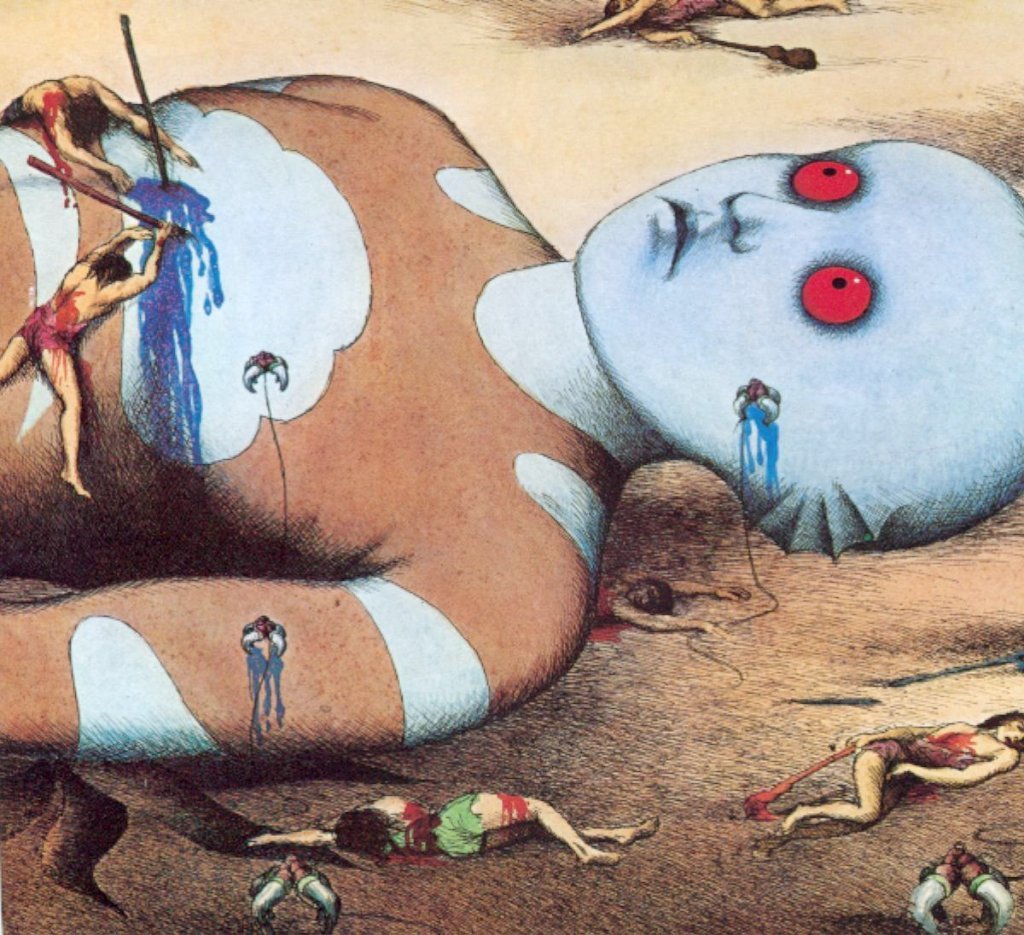
The Oms take down a giant Draag in Laloux’s surreal animated feature “Fantastic Planet” (1973). A joint production between France and the former Czechoslovakia, it’s Cold War politics are neatly embedded in the science fiction tale.

One of my earliest exposures to the technique of paper cutout animation was the feature-length science fiction film La Planète Sauvage, (“Fantastic Planet”, 1973), a collaboration between the French director René Laloux, writer/artist Roland Topor and a team of Czech animators at Jiří Trnka Studio. The sophistication of the paper cutout technique is astounding, and the visual style unique and thoroughly memorable. There’s quite a good synopsis of this film, accompanied by several screen shots, at the Twitchfilm blog which I would recommend. The author of this blog ends her/his post with a paragraph about the “adult” content of this film. It is, most assuredly, aimed at an adult audience, and I particularly enjoyed this author’s summary of the many and varied deaths the Oms faced in Laloux’s La Planète Sauvage:

In case you didn’t suspect it yet: this is not exactly a children’s film. Eureka (or rather the BBFC) rates this DVD “PG” but the film was clearly made with adults in mind. Some Draags wear very revealing outfits while the humans are naked, half-naked or wearing rags. Mating rituals of both humans and Draags are shown, but far more disturbing is the seemingly unending variety in which the tiny humans keep getting eaten, squashed, shredded, poisoned, radiated and stomped on by both Draags and the local flora and fauna. — Twitchfilm blog