The art of Hannah Wilke: ‘Feminist Narcissism’ and the reclamation of the erotic body.

I wrote the following essay on American visual artist Hannah Wilke for an art history class in graduate school. I include the full text and images, excluding citations. If you’re a student who discovers this via search engine, then I have every confidence in your research abilities to track down the scholarly sources. Wilke was a seminal Second Wave feminist artist whose work has received renewed interest from scholars since her death in 1993.

The politics of inclusion that shaped feminist discourse in the 1960s and 1970s spawned a legacy of body-based performance art, much of which was associated with women artists who used their own face as a subject of continual exploration. The self- imaging of women artists such as the provocative American artist Hannah Wilke was frequently attacked and dismissed by art critics as being indulgent exercises in narcissism that only served to reinforce the objectification of the female body. The charge of narcissism leveled on Wilke and her work may have been warranted, however, this should not be considered as a pejorative. Rather, the narcissism of Wilke can be viewed as a shrewd feminist tactic of self-objectification aimed at reclaiming the eroticized female body from the exclusive domain of male sexual desire. The ‘self-love’ of narcissism is a necessary component to this reclaiming of the body and the assertion of a female erotic will as being distinct from that of the male artist. Wilke wielded her narcissistic self-love as a powerful tool of critique, defiantly placing her own image into the hallowed halls of the male-dominated art institution.

The term “narcissism” derives from the ancient Greek myth of Narcissus, a beautiful but arrogant youth who cruelly spurned the love of his admirers. For his cruelty, he was cursed by the goddess Nemesis and fell in love with his own reflection in a pool of water. The doomed Narcissus pined away for his unattainable lover – the image of his own self – and literally died as a result of his amorous longing.

Sigmund Freud bestowed the name of this mythic Greek youth upon his psychoanalytic theory of narcissism, a theory that describes normal personality development. According to Freud, the self-love of narcissism is a normal complement to the development of a healthy ego. Whereas a certain amount of narcissism is desirable, an excess of self-love is considered dysfunctional and indicative of pathology. This latter definition of narcissism, the one of pathological self-absorption, has cast our current understanding of narcissism in a negative light and reinforced the use of the term as a pejorative.

The psychoanalytic theories of Freud suggest that negative or pathological narcissism is a specifically female perversion. Art critic Amelia Jones writes that “[d]rawing loosely on Freud’s definitions – which connect narcissism to both a stage of development and to a form of homosexual neurosis – narcissism has come in everyday parlance to mean simply a kind of “self-love” epitomized through woman’s obsession with her own appearance.” Hence, the charges of narcissism leveled on Hannah Wilke were attempts by the critics to summarily dismiss her work as mere manifestations of a woman’s obsessive self-love and infer, according to Jones, that Wilke’s art was not “successfully feminist.”

Critics such as Amelia Jones and Joanna Frueh have championed Wilke and proposed, through their respective writings, a new and positive view of narcissism as a legitimately feminist, subversive tactic in the making of art. In her catalogue essay entitled “Intra-Venus and Hannah Wilke’s Feminist Narcissism”, Jones contextualized Wilke’s work within the framework of her “radical narcissism” and argued that the use of her own image throughout her art is far from the conventional or passively ‘feminine’ depiction of women as seen in advertising and other forms of mass media. Joanna Frueh, in her essay that accompanied the 1989 Wilke retrospective in Missouri, equated Wilke’s “positive narcissism” with a form of feminist self-exploration and an assertion of a female erotic will. Both Frueh and Jones cogently argue for a “positive narcissism” that expunges itself of the negative connotations of Freudian psychoanalytic theory and, in contrast, actively and unapologetically engages in self-love. Wilke enacts an aggressive form of narcissistic self-imaging that defiantly solicits the patriarchal gaze which she then, as Jones writes, “graft[s] onto and into her body/self, taking hold of it and reflecting it back to expose and exacerbate its reciprocity.”

Fig. #1. Hannah Wilke. "S.O.S. Starification Object Series: An Adult Game of Mastication". Mixed media (artist's multiple). 1974-75.

Wilke’s active solicitation of the “male gaze” as a method of feminist critique is best exemplified in her photographic series entitled S.O.S. Starification Object Series: An Adult Game of Mastication (figs. 1-2), a series which had been originally produced as a box-set artist’s multiple for the 1975 exhibition “Artists Make Toys” at the Clocktower in New York. Wilke commissioned a commercial photographer to capture her semi-nude self-portraits in which she adopts the exaggerated postures of the celebrity and fashion industries. In one such photograph, a sunglass-wearing Wilke clutches her Mickey Mouse toy tight to her partly naked torso as she gazes off-camera at an imaginary paparazzi. She assumed the role of the celebrity art “star” suggested by the witty wordplay of her title S.O.S. Starification Object Series. As with many of Wilke’s titles – for she was fond of linguistic games and frequently engaged in puns – there is a double meaning to be found in the titular pun “starification.” Wilke dotted her own skin with several tiny vaginal sculptures that she had shaped from chewing gum. These small sculptures decorated her body in a manner recalling the practice of ritual scarification employed by certain African cultures as a means of beautification. Given the presence of the vaginal “scars” in combination with the sexy, glamourous black and white photographs of Wilke, it is not difficult to locate the artist’s critical stance on the occasionally painful regimens Western women inflict upon themselves in their conformity to accepted conventions of beauty. Wilke willfully submitted her own body to this ritualized, albeit pretend, self-abuse in order to address this “tyranny of Venus” which, as Susan Brownmiller writes in Femininity, “…a woman feels whenever she criticizes her appearance for not conforming to prevailing erotic standards.” The fact that Wilke herself was, by these same erotic standards, a beautiful and sexually desirable woman does not confuse her aim of critique but rather serves to strengthen her commentary on women’s roles and gender stereotypes. Her overstated, sultry expressions and postures of sexual display invite scrutiny. Wilke was keenly aware of her status as a celebrity art-star as well as a beautiful, eroticized object of desire and she capitalized on both with the S.O.S. Starification Object Series. The original dissemination of this photographic series in a packaged box set, complete with sticks of chewing gum, preformed gum vaginas and phalluses, and the semi-nude artist self- portraits, simultaneously commented on both the artist-celebrity as a commodity as well as the erotic consumption of the female body. Cleverly, Wilke underscored the erotic self-objectification of her image in the extended title for this box set multiple: S.O.S. Starification Object Series: An Adult Game of Mastication. We are reminded that this is an adult game, and Wilke’s use of the word mastication in reference to chewing (gum) is likely a pun on masturbation, a suggestion that locates her eroticized self-portraits on the parameters of pornography.

Fig. #2. Hannah Wilke. "S.O.S. Starification Object Series: An Adult Game of Mastication". Detail. Mixed media (artist's multiple). 1974-75.

Assimilating the visual language of the objectified female body, Wilke employed her own eroticized body as a metaphorical mirror that she then held up to reflect back the sexual projections of male desire. This act of reflection enabled Wilke to sever her passive (and traditionally female) receptiveness of this male projection and assert her own erotic will. In her collection of essays entitled Erotic Faculties, Joanna Freuh used the phrase “autoerotic autonomy” in reference to Wilke’s images and suggested that her “…self-exhibition may demonstrate the positive narcissism – self- love – that masculinist eros has all but erased.” The empty vessel that is the celebrity or the fashion model – devoid of a personal will as she functions as a receptacle for our projected desires – has been adopted and systematically absorbed by Wilke’s exaggerated poses. For her part, Wilke then engaged her narcissistic self-love as a means to fill these empty vessels with her aggressive sexuality. The sites of female erotic pleasure, namely the mouth and the vagina, are conjured in her chewing gum sculptures while, at the same moment, they hint at the violent aggression of the folkloric vagina dentata.

The consciously sexualized self-objectification of Wilke and the use of her own body as a “professional currency” often elicited harsh criticism from the ranks of feminism, an ideology to which she actively subscribed. Lucy Lippard, the champion of 1970s feminist art, famously wrote that Wilke’s “confusion of her roles as beautiful woman and artist, as flirt and feminist, has resulted at times in politically ambiguous manifestations that have exposed her to criticism on a personal as well as on an artistic level.” Art critics Judith Barry and Sandy Flitterman dismiss Wilke’s self-portraits: “In objectifying herself as she does, in assuming the conventions associated with a stripper, …Wilke…does not make her own position clear…It seems her work ends up by reinforcing what it intends to subvert…” The tense political climate and rapid social change of America during the decades of the 1960s and 70s fueled a radical activism amongst Second Wave feminists. The urgency felt by these activists to affect social change in relation to gender equality frequently generated a feminism that was fervent, even orthodox, in its ideology. This strict orthodoxy was shaped by anti- essentialism – a philosophical stance that rejected the representation of the female body as it was believed too imbued with a history of objectification by male artists – and therefore unable and unwilling to accommodate the sexualized body-based art of Hannah Wilke. The negative reception of Wilke by critics like Lippard, Barry and Flitterman may have been prompted by an adherence to this strict orthodoxy. The complex and ambiguous views of the body and female sexuality that Wilke presented, at times even contradictory to the aims of feminism, generated rancor in this inflexible climate of anti-essentialism.

In her 1978 interview “Artist Hannah Wilke Talks with Ernst” the artist unapologetically spoke of the “ethics of ambiguity” that characterized both her work and life. She addressed, in her honest and unmediated manner, the conflicted views of a woman who, though conscious of feminism, still felt concerned with her appearance and desirability to men. Rather than deny this impulse, Wilke embraced her feminine narcissism and brandished it as a weapon. Such a bold act of defiance and deliberate provocation against the anti-essentialist feminism that dominated the 1960s and 70s later established Wilke as the “…spiritual parent to postfeminist artists such as Tracey Emin…” and anticipated the self-imaging of Janine Antoni and Cindy Sherman.

Fig. #3. Film still from Carolee Schneemann’s ‘Fuses’, 1965.

Wilke was not the only woman artist of her generation to use her own body in a consciously sexualized manner, nor was she the only artist to engage with narcissism as a feminist tactic. Carolee Schneeman’s canonical 1965 Fuses (fig. 3), a film that included photographic footage of the artist having sex with her then-partner James Tenny, was greeted with outrage from the feminist audience who, as film theorist Shana MacDonald writes, “…[were] uncertain how to incorporate the sexualized, erotic and self-produced image provided by Schneemann” Similar to the harsh criticisms leveled on the photographs of Wilke, the erotic self-portraiture of Schneemann’s Fuses was frequently attacked as being “obscene and narcissistic.” According to MacDonald, it was her sexually graphic imagery – imagery that feminist theorists found indistinguishable from the objectified female image being resisted – that caused Schneemann to be misunderstood by her peers and ultimately marginalized.

As the coquettish semi-nudes of Wilke’s S.O.S. Starification Object Series made reference to imagery generated for pornographic use, so too does Schneemann’s Fuses address pornography in order to critique its traditional objectification of women. The repeated, non-linear narrative of Fuses interrupts the pornographic convention that the film necessarily terminate in the obligatory “cum shot” of male ejaculation. The sexuality communicated by Schneemann’s film is highly subjective and anchored in the banal reality of the everyday, including shots of the artist’s cat and the domestic surroundings of her home. The subjectivity of Fuses was further heightened by the literal mark of the artist, evidenced in Schneemann’s use of hand-processing techniques such as collage, painting and scratching directly onto the celluloid. Her infusion of a personal subjectivity performed as a feminist resistance against the sexual- objectification of the female body as seen in conventional pornography. By simultaneously inhabiting the roles of both the image and the image-maker, she positioned herself “not as sex object, but as willed and erotic subject, commanding her own image.” Schneemann’s urge to see her own sexualized image is a manifestation of self-love and the hypothesized “positive narcissism” of Jones and Freuh. As Narcissus romantically yearned for his own image, Schneemann desires to view her own erotic image, not reflected in a pool of water, but projected larger-than-life on the theatre screen. This act is a bold assertion of her narcissism and erotic will.

Fig. #4. Video still from Hannah Wilke’s ‘Gestures’, 1974.

At first glance Wilke’s S.O.S. Starification Object Series, much like Schneemann’s Fuses, appeared to reinforce the visual language of the objectified female body. The sultry eyes, seductively parted lips and naked breasts of Wilke read as cultural signifiers of female sexual invitation and availability. Lippard may have been correct in her observation that Wilke played both the “feminist and flirt” but her assessment that this polarity stemmed from her confusion over these two roles was essentially wrong. Wilke’s narcissistic self-imaging was not, as Elizabeth Hess charged, an impulse to “…wallow in cultural obsessions with the female body,” but a pointed feminist critique of these same obsessions. In contrast to fashion models and pin-up girls, who passively offer their flesh to be inscribed by male desire, Wilke interrupted this erotic exchange by the presence of her chewing gum “scar” sculptures. Recalling the artistic intervention of Schneemann’s hand-processing techniques in Fuses, Wilke’s sculptures mark the otherwise unblemished surface of her skin and disrupt the easy consumption of her body as an erotic object. She declared the canvas of her skin as the terrain of her own erotic expression, and marked it accordingly. Whereas the youth Narcissus failed to possess his own beloved self-image, Schneemann and Wilke are too shrewd in the deployment of their narcissism to suffer this same fate.
Women artists of the late 1960s and 1970s, such as Schneemann and Wilke, often engaged in the feminist project of reclaiming the female body from previous male privilege. Centuries of depiction by exclusively male artists had rendered the female nude a dehumanized, neutral object. Wilke and her feminist contemporaries sought to rectify this situation by seizing creative control over one’s own body. Performative works such as Wilke’s 1974 Gestures (fig. 4) – a video that featured the artist sculpting her flesh – enact this reclamation by proposing the artist’s own body as an artistic medium.

The thirty-minute black-and-white video Gestures showcases Wilke, her head and shoulders tightly framed, performing a series of repeated, often exaggerated gestures and facial expressions. These gestures are often absurd and comical in nature, while others verge on sexual seduction. A silent Wilke gently pulls and kneads her own face, manipulating her youthful, elastic skin much like the soft, putty-like material of her chewing gum sculptures. Saundra Goldman observed that Gestures “…signaled [Wilke’s] transition from sculpture to performance,” and there is a cyclical component to this transition: the soft, pliable chewing gum that Wilke employed to approximate flesh was now being mimicked by the artist’s own skin.

Fig. #5. Hannah Wilke. ‘I OBJECT: Memoirs of a Sugargiver, 1977-78.

The reclamation of the female body from the privileged control by male artists was the primary motivation behind Wilke’s photographic diptych entitled I OBJECT: Memoirs of a Sugargiver (fig. 5). Wilke’s strong objection was directly aimed at the father of the avant-garde, Marcel Duchamp. While the box set of S.O.S. Starification Object Series offered a critical view of consumerism, the fashion industry and pornography, and Gestures a declaration of control over one’s own body, the faux book jacket of I OBJECT was a direct response to Duchamp’s static rape victim of his infamous diorama Etant donnès (fig. 6). In her 1988 conversation with Joanna Freuh, Wilke stated: “I find Etant donnès repulsive, which is perhaps its message. She has a distorted vagina.” The pun contained in the title I OBJECT, with the play on the word “object” as both noun and verb, laid the foundation for the critical feminist dialogue Wilke embarked upon with this heavy-weight of art history.
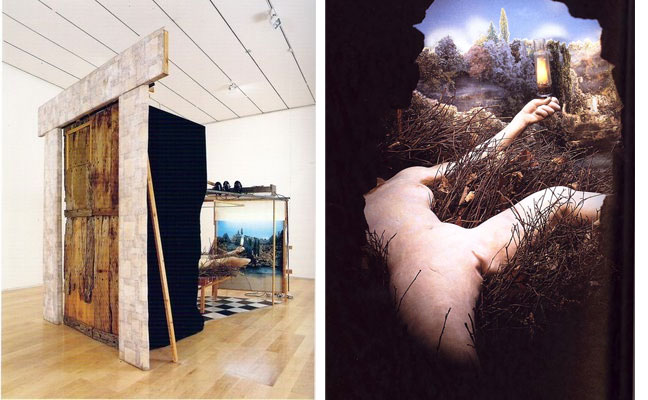
Fig. #6. Marcel Duchamp. ‘Etant donnès’. View of installation (left) and detail (right). 1946-66.

The sculptural diorama Etant donnès confronts the viewer with a rustic wooden door, riddled with small holes. A light source shines through these holes, enticing the viewer to peek through and witness a scene hitherto concealed. A pastoral, natural landscape is suddenly revealed, in the foreground of which an alarmingly pale, naked female torso lies inert amongst a bramble of dried twigs and leaves. Her legs are splayed open to reveal her strangely misshapen vagina. The exposed nakedness of the woman, her corpse-like stillness and her derelict location amongst the bramble imply violation and victimhood. As if in a final gesture of violence, Duchamp has chosen to frame the woman’s image within the peepholes of the door in such a manner as to visually decapitate her. The mechanism of display – namely the peepholes through which the scene is revealed – forces the viewer to assume the role of voyeur, further compounding the violation of the woman.

Wilke’s I OBJECT functions as both homage and a critical response to Duchamp: she believed that “to honor Duchamp is to oppose him.” Taken while on a family vacation in Spain, the glossy colour photographs of Wilke show the artist, fully nude, lying atop some discarded clothing on a large, craggy rock. One of the photographs that comprise this diptych approximates the pose of Duchamp’s female torso, with Wilke’s body foreshortened in the camera lens so that her pubic region dominates the picture plane. In stark contrast to the deathly paleness of the woman in Etant donnès, Wilke appears whole-limbed, healthy and tanned. The clothing upon which she lies may have been voluntarily shed in a moment of spontaneous sexual activity, or simply in the act of sunbathing. A bottle of suntan lotion that lies nearby seems to support the latter. The second photograph of the diptych shows Wilke staring upwards at the camera, and directly at the viewer, her face partly concealed by a rocky outcropping. A small but satisfied smile adorns her face. The superimposed text reads “I OBJECT: Memoirs of a Sugargiver” across the upper left portion of the image and then “Hannah Wilke” on the lower left, in close juxtaposition to her smiling face. The presence of her written name paired with her direct, outward gaze reads like a radical declaration of personhood, as if to say I am Hannah Wilke, and here is my body. The feminist gesture of “positive narcissism” comes strongly into play in this particular context. Wilke’s feminist response to the faceless victim of Etant donnès is a bold affirmation of both her personhood and her female sexuality.

As previously mentioned, the close association of women to narcissism partly derives from a loose interpretation of Freudian theory that linked a “woman’s obsession with her own appearance” with a form of psychoanalytic pathology. This association is highly relevant in the critical reception of a work of art; a crucial factor to consider is the gender of the artist. Lucy Lippard, the same art critic who, ironically, dismissed Wilke for being a “feminist and flirt”, denounced the gender divide that existed between the reception of body-based performance work created by male artists against similar work produced by women. “She is a narcissist,” Lippard wrote of women artists, “and Vito Acconci with his less romantic image and pimply back, is an artist.” The crucial distinction between the narcissism of Vito Acconci and Hannah Wilke – for as Rosalind Krauss effectively argues in her essay “Video: the Aesthetics of Narcissism”, Acconci was most assuredly a narcissist – lies in the feminist agenda that fuelled the narcissism of Wilke.

Fig. #7. Video still from Vito Acconci's ‘Undertone’, 1972.

Vito Acconci’s performance-based work often contains ambiguous narratives that frequently wander into the territory of the absurd and contradictory. Much like his contemporary Hannah Wilke, Acconci primarily used his own body as an artistic medium. In his 1972 video entitled Undertone (fig. 7), Acconci is as conspicuously aware of performing as Wilke was of posing in her multitudinous self-images. Undertone begins with Acconci seating himself at a table, the opposite end of which extends in the direction of the camera. This arrangement immediately implicates the camera/viewer into the scene. Acconci closes his eyes, placing his hands on his thighs, and repeatedly mumbles an awkwardly confessional sexual fantasy involving an imagined woman who lurks beneath the table: I want to believe there’s a girl here under the table…who’s resting her hands on my knees…she’s resting her forearms on my thighs…slowly, slowly rubbing my thighs… After several repetitions of this fantasy, Acconci suddenly pauses, straightens his body and stares directly out at the camera/viewer. His hands, now resting on the table top, are clasped together in a pleading gesture while he repeatedly intones: I need you to be sitting there…facing me…because I have to have someone to talk to…so I know there’s someone there to address this to… Acconci proceeds to again close his eyes and place his hands beneath the table. Resuming his mumbled confession, he contradicts his original narrative by stating: I want to believe there’s no one under the table…I want to believe…it’s me that’s rubbing my thighs… The video concludes with a final plea to the viewer to witness the revelation of his fantasy.

Comparable to the revealing titles of Wilke, the layered meanings behind Acconci’s title Undertone provides an important clue to its interpretation. The Concise Oxford Dictionary defines the word undertone as an “underlying quality; undercurrent of feeling.” The underlying theme of Acconci’s video is not found in his repeated sexual fantasy of the imaginary woman under the table – a fiction that his monologue later negates – but rather in his urgent plea directed at the viewer. Acconci compels the viewer to witness his confessional fantasy and thus, by acting in this capacity, participate. A necessary reciprocity exists between Acconci’s performance and the viewer’s reception of this fictitious fantasy. A fruitful comparison can be drawn between Acconci’s Undertone and Wilke’s Gestures video. The performance of Acconci is validated by an exchange with the viewer in the same manner as the poses of Wilke require an onlooker. Equally, both artists achieve a form of sexual power through their performative actions. The crucial difference lies in gender. Even as the awkward disclosure of the fantasy ostensibly renders him vulnerable, Acconci nonetheless seizes sexual control. He punctuates the revelation of his fantasy by a vigorous and masturbatory rubbing of his own thighs, a gesture that creates an uncomfortable tension in the viewer who has been manoeuvred into the place of the voyeur. His repeated pleas to the viewer to witness recall the dynamic of the sexual exhibitionist who requires an onlooker to fulfill his perversion. Acconci enacts his narcissism by forcing his passive-aggressive sexuality upon the viewer.

In the video Gestures, Wilke systematically performs the postures of female display. She seductively rubs her finger across her upper lip. With the practiced smile of a fashion model, she repeatedly tosses her long hair in simulation of a shampoo commercial. Isolated from their usual context of seduction or advertising, these gestures appear absurd – which is entirely Wilke’s point. By repeatedly and methodically performing these gestures, she empties them of meaning. As a young, desirable woman Wilke understands that sexual display is the currency of her power. As a feminist, she acknowledges that these same gestures reduce her to a mere sex object. There is an implicit solicitation of the viewer to witness Wilke’s repetitive actions in much the same manner as Acconci’s Undertone requests participation with his narrative. Their respective sexual power – Wilke as the female sex object and Acconci as the male sexual exhibitionist – require the gaze of the viewer to activate this power exchange.

The deliberate self-objectification of Hannah Wilke seems, in the context of contemporary art practice, very prescient indeed. A consummate agitator and provocateur, her legacy of complex and eroticized body-based art anticipated the work of numerous future women artists whose creative point-of-departure was their own visage. While her work may have been devalued by feminist critics of her generation, a renewed interest from the ranks of feminist scholarship has emerged since her untimely death from lymphoma in 1993. Wilke and her feminist colleague Carolee Schneemann, who worked similarly with erotic self-portraiture, shrewdly engaged with the self-love of positive narcissism to reclaim the erotic female body from the objectification of the male gaze. Fully comfortable within her own skin and embracing all of her very human contradictions – as an artist, a feminist and a woman – she skillfully commanded her own image, both in front of and behind the camera.

Horror Films 101: Nothing says “Merry Christmas” like a creepy Canadian slasher flick.

An often overlooked classic, the 1974 Canadian film Black Christmas now enjoys a cult status amongst horror fans and critical acknowledgment as being the progenitor of  the “slasher” genre that dominated horror cinema in the late ’70s and throughout the 1980s. Directed by Bob Clark — best known for his raunchy teen sex comedy Porky’s (1982) — the film boasts an enviable list of talented Canadian actors: Margot Kidder, Keir Dullea (yes, that’s “Dave” from Stanley Kubrick’s 2001: A Space Odyssey), John Saxon and comedienne Andrea Martin. The film stars Olivia Hussey, a British actress who’s most frequently recognized for her role as “Juliet” in Franco Zeffirelli’s 1968 film adaptation of Shakespeare’s Romeo & Juliet. In Black Christmas, Hussey leaves the Elizabethan poetry behind and gets her “scream queen” on.

Lynne Griffin gets all wrapped up for the holidays in Bob Clark’s 1974 cult slasher film “Black Christmas.” Apologies in advance for the bad pun.

It’s important to note that Black Christmas predates the better known slasher films like John Carpenter’s Halloween (1978) and Sean S. Cunningham’s Friday the 13th (1980). Although the latter are arguably better films, they owe a great debt to Clark’s film. The quote below from Wikipedia concisely captures this film’s current cult status:

The film gained a fairly decent cult following over the years of its release, and has been praised by fans of the slasher film genre internationally. The Black Christmas fan site has considerably increased the film’s popularity over the years. The film ranked #87 on Bravo’s 100 Scariest Movie Moments for Lynne Griffin’s infamous plastic sheeting scene. During an interview regarding the film, Olivia Hussey met Steve Martin at an industry event and he brought up the fact that she starred in one of his favorite movies of all time. Hussey thought he might have referred to her work in Romeo & Juliet, but was surprised to hear from Martin that it was Black Christmas, which he claimed to have seen 25 times.

Below is a wonderfully creepy clip, featuring an uncomfortably prolonged obscene phone call from the psycho-killer. There is a prodigious use of the word “c*nt” in the following sequence, so consider yourself warned. Oh, and Merry Christmas.

Enhanced by Zemanta

Calamari Love: the curious tradition of Japanese ‘tentacle erotica.’

Katsushika Hokusai, "The Dream of the Fisherman's Wife," 1814.

Tentacle…what? Yes, indeed. In the realm of sexual fantasy, any and all things that can be imagined are possible. Like, for instance, receiving cunnilingus from an obliging octopus, as depicted in the above image by renowned artist Katsushika Hokusai. Known in the West by the title The Dream of the Fisherman’s Wife, Hokusai’s print is one of the most celebrated examples of shunga (erotic art) from the Edo Period in Japan. According to a scholarly paper written by Danielle Talerico, the Edo audience would have clearly recognized Hokusai’s woman as a depiction of the female abalone diver Tamatori. In the legend, Tamatori steals a jewel from the Dragon King. However, during her egress, the Dragon King and his sea-life minions — including octopodes — pursue her. Evidently, once the minions successfully capture Tamatori, some sexy-time ensues.

The more contemporary version of Japanese ‘tentacle erotica’, known as shokushu goukan, is a darker, violent and sadistic cousin of the gentler, Edo-period erotica. In 1986, manga artist Toshio Maeda created his infamous series Demon Beast Invasion, which featured malevolent tentacled aliens who embark upon a cross-breeding campaign with human females in a bid to rule the Earth. Essentially, Maeda’s rather thin plot-device afforded him the excuse to stuff a large number of phallic ‘tentacles’ into a great many female orifices. The reason for the reliance on tentacles was simple. Until 1993, Japanese law prohibited straightforward depictions of penises and intercourse. So Maeda was obliged to come up with a substitute: tentacles.

So, there you have it. I bet you’ll never look at a plate of deep-fried calamari in quite the same way again.

…to which Red Riding Hood replied, “I prefer my men hairy, but housebroken.”

Amanda Seyfried stars in Catherine Hardwicke’s latest cinematic offering "Red Riding Hood" (2010). Seems a lot like Hardwicke's other franchise "Twilight," only with more fur.

The popular children’s story Little Red Riding Hood began, as many such fables do, as a cautionary tale aimed specifically at young girls. The red-hooded protagonist is instructed by her mother “not to stray from the path” as she ventures forth to deliver food to her ailing grandmother who lives alone in the woods. Along the way, she famously encounters the Big Bad Wolf —  and thus begins a succession of overtly sexual metaphors. In the earliest known printed version of this story, authored by Charles Perrault, the disguised Wolf tricks Red Riding Hood into removing her clothes and climbing into bed with him, at which point he “falls upon” her and she is devoured. To ensure that the moral of his tale was not lost upon his young readers, Perrault offered this sermon at the end of his text:

From this story one learns that children, especially young lasses, pretty, courteous and well-bred, do very wrong to listen to strangers, And it is not an unheard thing if the Wolf is thereby provided with his dinner. I say Wolf, for all wolves are not of the same sort; there is one kind with an amenable disposition — neither noisy, nor hateful, nor angry, but tame, obliging and gentle, following the young maids in the streets, even into their homes. Alas! Who does not know that these gentle wolves are of all such creatures the most dangerous!

Well, so much for subtlety. Thus, from it’s earliest incarnation, this was a moralizing tale that warned young girls not to succumb to wild, carnal desire. Modern interpretations of this story, however, replace the traditionally naïve heroine with an empowered one. The best known of these ‘revisionist’ versions is Angela Carter’s 1979 short story The Company of Wolves, in which the Wolf is reconfigured as a werewolf — a wolfman seducer with whom Red Riding Hood engages in consensual sex. Carter’s version of the sexually-awakened heroine was adapted to screen by Irish filmmaker Neil Jordan in 1984. Jordan’s The Company of Wolves is a gorgeous — though flawed — gem of a film. Although the narrative of Jordan’s film wanders to the brink of incoherence, the journey is a visually rewarding one. My favourite scene from The Company of Wolves is the initial meeting between Rosalind (the Red Riding Hood character) and the elegant, mysterious Huntsman whom she encounters in the forest. Admittedly, the guy who portrays the Huntsman was not cast for his stellar acting ability. But then, who’s looking at his acting…?

Horror Films 101: Movie moments that traumatized my childhood.

A still from the animated film version of “Watership Down,” showing the last, terrified moments of a rabbit’s life.

1. The destruction of the rabbit warren and wholesale slaughter of its occupants in the 1978 film adaptation of the Richard Adams novel Watership Down. The filmmakers did not shy away from the darker shadings of Adams’s novel,  and the violence contained in the source material appears, quite graphically at times, on screen. The scene of the warren destruction is rendered in an abstracted fashion, but is nonetheless effective in conveying the horror of the rabbit massacre. Walt Disney, this ain’t.

The ‘demon face’ was that of Eileen Dietz, who also starred in Happy Days and General Hospital. Oh, what a little make-up and effective editing can do.

2. The freaky demon face that flashes on-screen in William Friedkin’s 1973 horror classic The Exorcist. In the (far superior) original theatrical release of the film, this ‘demon face’ only appears twice: once, during the nightmare sequence of Father Karras, where he envisions his elderly mother standing at the top of a stairway leading down to the NYC subway; and lastly, during Regan’s exorcism. Each time, the face only flashes on-screen for mere seconds — just enough time to burn onto your retina and torment you for the rest of your days. According to the trivia section of imdb.com, the ‘demon face’ was supplied by the actress Eileen Dietz, who also stood in as a body-double for Linda Blair in a couple of scenes. In the  director’s cut of the film (released in 2000), the face appears with considerably greater frequency, diluting its impact.

“Let me in, Mark…screeeetch….screeeetch…let me in…”

3. The vampire kid scratching on his friend’s bedroom window from the 1979 made-for-TV adaptation of Stephen King’s novel Salem’s Lot. Director Tobe Hooper, best known for his masterpiece of the macabre The Texas Chainsaw Massacre, fully understands the dark, seedy underbelly that lies just beneath the surface of small town, white-picket-fence America. Few directors — other than, perhaps, David Lynch — have as great an insight into the ‘suburban Gothic’. The vampire of Hooper’s film is not a romantic seducer but, in keeping with the German Expressionist tradition of F. W. Murnau’s Nosferatu, he’s a ghoulish, hideous monster with a taste for the blood of children. This scene with the undead child paying a nighttime visit to his former playmate scared the bejeezus out of me when I was a kid. It was, in part, the awful sound that his fingernails made as he scratched the glass, beckoning to his friend to open the window.

4. Ben Gardners’s head suddenly appearing through the smashed hull of his sunken boat in Steven Spielberg’s 1975 masterpiece Jaws. Even though, as an audience member, you know exactly what Richard Dreyfuss is about to stumble across, I betcha it’ll still make you jump.

5. The terrifying tale of Large Marge from Tim Burton’s 1985 Pee-wee’s Big Adventure. No, seriously. It’s a creepy — and classically Tim Burton — moment. Just tell ’em Large Marge sent ya.

Preface & Chapter One: A Sense of Nostalgia

For many years, I was satisfied by the simple act of drawing. While a number of my colleagues relied on computer software or other technologies to produce their art, I rejoiced in the analog. Aided by a pencil and a facility for drawing, I was limited only by my imagination when creating fantastical worlds between the borders of my paper. And then, one day, I wondered how my fantastical worlds would appear were they freed from their paper borders and delivered into our three-dimensional world.

Tatebanko is the Japanese art of creating dioramas and scenic perspectives from paper. It was popular and widely admired from the 17th century to the early 20th century.

The desire to see my drawings projected into space began, nearly two years ago, with a moment of pure serendipity. While checking my email, an advertisement for an ‘arts & crafts’ store landed in my inbox that offered Japanese paper dioramas for sale. These paper dioramas – known as tatebanko in their native land – are small boxes containing flat, printed paper elements that are folded and glued into miniature tableaux. I grew instantly curious. The shallow relief of the tatebanko provided the perfect stage upon which to mount my drawings and project them into space. As an artist who also works in print media, I could use printmaking techniques to generate multiples that could be cut out, folded and glued. I decided that the box diorama was an obvious next step in the evolution of my hitherto two-dimensional art practice, enabling me to consider space and volume with relative ease.

In the months that followed my virtual encounter with the tatebanko boxes, my project grew in both size and scope. My initial concept of a box diorama expanded into the much larger and more complex construction of a dollhouse, a toy fondly remembered from my childhood. Revisiting the dollhouse in adulthood, myself a parent, has proven a psychologically rich and poignant exercise. In stark contrast to the innocuous role-playing of childhood – when one could ‘play Mommy’ – as an actual parent, the actions I take have real life consequences. This simple fact can, at times, be the cause of anxiety. Additionally, while the household provides a peaceful refuge from the hectic pace of the outside world, the daily negotiations between career aspirations and familial responsibilities simultaneously render the house a site of friction and conflict. An exploration of the conflicts that arise from these competing interests was, in part, the impetus behind my dollhouse project.

Domestic conflict aside, the physical construction of the dollhouse presented the greatest degree of friction and conflict during its creation. Not being a sculptor or an individual with any discernible building skills, working with three-dimensional materials proved a challenging and, at times, frustrating process. However, rather than enlist the aid of someone more technically proficient, I was stubbornly determined to construct the dollhouse myself. Although this aspect of the project offered the steepest learning curve, it also proved surprisingly rewarding to begin to understand and address the special demands of my chosen building materials. Whereas at the start of this project, I viewed the dollhouse solely as a devise for the display of my drawings, by its conclusion, I gave equal consideration to the dollhouse as an object unto itself. This newly found appreciation for sculptural space was, for me, the most pivotal and profound moment of the creative process.

Yet another surprising discovery was the quality of play I found in working with the cut out lithographs. Having printed multiples of the same drawing meant that I was able to explore different arrangements of the same graphic elements. With my drawings freed from the static plane of the paper, I could experiment with composition, contextualizing and re-contextualizing with each new grouping of images. A folded paper wardrobe in one room, for instance, appears subtly altered when combined with different objects in another room. This quality of ‘play’ not only proved enjoyable, but also highly appropriate given the framework of a dollhouse.

Within the body of this paper, I reveal and discuss the various sources that have guided the aesthetics of my project. These sources – which include the Gothic novel, the horror film, and the art of the Surrealists – have shaped not only this project, but have greatly informed my artistic practice to date. It is to these sources that the Disobedient Dollhouse pays homage.

Chapter One: A Sense of Nostalgia

“A house constitutes a body of images that give mankind proofs or illusions of stability. We are constantly re-imagining its reality: to distinguish all these images would be to describe the soul of the house; it would mean developing a veritable psychology of the house.”
— Gaston Bachelard, The Poetics of Space.

The image that appears in my mind when I meditate on the word “house” is not a recreation of the family home of my childhood, nor is it a straightforward rendering of the house in which I currently dwell. Rather, it is an amalgamation of all the houses in which I’ve lived, blended together with the houses belonging to friends, and the houses I’ve vicariously experienced through films or books. This is the composite house of my dreams, a grand and expansive place with numerous corridors and hidden rooms. The space within my imagined house is infinite in scope. Doors from great hallways lead into small rooms, each presenting more doors which, in turn, lead to progressively smaller rooms, stacked into each other with the artful precision of a Russian matryoshka nesting doll. The endless replication of interiority in my imagined house, unlike that of the nesting doll, has no physical limits. Space as it is experienced through the psyche is boundless. Mine is an oneiric house – a house of dreams – similar in nature to the one conjured by philosopher Gaston Bachelard in his text Poetics of Space, built not from bricks-and-mortar but constructed from layers of memory and experience. According to Bachelard, my every experience with the phenomenon that is “house” is imbued with a deeply personal, psychological resonance derived from the memory of the very first house of my childhood. While I do support Bachelard’s claim that the childhood home is fundamental to the psychological mapping of the oneiric house, I would graft onto his argument the importance of the towers of fairytale castles and the cobwebbed elegance of aristocratic manors that so often provide the setting for Gothic narratives in film and literature. These majestic dwellings, while considerably more grandiose and romantic than the humble home of my childhood, are nonetheless formative to the house of which I dream. The mysterious interior of my oneiric house – the one of endless doors and dark, secret passageways – owe as great a debt to these traditions of literature and film as it does to my own personal, lived-in experience with a physical house. It is this house, this strange amalgam of the real and the fantastic, that I strive to conjure in my project entitled the Disobedient Dollhouse.
Granting form and substance to my house of dreams has proved a daunting task. The infinite space of the dreamscape, with its ever-shifting walls and limitless rooms and doors, defies reproduction in the static world of the real. At best, my aim to is achieve some sort of compromise with the infinite. Thus, I have sought to make this compromise concrete through the creation of a miniature toy house: a dollhouse.

My fascination with dollhouses began, predictably, in childhood. Though I was never fortunate enough to own a dollhouse, I did possess several pieces of plastic miniature furniture that I would fastidiously arrange into rooms. These rooms provided the setting for the domestic scenes myself and my playmates would enact with our dolls – scenes that mimicked the day-to-day household routines of our mothers. This form of play amongst young girls – where we would ‘play house’ and pretend to be ‘the Mommy’ – was not only an imitation of the maternal role as we observed it, but, presumably, constituted a type of practice for our future lives as women. Now, as an adult, artist and mother, I revisit the dollhouse. The idealized view of domesticity that informed my childhood dollhouse is reconfigured by my adult self as a place much more complex, even contradictory in nature. These darker, more nuanced shadings find expression in the ‘gothic’ elements of my dollhouse.

A dollhouse is a gendered space, one specifically codified as feminine. Literary critic Susan Stewart defines the dollhouse as a “discourse of the ‘petite feminine’” that yearns to see itself replicated in a tiny, precious model of perfect domesticity. Developed in the 17th century as an amusement solely intended for adults, it served as a trophy of the wealthy European woman. Given the rise in popularity of dollhouses in 18th century Europe, at a time in history when women’s roles were increasingly confined to the home, it is tempting to draw a correlation between this change in gender-based codes of conduct and the miniature toy house that reinforced a woman’s role as being solely defined by her place within the house. Her fantasy of a microcosm over which she held complete control – in a world in which she held little or no political control  – played out through the choreography of furnishings in her miniature rooms. Unlike the traditional toy object, the staged interiors of the dollhouse were not meant to be manually played with but rather to be “consumed by the eye” as an object of display. As such, the dollhouse was modeled as a shrine to an idealized domesticity, forever unsoiled by the grimy reality of daily living.

A compulsion towards nostalgia often shapes the interior of a dollhouse. Contemporary dollhouses are decidedly not contemporary in their motifs, with the historic splendor of wealthy Victorian homes being the most frequently represented style amongst current dollhouse enthusiasts. As Stewart notes:

“…it is probably not accidental that it is the Victorian period which is presently so popular for reproduction in miniature […] because of that period’s obsession with detail and materiality is so analogous to the miniature’s general functions…”

Nostalgia is characterized by a sense of yearning, either for one’s own past or for an imaginary past located somewhere in history. Yearning constructs a view of the past that is sentimental in nature, and the dollhouse is a manifestation of this essentially romantic construction. There are no shoeless Dickensian street urchins haunting the perimeters of a Victorian-themed dollhouse; these are sumptuous interiors fuelled by fantasy and free of social critique.

A trace of nostalgia can be discerned in my Disobedient Dollhouse, evidenced by the Victorian-style decoration and furnishings, as well as in the clothing worn by some of its inhabitants. An old-fashioned cast iron cook-stove is represented in the kitchen. The parlor room prominently features an upright piano, an entertainment staple in many wealthy Victorian households. The era’s obsession with detail is fully on display in the intricately patterned wallpaper that adorns each room of my dollhouse.

Fig. #1. Odilon Redon. "The Crying Spider". 1881. Lithograph.

Not only do the furnishings and other contents express nostalgia, but the medium by which many of these contents were produced – namely the medium of stone lithography – is itself informed by nostalgia. The printmaking process of stone lithography enjoyed enormous popularity amongst visual artists in the 19th century, particularly during the later decades of that century. Hence, the formal characteristics of the medium carry a heightened association to print-based artwork produced during the Victorian era, particularly amongst fin-de-siècle artists such as Odilon Redon (fig. #1) and Edvard Munch. As a contemporary visual artist, producing a body of work using stone lithography is an especially purposeful act. Against the backdrop of the 21st century digital age, where images can be instantly produced and replicated with the click of a computer mouse, the physically arduous medium of stone lithography – which involves sanding and drawing onto a heavy slab of limestone – is comparatively anachronistic. At a time in history when images can be more easily obtained by photographic or digital means, the act of drawing and reproducing images with stone lithography carries with it a quality of nostalgia. By using this “nostalgic” print technology, my intention is to formally recall the style and design of Victorian art, and in particular the grotesque and macabre imagery of Victorian artists like Redon and Munch.

While a trace of nostalgia is detectible in the Disobedient Dollhouse, a tension also exists in the work that simultaneously disrupts the easy consumption of these same nostalgic images. The word “disobedient” contained in the title summons an image of a stubbornly defiant child who refuses to submit to a higher authority. Against which authoritative structure does my dollhouse rebel? In part, it is the force that drives the nostalgic impulse – the urge to construct a sentimentalized view of domesticity – that compels my dollhouse to revolt. A tactic of subversion has been employed as a means of rebellion. For instance, although the conventional Victorian domestic scene of a woman playing piano has been dutifully rendered, the woman depicted is a hybrid creature with the head of a bird. A chair located in the same room as the bird-headed woman mysteriously sprouts twisted floral vines that snake up the back wall. Gigantic insects infiltrate the room and swarm across the ornate damask wallpaper like a strange, inexplicable virus. These hybrid monsters, giant insects and fantastic vegetal growths disturb the inherent sentimentality of nostalgia and propose a dark, secret world that churns just beneath the veneer of domestic perfection.

[…this is an excerpt from my Master’s thesis on the Gothic aesthetic. For a continuation of this paper, please visit the earlier post “The Gothic House.”]

Lady Lazarus’s Halloween List: Top 10 Best Horror Films of the 2000s.

The past decade of the 2000s — or the Naughts, if you prefer — were an especially good one for the genre of horror. On television, we were treated to blood-soaked series like Dexter and True Blood, and in the movie theatres, the vampires and zombies ran amok. As is customary this time of year, I like to compile a film-geek list relating to horror. Halloween shall soon be upon us, my deadlings. Let’s revel in the macabre and spooky.

Below are my picks for the past decade’s best offerings in cinematic horror.

Shauna Macdonald in “The Descent,” a horror film by Neil Marshall set in the Appalachian Mountains.

1. The Descent (2005). Directed by Neil Marshall. An exceptionally attractive team of female ‘extreme’ spelunkers are coerced by one of their members to venture into a series of previously unexplored caves. So begins the ill-fated journey of The Descent, one that starts with squirm-inducing claustrophobia and eventually leads to the discovery of something much, much more sinister — and deadly.

2. Låt den rätte komma in (2008). English title: Let the Right One In. Director: Tomas Alfredson. Have not seen the recent English-language remake of this stellar coming-of-age vampire story and, quite frankly, I don’t feel the need. This one got it right. From its very first frame, you can feel the tangible ache of loneliness in the main characters, as well as the relentless cold of the Swedish winter.

3. [REC] (2007), Directors: Jaume Balagueró and Paco Plaza. The first two-thirds of this film were somewhat underwhelming for me. Sure, it was a serviceable, well-crafted ‘documentary’-style zombie film, but I’d seen many of its kind before. And then, the main characters unlock the door to that mysterious, (supposedly) uninhabited penthouse apartment. At that moment, this film transformed from a decent zombie-flick into something almost sublime.

The main character Alison is harassed by a vengeful (and apparently indestructible) Gypsy woman in Raimi's 'Drag Me To Hell.' Someone call the Roma People's Deflamation League.

4. Drag Me To Hell (2009). Director: Sam Raimi. A thoroughly enjoyable, gross, hilarious and, at times, truly scary film from the master of the comedy-horror, Sam Raimi. Watch for the scene with the animatronic goat. Hysterical.

5. Ichi the Killer (2001). Director: Takashi Miike. Just when you think that the saturation point for bloody splatter-gore has been reached, along come Japanese directors like Miike to push the limits beyond all previous imaginings. This film, along with Miike’s 1999 offering Audition, is completely unhinged. My major misgiving with Ichi the Killer is its graphic and highly sexualized violence toward women. Misogyny is a regrettably common characteristic in many of this genre’s films — particularly from countries such as Japan. All the same, I would recommend this film to the seasoned horror fan, simply on the basis of its insanity.

The character Kakihara admires the handiwork of Ichi in Miike's 'Ichi the Killer'.

6. À l’intérieur (2007), English title: Inside. Directors: Julien Maury and Alexandre Bustillo. This past decade has witnessed the growth of a strong horror-film industry in France, a country not previously known for films in this genre. Dubbed by some in the media as ‘New French Extremity,’ films such as Maury and Bastillo’s À l’intérieur confront the viewer with images of intense ‘body horror.’  The alone and heavily pregnant Sarah battles with an insane, homicidal intruder wielding impossibly-sharp — and profoundly effective — tailor scissors.

7. Ginger Snaps (2000). Director: John Fawcett. The mythology of the werewolf gets a modern feminist overhaul in this Canadian horror franchise. The hormone-induced lunacy of puberty is cleverly aligned with lycanthropy when the titular Ginger begins menstruation around the same time as she’s bitten by a ‘big dog’ in the forest surrounding her suburban home. It’s hard not to love a film that has as it’s tagline: “She’s got the curse.” Incidentally, the sequel Ginger Snaps 2: Unleashed (2004) was surprisingly good. The third installment, Ginger Snaps Back: The Beginning should be encased in cement, tossed down a mine shaft, and buried for eternity.

One of the feigned 'death scenes' staged by the Fitzgerald sisters. Kids these days.

One of the feigned 'death scenes' staged by the Fitzgerald sisters in 'Ginger Snaps'. Kids these days.

8. Ju-on (2003). English title The Grudge. Director: Takashi Shimizu. Hands-down, my favourite amongst all of the J-horror films I’ve seen over the past decade. And I’ve seen quite a few. The English-language remake is laughable by comparison. Avoid it and seek out the original Japanese film.

9. El orfanato (2007). English title: The Orphanage. Director: Juan Antonio Bayona. With contemporary French horror-film directors so successfully flooding the cinema with blood and viscera, it’s a rare treat to view a relatively subtle, classic ghost story like Bayona’s El orfanato. One of the very few horror films at which I openly wept. The ending is heartbreaking, and wonderful.

Autocannibalism + feminism combine in Marina de Van's disturbing 'In My Skin.'

10. Dans ma peau (2002), English title: In My Skin. Directed, written by and starring Marina de Van, this is a strange, atmospheric and generally overlooked gem of New French Extremity. The main character Esther develops an erotically-charged, cannibalistic fixation with her own body after being disfigured in a freak accident. Ponderously slow in parts, it does offer a unique and interesting premise.

Honourable Mentions:

1. Pontypool (2009). Director: Bruce McDonald.

2. Død snø (2009). English title “Dead Snow.”

3. Bakjwi (2009). English title “Thirst”. Director: Park Chan-Wook

4. Grindhouse Presents: Planet Terror (2007), Dir. Robert Rodriguez.

5. 28 Days Later (2002), Dir. Danny Boyle.

Horror Films 101: Favourite death scenes.

For the past three years, it’s been a pre-Halloween tradition of mine that I compile a geekish list relating to horror films. I’m presently working on 2010’s Halloween list. Doubtless, you are all aquiver with anticipation. Just to whet your ghoulish appetite, here’s a repost of the list I originally created on Facebook last Halloween listing my “Top 5 Favourite Death Scenes from a Horror Film.” Enjoy. Note: NOT FOR THE SQUEAMISH.

5. The death sequence that appears in the first 15 minutes of Dario Argento’s Suspiria is fantastically operatic in its baroque excess. Argento blows his cinematic load early, though, as the rest of this cult classic is fairly lacklustre. The music provided by the Italian prog-rock outfit Goblin, however, is wonderful and fittingly creepy.

4. The death of Captain Rhodes in George A. Romero’s Day of the Dead. This character was such a tightly-wound military jerk-off that you couldn’t help but cheer when the zombies finally got a hold of him.

3. Udo Kier plays a pale, sickly Count Dracula in search of “wergin” blood in Paul Morissey’s adaptation of the legendary vampire story, the Andy Warhol produced Blood for Dracula. Dracula meets his final comeuppance at the end of Joe Dallesandro’s axe in a scene of hilarious, way over-the-top gore. Couldn’t find the entire scene on Youtube but here’s a nifty mash-up with the Pixies that features the end sequence.

2. Final death scene in 1958’s The Horror of Dracula. I adore the films of Britain’s Hammer Studios, a.k.a. the “Hammer Horrors.” Christopher Lee stars as Dracula and Peter Cushing as his earthly nemesis, Van Helsing. Many a Saturday afternoon of my youth was spent watching these classic horror films. The video clip below is of regrettably poor quality, but it’s a fantastic sequence.

1. John Hurt births an alien at the dinner table in Ridley Scott’s Alien. Oh, c’mon, who hasn’t seen this famous sequence?

The horror films I probably won’t watch, and why.

The viewing of a good horror film can, at times, be likened to an amusement park ride. There’s suspense, action, usually a few laughs, and more than a few moments that’ll make you shriek or jump in your seat. At its conclusion, when the evil characters receive their final comeuppance, you’re rewarded with a heady chemical cocktail of endorphins. Thanks for riding Satanic Cannibal Cheerleaders from Outer Space, kids. Please exit to your right.

As a horror film aficionado, I’ve watched and thoroughly enjoyed films that featured copious amounts of gore. I would not classify myself as a gorehound, but neither do I shy away from imagery I know to be disturbing or taboo in nature. These are, after all, the mainstay of horror cinema.

That being said, I do have my limits. Blood, gore and flesh-eating zombies are one thing. Cruelty and sadism that serves no greater purpose in a film than base titillation — that’s quite another. And that is where I draw the metaphoric line in the sand. Whereas the gruesomely authentic torture scenes in Guillermo del Toro’s Pan’s Labyrinth were unpleasant to view, these scenes provided an important counterpoint to Ofelia’s dark fantasy world in which she sought refuge from the very real brutality of her step-father. Torture for its own sake, however, is something I prefer not to witness.

I have compiled a list of films that, quite frankly, I doubt I will ever watch. Then again, never say never…

Film still from “Cannibal Holocaust.”

1. Ruggero Deodato’s infamous Cannibal Holocaust (1980). Filmed with handheld 16mm cameras in a cinéma vérité documentary-style that proved so convincing that the Italian authorities seized it and charged Deodato with making an actual snuff film. No actors were harmed in the making of this film, but several animals (including an unsuspecting sea turtle) were literally butchered and dismembered before the camera. I don’t need to see that. I don’t need to see a woman raped, tortured and impaled to death on a stake, either.

Film still from Pasolini’s “Salò or the 120 Days of Sodom”

2. Salò or the 120 Days of Sodom (1975) directed by the Italian poet, filmmaker and famed provocateur Pier Paolo Pasolini. There’s much critical praise amongst cinema’s illuminati for the films of Pasolini. This one, his last and most controversial offering, was based upon the writings of the Marquis de Sade and Dante’s Inferno. While not officially a horror film, it includes scenes of torture, sadism and sexual depravity so thoroughly disturbing that, according to Wikipedia, “Salò was named the 65th scariest film ever made by the Chicago Film Critics Association in 2006.” Pasolini takes his audience on a merciless and unblinking trip through the Circles of Hell. Suffice to say, the Circe de Merde sounds like an especially unpleasant place.

3. The August Underground Trilogy (August Underground 2002, Mordum 2003, Penance 2007) created by the Pittsburgh-based film production/special effects/design company Toetag Pictures. These are simulated snuff films that, based solely on their description, read like a game of one-upmanship amongst gorehounds. One can just imagine the filmmakers snickering: “Does your film have rape, murder, dismemberment, necrophilia, pedophilia and infanticide? ‘Cause ours sure does…(snicker).” A big, juvenile gross-out contest that I can live without experiencing, thanks.

4. The mondo-style films Faces of Death (1978), and it’s imitators Faces of Gore and Traces of Death. See above.

Gratuitous rape scene from “Irreversible.”

5. Irreversible (2002) directed by Gaspar Noé. A cheap trick by a cheap director who opts for the shock-value and little else. Pass.