My Demon Lover: the mythology of the incubus.

“Inkubus” (photograph, 2005) by contemporary German visual artist Michael Hutter.

The incubus is a demon in male form — the female equivalent is called a succubus — who, according to different mythologies and legends throughout the world, lies upon women whilst they sleep in order to have sexual intercourse with them. In the Middle Ages, belief in demons who sexually preyed on humans assuaged a sleeping person’s shame and guilt over nocturnal emissions and other physical evidence of erotic dreams. Primarily, however, the incubus legend functioned as a convenient means to conceal incest and other types of sexual assault upon girls and women who had no unchaperoned access to men outside the home, but had nonetheless become inexplicably pregnant.

In contrast to the sleeping rape victims of medieval yore, the women that populate the photographic work of contemporary visual artist Michael Hutter are both wide awake and engaged in consensual coupling with their respective incubi. In the sepia-coloured photo-collage entitled Inkubus, a nude woman sporting a 1920’s flapper-style bob receives an amorous lick from the tiny demon lover perched on her shoulder. In The Alien Nurse, the erotic-grotesque combines with Victorian fetishism as a blindfolded “wet-nurse” offers up her breast to a curious intestinal/tentacled alien blob. In subsequent photo-collages, the wet-nurse discovers new and even more intimate uses for the alien tentacle, recalling shokushu goukan or ‘tentacle erotica’ of contemporary Japanese hentai.

“Die Alienamme (The alien nurse)”, photograph, 2006 by Michael Hutter.

The work of German artist Michael Hutter ranges from ink drawings on paper reminiscent of the Victorian kinkiness of Aubrey Beardsley’s Lysistrata, to the retro-inspired photo-collages you see here.  Visit his online gallery to see for yourself, though perhaps not whilst at the office.

“Domestikia: An Account of Some Strange Disturbances”, stop-motion animation project.

My latest creative project is “Domestikia: An Account of Some Strange Disturbances”. Continuing my interdisciplinary approach to artmaking, I have created jointed, movable paper cutouts from my lithographic prints for use in a series of stop-motion animations. This project will include several short stories linked together by an overarching narrative, all taking place within an imagined dollhouse. The narrative is non-linear, so scenes are not “shot” in sequence.

I’ll readily admit to being a complete neophyte when it comes to animation, but thus far I find the process a rewarding one. Painstakingly tedious and laborious, but rewarding nonetheless :-)

Quoth the Raven, ‘Nevermore.’

Open here I flung the shutter, when, with many a flirt and flutter,
In there stepped a stately Raven of the saintly days of yore.
Not the least obeisance made he; not a minute stopped or stayed he,
But, with mien of lord or lady, perched above my chamber door–
Perched upon a bust of Pallas just above my chamber door–
Perched, and sat, and nothing more.

Then the ebony bird beguiling my sad fancy into smiling,
By the grave and stern decorum of the countenance it wore,
“Though thy crest be shorn and shaven, thou,” I said, “art sure no craven,
Ghastly grim and ancient Raven wandering from the Nightly shore–
Tell me what thy lordly name is on the Night’s Plutonian shore!”
Quoth the Raven, “Nevermore.”
— an excerpt from the narrative poem “The Raven” by Edgar Allan Poe. First published in 1845.

In North America and most of Europe, the raven is a bird that symbolizes ill-omen and doom. Due to its jet-black plumage, eerie call and carrion-eating tendencies, the raven and its smaller cousin, the crow*, have haunted the imaginations of mankind from time immemorial. American Gothic writer Edgar Allan Poe famously employed the bird as a harbinger of doom in his poem “The Raven,” an excerpt of which is offered above. The poem tells of a talking raven’s mysterious visit to a distraught lover, tracing the man’s slow descent into madness. The narrator — whom, it’s been suggested, represents Poe himself — mourns the loss of his dead love Lenore. The raven flies into the room through an open window and perches itself (permanently, as it turns out) upon a sculptural bust of Athena that rests above the door. It then proceeds to torment the narrator to the brink of madness simply by repeating the poetic refrain “nevermore” at the end of each stanza. For his part, the narrator engages in a curiously self-defeating game of “20 questions” with the raven, peppering the bird with questions to which — he’s fully aware — it can only answer “nevermore.” In true Gothic tradition, Poe’s “The Raven” is epic, highly theatrical, and steeped in a melancholia characteristic of that literary genre.

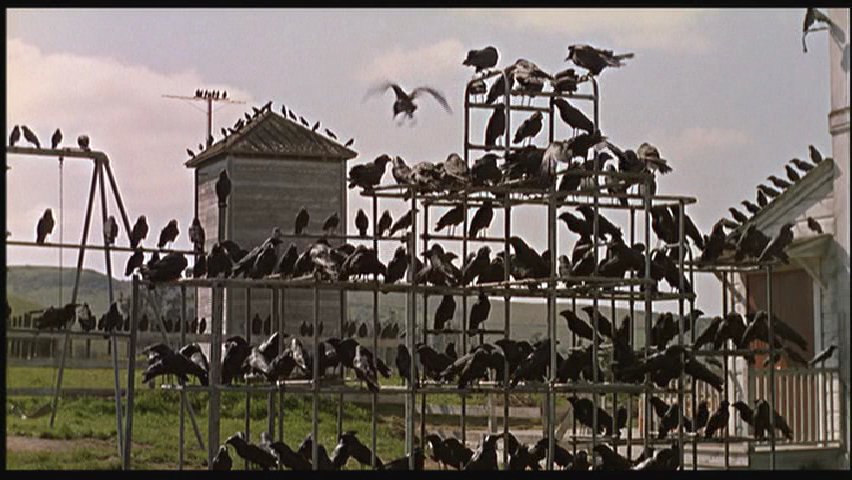
The crows begin to assemble on the play equipment behind the local school in Hitchcock's "The Birds" (1963).

The crow, the raven’s smaller yet equally foreboding cousin, gets its moment in the spotlight in British film director Alfred Hitchcock’s 1963 film “The Birds”. A profoundly intelligent and resourceful bird, a flock of crows is called a murder because “…the group will sometimes kill a dying cow.” Hitchcock capitalized on the silhouette of the menacing crows — not to mention their violent reputation — in his classic horror film in which birds inexplicably attack humans. Oh sure, the idea of violent attack from a single budgerigar seems ludicrous. However, as one character in the film points out, birds significantly outnumber humans on this planet, and if they did group together to get rid of us…

Mrs. Bundy: Birds have been on this planet, Miss Daniels, since Archaeopteryx, a hundred and forty million years ago. Doesn’t it seem odd that they’d wait all that time to start a…a war against humanity.

Salesman: Your captain should have shot at them… Gulls are scavengers anyway. Most birds are. Get yourselves guns and wipe them off the face of the earth.

Mrs. Bundy: That would hardly be possible… Because there are eight thousand, six hundred and fifty species of birds in the world today, Mr. Carter. It is estimated that five billion, seven hundred and fifty million birds live in the United States alone. The five continents of the world…

Salesman: Kill ’em all. Get rid of them. Messy animals.

Mrs. Bundy: …probably contain more than a hundred billion birds.

Drunk: It’s the end of the world.

Sebastian Sholes: Those gulls must have been after the fish.

Mrs. Bundy: Of course.

Boy: Are the birds gonna eat us, Mommy?

Mrs. Bundy[explaining that birds of different species never flock together] The very concept is unimaginable. Why, if that happened, we wouldn’t have a chance! How could we possibly hope to fight them?

Like the drunk guy said, “It’s the end of the world.”

*What’s the difference between a raven and a crow? Read more here to find out.

Hallowe’en Night divination game.

This slideshow requires JavaScript.

Halloween is one of the oldest holidays still celebrated in modern times, and can be traced back to the Druids, a Celtic culture in Ireland, Britain and Northern Europe. Its roots lay in the feast of Samhain (pronounced SA-WIN), which was annually held on October 31st to honor the dead. Much like Christmas, the pagan traditions of Samhain were later co-opted by the Christian church and replaced by All Saints Day (Nov. 1) as a means to align the Christian feast with the already well-established pagan festival. According to Wikipedia, “The word Halloween is first attested in the 16th century and represents a Scottish variant of the fuller All-Hallows-Even (“evening”), that is, the night before All Hallows Day.” Hence, we have the modern day Hallowe’en.

In keeping with its pagan origins, a belief arose that during Halloween the barrier between the realms of the living and the dead are at their most permeable, allowing for dead spirits to enter our world. A corollary of this belief is the traditional Scottish practice of Halloween-night divination. Though little known these days, the practice of various forms of “divination games” during Halloween was wildly popular in the late 19th-century and early 20th-century, a popularity commemorated in the divination-themed Halloween greeting cards above. One of the most popular of these was a form of scrying or mirror divination, in which an unmarried woman was instructed to sit before a mirror in a darkened room on Halloween night. Purportedly, if she gazed long enough, she would see a vision of her future husband reflected in the mirror. If, however, she was to die unmarried, a skull would appear instead — which just seems incredibly creepy. A common thread exists between this Halloween practice and the Bloody Mary game, in which the participants dare each other to look into a mirror and repeat Mary’s name three times, thus possibly summoning the folkloric witch.

Lady Lazarus’s 2011 Halloween Party Movie Night: ‘Pushing Boundaries.’

This is the follow-up post to Lady Lazarus’s 2011 Halloween Party Movie Night: ‘Ghoulish Delights.’

Pushing Boundaries.

Something you don’t want coming at you in the dark (and with that hammer) in REC and REC2.

1. The Spanish horror films [REC] (2007) and [REC]2 (2009) have proven to be a potent one-two punch in recent horror cinema. The second film is less of a sequel as a continuation of the first, with the action literally picking up where the first film ended. This is a very good thing, indeed, as the final third of [REC] set-up an unanticipated and fairly novel plot twist involving the Vatican, some dubious medical experiments, and a solitary priest living in the penthouse of the sealed-off, ‘zombie’-infested Madrid apartment building. It is this unique mashup of zombie-meets-supernatural thriller that makes the [REC] films standout from the recent overabundance of shaky-camera, faux found-footage style horror films. From what I’ve read, the shot-for-shot English language remake Quarantine (which I have not seen) altered the heavy Catholicism of the original Spanish film, replacing all those Virgin Marys with more generic, non-denominational Christian iconography. While the Catholicism would not have the same resonance for the multicultural, multi-faith English-speaking world as it would for the Latin, an easier and more obvious correlation exists between the flesh-eating ‘zombies’ and the characteristically morbid, blood-drenched imagery of Spanish Catholicism than it does for the more ‘sanitized’ versions of Christianity. The only disappointment I had with these films was the ending of [REC]2 which, as soon as a certain character reappears on the scene, is pretty much spelled out.

Catherine Begin as the diabolical Mademoiselle in “Martyrs” (2008).

2. I had purposely avoided Pascal Laugier’s Martyrs (2008) after reading the synopsis and questioning whether a plot that hinged upon the brutal and systematic abuse, torture and murder of young women was something I wanted to witness. After relenting and watching the film, I must admit that it pleasantly surprised me. Now, make no mistake — this is a troubling, violent, and gory film that boldly underscores the word extreme in the phrase ‘New French Extremity’, a category of recent French films in which Martyrs is often included. Much like the [REC] films above, Laugier’s Martyrs veers off in an unexpected and fascinating direction towards the end of the film, revealing a secret society of privileged individuals determined to discover — at any cost — the existence of an afterlife. The enigmatic ending will have you scratching your head for years to come.

3. Any film that re-imagines and updates the ‘slasher’ genre immediately gets my attention, as did Alexandre Aja’s superlative Haute Tension (2003). While some horror fans argue that the ‘big reveal’ in the film didn’t work, I give Aja credit for playing with the conventions of gender in the rigidly formulaic slasher genre. In one of my earlier posts, entitled Deviance, gender and the ‘aberrant female’ in horror, I wrote extensively on this film.

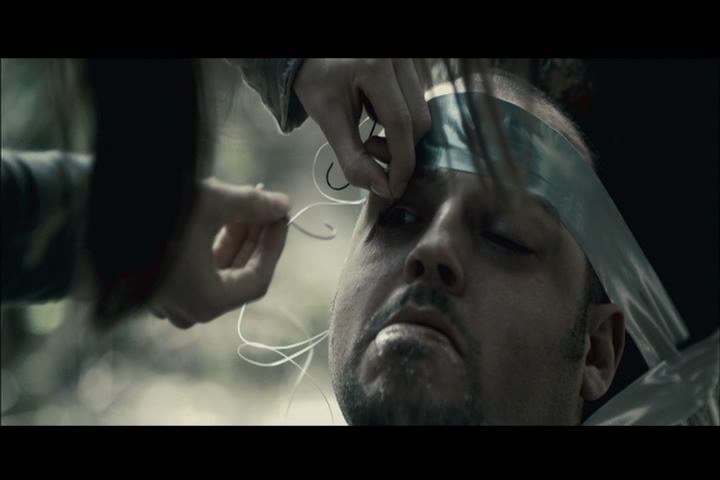
Nothing quite says “revenge” like a fish hook in the eyelid. Jennifer Hills is more of a badass in the 2010 remake of “I Spit On Your Grave.”

4. Like the dated sexual politics of the slasher film, the rape-revenge film is an exploitation subgenre also in need of an update. Much has changed in gender roles and equality since Meir Zarchi made his controversial 1978 cult film I Spit On Your Grave. The 2010 remake, which credits Zarchi as one of its producers, attempts to address some of the shortfalls of the original — at least, shortfalls in the eyes of this contemporary horror fan. In my earlier post Rape-Revenge Girl, I criticized Zarchi’s film for the rather unsatisfying revenge sequences. “The quotient of rape-to-revenge in Zarchi’s film is too much rape, not enough revenge,” I wrote, and “…the deaths of Jennifer’s rapists were not violent and/or gory enough for my — admittedly, gruesome — taste.” As if in direct response to my criticism, the 2010 remake offers up grisly and sickly-twisted revenge killings reminiscent of the stuff you’d find in “torture porn” films like Saw and Hostel. Admittedly, the whole transformation of Jennifer Hills from cheerful girl-next-door, to rape victim, to psychopathic and sadistic killer doesn’t work in any realm other than extreme, cathartic fantasy. Then again, if you’re opting to watch a film entitled I Spit On Your Grave, then you probably know what you’re in store for and will suspend your disbelief long enough to see the blood spill.

Lady Lazarus’s 2011 Halloween Party Movie Night: ‘Ghoulish Delights.’

Feel that crisp October chill in the air? That chill ushers in my favourite of the festive occasions: you guessed it, Halloween. If the spooky spirit of the season inspires you to celebrate all things horrific — or, like me, you celebrate such things on a regular basis — then below are some suggestions for Halloween-themed film viewing. I’ve grouped my suggestions into two distinct categories, and these I will separate across two blog posts. This first post offers up a small group of films I’ve labeled Ghoulish Delights. These are mainly campy, horror-comedy films best suited for Halloween party gatherings. Oh sure, there’s buckets of blood and disturbing scenes, but they’re all served-up with a big, mischievous wink. A follow-up post will address the second group, Pushing Boundaries, that will focus on horror films with considerable bite. These are films that either challenge or re-imagine standard narratives within the genre, or films that simply push the boundaries of taste and acceptability in contemporary horror.

Ghoulish Delights

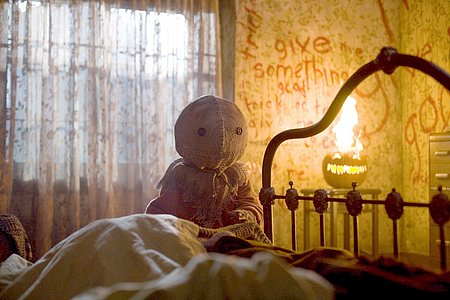
Michael Dougherty's sack cloth-headed horror mascot Sam (after 'Samhain', of course) from his little-known horror anthology "Trick r Treat" (2007).

1. A public release date fiasco on the part of Warner Bros. — that unfortunately resolved itself in Trick ‘r Treat (2007) being released direct-to-DVD two years after it initially screened at film festivals — essentially buried Michael Dougherty’s Halloween-themed horror anthology from the general public. However, thanks the internet and a dedicated horror-film blogger community, Trick ‘r Treat has gotten the love it so rightly deserves:

Despite only a handful of public screenings, the film has been reviewed extensively by online journalists and bloggers, especially in the genre/horror communities, and reviews are nearly unanimously positive. Dread Central gave it 5 out of 5 stars and stated “Trick ‘r Treat ranks alongside John Carpenter’s Halloween as traditional October viewing and I can’t imagine a single horror fan that won’t fall head over heels in love with it.”[3] The film earned 10 out of 10 from Ryan Rotten of ShockTilYouDrop.com.[4] It also earned an 8 out of 10 from Bloody Disgusting,[5] who later ranked the film ninth in their list of the ‘Top 20 Horror Films of the Decade’, with the article saying, “[It’s] so good that its lack of a theatrical release borders on the criminal.”[6] IGN attended a screening of the film and concluded, “This well-crafted Halloween horror tribute is a scary blast.”, rating it 8 out of 10 overall.[7] Based on 17 reviews collected by Rotten Tomatoes, the film has an overall “Fresh” approval rating from critics of 85%, with an average score of 7.7/10; the site’s critical consensus states “An deftly crafted tribute to Halloween legends, Trick ‘r’ Treat hits all the genre marks with gusto and old fashioned suspense.” — from Wikipedia.

Dougherty’s Trick ‘r Treat possesses the same irreverent black humour of horror-anthology franchises such as Creepshow and Tales From The Crypt, which gives the film a quality of both nostalgia and homage. Five interwoven tales of the macabre introduce us to the creepy Principal (played to the hilt by the gloriously creepy Dylan Baker), a self-conscious 22-year-old virgin portrayed by a pre-True Blood Anna Paquin, and a school bus packed with the vengeful ghosts of children in Halloween costumes. The one common element throughout all five stories is the presence of Sam, the mysterious and silent trick-or-treater who seems to embody the very spirit of Halloween.

2. I do love me some Bruce Campbell. This veteran actor of the B-horror genre — best known as Ash from Sam Raimi’s Evil Dead films — was perfectly cast as an old Elvis Presley in Don Coscarelli’s Bubba Ho-tep (2002). When a re-animated ancient Egyptian mummy suddenly appears in the nursing home in which Elvis lives, drastic action must be taken to destroy the creature and free the consumed souls of the nursing home’s elderly occupants. Serious fun.

He's back from the grave and ready to party in "Return of the Living Dead" (1985).

3. Have you ever wondered where that whole “zombies eating human brains” thing comes from? Nope, not from George A. Romero. The brain-eating zombie originated entirely from Dan O’Bannon’s Return of the Living Dead (1985).* In the words of one of the film’s reanimated dead, zombies seek out and devour human brains because “…it hurts to be dead…I can feel myself rotting” and “brains kill the pain”, however temporarily. So, there you have it. O’Bannon’s Return of the Living Dead is both a playful satire of, and a respectful homage to, earlier zombie films like those of Romero. Cheesy ’80s vintage camp in all the right places, this film boasts reasonably convincing zombies and the ‘scream queen’ actress Linnea Quigley, who spends almost her entire screen time completely naked save for a pair of blue stockings. Must’ve been a cold shoot for Ms. Quigley.

…and a couple of the usual suspects

4. Edgar Wright’s Shaun of the Dead (2004) is another — much, much better — satire/homage to the zombie horror genre. It’s such an exemplary horror-comedy that it’s pretty much a given, and I need not discuss it further here.

5. I mentioned Sam Raimi’s Drag Me To Hell (2009) in last year’s Halloween list, but the strength of this film cannot be overstated. A hilarious horror-comedy with some legitimate scares thrown in — an extraordinarily difficult balance to achieve and quite the accomplishment for Raimi, who adeptly showed us that he still knows how to do it.

*There was a single, zombie-eating-brains scene in Lucio Fulci’s City of the Living Dead (1980) but, to the best of my knowledge, this is the first film that truly places brain on the menu for the undead.

Lady Lazarus’s 2011 Halloween Party Movie Night: Scary Films for Kids.

OK, I admit it. It’s not even October, and I’m already planning out Halloween costumes for myself and my kids in eager anticipation of our favourite festive occasion. For the little ones, it’s all about spooky ‘make-believe’ and a prolonged sugar buzz. For the adults — those with and without children — it’s a culturally-acceptable opportunity to play masquerade and temporarily assume a different persona. And for those of us who revel in the macabre on a regular, year-round basis, it’s a chance to geek-out and make our ‘expert’ horror film recommendations for Halloween-themed movie nights.

Much like adults, children can vary widely in their tastes for, and tolerance of, scariness in films. Their reaction to such material can sometimes be unpredictable, but below I’ve listed a few spooky classics that should be age-appropriate for most children.

Scary films for kids:

1. Scooby-Doo And The… (series of DVDs, dating from the 2000’s-present). There are a number of direct-to-DVD, 90-minute movies featuring that super-sleuth canine Scooby-Doo and the Mystery Gang that even the youngest child in your family will enjoy. Some of the better spooky capers include Scooby-Doo And The Samurai Sword, Scooby-Doo and the Cyberchase, Scooby-Doo Camp Scare and Aloha Scooby-Doo! You can find most of these at your local DVD rental store or for purchase on Amazon. Recommended for age 4+

2. It’s the Great Pumpkin, Charlie Brown. A Halloween classic that’s appropriate for small kids. Recommended for age 3+

The Library Ghost (aka The Grey Lady) from "Ghostbusters" (1984). Could freak out very small kids, but a not-so-scary film for most.

3. Ghostbusters (1984). A couple of scenes might prove too frightening for very little ones, but on the whole a spooky-fun family film. Recommended for age 6+

4. Not too surprisingly, the gorgeously gothic creative efforts of Tim Burton features large on this list. Family-friendly Burton films include Beetlejuice (1988), and the animated feature-length films The Nightmare Before Christmas (1993) and The Corpse Bride (2005). I’ve shown the latter two films to my 4 and 6-year-old kids, and they reported that these were “a little too creepy” in parts. Use your own parental discretion, but I’d recommend these films for age 8+

The alternate-reality "spider Mom" from Coraline (2009).

5. Coraline (2009) has a very similar look-and-feel to the aforementioned Tim Burton animated films, and shares with these a creepiness that’s probably more appropriate for the 8+ crowd. All the same, a visually-stunning masterpiece of stop-motion animation that’s worthwhile for adults as well as children.

Quite frankly, I can’t wait until my kids are old enough to accompany their mother through a viewing of The Exorcist or a George A. Romero zombie gore-feast. Perhaps when they are around the age of 10…?

My next post will offer up suggestions for some adult-sized scares.

A Diabolical Decadence: Charles Baudelaire, Félicien Rops and the “Flowers of Evil.”

Come on my heart, cruel and insensible soul,
My darling tiger, beast with indolent airs;
I want to plunge for hours my trembling fingers
In your thick and heavy mane;

In your petticoats filled with your perfume
To bury my aching head,
And breathe, like a faded flower,
The sweet taste of my dead love.

I want to sleep, to sleep and not to live,
In a sleep as soft as death,
I shall cover with remorseless kisses
Your body beautifully polished as copper.

To swallow my appeased sobbing
I need only the abyss of your bed;
A powerful oblivion lives on your lips,
And all Lethe flows in your kisses.

I shall obey, as though predestined,
My destiny, that is now my delight;
Submissive martyr, innocent damned one,
My ardor inflames my torture,

And I shall suck, to drown my bitterness
The nepenthe and the good hemlock,
On the lovely tips of those jutting breasts
Which have never imprisoned love.

— Geoffrey Wagner, Selected Poems of Charles Baudelaire (NY: Grove Press, 1974). English translation of the poem Le Léthé by Charles Baudelaire from Fleurs du mal (1857).

Mysterious occult rituals, orgiastic parties and experiments with hallucinatory drugs: sounds like one of the notorious “acid test” road trips by Ken Kesey and the Merry Pranksters, right? While this does neatly summarize the wild merry-making of the Pranksters and the 1960’s hippie counterculture, what I’m describing above is instead the naughty behaviour of a much earlier group of non-conformists and bohemians: the Decadents of the late 19th-century.

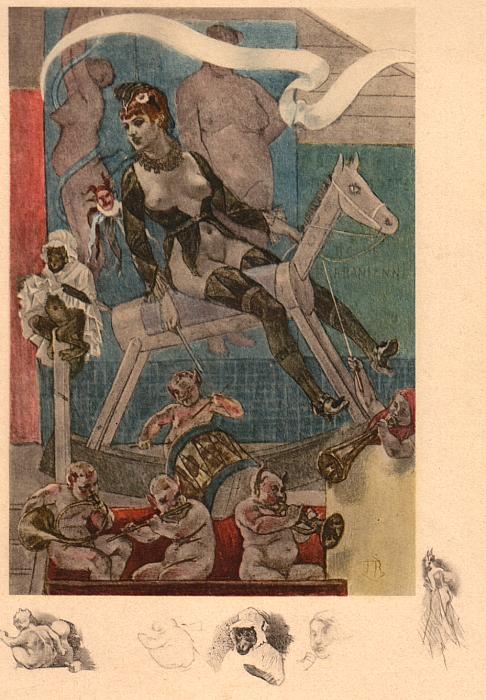
Etching & aquatint by Félicien Rops (1896).

The Decadence Movement was a fin de siècle artistic and literary style of Western Europe, primarily France. Fin de siècle or “end of the century” refers to the latter two decades of the 19th-century that were characterized by boredom, cynicism, and pessimism as well as an anxiety over the change that is inevitable in the ending of a century. While the term “decadent” was originally applied as a pejorative by critics of the style, writers and artists such as Charles Baudelaire and Félicien Rops eagerly adopted this label as a further act of defiance against the restrictive social mores they perceived in contemporary European society. For the most part, the Decadents were influenced by the tradition of Gothic novels and by the poetry and fiction of Edgar Allan Poe, and were associated with (but distinct from) Symbolism. The progenitor of Decadence was Baudelaire, and his poetry collection Les Fleurs du mal (‘The Flowers of Evil’, 1857) is considered by literary historians as a seminal work of Decadent writing. Steeped in a fashionably brooding melancholia and an almost morbid eroticism, Baudelaire’s poetry was targeted by French censors for its bold lasciviousness:


The author and the publisher were prosecuted under the regime of the Second Empire as an outrage aux bonnes mœurs (trans. “an insult to public decency”). As a consequence of this prosecution, Baudelaire was fined 300 francs. Six poems from the work were suppressed and the ban on their publication was not lifted in France until 1949. These poems were “Lesbos”, “Femmes damnés (À la pâle clarté)” (or “Women Doomed (In the pale glimmer…)”), “Le Léthé” (or “Lethe”), “À celle qui est trop gaie” (or “To Her Who Is Too Gay”), “Les Bijoux” (or “The Jewels”), and ” Les “Métamorphoses du Vampire” (or “The Vampire’s Metamorphoses”). These were later published in Brussels in a small volume entitled Les Épaves (Jetsam). — from Wikipedia.

Lithograph known alternately as “Black Mass” or “Calvary”, by Félicien Rops.

The Belgian visual artist Félicien Rops met Baudelaire towards the end of the poet’s life, and this meeting had a great impact on the career of the young artist. An accomplished printmaker, Rops illustrated many literary works including Baudelaire’s Les Épaves, a selection of poems for which he created the frontispiece. Like the works of the authors whose poetry he illustrated, Rops work tends to mingle sex, death, and Satanic images. He held a lifelong fascination with the femme fatale, an image of womankind that served as a dark and sinister Muse to that generation of Decadent artists. Of his views of Woman, Félicien Rops wrote: “Therefore it is his era, the end of the 19th century, that he [the artist] expresses through his graphic work, structured mainly around the themes of love, suffering and death, with the central unifying theme of the woman, la femme fatale in the full meaning of the word. Through her he portrays his vision of his era. Woman is Satan’s accomplice, and becomes the supreme attraction which provokes the most extreme vices and torments in Man, a mere puppet.” (an English translation of a quote taken from the Museum of Félicien Rops web site.)

Counting myself amongst the legion of “Satan’s accomplices”, I can easily admire the lewd and grotesque aspects of Rops, even as he does occasionally verge on a kind of vulgar kitsch. The unabashed sexuality of Rops lends a quality of surprising modernity to the work and gives it a contemporary feel, even as it dates from well over 100 years ago.

Goth like me; or, why does little Jenny mope in her bedroom all day, wearing black and writing bad poetry?

I have a theory that some people are simply born to be Goth. Long before I knew of such a subculture, I was, by virtue of natural inclination, compelled to seek out the dark, the morbid, and the theatrical. These are the mainstays of ‘the Gothic’, a darkly romantic movement within art, music, fiction and fashion.

My gateway music into all things Goth was The Cure’s 1989 album Disintegration, back in my undergraduate art school days — which is, as far as anyone is concerned, precisely the right place to discover the angst-ridden wails of Robert Smith. Similar bands, such as Bauhaus, Joy Division, and the Sisters of Mercy, soon followed. While I was not then– nor am presently — a daily devotee to dressing exclusively in the Goth style, I have held a continued fascination in all things related to the Goth subculture ever since those early, fateful days of art school.

Fashion is critical for the Goth, with adherence to a particular mode of dress strict, to the point of orthodoxy. There is, as it turns out, not one type of Goth, but several. These include the Classic Goth, the Romantigoth, the Cybergoth, Fetish Goth, Vampire Goth, Glitter (or Perky) Goth, Victorian Goth, Steampunk, Gothabilly, Gothic Lolita, and…well, the list is long, indeed. Below is a brief description of some of my personal favourite modes of Goth dress.

Classic (or Traditional) Goth

Siouxsie Sioux, lead singer of the seminal ’80’s Goth band Siouxsie & the Banshees, and the figurehead for the first generation of Goths.

The Goth subculture evolved from Punk in the early 1980s, with the London club The Batcave ostensibly functioning as its musical and stylistic home base. Famous club regulars included musicians such as Robert Smith, Siouxsie Sioux, Steve Severin, Marc Almond and Nick Cave. Collectively, their dark, moody and often somber music and penchant for theatricality shaped this new subculture, creating its very distinctive look and feel. While Punks were angry anarchists, Goths were melancholic fatalists.

The fashion of the Classic Goth was heavily influenced by British-based Punk. Fishnet, leather, and piercings were prominent, and the colour black was worn, head-to-toe, with slavish devotion. BDSM paraphernalia, such as black leather slave collars, corsets and harnesses, was also common. Hair was very big and very, very teased (it was the ’80s, after all) and make-up was heavy and often exaggerated. Trendsetters like Siouxsie Sioux served as models for the uniform of the Classic Goth female: black, spiky-teased hair, fishnet, leather, studded belts, wristbands and collars, dark, heavy eye make-up and thickly lined, deep red lips.

Victorian Goth

One of the biggest influences on Gothic fashion has been the imagery in Gothic literature and their movie counterparts, particular that of Victorian writers such as Edgar Allen Poe and Bram Stoker. Victorian fashions like corsets, lace, frock coats and pale skin are popular throughout the scene, but maybe none wear them with as much style as the Victorian Goth.

A Victorian Goth wearing a contemporary version of the Victorian “mourning dress”.

Like their Victorian role models, the Victorian Goths wish to convey an image of decorum and dignity. Clothes must be elegant and, for many, historically accurate. Ball dress and mourning garb are particularly prominent in the scene.

Victorian Goths may also indulge in activities that were popular in Victorian high society, including theatre, masquerades, tea parties and poetry. And, naturally, any kind of Dickensian or other Victorian festival that gives them an excuse to parade around in costume.

As for music, opera and classical are the true Victorian Gothic genres, but Victorian-inspired bands such as Rasputina are also acceptable.

Typical Steampunk outfit, complete with waist coat, pinstripes and the omnipresent goggles.

Steampunk

The antiquated, refined elegance of Victorian Goth and a rough, edgy futurism may seem a completely incompatible combination. But, thanks to a particular genre of fantasy, the two have been successfully wedded to create the Steampunk Goth.

Steampunk is, in essence, science fiction that takes place in the low-tech setting of the past — very often the Victorian era. In Steampunk, you may find steam-powered robots, clockwork computers and complex contraptions made from wood, brass and wheels. The merging of Victorian imagery with quirky technology is doubtlessly of huge appeal to many Goths, but perhaps the most important links between Steampunk and Goth culture are the Victorian writers who inspired the genre, including Mary Shelley and Edgar Allen Poe.

Steampunk Goth fashion is highly creative, incorporating elements that evoke Victorian technology such as clocks, keys and cogs. Although Steampunk is not a music scene, acts such as Rasputina, Emilie Autumn and Abney Park have all been cited as having Steampunk appeal.

Gothic Lolita

A Gothic Lolita proudly displays her subculture fashion sense in the Harajuku region of Tokyo.

While largely inspired by the Western Goth movement, the Gothic Lolita is a wholly Japanese creation. Inspired by Visual Kei and cosplay, the Lolita tries to closely emulate a demure, doll-like Victorian girl. Modesty and elegance are critical, and little or no skin should be exposed in Lolita costumes.

The Gothic Lolita is the darker sister of the frothy-pink Sweet Lolita, and typically dresses in a combination of black and white, or entirely in black. Eyes tend to be dark and smoky but, on the whole, make-up tends more towards the natural tones rather than the theatricality of Goth “white face” — which wouldn’t work on Asian skin, anyway.

This style has recently come full circle, with Westerners now borrowing fashion elements from the Japanese. Westernized versions of Lolita fashion tend to minimize the girlish frills and add an element of coquettish sex appeal.
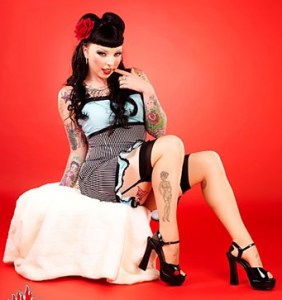
A classic retro 1950’s “Gothabilly” look.

The Gothabilly

What do you get if you mix Elvis Presley, The Cramps, a bunch of old horror movies and a splash of lounge?  Bizarrely, you get Gothabilly – a rare and exotic breed of Goth with rather eclectic tastes in both music and wardrobe.

With styles originating from “Rockabilly” (American 1950s rock n roll) and “Psychobilly” (1980s punk with a heavy rockbilly influence), Gothabilly is visually and musically a play on retro, kitsch aesthetics – but with a dark twist.  Like Deathrock, which often shows many overlapping traits with Gothabilly, the  music and imagery is frequently tongue-in-cheek and deliberately cheesy.  As such, many Gothabilly bands sport such creative names as Nacho Knoche & The Hillbilly Zombies, Cult Of The Psychic Fetus, and Vampire Beach Babes.

Gothabillys tend to be some of the brighter Goths out there, with their vivid tattoos, cherry accessories and ubiquitous polka dot clothes.