The Great Mother vs. the Terrible Mother: the dual nature of the Jungian archetype.

The prehistoric figurine famously known as the “Venus of Willendorf”, which was made between 24,000 and 22,000 BCE.

That flowers-and-Hallmark-card festival of “why don’t you call more often?” guilt we so lovingly refer to as Mother’s Day has just passed, so I thought it topical to dedicate a post to mother archetypes. It goes without saying that, as long as there’s been people, there’s been mothers. Some of the earliest known artifacts of human prehistory are — or, at least, are believed to be — representations of female fertility and motherhood. The most famous of these is the Venus of Willendorf, a small, carved stone figurine of an ancient woman with what could be best described as fleshy, Rubenesque proportions. The exaggerated sexual characteristics of the figurine — her large, pendulous breasts, full, rounded belly and pronounced vulva — seem to support the theory that the Venus was used as a sacred fetish object relating to fertility, perhaps in some sort of Mother Goddess worship. Of course, the true purpose of the artifact remains a mystery:

Like many prehistoric artifacts, the cultural meaning of these figures may never be known. Archaeologists speculate, however, that they may be emblems of security and success, fertility icons, pornographic imagery, or even direct representations of a mother goddess or various local goddesses. — from Wikipedia.

Regardless of the cultural meaning behind such representations of womanhood, various historians and scholars have looked to the prehistoric Venus figurines for images of mother goddesses. The Jungian psychologist Erich Neumann argued that these figurines served as evidence of ancient matriarchal religion in his book The Great Mother: an Analysis of the Archetype (1955), although his theories have since been disputed by subsequent generations of academics. Whether or not there actually was a prehistoric practice of Mother Goddess worship, what we are left with from Neumann’s book is the potent archetypal image of the Great Mother. According to Jungian psychoanalysis, the Great Mother archetype symbolizes creativity, birth, fertility, sexual union and nurturing. She is a creative force not only for life, but also for art and ideas.

Lithograph of the bloodthirsty Hindu Kali, goddess of time, change, and death.

But, for every positive, creative force, there must be an opposing, destructive one. This notion is doubly true in the esoteric world of Carl Jung, where all archetypes must, by necessity, possess a shadow self. The dark twin sister of the Great Mother is the Terrible Mother, a force of death and destruction. This archetype inhabits the world of the primordial instincts, and is frequently represented as sub-human or even animal-like in form. A good example of the Terrible Mother archetype is the black-skinned Hindu goddess Kali. Her eyes are described as red with absolute rage, her hair disheveled, and small fangs sometimes protrude out of her mouth. She is often shown naked or just wearing a skirt made of human arms and a garland of human heads. Kali is often accompanied by serpents and a jackal while standing on a seemingly dead Shiva, her male consort. Her open, fanged mouth — with tongue lolling out — is a common characteristic of the Terrible Mother, whose image often emphasizes the oral and is closely related to the mythology of the vagina dentata. Erich Neumann relays one such myth in which “a fish inhabits the vagina of the Terrible Mother; the hero is the man who overcomes the Terrible Mother, breaks the teeth out of her vagina, and so makes her into a woman.” (The Great Mother. Princeton: Princeton University Press. pp. 168.).

Well, in either case — Great or Terrible — I sincerely hope you called your mother this past weekend.

The haunted ‘Island of the Dolls.’

Some of the derelict inhabitants of “La Isla De La Muñecas”, located on Teshuilo Lake, Mexico.

Ghost stories. Every culture around the world has them and, whether they arise from ancient folklore, the Gothic novelists, or the humble campfire, they continue to both frighten and fascinate. What is it about the ghost story that has held our collective fascination from time immemorial? I have a personal theory that, beyond their chilling narratives, there’s a psychological comfort to be derived from the ghost story. The very idea of a ‘ghost’ fundamentally supports the belief in an afterlife and that something exists beyond the grave. In spite of geographic, political, or cultural differences, an intrinsic fear of death is the one thing we all have in common.

So, if a good ghost story gives you a cold sort of comfort, then you might consider packing your bags for a trip to Mexico. Located on Teshuilo Lake in Mexico’s ancient Xochimilco district, the remote island dubbed La Isla De La Muñecas (or, ‘the Island of the Dolls’) has become a curious tourist destination for fans of the macabre. Festooned about this quiet and uninhabited island are thousands of dolls, supposedly left by the island’s former occupant to weather and decay. A tale of tragedy accompanies these dolls, offering a possible explanation as to their placement here:

In the late 1950s, Don Julian Santana Barrera came to inhabit the nameless island on Teshuilo Lake, which [was] then a lonely, overgrown spot and seemingly perfect for his hermit-like requirements.

But, unbeknownst to Julian, the quiet island has a dark history. Local legend maintains that in the 1920s three young girls were playing on the island, only for one of them to drown, falling into the canal’s murky waters close to a small jetty. The nearby residents claimed that the dead girl’s spirit refused to pass on and remained tethered to the island. The area soon gained a degree of infamy and few dared to venture near the supposedly haunted land, especially at night.

Now, with Julian’s arrival, the girl’s spirit once again had someone to talk to. She told him of the manner of her death and asked him to find dolls for her to play with; adding that they would also help to ward off the ancient and evil spirits that still wandered the prehistoric wetlands. Evidently, Julian listened to the girl’s appeal, and began to search the area, scouring the rubbish dumps and plucking any discarded dolls that floated on the gently lapping waters of the cloudy canals.

Some of the thousands of dolls that haunt “La Isla De La Muñecas”.

At first Julian was thought to be something of an oddity; a crackpot who would gather unwanted dolls because he thought they were actual children that he could nurse back to life, but eventually people realized that he was simply a harmless old man with a rather peculiar past-time. In time, Julian accrued so many dolls that the island came to be called La Isla de las Muñecas (The Island of Dolls) but according to Julian, no amount of plastic companions seemed to satisfy the spirit’s thirst, and soon thousands of the toys festooned the island’s every square foot. Julian even constructed a modest hut for the purpose of housing a shrine dedicated to the dead girl’s spirit and the most special dolls he was given.

On April 21st 2001, Julian and his nephew, Anastasio were fishing on the island. Julian told his nephew that strange voices had been calling out to him from the waters of the canals, beckoning him to enter the water and join them. He explained that he had often heard weird voices, but had always been able to resist their calls. The two men carried on fishing together until Anastasio left to undertake some errands. When he returned he discovered his uncle floating face down in the canal near the small pier – at the same place that the girl had lost her life in the 1920s.

— Source: ‘The Mexican Island Haunted by Evil Dolls‘, on the Environmental Graffiti blog.

Of course, the cynic in me says that the story of Julian Barrera and the drowned girl are completely apocryphal, and some enterprising locals collected discarded plastic dolls and decorated the island, inventing this ghost story in the hopes of attracting tourist dollars to an off-the-beaten-path region of Mexico. Whatever the truth behind the dolls, it’s still an impressive and effectively eerie sight to behold. Click on the link above to view more creepy photos of the ‘haunted’ Island of the Dolls.

Horror Films 101: 5 vampire films you may not have seen.

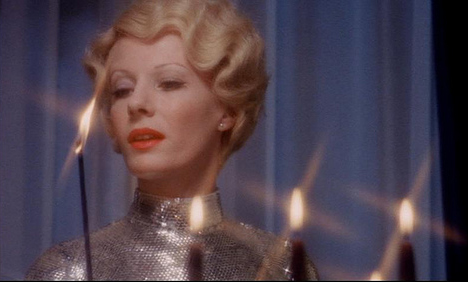
The beautiful Delphine Seyrig stars as the bloodthirsty Countess Báthory in Harry Kümel's "Daughters of Darkness" (1971).

1. The stylish Daughters of Darkness (1971) from Belgian director Harry Kümel continues to be one of my favourite indulgences when it comes to eurotrash vampire films. I’ve already dedicated an entire blog post on Kümel’s film, but a recently discovered quote from “dissident feminist” Camille Paglia has reminded me of my great admiration for this lesbian-vampire classic:

“A classy genre of vampire film follows a style I call psychological high Gothic. […] A good example is Daughters of Darkness, starring Delphine Seyrig as an elegant lesbian vampire. High gothic is abstract and ceremonious. Evil has become world-weary, hierarchical glamour. There is no bestiality. The theme is eroticized western power, the burden of history.”

— Camille Paglia, Sexual Personae: Art and Decadence from Nefertiti to Emily Dickinson. Yale University Press, 1990, p. 268.

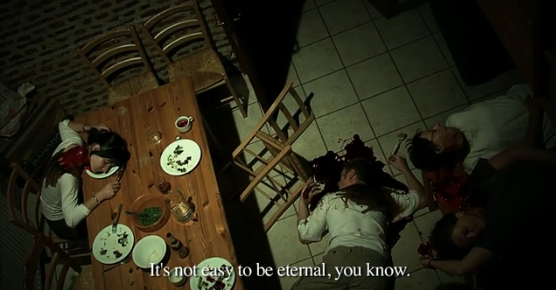
Vincent Lannoo's mockumentary "Vampires" (2011).

2. Yet another Belgian vampire film, although the ‘found-footage’ hand-held camera-style of Vincent Lannoo’s Vampires (2011) could scarcely be more of a departure from Kümel’s meticulously crafted film. Touted in the media as “Spinal Tap meets the Munsters”, Lannoo’s mockumentary delves into the culture of contemporary Belgian vampires, all with a wonderfully deadpan, blacker-than-night sense of humour. After several unsuccessful attempts to document the vampire community — as the film crews kept, um, getting eaten — the crew that purportedly filmed Vampires manage to locate an amenable vampire family that allow them to document their daily routines. Even though the found-footage schtick has grown very, very tired in the horror genre, I found myself enjoying the detailed accounts of vampire customs and culture.

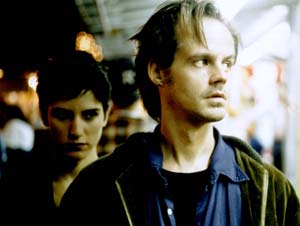
Director Larry Fessenden plays Sam, a world-weary bartender in "Habit" (1999).

3. The low-budget indie film Habit (1999) was written, produced, directed, and edited by genre fave Larry Fessenden. This is a grungy and unglamorous revisionist-vampire film that uses vampirism as a metaphor for addiction. Fessenden plays Sam, a world-weary bartender who struggles with alcoholism and the recent death of his estranged father. When Sam meets the mysterious Anna at a friend’s party, things eventually go from bad to worse. While this film offers little in terms of fanged neck-biting, it has an effectively moody atmosphere and some fairly erotic sex scenes.

4. Cronos (1993), written & directed by Guillermo del Toro, was the cinematic debut of the Mexican filmmaker better known for his later film Pan’s Labyrinth. A fairly unique treatment of the vampire mythology in which an ancient and mysterious mechanical device is used to transmit the virus of vampirism. An old antique dealer unwittingly discovers the scarab-shaped device in his shop and becomes infected. Fans of del Toro’s work will recognize his characteristic black humour and fondness for grotesquery.

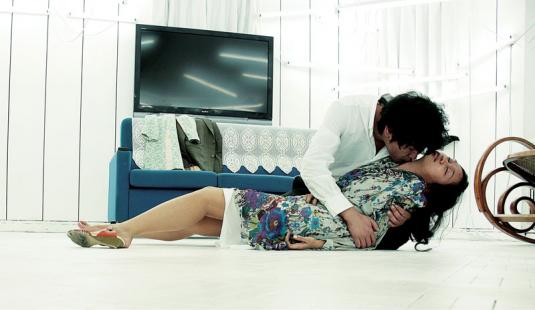
The priest Sang-hyun saves his dying love interest Tae-ju by rendering her a vampire in "Thirst" (2009).

5. Another clever twist on the vampire legend is Chan-wook Park’s Thirst (2009). Sang-hyun is a devout Catholic priest who, for all intents and purposes, opts to martyr himself by subjecting his body to some radical medical experiments. When these medical experiments result in vampirism, the priest wrestles not only with a heightened desire for carnality, but also a thirst for human blood.

“Domestikia: An Account of Some Strange Disturbances” begins February 24th, 2012.

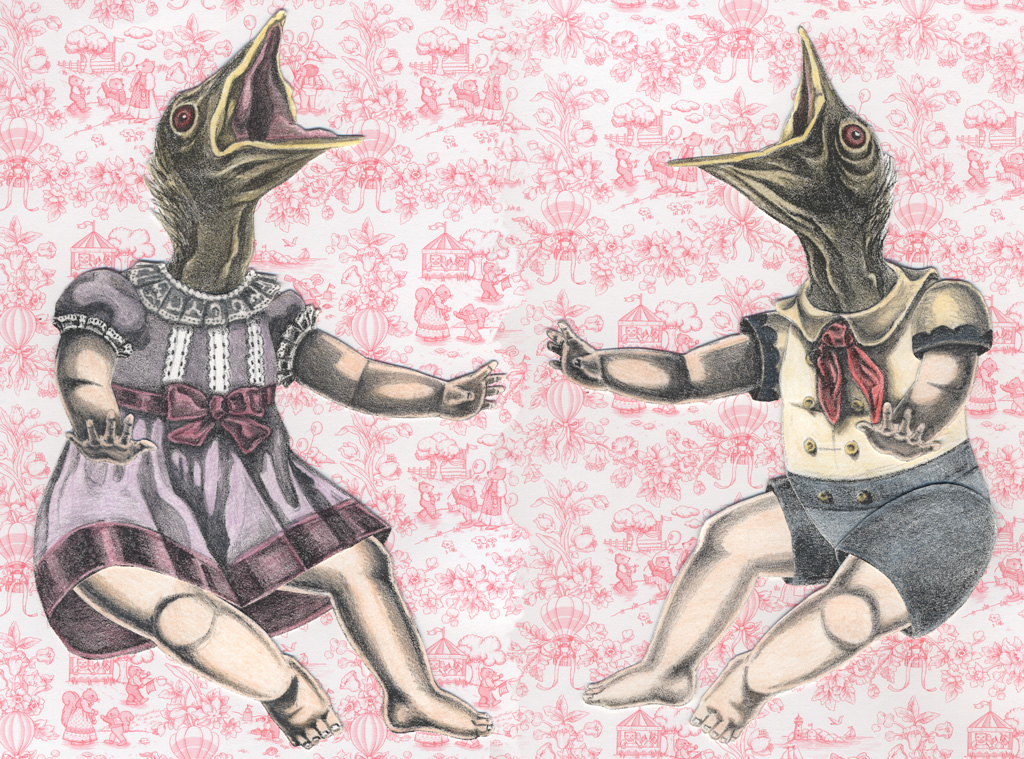
"The Brood" (2012) by Jennifer Linton. Work-in-progress photograph of a shadowbox assemblage, which includes hand-coloured lithographs that are cut out and pasted into paper dolls.

If you live in the Toronto area, then drop by Open Studio to view some of my recent creative efforts. My latest exhibition “Domestikia: An Account of Some Strange Disturbances” is an exploration into the interdisciplinary possibilities of printmaking. I’ve created articulated paper puppets from lithographic prints, which are then arranged into strange, dream-like shadow box tableaux. These same paper puppets are brought to life in a stop-motion animation, all taking place within an imagined dollhouse.

Opening reception is Friday, February 24th at 6:30 – 8:30 p.m. Join me for wine, conversation and general frivolity. Show runs from February 24 – March 31, 2012. Open Studio is located on the ground floor of 401 Richmond, at the corner of Richmond and Spadina in Toronto. For more information on this show, visit the Open Studio web site.

The month of February is quickly being swallowed up by my teaching & an exhibition of my art taking place on the 24th. Here’s a repost of an earlier entry on the late American artist Hannah Wilke. She was a busy person, too.

Lady Lazarus's avatarLady Lazarus

I wrote the following essay on American visual artist Hannah Wilke for an art history class in graduate school. I include the full text and images, excluding citations. If you’re a student who discovers this via search engine, then I have every confidence in your research abilities to track down the scholarly sources. Wilke was a seminal Second Wave feminist artist whose work has received renewed interest from scholars since her death in 1993.

The politics of inclusion that shaped feminist discourse in the 1960s and 1970s spawned a legacy of body-based performance art, much of which was associated with women artists who used their own face as a subject of continual exploration. The self- imaging of women artists such as the provocative American artist Hannah Wilke was frequently attacked and dismissed by art critics as being indulgent exercises in narcissism that only served to reinforce the objectification of the…

View original post 4,045 more words

The 3D paper cutout animation of Co Hoedeman’s ‘Charles et François’.

I recently discovered the stop-motion work of French-Canadian animator Co Hoedeman. One of his earlier animations, Charles et François, made use of paper cutouts mounted upright in a fully 3-dimensional set. He employed the technique of “substitution” — where different paper drawings are swapped in, frame to frame, to indicate movement — rather than rely on jointed or “articulated” paper puppets. The effect is quite breathtaking.

"Charles et François", by Co Hoedeman, 1987, 15 min 24 s.

Here is the synopsis as it is given in French on the NFB/ONF web site, followed by a predictably clumsy Google Translate English version:

Film d’animation dévoilant le récit d’une relation hors de l’ordinaire, toute de tendresse et de complicité. Ce film témoigne des bouleversements physiques et psychologiques qui se vivent, pour un grand-papa et son petit-fils, au fil des ans. Voilà ainsi posée une douce réflexion sur le caractère changeant des choses et de la vie.

Animation revealing the story of an extraordinary relationship, full of tenderness and complicity. This film reflects the physical and psychological changes that live for agrandfather and his grand-son, over the years. This is a gentle and laid reflection on the changing nature of things and of life.

Unfortunately, I can’t embed the video from the NFB web site. However, if you click on the following link you can view this animation: http://www.nfb.ca/film/charles_et_francois/embed/player

The Gothic Lolita, examined.

A Japanese 'kurololi', characteristically dressed entirely in black.

Back in August of 2011, I wrote a blog entry about my fascination with the Goth subculture, an entry appropriately entitled Goth like me; or, why does little Jenny mope in her bedroom all day, wearing black and writing bad poetry? Indeed, for several years I have held an interest in Goth-inspired art, music and fashion, even before I was aware of that particular label. As my earlier post explained, there are several different fashion styles that fall under the broad category ‘Goth’, all with their own distinct rules and conventions. One of the most interesting and — for some Westerners — difficult to understand modes of Goth dress is the Japanese Lolita.

One of the most common misunderstandings of the Lolita subculture is the belief that the associated costuming somehow relates to either sex and/or cosplay. Neither, however, are true. The Japanese use of the English name “Lolita” is likely a case of wasei-eigo, or Japanese-derived English, and does not refer to the novel by Vladimir Nabokov nor its titular 12-year-old “nymphette” heroine. The Lolita mode of dress places a strong emphasis on Victorian-era elegance and modesty, and is not intended to be ‘sexy’. Nor is Lolita garb derived from anime or manga characters, like the cat-ears and spiky blue-hair of cosplay costumes.

Lolita fashion grew out of the 1980s-90s Japanese music scene, inspired by flamboyantly-dressed pop music icons such as Princess Princess and the cross-dressing Malice Mizer. Much like Goth dress in general, the Lolita also has several different fashion incarnations:

The Gothic Lolita

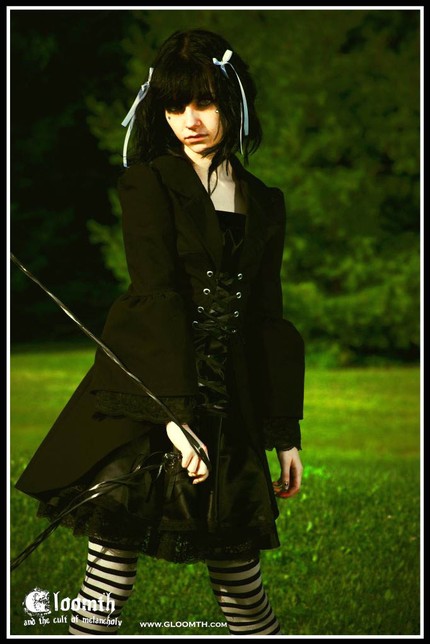
A Western version of the Gothic Lolita, from the Canadian-based fashion label Gloomth & the Cult of Melancholy.

Gothic Lolita (or ‘gothloli’) fashion originated in the late 1990s in Harajuku (region in Tokyo). This style is characterized by the wearing of black and white clothing, though black + another colour (red, purple) is not uncommon. Clothing generally includes ruffled blouses with bows and puffed sleeves, knee-length skirts (often worn with crinolines or petticoats for that classic bell-shaped silhouette), stockings or knee-high socks, and girlish mary-jane shoes or Victorian-style boots. Hats, ornate headbands, gloves and parasols are common accessories. The Westernized versions of the Gothic Lolita tend to downplay the ultra-feminine ribbons, ruffles and bows of the Japanese look, while still adhering to the Victorian doll-like Lolita aesthetic.

The Sweet Lolita

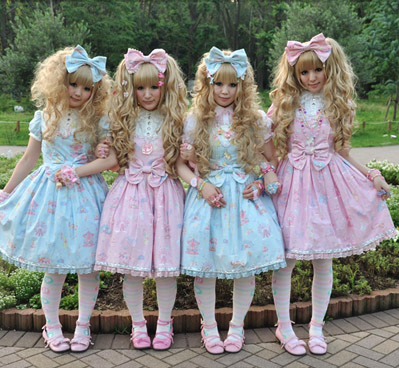
A small pack of Sweet Lolitas. So sweet, your teeth might ache.

Similar in dress to the gothloli, this style adopts saccharine-sweet, lighter colours — often pink or baby-blue — and childlike motifs like Alice in Wonderland, hearts, strawberries, cupcakes and teddy bears. I firmly believe that there are some modes of dress that can only be successfully worn by 16-year-old Japanese girls. This is one of those. The Sweet Lolita attempts to emulate the porcelain skin and blonde ringlets of a European, Victorian-era doll.

The Pirate Lolita

Not a particularly common Lolita style, but certainly a fun and flamboyant one. The fashion label Alice & the Pirates (a side-project of Baby, the Stars Shine Bright) offers all an aspiring pirate needs to look to part. Ahoy, maties!

Gurololis compare their wounds.

The Guro Lolita

This style is one of the most curious of the Lolita fashions. The Guro Lolita dresses as a “broken doll”, with band-aids, eye-patches, and bloodied gauze bandages. Often, they wear white — a colour that provides the perfect canvas on which to splatter pretend blood and gore. It is common for the gurololi to carry around an equally bandaged & bloodied doll or teddy-bear.

Shiro & Kuro Lolita

Shiro Lolita, or ‘White Lolita,’ is a Lolita outfit made entirely of white/cream/off-white co-ordinates, while its counterpart Kuro Lolita, or ‘Black Lolita,’ is an outfit made-up of entirely black co-ordinates. Shiro and Kuro Lolita can be taken from any style of Lolita, whether it be Gothic, Sweet, or Classic. If the co-ordination is completely white, then it is accepted as Shiro Lolita, while if it is entirely black it is accepted as Kuro.

Wa Lolita

The Wa Lolita.

The Wa Lolita combines traditional Japanese clothing — namely the kimono — with the Lolita style. The kimono-style garment is modified to accommodate the fullness of a petticoat and Japanese wooden sandals (called okobo) sometimes replace the typical Lolita boots or platform mary-janes. Another East-meets-West Lolita mashup is the Qi Lolita. This style uses Chinese clothing and accessories in place of Japanese, and usually this includes qipao dresses modified to accommodate a petticoat.

Even though I’m going to end my blog post here, by no means should you consider this list an exhaustive account of all of the Lolita styles. For the complete list, visit this Lolita Style Handbook.

2011 in review – Thank You & Happy New Year from Lady Lazarus!

The WordPress.com stats helper monkeys prepared a 2011 annual report for this blog.

Here’s an excerpt:

The concert hall at the Syndey Opera House holds 2,700 people. This blog was viewed about 27,000 times in 2011. If it were a concert at Sydney Opera House, it would take about 10 sold-out performances for that many people to see it.

Click here to see the complete report.

REPOST: Nothing says “Merry Christmas” like a creepy Canadian slasher flick.

A repost of last year’s blog entry on Bob Clark’s Black Christmas, with an added paragraph and one or two spoilers.

An often overlooked classic, the 1974 Canadian film Black Christmas now enjoys a cult status amongst horror fans and critical acknowledgment as being the progenitor of  the “slasher” genre that dominated horror cinema in the late ’70s and throughout the 1980s. Directed by Bob Clark — best known for his raunchy teen sex comedy Porky’s (1982) — the film boasts an enviably list of talented Canadian actors: Margot Kidder, Keir Dullea, John Saxon and comedienne Andrea Martin. The film stars Olivia Hussey, a British actress who’s most frequently recognized for her role as “Juliet” in Franco Zeffirelli’s 1968 film adaptation of Shakespeare’s Romeo & Juliet. In Black Christmas, Hussey leaves the Elizabethan poetry behind and gets her “scream queen” on.

Getting all wrapped up for the holidays in Bob Clark's 1974 cult slasher film "Black Christmas." Apologies in advance for the bad pun.

Getting all wrapped up for the holidays in Bob Clark's 1974 cult slasher film "Black Christmas."

It’s important to note that Black Christmas predates the better known slasher films like John Carpenter’s Halloween (1978) and Sean S. Cunningham’s Friday the 13th (1980), and they owe a great debt to Clark’s film. The quote below from Wikipedia concisely captures this film’s cult status:

The film gained a fairly decent cult following over the years of its release, and has been praised by fans of the slasher film genre internationally. The Black Christmas fan site has considerably increased the film’s popularity over the years. The film ranked #87 on Bravo’s 100 Scariest Movie Moments for Lynne Griffin’s infamous plastic sheeting scene. During an interview regarding the film, Olivia Hussey met Steve Martin at an industry event and he brought up the fact that she starred in one of his favorite movies of all time. Hussey thought he might have referred to her work in Romeo & Juliet, but was surprised to hear from Martin that it was Black Christmas, which he claimed to have seen 25 times.

What Black Christmas possessed — and what later films in the slasher genre often lacked — was the element of suspense. Rather than rely on the crude shock tactics of gore, Clark torques up the tension by placing the insane homicidal intruder inside the sorority house right at the opening of the film — and then keeps him there, undiscovered by the house’s other occupants. Only the audience is aware that the killer, and a couple of his victims, are stowed away in the attic. The fact that the events in the film happen over Christmas provides the killer (and Clark) the opportunity to surreptitiously dispatch a number of sorority sisters on an ordinarily bustling — but now slowly emptying — college campus as it shuts down over the holidays.

Below is a wonderfully creepy clip, featuring an uncomfortably prolonged obscene phone call from the psycho-killer. There is a prodigious use of the word “c*nt” in the following sequence, so consider yourself warned. Oh, and Merry Christmas.