
Quick & dirty snapshot of some of my articulated paper puppets.
Quick & dirty snapshot of some of my articulated paper puppets.
Hello gentle readers. It’s been over a month since I last wrote in this blog, and I felt that I should share with you what has been preoccupying my time. As some of you may know, I’ve been working in the medium of stop-motion animation these past few months. Animation has a tendency to devour time like a hungry little baby, and my new animation is a greedy baby, indeed. Now, before I get too ahead of myself, allow me to backtrack a bit.
Back in October, I lamented over the large amount of time and effort required to properly prepare a media artist grant application. I wrote that “[the grant application] is a long, tedious, and painful process that I submit to only grudgingly.” However, as the old axiom goes “you get out of life what you put in”, and this past exercise in painful tedium was no exception to this rule. I received both media artist grants to which I applied. There’s a reason why old axioms are old: they’re generally true.
Above is a “quick & dirty” test I worked on today for one of my new paper puppets. And by “quick”, I mean that it took me several hours to produce those 7 seconds. This is a rough, and by no means a finished work. Lots of pop and flicker in the lights. There is no audio.

Scene from the Thai film “Shutter” (2004).
1. Asian ghosts always have an agenda. Typically, it’s one motivated by a desire for revenge, or a need for justice. In the Thai supernatural-thriller Shutter (2004, directed by Banjong Pisanthanakun and Parkpoom Wongpoom), the heroine Jane mistakenly believes that the female ghost who torments both she and her boyfriend Tun is seeking revenge for the hit-and-run accident in which the mysterious woman was killed. There’s much more to the story, however, as a dark secret connecting Tun to the dead woman is ultimately revealed. The true horror of this film may be the fact that, even though Tun’s deeply troubling past has been shown, Jane seems to be supportive of him at the finale — so much for justice and gender equality in Thailand. I thoroughly enjoyed this Thai ghost story and, even though an English-language remake was released in 2008, I feel no need to watch it. I can read subtitles just fine, thanks.

Unrequited love gone wrong in “Haute Tension” (2003).
2. Haute Tension (2003). If a woman wielding a bloody chainsaw towers above you, shouting “Do you love me?!” over the ear-splitting whirl of the blade, I would just quickly say “YES!”. If you don’t happen to share her amorous feelings, you can explain so later at a safe distance. Preferably over the phone, from another continent.

May admires her Frankenstein-like creation.
3. The desperate ache of loneliness never seemed so palpable as it does in Lucky McKee’s May (2002). When our titular heroine, a socially-awkward misfit whose best friend is a (very creepy) doll, fails to find her true love, she takes matters into her own hands and fashions herself one. Angela Bettis, a long-time acting staple in McKee’s films, turns in a surprisingly sympathetic portrayal of a character who’s essentially a psychotic serial killer. A criminally neglected film.
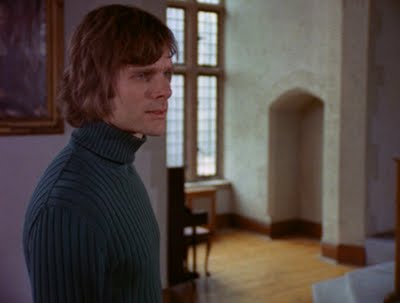
Keir Dullea, all turtlenecks and shaggy 1970’s hair, as Peter in “Black Christmas” (1974).
4. You know a relationship’s going south when you begin to suspect your lover of being a serial killer. Such was the case between Jess and her turtleneck-wearing boyfriend Peter in Black Christmas (1974). When Jess reveals to Peter her unwanted pregnancy and plans to have an abortion, his reaction is not only negative, but downright crazy in its intensity. But did this news, plus his failed piano recital — artists, they’re so sensitive — push Peter to the brink of insanity?


“Crime in a Madhouse”. Photograph by Hans Wilder, 1947.
If you’re a fan of horror and/or theatre, you will inevitably encounter the term grand guignol and, if you’re like me, wonder what it means and from where it comes. The French phrase grand guignol has been absorbed into the English lexicon as a term to describe any excessively gruesome and gory spectacle, but its origins are much more specific. Le Théâtre du Grand-Guignol was a theatre founded in Paris by Oscar Méténier in 1894. Operating for 65 years, it produced one-act plays, many of which focused on violent and erotic works of horror.
The theatre was opened by Oscar Metenier, a writer and police secretary, who created slice-of-life plays about the Parisian underlife and stories of true crime. Metenier was a follower of Naturalism: a movement in late 19th Century theatre that attempted to create a perfect illusion of reality. Naturalistic works often exposed the dark harshness of life, with themes of poverty, racism, sex, prejudice, disease, prostitution, and filth.
After a couple of years at the helm, Metenier handed the theatre over to Max Maurey, who saw the commercial potential of the theatre and, in particular, capitalized upon its darker side. Maurey incorporated melodrama into the Grand-Guignol’s acting style to heighten the emotion of the more sensational elements while keeping Naturalism as the guiding principle for characters and situations. It was under Maurey that the style of the Grand Guignol became renowned throughout Europe and, eventually, the world.
— text from Theatre of Blood web site.
Theatre-goers would be treated to five or six one-act plays in an evening’s performance, alternating between bawdy, Vaudevillian-style comedies, to violent tales of crime, madness, and bloody revenge. The gory special effects of the Grand-Guignol were world-renowned for their high degree of realism, and the theatre employed teams of propsmen who specialized in fake blood, severed limbs, and impaled eyeballs. Some of the more famous horror-themed plays staged included:
Le Laboratoire des Hallucinations, by André de Lorde: When a doctor finds his wife’s lover in his operating room, he performs a graphic brain surgery rendering the adulterer a hallucinating semi-zombie. Now insane, the lover/patient hammers a chisel into the doctor’s brain.
Un Crime dans une Maison de Fous, by André de Lorde: Two hags in an insane asylum use scissors to blind a young, pretty fellow inmate out of jealousy.
L’Horrible Passion, by André de Lorde: A nanny strangles the children in her care.
Le Baiser dans la nuit by Maurice Level: A young woman visits the man whose face she horribly disfigured with acid, where he obtains his revenge.

A scene from Grand Guignol.
Le Théâtre du Grand-Guignol closed its door in 1962. Audiences had dwindled in the years following WWII, likely due to the fact that the staged horrors had now been eclipsed by the real world horrors of the war and the Holocaust. “We could never equal Buchenwald,” said its final director, Charles Nonon. “Before the war, everyone felt that what was happening onstage was impossible. Now we know that these things, and worse, are possible in reality.” (from Wikipedia).

Video still from “Domestikia: The Incident in the Nursery” by Jennifer Linton, 2:01 minutes, 2012.
My short animated film Domestikia: The Incident in the Nursery will be screened next month during the 2nd Winter edition of the King Street Alternative Film & Video Festival. According to the festival’s blog, they’ve programmed over 35 films & videos over the 8th and 9th of February (2013), ranging from the very short to over 20-minutes in length. The event is held at Betty’s, that stalwart Corktown staple located directly across from the Toronto Sun building on an otherwise desolate stretch of King Street East. The beer and nachos at Betty’s are glorious, and the evening should prove fun and entertaining. Come on out and support your local, indie filmmakers!
Wow! This blog Lady Lazarus: dying is an art received exactly 47,512 visits in 2012. That’s pretty impressive for a personal blog fuelled by the writing powers of just one individual. Many thanks to those amongst you who “follow” me and add your comments to my posts. It takes at least two to make a conversation, so keep those comments coming in 2013. This blog is a pure labour of love, and I plan to keep it that way. The drive that keeps me researching and writing about all things dark and macabre is a genuine, unslakable curiosity. I’m just a big nerd that way.
The WordPress.com stats helper monkeys prepared a 2012 annual report for this blog.

Here’s an excerpt:
4,329 films were submitted to the 2012 Cannes Film Festival. This blog had 47,000 views in 2012. If each view were a film, this blog would power 11 Film Festivals
Viva la Google. Discovered this little gem via the search engine. No author’s name is attached to it, but here is the originating web site. Silly fun, so I thought I’d share it with you. Assuming the world doesn’t come to an abrupt end on December 21st as per the Mayan predictions, have a good holiday everyone! — Lady Lazarus.

Have a dreary Gothic Christmas and a wretched New Year.
With somber and tormented apologies to Clement C. Moore:
‘Twas the night before Christmas, and all through our house
was blasting the “St. Vitus Dance” by Bauhaus;
Torn fishnets were draped on my forearms with care,
And two cans of Aquanet applied to my hair;
My thoughts were of graveyards, and horror and dread,
Black visions of pain and despair in my head;
And Bianca, whose face was as pale as the moon,
Had thrown up her arm for this evening’s swoon,
When out by the gravestones there came such a clatter,
I sprang from the coffin to find out the matter.
Away to the window I flew like a ghost,
Expecting to find a dark devilish host.
The moon on the breast of the uncaring snow
Threw ominous shadows on objects below,
When, before my tormented eyes did traverse,
But a gorgeous black Crane & Breed carved-panel hearse,
With a gaunt, shrouded driver, who filled me with fear,
And eight skeletal creatures that might have been deer.
More rapid than vultures his coursers they came,
And his deep Andrew Eldritch voice called them by name;
Now, Murphy! Now, Morgoth! Now, Torment and Woe!
On, Dreadful! On, Lovecraft! Mephisto and Poe!
To the top of the gravestones where fog wisps its breath!
With a weight on my soul I consign you to death!
As dead leaves that before hellish hurricanes fly,
When they flutter like giant bats’ wings to the sky,
So up to the crypt-top the coursers they leapt,
While dearest Bianca, like death, still but slept.
And then, to my horror, I heard on the roof
The clicking and scratching of each bone-white hoof.
As I drew in my arm, and was whirling around,
Down the ebony chimney he came without sound.
He was clad all in black, and he looked oh-so-goth,
A billowy ensemble of crushed velvet cloth;
His boots were knee-high, quite buckled and zipped,
And the Spandex and fishnets ’round his legs were ripped.
His eyes glowed with bluish fire, deathly and cold,
A black eye-liner’d face neither youthful nor old.
A broad lipless mouth drawn with torment and hurt,
And his sorrowful face was as white as my shirt.
A smoldering cigarette tight in his grasp,
Its smoke curling eerily ’round his cloak clasp;
His gaunt frame was topped with long ebon hair,
And a sharp scent of brimstone and cloves choked the air.
His arms were outspread in the shape of a cross,
And I quailed when I saw him, feeling sorrow and loss;
He narrowed his eyes with a twist of his head,
And I felt the full weight of his angst and dread.
He spoke not a word, but went straight to his task,
Left some Dead Can Dance CD’s; before I could ask,
A single tear fell across his aquiline nose,
And then, like an angel, up the chimney he rose;
He sprang to his hearse, to his team he then hissed,
And away they all drifted like early dawn’s mist.
But I heard him intone, ere he vanished from sight,
“Gothic Christmas to all, and to all a good fright!”
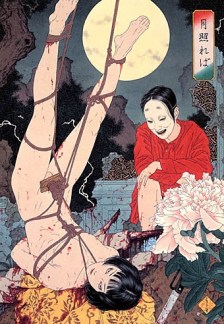
An illustration by Takato Yamamoto, a contemporary Japanese artist working in the “ero guro” style.
Ero guro nansensu (a wasei-eigo term that literally means “erotic-grotesque-nonsense”) was a media-driven cultural phenomenon that originated in 1920–1930 Japan. The social climate of Tokyo between the two World Wars can be closely compared to that of Berlin’s Weimar era, with its famous hedonism and nihilistic world view amongst its artists and bohemian fringe. In his essay “Deviance and Social Darwinism in Edogawa Rampo’s Erotic-Grotesque Thriller Koto no Ōni” (2001), Stanford University professor Jim Reichert characterized ero guro as a “prewar, bourgeois cultural phenomenon that devoted itself to explorations of the deviant, the bizarre, and the ridiculous.” The art of ero guro puts its focus on eroticism, sexual corruption, decadence and the grotesque. While ero guro is a specific movement, many of its components can be found throughout Japanese history and culture. In fact, there is a well-established tradition in Japanese ukiyo-e (woodblock prints) of shunga depicting decapitations and acts of violence from Japanese history such as rape, bondage and erotic crucifixion.

Takato Yamamoto.
This tradition of morbid eroticism continues in the work of contemporary Japanese illustrators and manga artists Takato Yamamoto and Suehiro Maruo. An obvious and immediate connection can be traced from the aforementioned ukiyo-e prints to Takato Yamamoto’s delicate colour palette and rendering style. Even as his dreamlike scenes reveal bondage and torture, his protagonists — often naked, effeminate boys — are frequently shown staring off in a calm, eerily detached manner. Yamamoto leaves his narratives deliberately opaque: it’s difficult to decipher whether these young boys are willing participants in these sinister proceedings, or have merely resigned themselves to their fate. The horror in Yamamoto’s art — while undeniably present — is tempered by the strange stillness of his scenes, as well as by his beautiful and virtuosic rendering.

The art of Suehiro Maruo.
The horror in Suehiro Maruo’s illustrations, on the other hand, is big, bold and shaded bright red. Adopting an illustrative style highly reminiscent of WWII-era Japanese propaganda posters (similar to the Soviet “socialist realism” style), Maruo’s images are typically gorier than those of Yamamoto, though these images are no less beautiful. His favourite motif is the young couple locked in an embrace, a romantic image that Maruo disrupts with the insertion of gore — as seen in the image on the left of the young soldier licking the eyeball of his sweetheart, whose face he’s so tenderly peeled away from her skull. Whereas Maruo’s illustrations tend to celebrate the more grotesque elements of ero guro, they are typically tamer in their representations of sexuality in comparison to the raunchier Yamamoto.

My full-colour “alphabet book for adults” entitled My Alphabet of Anxieties & Desires is now available as an eBook for your iPad, iPhone or iPod Touch. All twenty-six letters of the Roman alphabet are rendered in original illustrations, all of which address either an “anxiety” or a “desire.” There’s also a preface written by myself, plus a foreword by gender-studies academic and PhD-candidate, Judith Mintz. All this for the princely sum of .99 cents (US).
You can purchase your copy at Blurb. The eBook can also be purchased in the iTunes bookstore: http://itunes.apple.com/ca/book/id582540445
The printed version of the book is available for $29.99 US.
 Lady Lazarus