The Nutshell Studies of Unexplained Death

Dollhouse enthusiasts are frequently known for their slavish devotion to detail. Countless hours will be spent in replicating a miniature world, whether idealized or dystopian, in exacting detail. The nineteen dollhouse rooms created by Frances Glessner Lee, however, take this attention to detail to startling — and brilliantly macabre — heights.

Frances Glessner Lee was a Chicago heiress with a curious obsession. During the 1940’s, Lee was a volunteer police officer with a honorary captain’s rank, and she possessed a passion for forensic science. At her New Hampshire estate, she installed a workshop to fashion crime scene dioramas, which she dubbed her “Nutshells”. These dollhouse-sized rooms were designed as classroom tools to instruct detectives in crime scene investigation. Lee founded Harvard’s department of legal medicine, the first program in the nation for forensic pathology.

According to a New York Times article on Lee, the Nutshells now reside in the office of the Maryland state examiner in Baltimore, where they are still used in seminars. Each diorama is packed with small-scale clues such as blood-splatters, a pillowcase smeared with lipstick, and a bullet embedded in a wall.

Corinne May Botz published a book of photographs entitled The Nutshell Studies of Unexplained Death, that beautifully capture the details of Lee’s crime scene “nutshells”. Below are some images from Botz’s book.

Centre 3 for Print and Media Arts

blueprints

My installation The Disobedient Dollhouse will be featured in the curated group show Blueprints at Hamilton’s  Centre 3 for Print and Media Arts. This exhibition will also screen my two recent animated videos Domestikia: The Incident in the Nursery and Domestikia, Chapter 3, La Petite Mort. Show runs from January 17 – March 1, 2014. The opening reception will take place Friday, February 14 at 7 – 10 p.m.

Lady Lazarus’s 2013 in review!

Was Jayne Mansfield a satanist? That, amongst other burning questions, is what drove the most traffic to my blog over 2013. View all the details in the 2013 annual report for this blog.

[For those of you not familiar with my blog, I don’t typically write on such heady topics as “was Jayne Mansfield a satanist?”. My blog features examples of my artwork from the past several years, as well as my musings about visual art and horror cinema, with a focus on art and film that evokes the bizarre, macabre and/or uncanny.]

Here’s an excerpt:

The concert hall at the Sydney Opera House holds 2,700 people. This blog was viewed about 47,000 times in 2013. If it were a concert at Sydney Opera House, it would take about 17 sold-out performances for that many people to see it.

Click here to see the complete report.

“My Alphabet Of Anxieties & Desires” — Christmas book sale!

Just in time for Christmas: My Alphabet Of Anxieties & Desires depicts all twenty-six letters of the Roman alphabet in original, highly-rendered illustrations. While based on the format of a child’s alphabet book, this book is most assuredly for adults. If you prefer a book that you can actually touch, then you’ll appreciate the high-quality paper and printing. Ships directly to your doorstep, no matter where you are. Sweet.

The book is 40 full-colour pages, printed on a premium matte paper with a perfect-bound softcover. There’s a short preface written by myself, and a thought-provoking foreword by Judith Mintz.

Dolls House & Miniature Scene Magazine interview.

Somehow, I completely forgot to post the interview I had back in August 2013 with the UK-based magazine Dolls House & Miniature Scene. Here’s a scan of the layout and the article. The interview was focused on my earlier project, The Disobedient Dollhouse. Click on the images below to get a larger (and much more legible) article.

I found it amusing how the editor kept insisting on changing the title of my work to conform to the British usage of the term “dollshouse” with the plural, rather than my North American-derived term “dollhouse”. Whatever.

1014646_10152904366835408_840964568_o 1040617_10152904366865408_359775656_o

Happy Hallowe’en from Lady Lazarus!

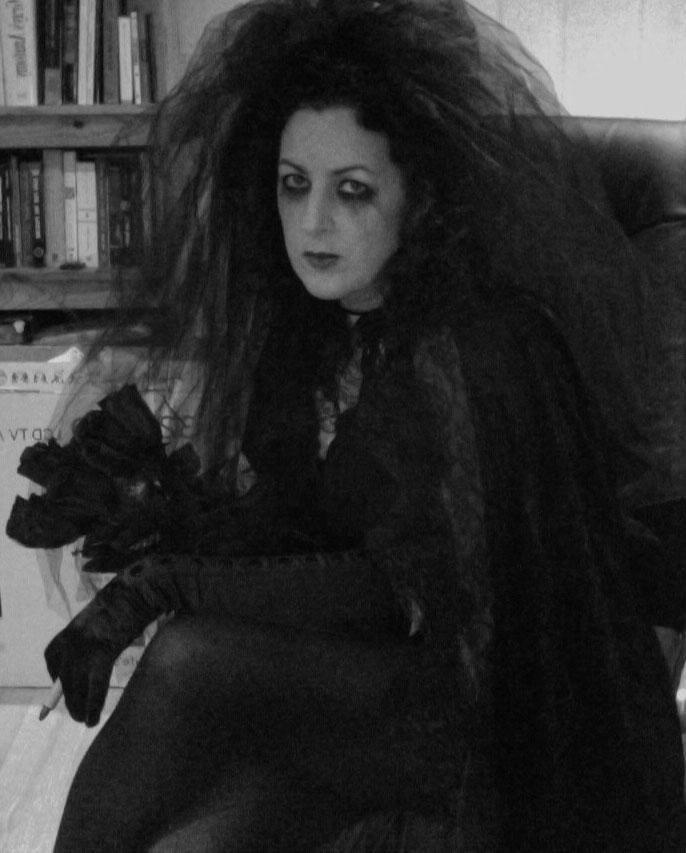
death_the_bride

Myself dressed as “Death the Bride”. Halloween 2013.

My Hallowe’en costume this year is channelling the melancholic romanticism of a tragic, Edgar Allan Poe heroine*. On October 31st, I shall fall into a despair that leads to madness, succumbing to a death-like trance. This will prompt my bereaved loved ones to prematurely bury me in the family crypt. Afterwards, my restless ghost shall arise for revenge, and chocolate.

Happy Halloween, everyone!

*my costume is also channelling the morbid romanticism of the Pre-Raphaelite painter Thomas Cooper Gotch — a morbidity best captured by his 1895 painting entitled (as you may have guessed)  Death the Bride.

"Death the Bride" by Thomas Cooper Gotch. 1895. Oil on canvas

“Death the Bride” by Thomas Cooper Gotch. 1895. Oil on canvas

The Life and Untimely Death of Ann Hibbins.

“Execution of Ann Hibbins on Boston Common” Sketch by F. T. Merril, 1886.

During times of conservatism and religious fundamentalism it can prove difficult, if not downright lethal, to be an independent and outspoken woman. The recent case of Malala Yousafzai — the teenage Afghan activist who was shot by the Taliban for her vocal condemnation of their refusal to allow Afghan girls to attend school — reminds us that this danger still looms in many parts of the contemporary world.

The modern-day plight of Afghan girls like Yousafzai, and their systematic oppression by the ultra-conversative Taliban, recalls an earlier time in history when fervent religiosity ran rampant: the Salem Witch Trials.

The Salem witch trials were a series of hearings and prosecutions of people accused of witchcraft in colonial Massachusetts, between February 1692 and May 1693. They later became a notorious example of mass hysteria in American history, and highlighted the very real danger of religious extremism. The overwhelming majority of the people prosecuted for witchcraft were women. These women tended to belong to the poor and working class, and thus were disadvantaged in terms of economics and social status. The one exception was the wealthy widow, Ann Hibbins.

Ann Hibbins was executed for witchcraft in Boston, Massachusetts, on June 19, 1656. Her execution was the third for witchcraft in Boston and actually predated the Salem Witch Trials by thirty-six years. Twice-widowed, Hibbins was an outspoken and financially-independent woman, all of which tended to antagonize the local religious authority:

In 1640, Ann Hibbins sued a group of carpenters, whom she had hired to work on her house, accusing them of overcharging her. She won the lawsuit, but her actions were viewed as “abrasive”, and so she became subjected to an ecclesiastical inquest. Refusing to apologize to the carpenters for her actions, Hibbins was admonished and excommunicated. The church also cited her for usurping her husband’s authority. Within months of her husband’s death, proceeding against her for witchcraft began. — from Wikipedia.

It’s interesting to note that none of the evidence used to convict Hibbins of witchcraft remains. One of her supporters, a minister named John Norton, commented privately to another clergy that, “…[Hibbins] was hanged for a witch only for having more wit than her neighbors.”

So, here’s what I’m suggesting, my fellow XX-chromosome owners. Rather than wait for the religious extremists to ’round us up, let’s go git ’em first. They’d never see us coming till it’s too late. Lemme go grab my broomstick and pointy black hat [cackle].

VideoArt.net Selection of the Month (October)

videoart

My stop-motion animation Domestikia, Chapter 3: La Petit Mort is one of the Selections of the Month (October 2013) at Videoart.net, an international curated video-sharing network for video artists and experimental filmmakers: http://vlog.videoart.net/jennifer-linton-domestikia-chapter-3-la-petite-mort/

Founded in 2005, Videoart.net quickly positioned itself as the most popular video art and experimental film website in the world. Videoart.net attracts both art and film industry professionals by providing a gateway to an international network with a dynamic online curatorial community. By carefully curating thousands of video artworks by hundreds of artists all over the world, Videoart.net prides itself in providing the most rousing, thought-provoking, unprecedented, and significant works in film and video currently being produced. — from VideoArt.net web site.