“Domestikia: An Account of Some Strange Disturbances” begins February 24th, 2012.

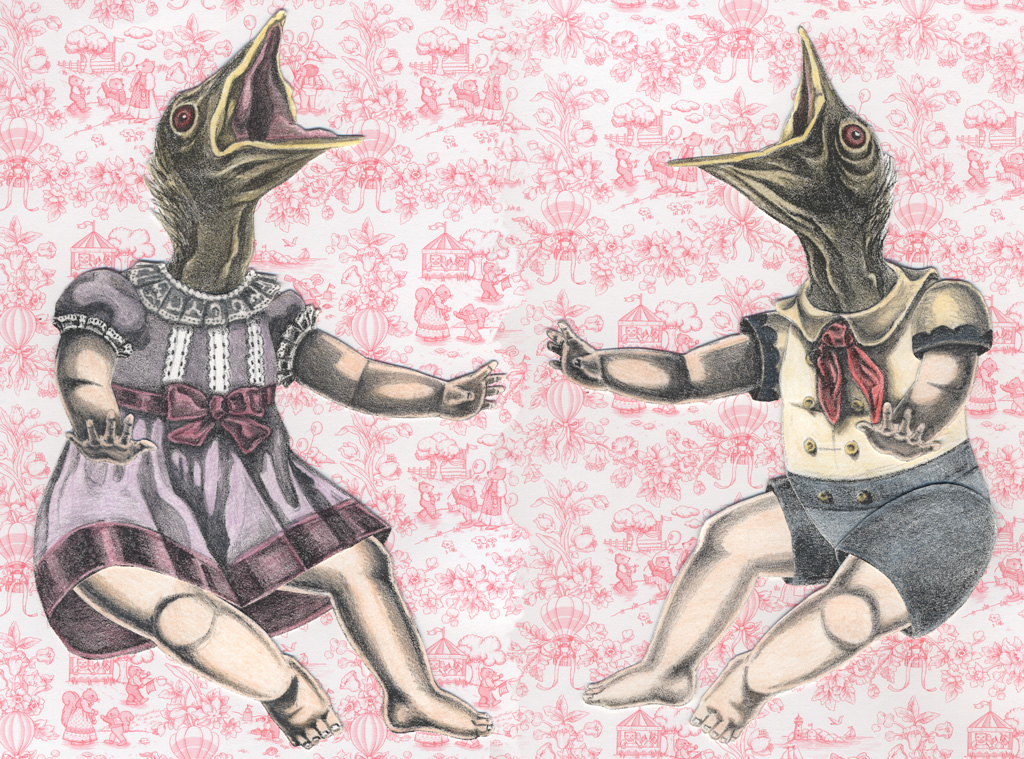
"The Brood" (2012) by Jennifer Linton. Work-in-progress photograph of a shadowbox assemblage, which includes hand-coloured lithographs that are cut out and pasted into paper dolls.

If you live in the Toronto area, then drop by Open Studio to view some of my recent creative efforts. My latest exhibition “Domestikia: An Account of Some Strange Disturbances” is an exploration into the interdisciplinary possibilities of printmaking. I’ve created articulated paper puppets from lithographic prints, which are then arranged into strange, dream-like shadow box tableaux. These same paper puppets are brought to life in a stop-motion animation, all taking place within an imagined dollhouse.

Opening reception is Friday, February 24th at 6:30 – 8:30 p.m. Join me for wine, conversation and general frivolity. Show runs from February 24 – March 31, 2012. Open Studio is located on the ground floor of 401 Richmond, at the corner of Richmond and Spadina in Toronto. For more information on this show, visit the Open Studio web site.

The month of February is quickly being swallowed up by my teaching & an exhibition of my art taking place on the 24th. Here’s a repost of an earlier entry on the late American artist Hannah Wilke. She was a busy person, too.

Lady Lazarus's avatarLady Lazarus

I wrote the following essay on American visual artist Hannah Wilke for an art history class in graduate school. I include the full text and images, excluding citations. If you’re a student who discovers this via search engine, then I have every confidence in your research abilities to track down the scholarly sources. Wilke was a seminal Second Wave feminist artist whose work has received renewed interest from scholars since her death in 1993.

The politics of inclusion that shaped feminist discourse in the 1960s and 1970s spawned a legacy of body-based performance art, much of which was associated with women artists who used their own face as a subject of continual exploration. The self- imaging of women artists such as the provocative American artist Hannah Wilke was frequently attacked and dismissed by art critics as being indulgent exercises in narcissism that only served to reinforce the objectification of the…

View original post 4,045 more words

The 3D paper cutout animation of Co Hoedeman’s ‘Charles et François’.

I recently discovered the stop-motion work of French-Canadian animator Co Hoedeman. One of his earlier animations, Charles et François, made use of paper cutouts mounted upright in a fully 3-dimensional set. He employed the technique of “substitution” — where different paper drawings are swapped in, frame to frame, to indicate movement — rather than rely on jointed or “articulated” paper puppets. The effect is quite breathtaking.

"Charles et François", by Co Hoedeman, 1987, 15 min 24 s.

Here is the synopsis as it is given in French on the NFB/ONF web site, followed by a predictably clumsy Google Translate English version:

Film d’animation dévoilant le récit d’une relation hors de l’ordinaire, toute de tendresse et de complicité. Ce film témoigne des bouleversements physiques et psychologiques qui se vivent, pour un grand-papa et son petit-fils, au fil des ans. Voilà ainsi posée une douce réflexion sur le caractère changeant des choses et de la vie.

Animation revealing the story of an extraordinary relationship, full of tenderness and complicity. This film reflects the physical and psychological changes that live for agrandfather and his grand-son, over the years. This is a gentle and laid reflection on the changing nature of things and of life.

Unfortunately, I can’t embed the video from the NFB web site. However, if you click on the following link you can view this animation: http://www.nfb.ca/film/charles_et_francois/embed/player

The Gothic Lolita, examined.

A Japanese 'kurololi', characteristically dressed entirely in black.

Back in August of 2011, I wrote a blog entry about my fascination with the Goth subculture, an entry appropriately entitled Goth like me; or, why does little Jenny mope in her bedroom all day, wearing black and writing bad poetry? Indeed, for several years I have held an interest in Goth-inspired art, music and fashion, even before I was aware of that particular label. As my earlier post explained, there are several different fashion styles that fall under the broad category ‘Goth’, all with their own distinct rules and conventions. One of the most interesting and — for some Westerners — difficult to understand modes of Goth dress is the Japanese Lolita.

One of the most common misunderstandings of the Lolita subculture is the belief that the associated costuming somehow relates to either sex and/or cosplay. Neither, however, are true. The Japanese use of the English name “Lolita” is likely a case of wasei-eigo, or Japanese-derived English, and does not refer to the novel by Vladimir Nabokov nor its titular 12-year-old “nymphette” heroine. The Lolita mode of dress places a strong emphasis on Victorian-era elegance and modesty, and is not intended to be ‘sexy’. Nor is Lolita garb derived from anime or manga characters, like the cat-ears and spiky blue-hair of cosplay costumes.

Lolita fashion grew out of the 1980s-90s Japanese music scene, inspired by flamboyantly-dressed pop music icons such as Princess Princess and the cross-dressing Malice Mizer. Much like Goth dress in general, the Lolita also has several different fashion incarnations:

The Gothic Lolita

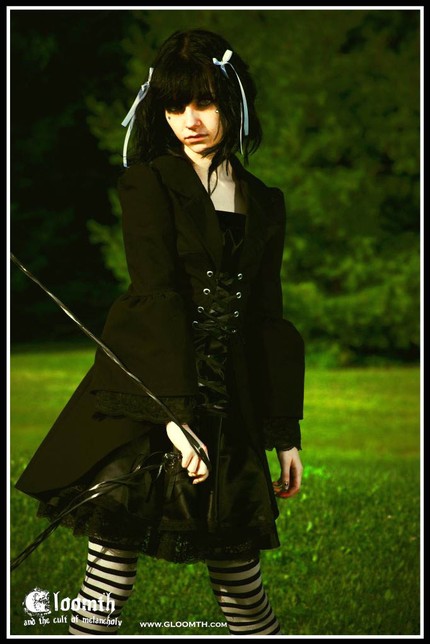
A Western version of the Gothic Lolita, from the Canadian-based fashion label Gloomth & the Cult of Melancholy.

Gothic Lolita (or ‘gothloli’) fashion originated in the late 1990s in Harajuku (region in Tokyo). This style is characterized by the wearing of black and white clothing, though black + another colour (red, purple) is not uncommon. Clothing generally includes ruffled blouses with bows and puffed sleeves, knee-length skirts (often worn with crinolines or petticoats for that classic bell-shaped silhouette), stockings or knee-high socks, and girlish mary-jane shoes or Victorian-style boots. Hats, ornate headbands, gloves and parasols are common accessories. The Westernized versions of the Gothic Lolita tend to downplay the ultra-feminine ribbons, ruffles and bows of the Japanese look, while still adhering to the Victorian doll-like Lolita aesthetic.

The Sweet Lolita

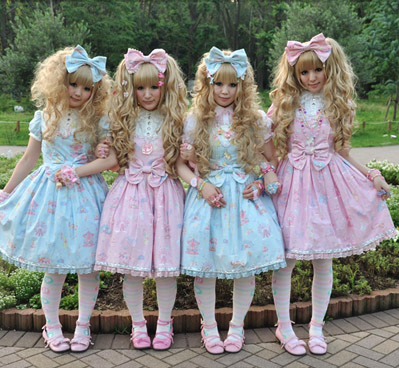
A small pack of Sweet Lolitas. So sweet, your teeth might ache.

Similar in dress to the gothloli, this style adopts saccharine-sweet, lighter colours — often pink or baby-blue — and childlike motifs like Alice in Wonderland, hearts, strawberries, cupcakes and teddy bears. I firmly believe that there are some modes of dress that can only be successfully worn by 16-year-old Japanese girls. This is one of those. The Sweet Lolita attempts to emulate the porcelain skin and blonde ringlets of a European, Victorian-era doll.

The Pirate Lolita

Not a particularly common Lolita style, but certainly a fun and flamboyant one. The fashion label Alice & the Pirates (a side-project of Baby, the Stars Shine Bright) offers all an aspiring pirate needs to look to part. Ahoy, maties!

Gurololis compare their wounds.

The Guro Lolita

This style is one of the most curious of the Lolita fashions. The Guro Lolita dresses as a “broken doll”, with band-aids, eye-patches, and bloodied gauze bandages. Often, they wear white — a colour that provides the perfect canvas on which to splatter pretend blood and gore. It is common for the gurololi to carry around an equally bandaged & bloodied doll or teddy-bear.

Shiro & Kuro Lolita

Shiro Lolita, or ‘White Lolita,’ is a Lolita outfit made entirely of white/cream/off-white co-ordinates, while its counterpart Kuro Lolita, or ‘Black Lolita,’ is an outfit made-up of entirely black co-ordinates. Shiro and Kuro Lolita can be taken from any style of Lolita, whether it be Gothic, Sweet, or Classic. If the co-ordination is completely white, then it is accepted as Shiro Lolita, while if it is entirely black it is accepted as Kuro.

Wa Lolita

The Wa Lolita.

The Wa Lolita combines traditional Japanese clothing — namely the kimono — with the Lolita style. The kimono-style garment is modified to accommodate the fullness of a petticoat and Japanese wooden sandals (called okobo) sometimes replace the typical Lolita boots or platform mary-janes. Another East-meets-West Lolita mashup is the Qi Lolita. This style uses Chinese clothing and accessories in place of Japanese, and usually this includes qipao dresses modified to accommodate a petticoat.

Even though I’m going to end my blog post here, by no means should you consider this list an exhaustive account of all of the Lolita styles. For the complete list, visit this Lolita Style Handbook.

2011 in review – Thank You & Happy New Year from Lady Lazarus!

The WordPress.com stats helper monkeys prepared a 2011 annual report for this blog.

Here’s an excerpt:

The concert hall at the Syndey Opera House holds 2,700 people. This blog was viewed about 27,000 times in 2011. If it were a concert at Sydney Opera House, it would take about 10 sold-out performances for that many people to see it.

Click here to see the complete report.

My Demon Lover: the mythology of the incubus.

“Inkubus” (photograph, 2005) by contemporary German visual artist Michael Hutter.

The incubus is a demon in male form — the female equivalent is called a succubus — who, according to different mythologies and legends throughout the world, lies upon women whilst they sleep in order to have sexual intercourse with them. In the Middle Ages, belief in demons who sexually preyed on humans assuaged a sleeping person’s shame and guilt over nocturnal emissions and other physical evidence of erotic dreams. Primarily, however, the incubus legend functioned as a convenient means to conceal incest and other types of sexual assault upon girls and women who had no unchaperoned access to men outside the home, but had nonetheless become inexplicably pregnant.

In contrast to the sleeping rape victims of medieval yore, the women that populate the photographic work of contemporary visual artist Michael Hutter are both wide awake and engaged in consensual coupling with their respective incubi. In the sepia-coloured photo-collage entitled Inkubus, a nude woman sporting a 1920’s flapper-style bob receives an amorous lick from the tiny demon lover perched on her shoulder. In The Alien Nurse, the erotic-grotesque combines with Victorian fetishism as a blindfolded “wet-nurse” offers up her breast to a curious intestinal/tentacled alien blob. In subsequent photo-collages, the wet-nurse discovers new and even more intimate uses for the alien tentacle, recalling shokushu goukan or ‘tentacle erotica’ of contemporary Japanese hentai.

“Die Alienamme (The alien nurse)”, photograph, 2006 by Michael Hutter.

The work of German artist Michael Hutter ranges from ink drawings on paper reminiscent of the Victorian kinkiness of Aubrey Beardsley’s Lysistrata, to the retro-inspired photo-collages you see here.  Visit his online gallery to see for yourself, though perhaps not whilst at the office.

Quoth the Raven, ‘Nevermore.’

Open here I flung the shutter, when, with many a flirt and flutter,
In there stepped a stately Raven of the saintly days of yore.
Not the least obeisance made he; not a minute stopped or stayed he,
But, with mien of lord or lady, perched above my chamber door–
Perched upon a bust of Pallas just above my chamber door–
Perched, and sat, and nothing more.

Then the ebony bird beguiling my sad fancy into smiling,
By the grave and stern decorum of the countenance it wore,
“Though thy crest be shorn and shaven, thou,” I said, “art sure no craven,
Ghastly grim and ancient Raven wandering from the Nightly shore–
Tell me what thy lordly name is on the Night’s Plutonian shore!”
Quoth the Raven, “Nevermore.”
— an excerpt from the narrative poem “The Raven” by Edgar Allan Poe. First published in 1845.

In North America and most of Europe, the raven is a bird that symbolizes ill-omen and doom. Due to its jet-black plumage, eerie call and carrion-eating tendencies, the raven and its smaller cousin, the crow*, have haunted the imaginations of mankind from time immemorial. American Gothic writer Edgar Allan Poe famously employed the bird as a harbinger of doom in his poem “The Raven,” an excerpt of which is offered above. The poem tells of a talking raven’s mysterious visit to a distraught lover, tracing the man’s slow descent into madness. The narrator — whom, it’s been suggested, represents Poe himself — mourns the loss of his dead love Lenore. The raven flies into the room through an open window and perches itself (permanently, as it turns out) upon a sculptural bust of Athena that rests above the door. It then proceeds to torment the narrator to the brink of madness simply by repeating the poetic refrain “nevermore” at the end of each stanza. For his part, the narrator engages in a curiously self-defeating game of “20 questions” with the raven, peppering the bird with questions to which — he’s fully aware — it can only answer “nevermore.” In true Gothic tradition, Poe’s “The Raven” is epic, highly theatrical, and steeped in a melancholia characteristic of that literary genre.

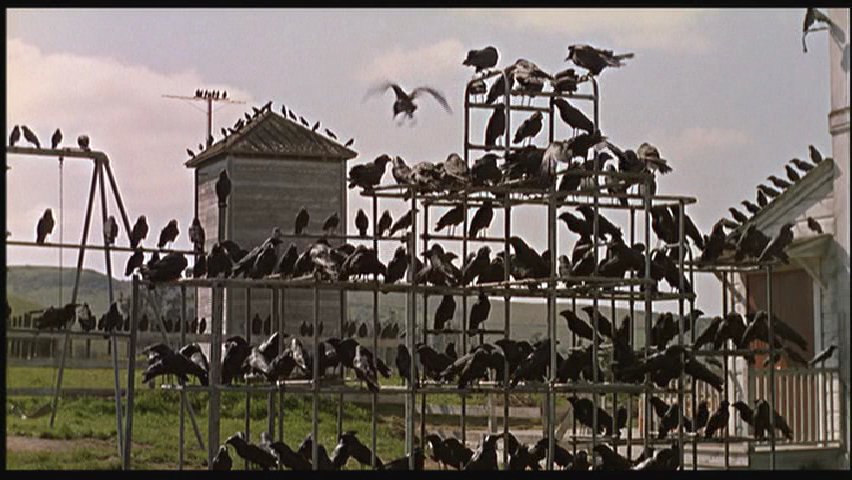
The crows begin to assemble on the play equipment behind the local school in Hitchcock's "The Birds" (1963).

The crow, the raven’s smaller yet equally foreboding cousin, gets its moment in the spotlight in British film director Alfred Hitchcock’s 1963 film “The Birds”. A profoundly intelligent and resourceful bird, a flock of crows is called a murder because “…the group will sometimes kill a dying cow.” Hitchcock capitalized on the silhouette of the menacing crows — not to mention their violent reputation — in his classic horror film in which birds inexplicably attack humans. Oh sure, the idea of violent attack from a single budgerigar seems ludicrous. However, as one character in the film points out, birds significantly outnumber humans on this planet, and if they did group together to get rid of us…

Mrs. Bundy: Birds have been on this planet, Miss Daniels, since Archaeopteryx, a hundred and forty million years ago. Doesn’t it seem odd that they’d wait all that time to start a…a war against humanity.

Salesman: Your captain should have shot at them… Gulls are scavengers anyway. Most birds are. Get yourselves guns and wipe them off the face of the earth.

Mrs. Bundy: That would hardly be possible… Because there are eight thousand, six hundred and fifty species of birds in the world today, Mr. Carter. It is estimated that five billion, seven hundred and fifty million birds live in the United States alone. The five continents of the world…

Salesman: Kill ’em all. Get rid of them. Messy animals.

Mrs. Bundy: …probably contain more than a hundred billion birds.

Drunk: It’s the end of the world.

Sebastian Sholes: Those gulls must have been after the fish.

Mrs. Bundy: Of course.

Boy: Are the birds gonna eat us, Mommy?

Mrs. Bundy[explaining that birds of different species never flock together] The very concept is unimaginable. Why, if that happened, we wouldn’t have a chance! How could we possibly hope to fight them?

Like the drunk guy said, “It’s the end of the world.”

*What’s the difference between a raven and a crow? Read more here to find out.

Hallowe’en Night divination game.

This slideshow requires JavaScript.

Halloween is one of the oldest holidays still celebrated in modern times, and can be traced back to the Druids, a Celtic culture in Ireland, Britain and Northern Europe. Its roots lay in the feast of Samhain (pronounced SA-WIN), which was annually held on October 31st to honor the dead. Much like Christmas, the pagan traditions of Samhain were later co-opted by the Christian church and replaced by All Saints Day (Nov. 1) as a means to align the Christian feast with the already well-established pagan festival. According to Wikipedia, “The word Halloween is first attested in the 16th century and represents a Scottish variant of the fuller All-Hallows-Even (“evening”), that is, the night before All Hallows Day.” Hence, we have the modern day Hallowe’en.

In keeping with its pagan origins, a belief arose that during Halloween the barrier between the realms of the living and the dead are at their most permeable, allowing for dead spirits to enter our world. A corollary of this belief is the traditional Scottish practice of Halloween-night divination. Though little known these days, the practice of various forms of “divination games” during Halloween was wildly popular in the late 19th-century and early 20th-century, a popularity commemorated in the divination-themed Halloween greeting cards above. One of the most popular of these was a form of scrying or mirror divination, in which an unmarried woman was instructed to sit before a mirror in a darkened room on Halloween night. Purportedly, if she gazed long enough, she would see a vision of her future husband reflected in the mirror. If, however, she was to die unmarried, a skull would appear instead — which just seems incredibly creepy. A common thread exists between this Halloween practice and the Bloody Mary game, in which the participants dare each other to look into a mirror and repeat Mary’s name three times, thus possibly summoning the folkloric witch.

A Diabolical Decadence: Charles Baudelaire, Félicien Rops and the “Flowers of Evil.”

Come on my heart, cruel and insensible soul,
My darling tiger, beast with indolent airs;
I want to plunge for hours my trembling fingers
In your thick and heavy mane;

In your petticoats filled with your perfume
To bury my aching head,
And breathe, like a faded flower,
The sweet taste of my dead love.

I want to sleep, to sleep and not to live,
In a sleep as soft as death,
I shall cover with remorseless kisses
Your body beautifully polished as copper.

To swallow my appeased sobbing
I need only the abyss of your bed;
A powerful oblivion lives on your lips,
And all Lethe flows in your kisses.

I shall obey, as though predestined,
My destiny, that is now my delight;
Submissive martyr, innocent damned one,
My ardor inflames my torture,

And I shall suck, to drown my bitterness
The nepenthe and the good hemlock,
On the lovely tips of those jutting breasts
Which have never imprisoned love.

— Geoffrey Wagner, Selected Poems of Charles Baudelaire (NY: Grove Press, 1974). English translation of the poem Le Léthé by Charles Baudelaire from Fleurs du mal (1857).

Mysterious occult rituals, orgiastic parties and experiments with hallucinatory drugs: sounds like one of the notorious “acid test” road trips by Ken Kesey and the Merry Pranksters, right? While this does neatly summarize the wild merry-making of the Pranksters and the 1960’s hippie counterculture, what I’m describing above is instead the naughty behaviour of a much earlier group of non-conformists and bohemians: the Decadents of the late 19th-century.

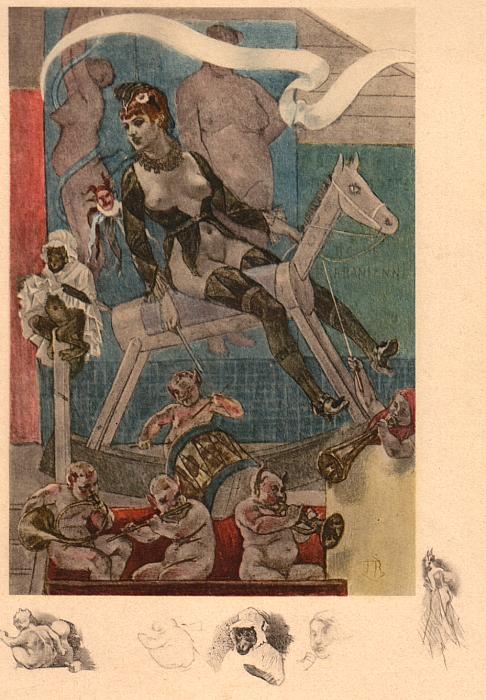
Etching & aquatint by Félicien Rops (1896).

The Decadence Movement was a fin de siècle artistic and literary style of Western Europe, primarily France. Fin de siècle or “end of the century” refers to the latter two decades of the 19th-century that were characterized by boredom, cynicism, and pessimism as well as an anxiety over the change that is inevitable in the ending of a century. While the term “decadent” was originally applied as a pejorative by critics of the style, writers and artists such as Charles Baudelaire and Félicien Rops eagerly adopted this label as a further act of defiance against the restrictive social mores they perceived in contemporary European society. For the most part, the Decadents were influenced by the tradition of Gothic novels and by the poetry and fiction of Edgar Allan Poe, and were associated with (but distinct from) Symbolism. The progenitor of Decadence was Baudelaire, and his poetry collection Les Fleurs du mal (‘The Flowers of Evil’, 1857) is considered by literary historians as a seminal work of Decadent writing. Steeped in a fashionably brooding melancholia and an almost morbid eroticism, Baudelaire’s poetry was targeted by French censors for its bold lasciviousness:


The author and the publisher were prosecuted under the regime of the Second Empire as an outrage aux bonnes mœurs (trans. “an insult to public decency”). As a consequence of this prosecution, Baudelaire was fined 300 francs. Six poems from the work were suppressed and the ban on their publication was not lifted in France until 1949. These poems were “Lesbos”, “Femmes damnés (À la pâle clarté)” (or “Women Doomed (In the pale glimmer…)”), “Le Léthé” (or “Lethe”), “À celle qui est trop gaie” (or “To Her Who Is Too Gay”), “Les Bijoux” (or “The Jewels”), and ” Les “Métamorphoses du Vampire” (or “The Vampire’s Metamorphoses”). These were later published in Brussels in a small volume entitled Les Épaves (Jetsam). — from Wikipedia.

Lithograph known alternately as “Black Mass” or “Calvary”, by Félicien Rops.

The Belgian visual artist Félicien Rops met Baudelaire towards the end of the poet’s life, and this meeting had a great impact on the career of the young artist. An accomplished printmaker, Rops illustrated many literary works including Baudelaire’s Les Épaves, a selection of poems for which he created the frontispiece. Like the works of the authors whose poetry he illustrated, Rops work tends to mingle sex, death, and Satanic images. He held a lifelong fascination with the femme fatale, an image of womankind that served as a dark and sinister Muse to that generation of Decadent artists. Of his views of Woman, Félicien Rops wrote: “Therefore it is his era, the end of the 19th century, that he [the artist] expresses through his graphic work, structured mainly around the themes of love, suffering and death, with the central unifying theme of the woman, la femme fatale in the full meaning of the word. Through her he portrays his vision of his era. Woman is Satan’s accomplice, and becomes the supreme attraction which provokes the most extreme vices and torments in Man, a mere puppet.” (an English translation of a quote taken from the Museum of Félicien Rops web site.)

Counting myself amongst the legion of “Satan’s accomplices”, I can easily admire the lewd and grotesque aspects of Rops, even as he does occasionally verge on a kind of vulgar kitsch. The unabashed sexuality of Rops lends a quality of surprising modernity to the work and gives it a contemporary feel, even as it dates from well over 100 years ago.