The Life and Untimely Death of Ann Hibbins.

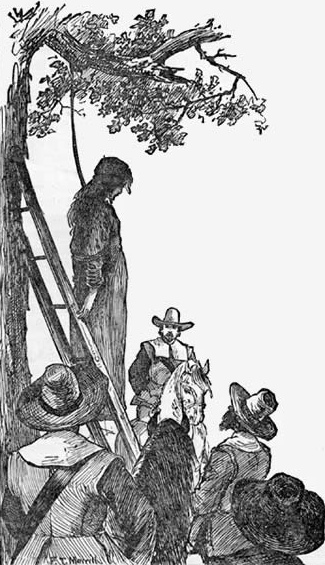
“Execution of Ann Hibbins on Boston Common” Sketch by F. T. Merril, 1886.

During times of conservatism and religious fundamentalism it can prove difficult, if not downright lethal, to be an independent and outspoken woman. The recent case of Malala Yousafzai — the teenage Afghan activist who was shot by the Taliban for her vocal condemnation of their refusal to allow Afghan girls to attend school — reminds us that this danger still looms in many parts of the contemporary world.

The modern-day plight of Afghan girls like Yousafzai, and their systematic oppression by the ultra-conversative Taliban, recalls an earlier time in history when fervent religiosity ran rampant: the Salem Witch Trials.

The Salem witch trials were a series of hearings and prosecutions of people accused of witchcraft in colonial Massachusetts, between February 1692 and May 1693. They later became a notorious example of mass hysteria in American history, and highlighted the very real danger of religious extremism. The overwhelming majority of the people prosecuted for witchcraft were women. These women tended to belong to the poor and working class, and thus were disadvantaged in terms of economics and social status. The one exception was the wealthy widow, Ann Hibbins.

Ann Hibbins was executed for witchcraft in Boston, Massachusetts, on June 19, 1656. Her execution was the third for witchcraft in Boston and actually predated the Salem Witch Trials by thirty-six years. Twice-widowed, Hibbins was an outspoken and financially-independent woman, all of which tended to antagonize the local religious authority:

In 1640, Ann Hibbins sued a group of carpenters, whom she had hired to work on her house, accusing them of overcharging her. She won the lawsuit, but her actions were viewed as “abrasive”, and so she became subjected to an ecclesiastical inquest. Refusing to apologize to the carpenters for her actions, Hibbins was admonished and excommunicated. The church also cited her for usurping her husband’s authority. Within months of her husband’s death, proceeding against her for witchcraft began. — from Wikipedia.

It’s interesting to note that none of the evidence used to convict Hibbins of witchcraft remains. One of her supporters, a minister named John Norton, commented privately to another clergy that, “…[Hibbins] was hanged for a witch only for having more wit than her neighbors.”

So, here’s what I’m suggesting, my fellow XX-chromosome owners. Rather than wait for the religious extremists to ’round us up, let’s go git ’em first. They’d never see us coming till it’s too late. Lemme go grab my broomstick and pointy black hat [cackle].

VideoArt.net Selection of the Month (October)

videoart

My stop-motion animation Domestikia, Chapter 3: La Petit Mort is one of the Selections of the Month (October 2013) at Videoart.net, an international curated video-sharing network for video artists and experimental filmmakers: http://vlog.videoart.net/jennifer-linton-domestikia-chapter-3-la-petite-mort/

Founded in 2005, Videoart.net quickly positioned itself as the most popular video art and experimental film website in the world. Videoart.net attracts both art and film industry professionals by providing a gateway to an international network with a dynamic online curatorial community. By carefully curating thousands of video artworks by hundreds of artists all over the world, Videoart.net prides itself in providing the most rousing, thought-provoking, unprecedented, and significant works in film and video currently being produced. — from VideoArt.net web site.

Lady Lazarus’s Halloween Party Movie Night, 2013 Edition.

It’s a cold, misty, grey and rainy Saturday afternoon — the perfect climate in which to begin compiling my annual Halloween horror-movie list to whet your ghoulish, pre-Halloween appetites. Last year, when it came time to write my list, I shared with you the outstanding horror films I’d seen in 2012. I decided to continue with that tradition this year, with a list of horror films that you might want to keep an eye out for — read on to get the bad Lucio Fulci-themed joke, and apologies in advance — and track down online or on DVD. As with last year’s list, some of these films are new, and some were just new to me in 2013.
Lucio Fulci's "The Beyond" (1981).

The blind girl and her canine companion from Lucio Fulci’s “The Beyond” (1981).

1. This past year I caught up with two classics from Italian horror maestro, Lucio Fulci. The sheer audacity of his signature goopy, oozing, swarming-with-maggots gore and trademark eye-gougings rightfully earned him the title of ‘Godfather of Gore’ in late 70’s – 80’s horror cinema. While I can’t recommend any of his films on the basis of story or dialogue, what they do offer are arresting visuals, an undeniably effective atmosphere of dread, and a try-anything attitude towards experimentation in B-movie filmmaking. How else can you explain the batshit-crazy scene that occurs in Zombi 2 where an underwater zombie battles a shark? Although that zombie vs. shark scene is truly heaps of campy-horror fun, the film that I’d most enthusiastically recommend by Fulci is his nightmarish masterpiece The Beyond (1981). For this film, Fulci pulls out all the stops and gives us a crumbling Southern-Gothic hotel, black magic, zombies, a portal to Hell, face-eating tarantulas and not one but three graphic scenes of eyeballs being pulled, poked and eaten out of their sockets. The story meanders passed the brink of comprehension, but the images are worth seeing it through to the end. And speaking of the end, The Beyond boasts one of the most bleak and truly haunting finales to a horror film that I’ve seen in quite a while.

Elijah Wood plays a surprisingly sympathetic serial killer in "Maniac" (2012).

Elijah Wood plays a surprisingly sympathetic serial killer in “Maniac” (2012).

2. The recent remake of the 1980’s slasher-horror Maniac by French director Franck Khalfoun was a superlative rethink of the serial killer cult classic. Then again, with Alexandre Aja heading up the screenwriting team, one should hardly be surprised at this clever re-contextualization of the tired old slasher genre. It was Aja, after all, who gave us the gender-bending slasher-thriller Haute Tension back in 2003. When the remake of Maniac was announced, many wondered (as I did) how the relatively diminutive Elijah Wood could step into the role of serial killer Frank Zito that had been originally portrayed by the large, hulking Joe Spinell. Admittedly, he was convincingly creepy as the cannibalistic Kevin in Robert Rodriguez’s Sin City, but then all Wood needed to do for that role was stare vacantly behind eyeglasses and grin. The character of Frank needs to be equal parts nerdy, pathetic and truly terrifying. Wood pulls this off, in part due to the POV-style of the film. The audience experiences the film through Frank’s eyes, and Wood is only occasionally glimpsed in mirrors and other reflective surfaces. As the grimy, crime-infested New York City of the original film no longer exists, Khalfoun shot in the sleazier neighbourhoods still existent in Los Angeles to recreate an environment that threatens violence. The kills are bloody enough to satisfy most gorehounds, though the CGI does lack the visceral quality of Tom Savini’s famed physical SFX — such as the infamous scene in the 1980 original where Savini himself has his head blown off by a close range shotgun. That said, this remake is definitely worth a look.

Jorge Michel Grau's cannibal film "We Are What We Are." (2010).

Jorge Michel Grau’s cannibal film “We Are What We Are.” (2010).

3. Recently on Hulu, I noticed there’d been an English-language remake of the Mexican cannibal film We Are What We Are (Original Spanish title Somos lo que hay, 2010. Directed by Jorge Michel Grau). While I’ve not seen this remake, the original Mexican film was a surprise discovery for me this past year (the film was only released in North America on VOD). It tells the curious story of a family of cannibals who are compelled — for reasons that are left to one’s own imagination — to ritualistically murder and devour victims kidnapped off the streets of Mexico City. For a cannibal film, We Are What We Are is profoundly understated in it’s gore…at least, until the latter half of the film. For the most part, it’s a tense family drama, and relies much more on character development and atmosphere than one would expect from a film in this genre. Recommended for the horror fan who likes a dash of the unexpected.
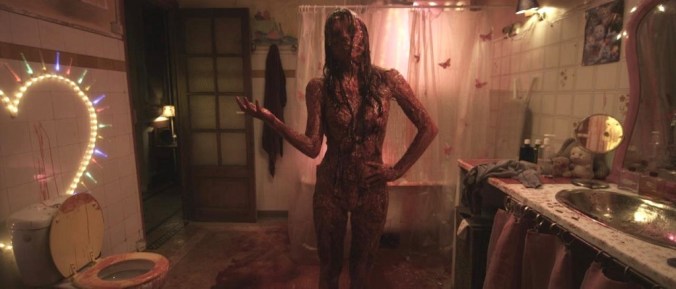
"X is for XXL" from the horror anthology "The ABC's of Death." (2012)

“X is for XXL” from the horror anthology “The ABC’s of Death.” (2012)

4. Five minutes, five thousand dollars, and one randomly-selected letter of the alphabet. That was the premise behind the massive horror anthology The ABC’s of Death (2012).  It contains 26 different shorts, each by different directors spanning fifteen countries. Like most anthologies, it’s a real mixed bag of offerings. Even though watching all 26 shorts felt like a bit of a slog, at least one could have fun trying to guess what each letter represented, as this information is never revealed until the end of each segment. Stand-outs for me include “D is for Dogfight”, the darkly funny claymation “T is for Toilets”, and the very meta “Q is for Quack.” “L is for Libido” by Indonesian director Timo Tjahjanto is sick and twisted, and Noboru Iguchi’s “F is for Fart” is just plain loopy. The best of the bunch, by a wide margin, is Xavier Gens “X is for XXL”.
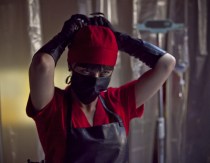
Katharine Isabelle stars as the titular "American Mary", though it's never revealed as to why she's identified as "American."

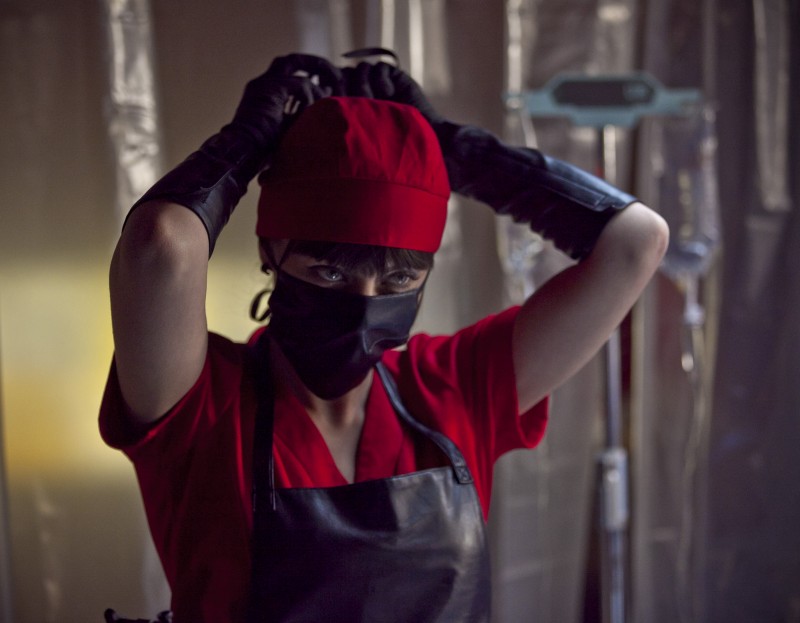
Katharine Isabelle stars as “American Mary”, though it’s never revealed as to why she’s identified as American.

5. The Canadian directorial-duo of Jen and Sylvia Soska, a.k.a. the “Twisted Twins”, have been steadily gaining notoriety in the genre film world these past few years.  They first gained attention with the low-budget exploitation film Dead Hooker in a Trunk (2009), and returned in 2013 with the gloss and production values of a bigger budget with American Mary (2013). Starring Katharine Isabelle — best known to horror fans as Ginger from the Ginger Snaps franchise — this film is essentially a rape-revenge mashed up with medical-horror. The titular Mary is a medical school drop-out who finds herself working as an underground surgeon in the world of (very extreme) body modification. The visual style of American Mary is very much fetish intermingled with body horror, though the body modification community is not exploited nor treated unkindly.

Domestikia, Chapter 3: La Petite Mort

A tale of love, betrayal and one vengeful butterfly. This project was inspired by the surreal animations of Lenica, Borowyck and Svankmajer, Japanese tentacle erotica, and those strange, middle-of-the-night dreams one has after spicy food.

Story, artwork and articulated paper puppets created by Jennifer Linton.
Stop-motion animation by Carla Veldman.
Original musical score by Zev Farber.
Directed & edited by Jennifer Linton.

This animation was made possible by the financial support of the Toronto Arts Council and the Ontario Arts Council. Copyright ©2013 Papercut Pictures (Jennifer Linton). All rights reserved.

The Haunted Dollhouse, revisited.

Back in July of 2010, I wrote a blog post entitled The Haunted Dollhouse in which I briefly discussed this interesting and unconventional approach to the miniature house. Created by artists and hobbyists alike, the haunted dollhouse can range greatly from the kitschy, Halloween-themed miniature festooned with cotton-batting cobwebs and tiny jack o’ lanterns, to epic, post-apocalyptic landscapes created in miniature scale by a team of artists. Now, before I venture further in my discussion, I should define my use of the word dollhouse and explain that I’m employing it in the broadest possible sense. While the spooky Halloween-themed dollhouse can be more readily defined as a house, the post-apocalyptic landscape — while still miniature in scale — is less traditionally identifiable as such. Both, however, are miniatures that share a common link to the uncanny (see below).

So, with semantics out of the way, let’s continue with a quote taken from my earlier post on the dollhouse that links our enjoyment of the miniature with the experience of the uncanny:

There’s something inherently unnerving about a dollhouse. While we can easily admire and delight in its minuscule detail, this admiration is frequently accompanied by a sense of unease. This simultaneous intermingling of delight-with-unease is a manifestation of the uncanny — a sensation of anxiety experienced when one encounters “something familiar, yet foreign.” The dollhouse, with its miniaturized approximation of reality, recalls the familiar domestic setting of the home. At the same time, it falls short of appearing truly real. It’s the tension that exists within this disconnect — the miniature’s approximation of scaled-down reality with its inevitable failure — that contributes to our experience of the uncanny.

To reiterate, the uncanny is a sense of discomfort within the familiar setting of the home. I would argue that since the dollhouse is already imbued with an element of the uncanny, it’s not a far stretch to imagine and reconfigure the miniature as a nightmarish, dystopic space. This may have been the thought-process behind the Apocalyptic Manhattan (in an Apartment) project created by Swedish artist Magnus Johannson and his team when they designed and constructed the fifty miniature buildings of their mangled landscape. This extraordinarily-detailed, post-apocalyptic Manhattan was later featured in a Swedish music video in which the band members stomp through the model in Godzilla-like fashion.

A post-apocalyptic Manhattan, as envisioned by two artists from Sweden.

A post-apocalyptic Manhattan, as envisioned by two artists from Sweden.

My favourite artist working in miniature, however, remains American photographer and diorama-artist Lori Nix. Blending a canny mixture of black humour with dread, she creates such varied post-apocalyptic miniature scenes as a burnt-out, long-abandoned beauty parlor, a subway car that has been gradually reclaimed by the surrounding sandy beach, and the interior of an empty mall which has been invaded by flora. Through her constructed dioramas, Nix “…imagines a human-less world where Mother Nature has reclaimed our cities.” (source).

"Beauty Shop" by Lori Nix.

“Beauty Shop” by Lori Nix. 18″x12″x33″

"Mall" by Lori Dix, 92"x42"x100".

“Mall” by Lori Dix, 92″x42″x100″.

REPOST. Karen Black like me: When dolls attack.

It’s summer, and I’m currently busy working away on my animation project. I decided to share one of my earlier posts from 2010. Enjoy!

Let’s face it, dolls are creepy. Horror fiction has always acknowledged this fact, and some of the earliest films in this genre have prominently featured the doll as an object of terror. One can relate this genre’s fascination with dolls to the psychological theory of the Uncanny as expressed by Ernst Jentsch in his 1906 essay, On the Psychology of the Uncanny:

Jentsch defines the Uncanny as: “doubts whether an apparently animate being is really alive; or conversely, whether a lifeless object might be, in fact, animate”[1]

Sigmund Freud later expanded on Jentsch’s concept in his 1919 essay “The Uncanny”, but this posting isn’t about psychoanalytic theory. It’s about some of my favourite horror films that feature dolls.

Of course, the Child’s Play series of films from the 1980’s immediately spring to mind, with their signature black humour, bad puns and sadistic doll-villain Chucky. To be honest, I’ve never been a big fan of that particular horror franchise.

I do, however, fondly recall a 1975 made-for-TV horror anthology Trilogy of Terror. The third story of this anthology, entitled “Amelia,” stars Karen Black — that darling of 1970s horror flicks — and involves a demonic Zuni fetish doll. And it’s one seriously pissed-off doll, too. Watch the clip below, because it’s likely to be the funniest thing you’ll see all year.

The next clip I want to include is a bit of a cheat. I’ve never actually seen this film, though I’ve viewed this trailer a number of times — and the trailer majorly creeps me out. Will definitely have the track down 1978’s Magic, a “terrifying love story” that starred Anthony Hopkins and Ann Margaret. Hopkins really must’ve been hitting the bottle hard when he took this role.

And lastly, an obscure little gem from Mexico called The Curse of the Doll People (1960). Midgets can be scary, too.

Horror Films 101: Favourite Ghost Stories.

Can I let you in on a secret? This hardcore horror fan is scared of ghosts — OK, more specifically, films that feature ghosts. I’ve watched zombie hordes feast on flesh, and vampires drink human blood. I’ve seen the minions of Satan perform gory midnight rituals, and serial killers dispatch their victims in creatively sadistic ways. None of these have frightened or unnerved me to the degree that a good, old-fashioned ghost story can. If anything can cause me to cower beneath the bed covers at night, it’s the suggestive power of a ghost story that relies on psychology rather than gore or cheap scare tactics to frighten the bejeezus outta you. Therein lies its true potency.

Film still from "Ugetsu Monogatari" (1958).

The Lady Wakasa from “Ugetsu Monogatari” (1953).

1. The Japanese have always had a knack for constructing effective tales of the supernatural. Ugetsu monogatari (dir. Kenji Mizoguchi, 1953) is a beautifully-shot, black-and-white masterwork from Japan’s “Golden Age” of cinema. This film is a  jidaigeki (period drama) set during the Edo period, and is ostensibly a morality play on the theme of personal responsibility. As is customary in many Asian ghost stories, the supernatural co-exists with the world of the living in a straightforward, matter-of-fact way. Ghosts can be the benevolent souls of the dearly departed who dwell on the earth to protect family members, or they are malevolent spirits bent on revenge. The ghosts in Ugetsu are more the former than the latter, although the Lady Wakasa has a definite sinister side to her. I would characterize this film as a tale of misfortune and poor-choices-with-tragic-consequences than as a ghost story whose raison d’être is to merely frighten.

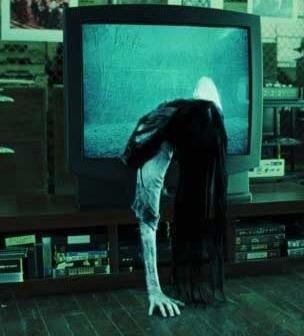
The malevolent ghost-child Samara climbs out of the TV in the now-iconic conclusion to "The Ring" (2002).

The malevolent ghost-child Samara climbs out of the TV in the now-iconic conclusion to “The Ring” (2002).

2. While we’re on the topic of Japanese ghost stories, my next pick The Ring (2002) is the English-language remake of the Japanese film Ringu (1998). When a foreign-language film is remade into an English version, I almost invariably prefer the original film — in fact, I very seldom watch remakes of foreign-language films as I feel that much of the original context is lost in translation (ie. the [REC] films are enriched by their location in Spain, with everyone speaking Spanish, etc). Gore Verbinski’s The Ring is that rare exception where the remake is an improvement over the original. Verbinski maintains the visual aesthetics of the original, but torques up the fright factor. The remake also removes some of the problematic (for a Western audience) gender issues that are present in the original film.

3. Ti West is one of my favourite new directors working in the horror genre. He is the master of the slow-boil, and while the snail’s pace of his 2011 film The Innkeepers is definitely not for the thrill-a-minute horror fan, I truly believe that the slow pace works to amplify the creepy-as-hell finale. West gives us ample time to get to know his two main characters Claire and Luke, two employees — and amateur paranormal investigators — who work at a supposedly haunted New England hotel. I actually switched this movie off twice whilst viewing it. The first time, it was out of sheer boredom. It was 45-minutes into the film, and virtually nothing had happened other than some banal, somewhat-flirty banter between our two protagonists, and the occasional hotel guest complaining that they had no towels in their rooms. I decided to try again. The second time I switched it off, it was because things were finally happening, and the suspense had me too much on edge.  My advice: stick with it, because the ending is worth it.

"I know, Luke. We should totally hang out in the dark, creepy basement of this haunted hotel."

“I know, Luke. We should totally hang out in the dark, creepy basement of this haunted hotel.” Claire and Luke try to record the ghost of Madeline O’Malley in “The Innkeepers”.

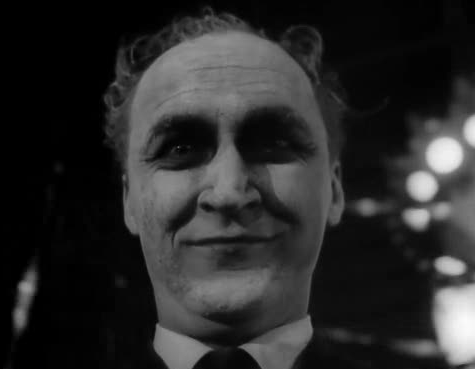
Majorly creepy dead guy from "Carnival of Souls" (1962).

Majorly creepy dead guy from “Carnival of Souls” (1962).

4. An overlooked gem from the early 1960’s, Carnival of Souls (1962) has received some well-deserved recognition from genre fans these past few years. An impressionistic, almost surreal black-and-white film that follows the lone survivor of a car accident who’s haunted by visions of a ghoulish man who stares silently at her, grinning. Did she survive the car accident, or is she truly dead and a ghost? That’s the question that torments poor Mary throughout Carnival of Souls, and while the story is somewhat threadbare, the visuals and atmosphere are superb.

5. I’ve already written about Robert Wise’s The Haunting (1963) in a previous post, but I felt it definitely needed to be on this list. Let’s all pretend that the abominable 1999 remake didn’t happen, shall we? This is such a beloved Gothic ghost story. Watch the clip below to see why:

TAIS Showcase 2013

My paper cutout animation “Domestikia: The Incident in the Nursery” will screen at the upcoming TAIS Showcase on May 11th, 2013. Below is the press release from TAIS for the event:

may2_tais

TAIS Independent Animation SHOWCASE 2013

The Toronto Animated Image Society (TAIS) presents their annual Showcase and U.F.O. Anijam, Saturday May 11, 7 pm at CineCycle. Enjoy a diverse collection of animated films from local, national and international independent animators.

Presenting a great selection of diverse animation techniques such as paint on glass, scratch on film, computer 3D, puppet, hand drawn and more.

Come enjoy the films, party, and vote for your favourite!

What: TAIS Showcase 2013 and UFO Anijam screening
When: Saturday, May 11, 7 pm
Where: CineCycle (in the coach house, down the laneway)
Address: 129 Spadina Avenue Toronto, Ontario

CONTACT: Janice Schulman
Toronto Animated Image Society
1411 Dufferin Street, Unit B
Toronto, ON M6H 4C7
(416) 533-7889

(W) www.tais.ca

Horror Films 101: The Demon Child.

Mia Farrow in a publicity shot for Roman Polanski's "Rosemary's Baby" (1968).

Mia Farrow in a publicity shot for Roman Polanski’s “Rosemary’s Baby” (1968).

In anticipation of Mother’s Day, I’ve decided to write about a trope in horror fiction that is a dark meditation on maternity: the Demon Child. This trope tends to divide itself into two separate categories: firstly, the demonic unborn child or baby; and second, the older but equally demonic child. While these two subcategories are closely related, there are subtle but critical differences between them that influence our reading of these character types and the meaning behind them. This post shall focus on the unborn Demon Child, a character type that TVTropes — in their usual tongue-in-cheek manner — dub the Fetus Terrible:

…The Fetus Terrible hasn’t even been born yet, but will become The Antichrist or a demon prophesied to bring about The End of the World as We Know It once it escapes from its womb. The woman carrying this (often literally) hellborn spawn is usually an innocent, unwittingly impregnated by the Devil himself, and the other characters have to race to prevent the birth or stop the child from becoming the ultimate Enfant Terrible. Occasionally this can result of a perfectly normal pregnancy Gone Horribly Wrong pre or post conception, where the issue can be a mutantHybrid MonsterUndead Child or some other abomination. This trope can also overlap with Body Horror, especially if the mother knows what’s growing inside her — TVTropes.org

In its fetal state, the Demon Baby represents maternal anxiety over the physicality of pregnancy and childbirth. Pregnancy itself is an invasive process not unlike parasitism, whereby a separate and distinct life form develops and thrives within a host’s body. As suggested in the above quote from TVTropes, the Demon Baby possesses aspects of body horror — a branch of the horror universe that explores fear relating to a loss-of-control over one’s own body. Not only does the mother-to-be fear the creature that grows inside her, there is often the threat of a grisly, and deadly, childbirth that capitalizes on every woman’s fear of painful labour and maternal mortality. While Roman Polanski’s 1968 film  Rosemary’s Baby practically invented this horror trope, the scene I feel best encapsulates this element of demon baby/body horror is the birthing scene from a much lesser film, the Hammer production To the Devil a Daughter (1976) with Christopher Lee and Nastassja Kinski. When the child of Satan is ready to be born, it demands the ultimate maternal sacrifice as it literally bursts forth from the womb, tearing the hapless woman apart. Although the actual birth happens off-camera, the mere suggestion of this gruesome event was enough to make me shudder.

The unfortunate Margaret is ripped apart birthing the demon child within her in "To the Devil A Daughter" (1976).

The unfortunate Margaret is ripped apart birthing the demon child in “To the Devil A Daughter” (1976). Ew.

Creepy mutant Demon Baby-Puppet from "To the Devil a Daughter" (1976).

Creepy mutant Demon Baby-Puppet from “To the Devil a Daughter” (1976).

And then, there’s the Demon Baby — or should I say, Demon Puppet? In this late-70’s, low-budget film, the devil-spawn is a slimy, malformed little puppet that — in one nightmarish dream sequence — flops across the splayed legs of the adolescent Kinski and crawls back inside. Yeah, back up there. I know, right?

Oh, and Happy Mother’s Day.