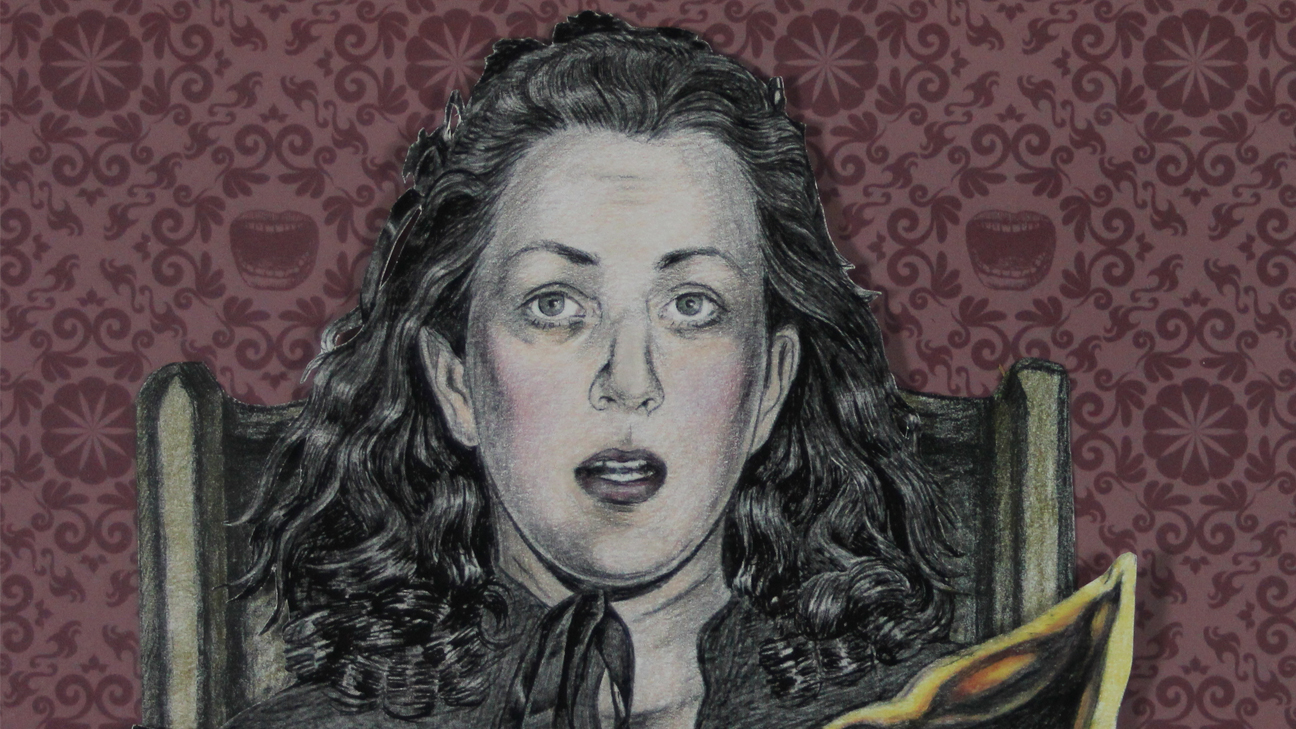
“Domestikia, Chapter 3: The Little Death”: I had a dream like that once…

Trying different heads.

One of the activities that keeps me busy these days — other than teaching, of course — is applying to grant programs. This is a long, tedious, and painful process that I submit to only grudgingly. It’s also, unfortunately, a necessary one. As part of the application process, I’ve been forced to cobble together a storyboard for my proposed animation project. This is yet another ‘necessary task’ that I perform grudgingly — being a naturally lazy creature, I’ve never done one before — though the benefits of having a storyboard are immediate and the process certainly worthwhile.

I don’t want to reveal all of my storyboard just yet, but here’s a sneak peak. Below the storyboard sample is my artist’s statement/project proposal, which might prove insightful to those of you who follow the development of my animations.

My current series of stop-motion animations entitled Domestikia developed directly out of a previous sculptural-installation project, in which I constructed a three-dimensional dollhouse from paper and lithographic prints. This project, entitled The Disobedient Dollhouse, employed the setting of a Victorian-themed dollhouse as a means to critique the sentimentality of nostalgia, as well as the tiny, precious model of perfect domesticity that the dollhouse itself proposes. A dollhouse is a gendered space, one specifically codified as feminine – it is therefore a highly suitable space in which to focus attention on women’s roles within the home. Furthermore, the strange, hybrid creatures and giant insects that populated my Dollhouse hinted at a dark, secret fantasy world churning just beneath the veneer of domestic perfection.

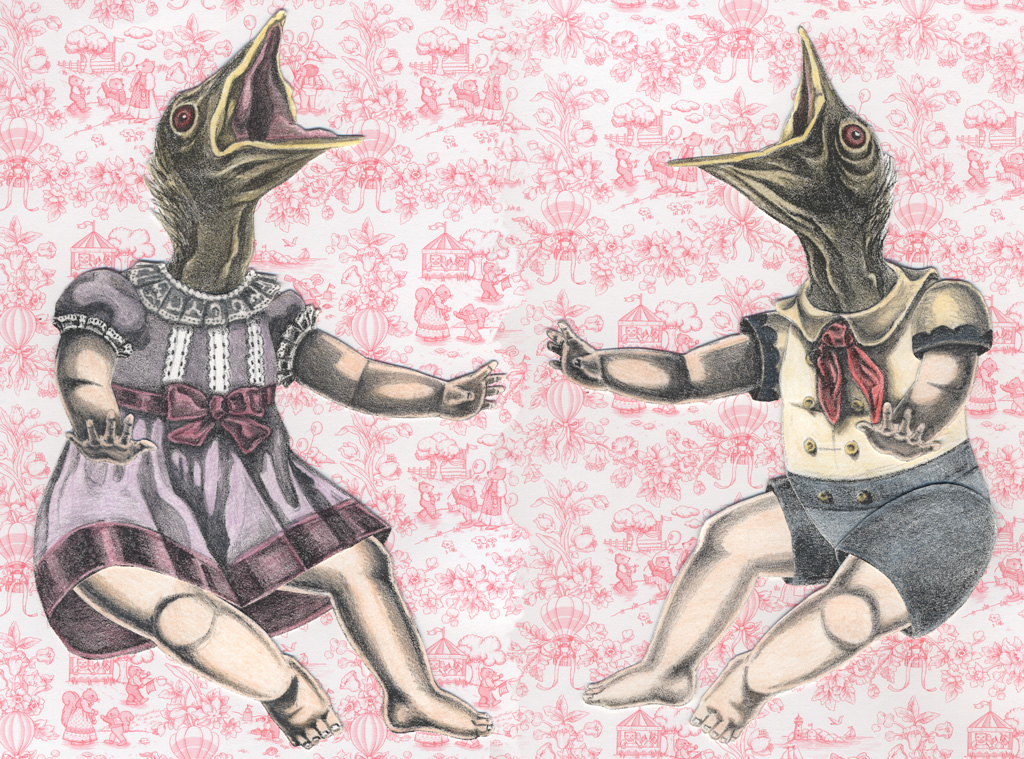
As previously stated, the Domestikia animation series began as an expansion of the narratives that originally appeared in The Disobedient Dollhouse project. For instance, the bird-headed children and Nanny (a self-portrait) featured in Domestikia: The Incident in the Nursery first existed as a paper diorama inside The Disobedient Dollhouse. The medium of stop-motion animation enabled me to — quite literally — bring that nursery scene alive. In addition to the scenes and narratives, the look and style of my Dollhouse has also carried over into my animations. Like the hand-drawn lithographs I created for the Dollhouse, the paper cutouts and articulated paper puppets from Domestikia possess the same grainy, textured quality of the lithographic crayon.

Similar to the other Domestikia films, the proposed project Domestikia, Chapter 3: The Little Death will employ the technique known as ‘cutout animation’, one of the earliest forms of stop-motion that uses flat characters and backgrounds cut from paper. The technical limitations of paper puppets, with their characteristically stiff and unnatural movements, make cutout animation particularly well suited to animations whose themes involve fantasy, surrealism, dreams, and that which otherwise lacks realism. Rather than being a technical limitation, the anti-realism of the paper cutout serves to amplify the strangeness of the events that happen throughout Domestikia – which is precisely why I’ve chosen to work with this technique. In Domestikia, Chapter 3: The Little Death, my plan is to further expand the technical and aesthetic possibilities of the paper cutout.

The storyline of Domestikia traces a series of strange, otherworldly events that take place within an imaginary dollhouse. The connecting thread between each narrative is the continual appearance of a butterfly, a creature that acts as a sort of ‘agent of chaos’, disrupting the daily domestic routines of the miniature household. In Domestikia, Chapter 6: An Unfortunate Incident Involving Her Hat, the appearance of the butterfly in the opening scene foreshadows the strangeness of subsequent events, in which the morning routine of dressing goes terribly wrong when a hat decides to grow out of control. The butterfly departs the scene, and in Domestikia: The Incident in the Nursery, it appears once more to disrupt the daily proceedings – this time, rousing an infant recently rocked to sleep by the Nanny, creating a cacophony of screams. The butterfly is once again featured in my proposed project, entitled Domestikia, Chapter 3: The Little Death. In this latest installment of the Domestikia series, the ‘little death’ of the title refers simultaneously to the metamorphosis process of the butterfly, as well as to ‘la petite mort’ of orgasm, as the butterfly is shown to have originated from an amorous encounter between Madelaine and her octopod lover. The ‘little death’ also refers to the literal building up, and subsequent dismantling of the Madelaine paper puppet when she is ‘lovingly dismembered’ by the octopus. Ostensibly, Domestikia, Chapter 3 is about shifts in identity that occur as one’s role in life changes: from individual, to couple, to parent. In short, sometimes it is necessary to ‘die’ in order to reinvent oneself.

Animaldiçoados/Animacursed 2012

Film still from “Domestikia: The Incident in the Nursery”, 2012, stop-motion animation done with paper cutouts and puppets.

It’s official. My animated short film Domestikia: The Incident in the Nursery has been selected under the International category for Animaldiçoados/Animacursed 2012, a film festival in Rio de Janeiro that features horror, suspense, and “other cursed” genres of animation. Mine is probably under the “other cursed” or possibly the “WTF” category, should they have one of those.

Visit the festival web site (in Portuguese, of course) and check out the selected films. Pretty solid programming! Amazingly enough, I’m sharing screen time with Julia Pott (see my last blog entry When I grow up, I want to make films like Julia). Not sure how that happened.

Backyard: a fearonrevell project

I have created a site-specific sculpture for the upcoming group exhibition Backyard, curated by Elizabeth Fearon. The concept for the show is simple and clever: site-specific work in the backyard of her own home. There’s an impressive roster of participants, so it promises to be a good show. Here’s all the details:

My site-specific installation for the group exhibition “Backyard.” Jennifer Linton, “Lawn Shadows”, 2012, wood, paint, copper pipe, electrical tape.

Backyard: a fearonrevell project

Site-specific installations will be created for our backyard by:

Myfanwy Ashmore
Mark Connery
Marie de Sousa
Elizabeth Fearon
Michelle Johnson
Jennifer Linton
Tanya Read
Rupen
Fiona Smyth
Julie Voyce
Natalie Majaba Waldburger

The show will run from the 4th of Aug. (Opening reception: 2-6pm) until the 26th of August. The backyard will be open to the public from 1 to 6, Wednesday through Sunday.

Location: 85 Carlaw Ave. Toronto

For more information call 416 654 3232

Domestikia: An Account of Some Strange Disturbances. The Incident in the Nursery.

Domestikia: The Incident in the Nursery. from Jennifer Linton on Vimeo.

At last, I’ve completed my second stop-motion animated short film. Domestikia uses paper cutouts and articulated paper puppets in a stop-motion animation to explore the strange, dreamlike and uncanny realm of the Domestic Gothic.  With a healthy dose of black humour, it tackles the anxieties and challenges experienced by parents of young children. The ‘Domestic Gothic’ as a motif developed through the writing of 19th-century women Gothic novelists, such as the Brontë Sisters, and dealt specifically with the horror of confinement felt by women who were ‘imprisoned’ within the home and unable to move freely in Victorian society. With contemporary women still predominantly acting as primary caregivers to their children — and thus financially penalized by either remaining at home or opting for employment that allows for ‘family friendly’ work hours — this sense of confinement is still present. The realm of the domestic has become infiltrated by strange creatures — a giant butterfly, an octopus, and bird-headed children — whose presence suggest a level of discomfort within the home. These creatures are the physical manifestation of Freud’s das Unheimlich (translates to English as ‘the uncanny’), a term which literally means ‘unhomely.’

All images and animation were done by me, in my basement.

“Domestikia: An Account of Some Strange Disturbances” begins February 24th, 2012.

"The Brood" (2012) by Jennifer Linton. Work-in-progress photograph of a shadowbox assemblage, which includes hand-coloured lithographs that are cut out and pasted into paper dolls.

If you live in the Toronto area, then drop by Open Studio to view some of my recent creative efforts. My latest exhibition “Domestikia: An Account of Some Strange Disturbances” is an exploration into the interdisciplinary possibilities of printmaking. I’ve created articulated paper puppets from lithographic prints, which are then arranged into strange, dream-like shadow box tableaux. These same paper puppets are brought to life in a stop-motion animation, all taking place within an imagined dollhouse.

Opening reception is Friday, February 24th at 6:30 – 8:30 p.m. Join me for wine, conversation and general frivolity. Show runs from February 24 – March 31, 2012. Open Studio is located on the ground floor of 401 Richmond, at the corner of Richmond and Spadina in Toronto. For more information on this show, visit the Open Studio web site.

My Demon Lover: the mythology of the incubus.

“Inkubus” (photograph, 2005) by contemporary German visual artist Michael Hutter.

The incubus is a demon in male form — the female equivalent is called a succubus — who, according to different mythologies and legends throughout the world, lies upon women whilst they sleep in order to have sexual intercourse with them. In the Middle Ages, belief in demons who sexually preyed on humans assuaged a sleeping person’s shame and guilt over nocturnal emissions and other physical evidence of erotic dreams. Primarily, however, the incubus legend functioned as a convenient means to conceal incest and other types of sexual assault upon girls and women who had no unchaperoned access to men outside the home, but had nonetheless become inexplicably pregnant.

In contrast to the sleeping rape victims of medieval yore, the women that populate the photographic work of contemporary visual artist Michael Hutter are both wide awake and engaged in consensual coupling with their respective incubi. In the sepia-coloured photo-collage entitled Inkubus, a nude woman sporting a 1920’s flapper-style bob receives an amorous lick from the tiny demon lover perched on her shoulder. In The Alien Nurse, the erotic-grotesque combines with Victorian fetishism as a blindfolded “wet-nurse” offers up her breast to a curious intestinal/tentacled alien blob. In subsequent photo-collages, the wet-nurse discovers new and even more intimate uses for the alien tentacle, recalling shokushu goukan or ‘tentacle erotica’ of contemporary Japanese hentai.

“Die Alienamme (The alien nurse)”, photograph, 2006 by Michael Hutter.

The work of German artist Michael Hutter ranges from ink drawings on paper reminiscent of the Victorian kinkiness of Aubrey Beardsley’s Lysistrata, to the retro-inspired photo-collages you see here.  Visit his online gallery to see for yourself, though perhaps not whilst at the office.

“Domestikia: An Account of Some Strange Disturbances”, stop-motion animation project.

My latest creative project is “Domestikia: An Account of Some Strange Disturbances”. Continuing my interdisciplinary approach to artmaking, I have created jointed, movable paper cutouts from my lithographic prints for use in a series of stop-motion animations. This project will include several short stories linked together by an overarching narrative, all taking place within an imagined dollhouse. The narrative is non-linear, so scenes are not “shot” in sequence.

I’ll readily admit to being a complete neophyte when it comes to animation, but thus far I find the process a rewarding one. Painstakingly tedious and laborious, but rewarding nonetheless :-)

A Diabolical Decadence: Charles Baudelaire, Félicien Rops and the “Flowers of Evil.”

Come on my heart, cruel and insensible soul,
My darling tiger, beast with indolent airs;
I want to plunge for hours my trembling fingers
In your thick and heavy mane;

In your petticoats filled with your perfume
To bury my aching head,
And breathe, like a faded flower,
The sweet taste of my dead love.

I want to sleep, to sleep and not to live,
In a sleep as soft as death,
I shall cover with remorseless kisses
Your body beautifully polished as copper.

To swallow my appeased sobbing
I need only the abyss of your bed;
A powerful oblivion lives on your lips,
And all Lethe flows in your kisses.

I shall obey, as though predestined,
My destiny, that is now my delight;
Submissive martyr, innocent damned one,
My ardor inflames my torture,

And I shall suck, to drown my bitterness
The nepenthe and the good hemlock,
On the lovely tips of those jutting breasts
Which have never imprisoned love.

— Geoffrey Wagner, Selected Poems of Charles Baudelaire (NY: Grove Press, 1974). English translation of the poem Le Léthé by Charles Baudelaire from Fleurs du mal (1857).

Mysterious occult rituals, orgiastic parties and experiments with hallucinatory drugs: sounds like one of the notorious “acid test” road trips by Ken Kesey and the Merry Pranksters, right? While this does neatly summarize the wild merry-making of the Pranksters and the 1960’s hippie counterculture, what I’m describing above is instead the naughty behaviour of a much earlier group of non-conformists and bohemians: the Decadents of the late 19th-century.

Etching & aquatint by Félicien Rops (1896).

The Decadence Movement was a fin de siècle artistic and literary style of Western Europe, primarily France. Fin de siècle or “end of the century” refers to the latter two decades of the 19th-century that were characterized by boredom, cynicism, and pessimism as well as an anxiety over the change that is inevitable in the ending of a century. While the term “decadent” was originally applied as a pejorative by critics of the style, writers and artists such as Charles Baudelaire and Félicien Rops eagerly adopted this label as a further act of defiance against the restrictive social mores they perceived in contemporary European society. For the most part, the Decadents were influenced by the tradition of Gothic novels and by the poetry and fiction of Edgar Allan Poe, and were associated with (but distinct from) Symbolism. The progenitor of Decadence was Baudelaire, and his poetry collection Les Fleurs du mal (‘The Flowers of Evil’, 1857) is considered by literary historians as a seminal work of Decadent writing. Steeped in a fashionably brooding melancholia and an almost morbid eroticism, Baudelaire’s poetry was targeted by French censors for its bold lasciviousness:


The author and the publisher were prosecuted under the regime of the Second Empire as an outrage aux bonnes mœurs (trans. “an insult to public decency”). As a consequence of this prosecution, Baudelaire was fined 300 francs. Six poems from the work were suppressed and the ban on their publication was not lifted in France until 1949. These poems were “Lesbos”, “Femmes damnés (À la pâle clarté)” (or “Women Doomed (In the pale glimmer…)”), “Le Léthé” (or “Lethe”), “À celle qui est trop gaie” (or “To Her Who Is Too Gay”), “Les Bijoux” (or “The Jewels”), and ” Les “Métamorphoses du Vampire” (or “The Vampire’s Metamorphoses”). These were later published in Brussels in a small volume entitled Les Épaves (Jetsam). — from Wikipedia.

Lithograph known alternately as “Black Mass” or “Calvary”, by Félicien Rops.

The Belgian visual artist Félicien Rops met Baudelaire towards the end of the poet’s life, and this meeting had a great impact on the career of the young artist. An accomplished printmaker, Rops illustrated many literary works including Baudelaire’s Les Épaves, a selection of poems for which he created the frontispiece. Like the works of the authors whose poetry he illustrated, Rops work tends to mingle sex, death, and Satanic images. He held a lifelong fascination with the femme fatale, an image of womankind that served as a dark and sinister Muse to that generation of Decadent artists. Of his views of Woman, Félicien Rops wrote: “Therefore it is his era, the end of the 19th century, that he [the artist] expresses through his graphic work, structured mainly around the themes of love, suffering and death, with the central unifying theme of the woman, la femme fatale in the full meaning of the word. Through her he portrays his vision of his era. Woman is Satan’s accomplice, and becomes the supreme attraction which provokes the most extreme vices and torments in Man, a mere puppet.” (an English translation of a quote taken from the Museum of Félicien Rops web site.)

Counting myself amongst the legion of “Satan’s accomplices”, I can easily admire the lewd and grotesque aspects of Rops, even as he does occasionally verge on a kind of vulgar kitsch. The unabashed sexuality of Rops lends a quality of surprising modernity to the work and gives it a contemporary feel, even as it dates from well over 100 years ago.

Cannibals, werewolves and tentacles: The web searches that bring you here.

Blog statistics are a fascinating gateway into the collective unconscious. While the identities of those who’ve visited my blog remain anonymous, their mouse clicks remain on record and provide an insight into the topics that interest them most. What occupies people’s thoughts during those moments of procrastination when they are not writing that report for their boss or essay for that class? Cannibals, apparently. More specifically, Ruggero Deodato’s 1980 horror film Cannibal Holocaust, a film that’s still considered controversial after 32 years and, likely due to its continued notoriety, received the most “hits” on my blog. If they’re not seeking information on cannibal films, people are looking into the Canadian teenage werewolves of Ginger Snaps which, as far as I’m concerned, is a much better use of their time.

Periodically, I will write about topics other than horror films, though these topics are as equally strange and macabre. Heinrich Hoffmann’s darkly comedic children’s book Der Struwwelpeter (1845) has garnered a great deal of interest on my blog, as well as the eroticized anatomical art of Jacques D’Agoty and anatomists of the 18th-century. The mythological vagina dentata and Japanese ‘tentacle erotica’ draw a fair amount of interest, as one might expect.

Celebrities and famous artists predictably top my statistics tally. People have searched on marquee names from art history including Marcel Duchamp, Max Ernst, Odilon Redon, and Hannah Wilke (though the latter is lesser known), as well as contemporary visual artists Loretta Lux, Marcel Dzama and Shary Boyle. And, 45 years after her death, Jayne Mansfield still attracts a large amount of attention. I only wrote about her in a post last week, and she’s #22 on the list of “all-time” top searches. Of course, her story is a ‘perfect storm’ for achieving immortality on the Internet: a beautiful, buxom starlet, who reportedly dabbled in Satanism, died young and in most grisly manner (depending on which account you read, she was either scalped or decapitated in a car accident). We are, as a species, a ghoulish bunch.

Here’s the top 30 searches, according to WordPress:

cannibal holocaust 577
ginger snaps 287
holocaust 279
struwwelpeter 253
loretta lux 247
odilon redon 246
max ernst 246
vagina dentata 184
daguerreotype 123
tentacle erotica 109
cannibal 97
jennifer linton alphabet series 94
walerian borowczyk 91
max ernst collage 84
der struwwelpeter 78
hannah wilke 70
contes immoraux 67
drag me to hell 56
agoty angel 49
anatomical art 46
jayne mansfield 45
marcel dzama 43
the descent 40
macabre art 37
drag me to hell old lady 37
best animated movies of all time………… 33
holocaust pictures 33
redon 33
irreversible 28

Now, get back to work…

p.s. One of the funniest web searches I’ve seen to date would be this one: “horror movie with a women who seducing and kill men with her vagina.” Hey, who am I to judge? Incidentally, there is such a film — not surprisingly, it’s Japanese and called Killer Pussy. You’re welcome.