My installation The Disobedient Dollhouse will pay a visit to the Art Gallery of Peterborough, starting this month. This exhibition will also screen my 2-minute stop-motion animation Domestikia: The Incident in the Nursery. Exhibition runs from November 9 – January 6, 2013. The opening reception will take place Friday November 16, 7 – 9 pm. Visit the web site of the AGP for details and/or directions.
Jennifer Linton
“Domestikia, Chapter 3: The Little Death”: I had a dream like that once…
One of the activities that keeps me busy these days — other than teaching, of course — is applying to grant programs. This is a long, tedious, and painful process that I submit to only grudgingly. It’s also, unfortunately, a necessary one. As part of the application process, I’ve been forced to cobble together a storyboard for my proposed animation project. This is yet another ‘necessary task’ that I perform grudgingly — being a naturally lazy creature, I’ve never done one before — though the benefits of having a storyboard are immediate and the process certainly worthwhile.
I don’t want to reveal all of my storyboard just yet, but here’s a sneak peak. Below the storyboard sample is my artist’s statement/project proposal, which might prove insightful to those of you who follow the development of my animations.
My current series of stop-motion animations entitled Domestikia developed directly out of a previous sculptural-installation project, in which I constructed a three-dimensional dollhouse from paper and lithographic prints. This project, entitled The Disobedient Dollhouse, employed the setting of a Victorian-themed dollhouse as a means to critique the sentimentality of nostalgia, as well as the tiny, precious model of perfect domesticity that the dollhouse itself proposes. A dollhouse is a gendered space, one specifically codified as feminine – it is therefore a highly suitable space in which to focus attention on women’s roles within the home. Furthermore, the strange, hybrid creatures and giant insects that populated my Dollhouse hinted at a dark, secret fantasy world churning just beneath the veneer of domestic perfection.
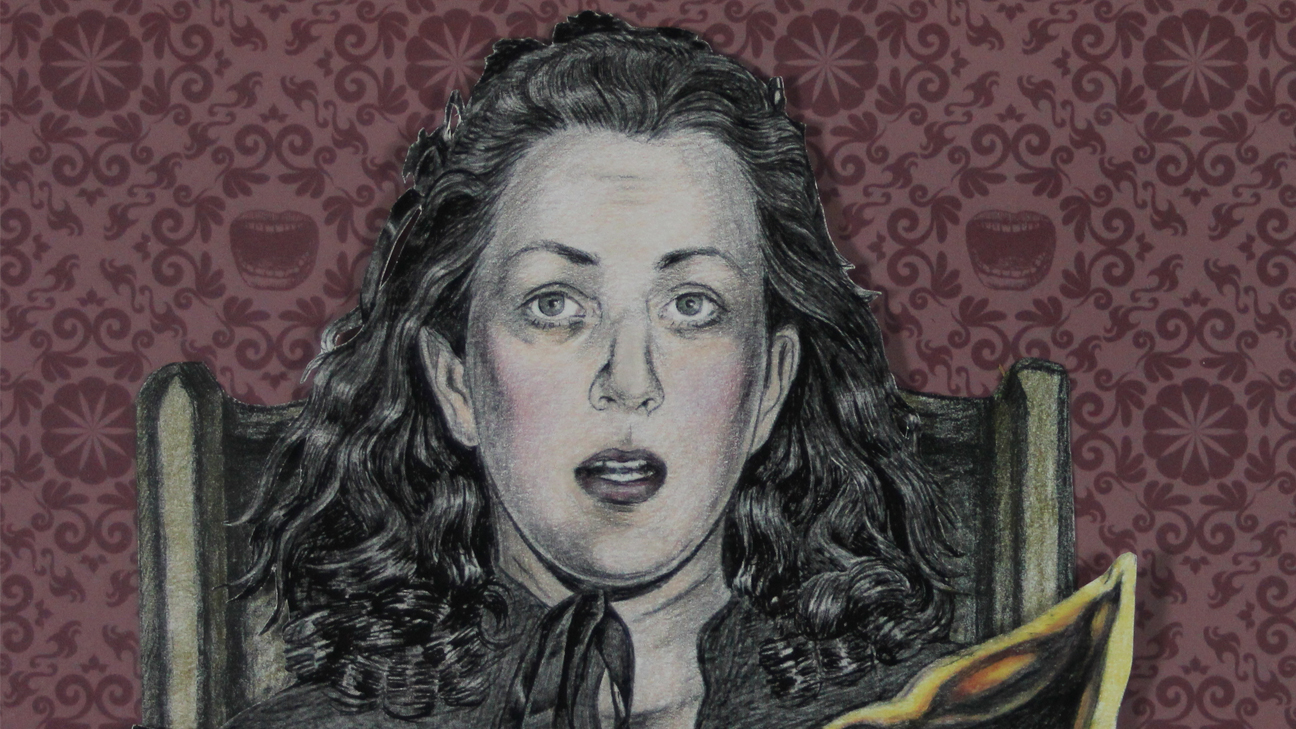
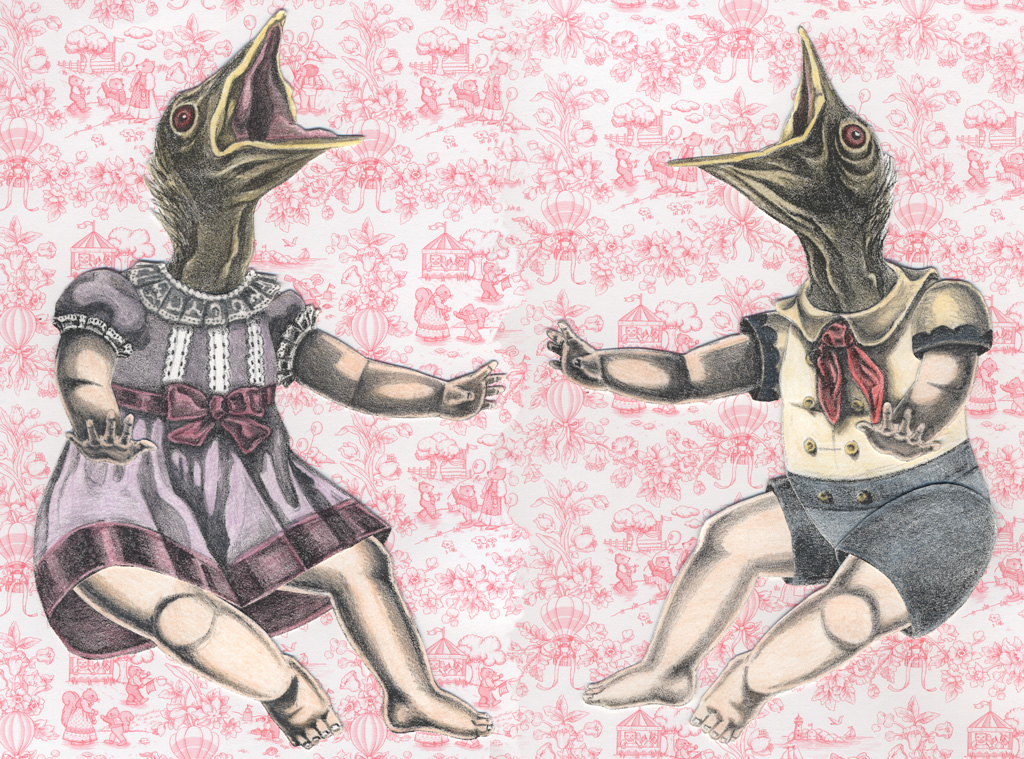
As previously stated, the Domestikia animation series began as an expansion of the narratives that originally appeared in The Disobedient Dollhouse project. For instance, the bird-headed children and Nanny (a self-portrait) featured in Domestikia: The Incident in the Nursery first existed as a paper diorama inside The Disobedient Dollhouse. The medium of stop-motion animation enabled me to — quite literally — bring that nursery scene alive. In addition to the scenes and narratives, the look and style of my Dollhouse has also carried over into my animations. Like the hand-drawn lithographs I created for the Dollhouse, the paper cutouts and articulated paper puppets from Domestikia possess the same grainy, textured quality of the lithographic crayon.
Similar to the other Domestikia films, the proposed project Domestikia, Chapter 3: The Little Death will employ the technique known as ‘cutout animation’, one of the earliest forms of stop-motion that uses flat characters and backgrounds cut from paper. The technical limitations of paper puppets, with their characteristically stiff and unnatural movements, make cutout animation particularly well suited to animations whose themes involve fantasy, surrealism, dreams, and that which otherwise lacks realism. Rather than being a technical limitation, the anti-realism of the paper cutout serves to amplify the strangeness of the events that happen throughout Domestikia – which is precisely why I’ve chosen to work with this technique. In Domestikia, Chapter 3: The Little Death, my plan is to further expand the technical and aesthetic possibilities of the paper cutout.
The storyline of Domestikia traces a series of strange, otherworldly events that take place within an imaginary dollhouse. The connecting thread between each narrative is the continual appearance of a butterfly, a creature that acts as a sort of ‘agent of chaos’, disrupting the daily domestic routines of the miniature household. In Domestikia, Chapter 6: An Unfortunate Incident Involving Her Hat, the appearance of the butterfly in the opening scene foreshadows the strangeness of subsequent events, in which the morning routine of dressing goes terribly wrong when a hat decides to grow out of control. The butterfly departs the scene, and in Domestikia: The Incident in the Nursery, it appears once more to disrupt the daily proceedings – this time, rousing an infant recently rocked to sleep by the Nanny, creating a cacophony of screams. The butterfly is once again featured in my proposed project, entitled Domestikia, Chapter 3: The Little Death. In this latest installment of the Domestikia series, the ‘little death’ of the title refers simultaneously to the metamorphosis process of the butterfly, as well as to ‘la petite mort’ of orgasm, as the butterfly is shown to have originated from an amorous encounter between Madelaine and her octopod lover. The ‘little death’ also refers to the literal building up, and subsequent dismantling of the Madelaine paper puppet when she is ‘lovingly dismembered’ by the octopus. Ostensibly, Domestikia, Chapter 3 is about shifts in identity that occur as one’s role in life changes: from individual, to couple, to parent. In short, sometimes it is necessary to ‘die’ in order to reinvent oneself.
Animaldiçoados/Animacursed 2012

Film still from “Domestikia: The Incident in the Nursery”, 2012, stop-motion animation done with paper cutouts and puppets.
It’s official. My animated short film Domestikia: The Incident in the Nursery has been selected under the International category for Animaldiçoados/Animacursed 2012, a film festival in Rio de Janeiro that features horror, suspense, and “other cursed” genres of animation. Mine is probably under the “other cursed” or possibly the “WTF” category, should they have one of those.
Visit the festival web site (in Portuguese, of course) and check out the selected films. Pretty solid programming! Amazingly enough, I’m sharing screen time with Julia Pott (see my last blog entry When I grow up, I want to make films like Julia). Not sure how that happened.
Backyard: a fearonrevell project
I have created a site-specific sculpture for the upcoming group exhibition Backyard, curated by Elizabeth Fearon. The concept for the show is simple and clever: site-specific work in the backyard of her own home. There’s an impressive roster of participants, so it promises to be a good show. Here’s all the details:

My site-specific installation for the group exhibition “Backyard.” Jennifer Linton, “Lawn Shadows”, 2012, wood, paint, copper pipe, electrical tape.
Backyard: a fearonrevell project
Site-specific installations will be created for our backyard by:
Myfanwy Ashmore
Mark Connery
Marie de Sousa
Elizabeth Fearon
Michelle Johnson
Jennifer Linton
Tanya Read
Rupen
Fiona Smyth
Julie Voyce
Natalie Majaba Waldburger
The show will run from the 4th of Aug. (Opening reception: 2-6pm) until the 26th of August. The backyard will be open to the public from 1 to 6, Wednesday through Sunday.
Location: 85 Carlaw Ave. Toronto
For more information call 416 654 3232
Domestikia: An Account of Some Strange Disturbances. The Incident in the Nursery.
Domestikia: The Incident in the Nursery. from Jennifer Linton on Vimeo.
At last, I’ve completed my second stop-motion animated short film. Domestikia uses paper cutouts and articulated paper puppets in a stop-motion animation to explore the strange, dreamlike and uncanny realm of the Domestic Gothic. With a healthy dose of black humour, it tackles the anxieties and challenges experienced by parents of young children. The ‘Domestic Gothic’ as a motif developed through the writing of 19th-century women Gothic novelists, such as the Brontë Sisters, and dealt specifically with the horror of confinement felt by women who were ‘imprisoned’ within the home and unable to move freely in Victorian society. With contemporary women still predominantly acting as primary caregivers to their children — and thus financially penalized by either remaining at home or opting for employment that allows for ‘family friendly’ work hours — this sense of confinement is still present. The realm of the domestic has become infiltrated by strange creatures — a giant butterfly, an octopus, and bird-headed children — whose presence suggest a level of discomfort within the home. These creatures are the physical manifestation of Freud’s das Unheimlich (translates to English as ‘the uncanny’), a term which literally means ‘unhomely.’
All images and animation were done by me, in my basement.
“Domestikia: An Account of Some Strange Disturbances” begins February 24th, 2012.

"The Brood" (2012) by Jennifer Linton. Work-in-progress photograph of a shadowbox assemblage, which includes hand-coloured lithographs that are cut out and pasted into paper dolls.
If you live in the Toronto area, then drop by Open Studio to view some of my recent creative efforts. My latest exhibition “Domestikia: An Account of Some Strange Disturbances” is an exploration into the interdisciplinary possibilities of printmaking. I’ve created articulated paper puppets from lithographic prints, which are then arranged into strange, dream-like shadow box tableaux. These same paper puppets are brought to life in a stop-motion animation, all taking place within an imagined dollhouse.
Opening reception is Friday, February 24th at 6:30 – 8:30 p.m. Join me for wine, conversation and general frivolity. Show runs from February 24 – March 31, 2012. Open Studio is located on the ground floor of 401 Richmond, at the corner of Richmond and Spadina in Toronto. For more information on this show, visit the Open Studio web site.
“Domestikia: An Account of Some Strange Disturbances”, stop-motion animation project.
My latest creative project is “Domestikia: An Account of Some Strange Disturbances”. Continuing my interdisciplinary approach to artmaking, I have created jointed, movable paper cutouts from my lithographic prints for use in a series of stop-motion animations. This project will include several short stories linked together by an overarching narrative, all taking place within an imagined dollhouse. The narrative is non-linear, so scenes are not “shot” in sequence.
I’ll readily admit to being a complete neophyte when it comes to animation, but thus far I find the process a rewarding one. Painstakingly tedious and laborious, but rewarding nonetheless :-)
Classical mythology revisited: the shrewd ecofeminism of Shary Boyle.
The last (I promise) of the grad school essays I shall inflict upon you. In this one, my task was to compare my work with that of another contemporary visual artist. I chose Shary Boyle. The astute among you will recognize a passage or two from my Master’s thesis in this essay. Hey, it’s not plagarism when you cannibalize your own writing.
Throughout history, visual artists have fleshed out mythological subjects and generated images based on traditional, time-honoured stories. Myths supply an accessible and universal narrative to which the artist can attach a personal story. Renowned scholar and mythologist Joseph Campbell describes one of the goals of myth as “…effecting a reconciliation of the individual consciousness with the universal will.” Similarly, in his essay “The Expressive Fallacy” Hal Foster cites Nietzsche’s discussion of an artist’s use of myth to express an interior world: “The whole notion of an ‘inner experience’ enters our consciousness only after it has found a language that the individual understands – i.e., a translation of a situation into a familiar situation…” The “language” to which Nietzsche refers can be interpreted as “mythology” which provides a universal narrative to which all cultures, no matter how disparate, have access. The “inner experience” may be read as the personal, psychological or emotional world that the artist seeks to materialize through the use of myth. In short, myths connect us to each other by anchoring the idiosyncrasy of the individual to a universally shared point of reference.
In my own art practice, I frequently make use of myths and archetypes as cultural ready-mades into which I insert my own personal history and meanings. Myths are reinterpreted in my work from a feminist perspective that considers gender representation in these mythological narratives. Another contemporary Canadian artist who employs a similar creative, feminist tactic is Shary Boyle. A commonality in our work is the use of female mythological subjects that evoke the traditional, allegorical link between women and nature. Rather than simply offer a critique of the feminized concept of nature, however, both Boyle and myself use motifs derived from nature in a subversive manner that transform our female subjects in strange, fantastic ways. The transformations and mutations that our mythological heroines experience provide the visible, external evidence of their inner psychological and emotional world.
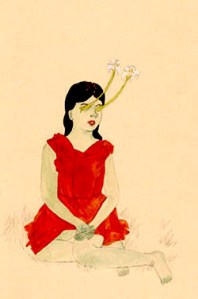
In her work prior to 2008, Boyle’s use of fairytales and mythological subjects tended to be global rather than specific. Her phantasmagoric imagery suggested the realm of dreams and myths without representing a particular legend or cultural tradition. Her two pencil and gouache drawings that we shall examine, both dating from 2003 and simply called Untitled, are evidence of her generalized incorporation of myth. Both drawings involve remarkable incidents in which a single female figure, isolated on the white void of the paper, quietly experiences a magical transformation. In Untitled (fig. 1) we are confronted with a woman in a bright red dress sitting contentedly in the grass, hands resting peacefully in her lap. The drawing is linear and economical; the grass on which the woman sits is minimally drawn. Two long, yellow plant stalks topped with white blossoms grow outwards from the eye sockets of the woman, a strange phenomenon that has not managed to disturb her serenity. The very fact that the woman appears unconcerned by this fantastic event seems to suggest that this transformation is metaphoric as the flowers are a manifestation of an interior psychological state. Equally, the woman may have simply acquiesced to the inevitability of this strange transformation. The subject of Boyle’s second drawing Untitled (fig. 2), a prepubescent girl whose rigid stance and sideways glance suggests that she’s somewhat more alarmed by the tangled bush growing out from her mouth, nevertheless seems to accept the strangeness of this event as normative.
In her essay entitled “Ornamental Impulse”, art writer Josée Drouin-Brisebois comments on Boyle’s surreal transformations as a manifestation of the emotional and psychological worlds of her subjects. “Boyle’s [figures]”, says Drouin-Brisebois, “express the inner life of the emotions materially.” Drouin-Brisebois cites the review of art critic Robin Laurence for Boyle’s paintings Companions (2004), wherein Laurence states: “Boyle’s portraits suggest that what looks outwardly freakish in others is the metaphorical equivalent of inward aspects of all our characteristics and circumstances.” Thus, the plant life that blooms from the bodily orifices of these female subjects is emblematic of their interior states, though what precisely those states would be remain vague and mysterious.
The mythology to which Boyle attaches her idiosyncratic narratives serves to anchor the work in tradition and provide the viewer with visual clues as to how one might interpret her dream-like imagery. For instance, the otherworldly flora of these drawings reference allegorical and mythological associations of women to nature. Rather than challenge the traditional dichotomy of women and nature, Boyle embraces it in a subversive manner. According to Drouin-Brisebois, Boyle’s women “become…nature in unsettling ways – verdancy out of control or a parasite that takes over the body…” Boyle acknowledges the allegorical tradition while at the same time engaging a sinister playfulness that alters it.
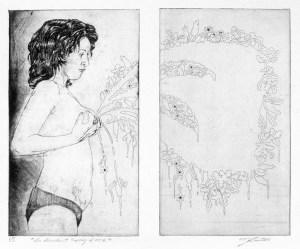
Similar to Boyle, otherworldly flora plays a prominent role in my 2006 intaglio print entitled An Abundant Supply of Milk (fig. 3). Whereas Boyle rarely identifies her female subjects as aspects of herself, my work makes frequent use of self-portraiture and is characterized by an autobiographical content. This particular self-portrait shows myself standing in profile, naked save for a pair of underwear. With my hands I squeeze my breasts and produce an exaggeratedly large spray of breast milk. This cloud-like spray of breast milk, in turn, blossoms into a soggy mass of flowers. Like the drawings of Boyle discussed earlier, this print recognizes the mythic association between women and nature, and in particular the concept of a nurturing “mother nature”, while at the same time subverting it. The nourishing food that is breast milk has transformed into a bizarre floral mass that, rather than natural, appears inexorably alien. Created in the months that followed becoming a first-time mother, this image addressed my response to the strange transformations enacted upon my body as a result of pregnancy and childbirth. The milk-flowers that spring forth from my breasts represent an externalization of the estrangement I felt from my own body.
A second, earlier self-portrait speaks not to a feeling of estrangement but to the human impulse towards creation, both in art as well as in procreation. The coloured pencil drawing entitled Genesis (fig.4) illustrates the growth of a leafy, magenta and orange plant stalk out of my opened mouth. This fanciful stalk terminates in a perfectly round, ripe pomegranate fruit. Similar to the heroines of Boyle’s drawings, my visage appears untroubled by the unconventional growth of this fruit as if this were the result of a natural, internal process. In contrast to Boyle’s 2003 Untitled drawings, however, the magical vegetation of Genesis recalls a very specific mythological story while at the same time evoking the women-nature dichotomy. The appearance of the pomegranate in this drawing is highly significant as it is a direct quotation from an earlier body of work in which I assumed the role of Persephone, a tragic heroine from Greco-Roman mythology. This role-playing allowed for the insertion of personalized content within the larger context of a universal narrative. Or, as Nietzsche expressed, the myth of Persephone provided “…a translation of a situation into a familiar situation.” We will return to this discussion of Persephone after an introduction to Boyle’s latest works, one of which, coincidentally, deals directly with this same myth.
As previously stated, Boyle’s work is frequently characterized by a global adoption of mythology, her imagery an amalgam of different mythic traditions synthesized with her own idiosyncratic symbolism. The recent unveiling of Boyle’s latest porcelain sculptures at the 2008 grand reopening of the Art Gallery of Ontario, however, provides an exciting and atypical exception to this aspect of her work. Boyle was commissioned by the AGO to create work that responded to the gallery’s permanent collection. She selected two 18th-century Italian bronze statuettes by Giovanni Battista Foggini with which to engage in a conversation across history. The subjects of Foggini’s sculptures are two commonly depicted Greco-Roman myths: Perseus slaying Medusa and The Rape of Proserpine. Boyle’s porcelains offer feminist reinterpretations of these myths while simultaneously maintaining her characteristic surreal imagery that hints at the internal, psychological world of her subjects.
Boyle’s response to Foggini’s The Rape of Proserpine re-imagines the Greco-Roman myth upon which it is based and addresses the violent and sexually problematic subject matter of the original Baroque bronze. Her delicate porcelain sculpture entitled The Rejection of Pluto (fig. 5) casts the titular deity as a hideously yawning monster and not the sinewy, handsome abductor of Foggini’s statuette. In her 2008 interview with art critic Sarah Milroy featured in The Globe and Mail, Boyle discussed the responsibility she felt as a feminist artist in rendering an alternate version of this classical myth: “I guess I just felt that this subject matter had to be engaged. I had been asked inside the museum, and I felt a kind of responsibility to interrupt some of those narratives, to propose some other kinds of stories.”
Proserpine is the Roman goddess of springtime, wife of Pluto and mythological equivalent of the Greek goddess Persephone. Her story is one of great emotional power: an innocent maiden abducted by the lustful god of the Underworld and forced to become his bride. In the Globe and Mail interview, Boyle related the version of this Greco-Roman myth that inspired her reinterpretation:
“…Pluto, the Lord of the Underworld, fell in love with Proserpine, the beautiful daughter of the harvest goddess. Lust incarnate, he emerges from Hades through a pond in the glade of the water nymph Cyane, wreaking havoc on this sacred sylvan spot and seizing Proserpine by force, making her his bride in Hell. Cyane, who protects the natural realms, weeps tears over this loss, so much so that her tears replenish the landscape Pluto has devastated.”
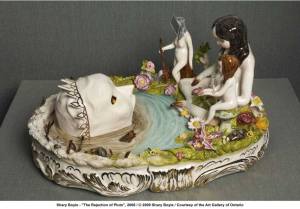
The scene of Boyle’s The Rejection of Pluto is the idyllic glade of the water nymph Cyane, decorated with exotic flowers, seashells and fairytale toadstools. The monstrous head of Pluto emerges from the water, his cavernous mouth yawning open as if to swallow his intended victim. Bright red-orange light, suggestive of the flames of Hell, flickers inside the mouth and eyes of the hollow, chasmal head. The water that immediately surrounds Pluto’s head appears brown and putrid and the vegetation bleached white, all vitality having been drained out by its proximity to the god of the Underworld. The female characters of this story – the girl-child Proserpine, her mother Demeter, and the nymph Cyane – are all gathered in a group at the opposite end of the glade. The amphibious water nymph Cyane glowers fiercely at Pluto, defending Proserpine whom Boyle has cast as a small child wounded by mirrored shards. According to Boyle, these three female figures “represent emotional, mental and physical resistance under siege.”
The crucial role that nature plays in The Rejection of Pluto can be likened to that of Boyle’s 2003 Untitled drawings, although the correlation between women and nature in the sculpture have been further strengthened. The landscape of The Rejection of Pluto reflects the violation suffered by Proserpine through its transformation from lush verdancy to polluted wasteland. This transformation of the landscape symbolizes Proserpine’s psychological and emotional turmoil in much the same manner as the mirrored shards that have pierced her flesh represent her physical violation. Boyle’s shrewd interpretation of the Proserpine/Persephone myth emphasizes the allegorical link between women and nature in her analysis of the mistreatment of both women and nature in the world.
The tragic heroine Persephone has also been depicted as a prepubescent girl in my 2000 mixed-media drawing entitled The Bitter Seed. In this drawing, I combine an image of myself as a child with the myth of Persephone as a means to address the difficult territory of childhood sexual abuse. By adopting the role of the mythological heroine, I translate and universalize my personal experience. Through the use of this metaphor, I strive to make an emotional state palatable and thus more easily approachable by the viewer.
The Bitter Seed takes its name from the pomegranate seed that Persephone was forced to eat, thus sealing her fate as the goddess whose annual death and rebirth would usher in the changing seasons:
“Persephone was the daughter of Zeus and Demeter, the goddess of agriculture. Hades, the lord of the Underworld, surprised Persephone one day while she was picking flowers and carried her off to be his bride. Demeter, the distraught mother, threatens to destroy all mortal men by causing an endless drought unless her daughter is returned. Zeus, who is the king of the gods at Olympus, commands Hermes to fetch Persephone from the realm of Hades. The wise Hades chooses to obey the command of Zeus; however, before Persephone is returned, he tricks her into eating a seed from a pomegranate. This deception is later revealed when Demeter asks her daughter “…have you eaten any food while you were below? If you have not, even though you have been in the company of loathsome Hades, you will live with me and your father…but if you have…you will return again beneath the depths of the earth and live there a third of the year; the other two-thirds of the time you will spend with me…”
To the ancient Greeks, the myth of Demeter and Persephone served to explain the death and regeneration of plant life each year. The metaphoric link between women and nature is quite overt: Persephone personifies the cycle of the seasons through her annual sacrifice.
In The Bitter Seed, my childhood self stands thickly outlined in black against a brightly coloured background reminiscent of a stained-glass window. One of my hands holds aloft a pomegranate, above which hangs the phrase “dirty girl.” I stare quizzically at both the fruit and the phrase, my child mind unable to fully grasp their meaning. Like the pomegranate in the Persephone myth, the fruit I hold represents violation and entrapment. Similar to the girl-child Proserpine in Boyle’s sculpture, who displays her wounded arms for the consideration of the viewer, my child-self in The Bitter Seed holds the pomegranate up as a symbolic manifestation of inner “wounds”.

Fig. 6. Jennifer Linton, "St. Ursula and the Gorgon’s Head", coloured pencil and drawing ink on Mylar, 62 cm x 80 cm, 2002.
The victimization of the girl-child Persephone in The Bitter Seed is later redressed in my 2002 drawing St. Ursula and the Gorgon’s Head (fig. 6) in which I assumed the role of the Catholic Saint Ursula, the patron saint of schoolgirls. In a manner similar to The Bitter Seed, this drawing blended autobiographical elements with mythological role-playing in order to universalize personal experience. The heroine of St. Ursula and the Gorgon’s Head assimilates two divergent mythological traditions: the hagiography of the Catholic saint with the Greco-Roman myth of the Gorgon Medusa. More avenging angel than saint, St. Ursula is shown adorned with angel wings and holding aloft a sword and the severed head of Medusa. The mouth of the snake-haired Medusa gapes open in a silent scream while a magical bloom of red flowers bleed from the wound of the severed neck. In the background, graphic and highly stylized red flowers also appear to bleed. Much like the strange, sinister flowers of Boyle’s 2003 Untitled drawings, these violent blossoms subvert the traditional woman-nature dichotomy and the association of women with a passive and nurturing feminine principle.
Women are frequently cast as the prize at the end of the hero’s quest but are seldom depicted as the active, adventurous hero themselves in mythology. This gender-biased tradition was best summarized by Joseph Campbell in his 1982 interview with Rozanne Zucchet from his collected writings entitled “The Hero’s Journey”:
“I was teaching these courses on mythology and at the end of my last year there this woman comes in and sits down and says, ‘Well, Mr. Campbell, you’ve been talking about the hero. But what about the woman?’ I said, ‘The woman’s the mother of the hero; she’s the goal of the hero’s achieving; she’s the protectress of the hero; she is this, she is that. What more do you want?’ She said, ‘I want to be the hero!’ So I was glad that I was retiring that year and not going to teach any more [audience laughter].”
While Campbell’s anecdote evidently amused his audience, it also underscores the gender discrimination inherent in mythological models. The sword-wielding heroine of St. Ursula and the Gorgon’s Head constitutes my feminist response to Campbell and this gender-biased tradition. My heroine adopts the stance traditionally occupied by the male hero Perseus who, as the Greek myth tells us, beheaded the female monster Medusa. Additionally, the gender of Medusa in my drawing has been switched from female to male as the image of the severed gorgon’s head my heroine holds is, in fact, a direct visual quotation of a painting by Caravaggio where Medusa is uncharacteristically portrayed as male.
The representation of gender also plays a crucial role in Boyle’s second porcelain sculpture commissioned by the Art Gallery of Ontario. Entitled To Colonize the Moon (fig. 7), this sculpture encapsulates her response to Foggini’s bronze statuette Perseus Slaying Medusa as well as to the traditional Greco-Roman myth that she “has interpreted in light of both her environmentalist and feminist ideas.” Boyle’s reinterpretation of the myth views Medusa as a “very misunderstood monster” who suffers a number of indignities and violations resulting from the capricious cruelty of the Olympian gods. The severed head of Medusa lies atop a funeral pyre comprised of dead bats and bees, the expression on her lifeless face one of sad resignation to her tragic fate. In stark contrast to the heroic romanticism of Foggini’s Perseus, Boyle’s version of the Greek hero is a lily-skinned, rosy-cheeked effeminate boy who sits in quiet repose while he wipes the blood from his sword. This traditionally triumphal moment has been undercut by the calmness of the scene and soft, unheroic body of Boyle’s Perseus. The violence of the story is not celebrated, but merely represented in an anticlimactic manner. The death of the monster Medusa and the death of Nature – embodied by the dead bats and bees – are seen as being synonymous. There is a mournful aspect to this sculpture, as Boyle challenges the viewer to consider the violence enacted both upon women as well as upon the natural world.
Contemporary feminist artists such as Shary Boyle and myself are mining the past, revisiting the universal narratives of mythology and, as Boyle succinctly stated, “propos[ing] some other kinds of stories.” Inspired by the second wave feminists, who coined the phrase the personal is political, we disrupt the problematic, gender-biased narratives of traditional myths by inserting our own personal, idiosyncratic content into the larger framework of these universal stories. This personalized content adopts the symbolic vocabulary of myth and, through creative tactics such as role-playing, re-imagines these stories from contemporary feminist perspectives. Mythological motifs traditionally associated with women – namely the allegorical link made between women and nature – is wielded as a deconstructive weapon that knowingly acknowledges this association while at the same time playfully subverting it. The female subjects that populate our work ache, bleed, bloom and otherwise manifest their interior worlds in a number of strange and wondrously magical ways.
Preface & Chapter One: A Sense of Nostalgia
For many years, I was satisfied by the simple act of drawing. While a number of my colleagues relied on computer software or other technologies to produce their art, I rejoiced in the analog. Aided by a pencil and a facility for drawing, I was limited only by my imagination when creating fantastical worlds between the borders of my paper. And then, one day, I wondered how my fantastical worlds would appear were they freed from their paper borders and delivered into our three-dimensional world.

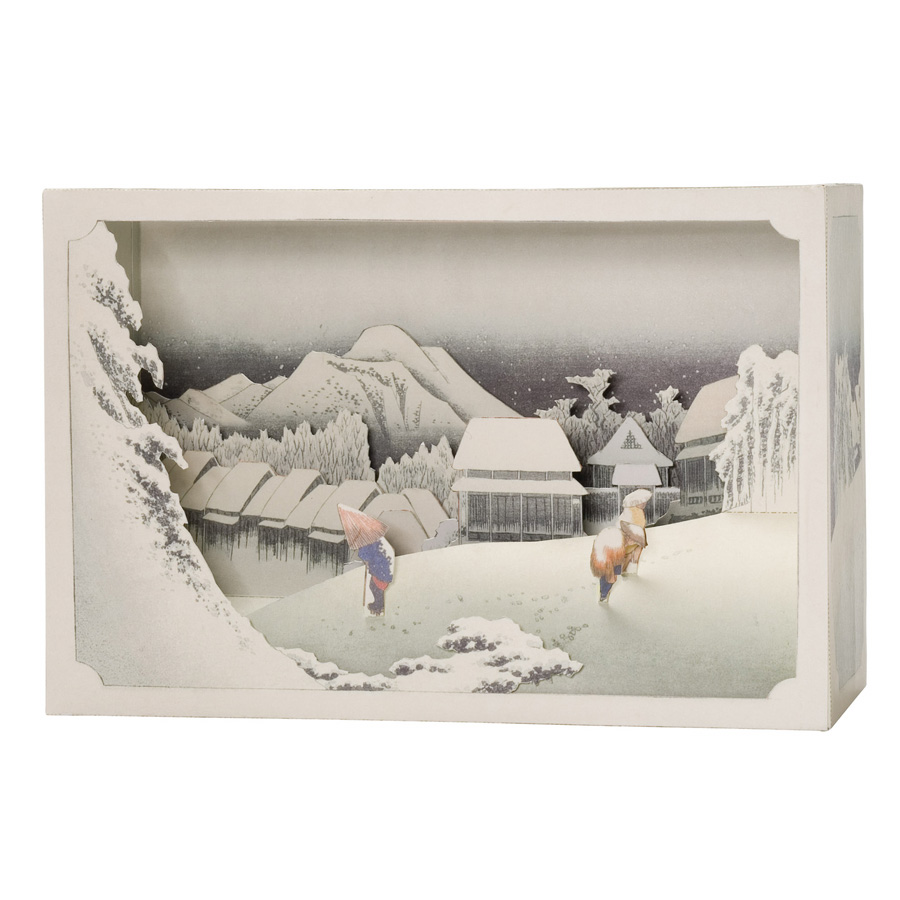
Tatebanko is the Japanese art of creating dioramas and scenic perspectives from paper. It was popular and widely admired from the 17th century to the early 20th century.
The desire to see my drawings projected into space began, nearly two years ago, with a moment of pure serendipity. While checking my email, an advertisement for an ‘arts & crafts’ store landed in my inbox that offered Japanese paper dioramas for sale. These paper dioramas – known as tatebanko in their native land – are small boxes containing flat, printed paper elements that are folded and glued into miniature tableaux. I grew instantly curious. The shallow relief of the tatebanko provided the perfect stage upon which to mount my drawings and project them into space. As an artist who also works in print media, I could use printmaking techniques to generate multiples that could be cut out, folded and glued. I decided that the box diorama was an obvious next step in the evolution of my hitherto two-dimensional art practice, enabling me to consider space and volume with relative ease.
In the months that followed my virtual encounter with the tatebanko boxes, my project grew in both size and scope. My initial concept of a box diorama expanded into the much larger and more complex construction of a dollhouse, a toy fondly remembered from my childhood. Revisiting the dollhouse in adulthood, myself a parent, has proven a psychologically rich and poignant exercise. In stark contrast to the innocuous role-playing of childhood – when one could ‘play Mommy’ – as an actual parent, the actions I take have real life consequences. This simple fact can, at times, be the cause of anxiety. Additionally, while the household provides a peaceful refuge from the hectic pace of the outside world, the daily negotiations between career aspirations and familial responsibilities simultaneously render the house a site of friction and conflict. An exploration of the conflicts that arise from these competing interests was, in part, the impetus behind my dollhouse project.
Domestic conflict aside, the physical construction of the dollhouse presented the greatest degree of friction and conflict during its creation. Not being a sculptor or an individual with any discernible building skills, working with three-dimensional materials proved a challenging and, at times, frustrating process. However, rather than enlist the aid of someone more technically proficient, I was stubbornly determined to construct the dollhouse myself. Although this aspect of the project offered the steepest learning curve, it also proved surprisingly rewarding to begin to understand and address the special demands of my chosen building materials. Whereas at the start of this project, I viewed the dollhouse solely as a devise for the display of my drawings, by its conclusion, I gave equal consideration to the dollhouse as an object unto itself. This newly found appreciation for sculptural space was, for me, the most pivotal and profound moment of the creative process.
Yet another surprising discovery was the quality of play I found in working with the cut out lithographs. Having printed multiples of the same drawing meant that I was able to explore different arrangements of the same graphic elements. With my drawings freed from the static plane of the paper, I could experiment with composition, contextualizing and re-contextualizing with each new grouping of images. A folded paper wardrobe in one room, for instance, appears subtly altered when combined with different objects in another room. This quality of ‘play’ not only proved enjoyable, but also highly appropriate given the framework of a dollhouse.
Within the body of this paper, I reveal and discuss the various sources that have guided the aesthetics of my project. These sources – which include the Gothic novel, the horror film, and the art of the Surrealists – have shaped not only this project, but have greatly informed my artistic practice to date. It is to these sources that the Disobedient Dollhouse pays homage.
Chapter One: A Sense of Nostalgia
“A house constitutes a body of images that give mankind proofs or illusions of stability. We are constantly re-imagining its reality: to distinguish all these images would be to describe the soul of the house; it would mean developing a veritable psychology of the house.”
— Gaston Bachelard, The Poetics of Space.
The image that appears in my mind when I meditate on the word “house” is not a recreation of the family home of my childhood, nor is it a straightforward rendering of the house in which I currently dwell. Rather, it is an amalgamation of all the houses in which I’ve lived, blended together with the houses belonging to friends, and the houses I’ve vicariously experienced through films or books. This is the composite house of my dreams, a grand and expansive place with numerous corridors and hidden rooms. The space within my imagined house is infinite in scope. Doors from great hallways lead into small rooms, each presenting more doors which, in turn, lead to progressively smaller rooms, stacked into each other with the artful precision of a Russian matryoshka nesting doll. The endless replication of interiority in my imagined house, unlike that of the nesting doll, has no physical limits. Space as it is experienced through the psyche is boundless. Mine is an oneiric house – a house of dreams – similar in nature to the one conjured by philosopher Gaston Bachelard in his text Poetics of Space, built not from bricks-and-mortar but constructed from layers of memory and experience. According to Bachelard, my every experience with the phenomenon that is “house” is imbued with a deeply personal, psychological resonance derived from the memory of the very first house of my childhood. While I do support Bachelard’s claim that the childhood home is fundamental to the psychological mapping of the oneiric house, I would graft onto his argument the importance of the towers of fairytale castles and the cobwebbed elegance of aristocratic manors that so often provide the setting for Gothic narratives in film and literature. These majestic dwellings, while considerably more grandiose and romantic than the humble home of my childhood, are nonetheless formative to the house of which I dream. The mysterious interior of my oneiric house – the one of endless doors and dark, secret passageways – owe as great a debt to these traditions of literature and film as it does to my own personal, lived-in experience with a physical house. It is this house, this strange amalgam of the real and the fantastic, that I strive to conjure in my project entitled the Disobedient Dollhouse.
Granting form and substance to my house of dreams has proved a daunting task. The infinite space of the dreamscape, with its ever-shifting walls and limitless rooms and doors, defies reproduction in the static world of the real. At best, my aim to is achieve some sort of compromise with the infinite. Thus, I have sought to make this compromise concrete through the creation of a miniature toy house: a dollhouse.
My fascination with dollhouses began, predictably, in childhood. Though I was never fortunate enough to own a dollhouse, I did possess several pieces of plastic miniature furniture that I would fastidiously arrange into rooms. These rooms provided the setting for the domestic scenes myself and my playmates would enact with our dolls – scenes that mimicked the day-to-day household routines of our mothers. This form of play amongst young girls – where we would ‘play house’ and pretend to be ‘the Mommy’ – was not only an imitation of the maternal role as we observed it, but, presumably, constituted a type of practice for our future lives as women. Now, as an adult, artist and mother, I revisit the dollhouse. The idealized view of domesticity that informed my childhood dollhouse is reconfigured by my adult self as a place much more complex, even contradictory in nature. These darker, more nuanced shadings find expression in the ‘gothic’ elements of my dollhouse.
A dollhouse is a gendered space, one specifically codified as feminine. Literary critic Susan Stewart defines the dollhouse as a “discourse of the ‘petite feminine’” that yearns to see itself replicated in a tiny, precious model of perfect domesticity. Developed in the 17th century as an amusement solely intended for adults, it served as a trophy of the wealthy European woman. Given the rise in popularity of dollhouses in 18th century Europe, at a time in history when women’s roles were increasingly confined to the home, it is tempting to draw a correlation between this change in gender-based codes of conduct and the miniature toy house that reinforced a woman’s role as being solely defined by her place within the house. Her fantasy of a microcosm over which she held complete control – in a world in which she held little or no political control – played out through the choreography of furnishings in her miniature rooms. Unlike the traditional toy object, the staged interiors of the dollhouse were not meant to be manually played with but rather to be “consumed by the eye” as an object of display. As such, the dollhouse was modeled as a shrine to an idealized domesticity, forever unsoiled by the grimy reality of daily living.
A compulsion towards nostalgia often shapes the interior of a dollhouse. Contemporary dollhouses are decidedly not contemporary in their motifs, with the historic splendor of wealthy Victorian homes being the most frequently represented style amongst current dollhouse enthusiasts. As Stewart notes:
“…it is probably not accidental that it is the Victorian period which is presently so popular for reproduction in miniature […] because of that period’s obsession with detail and materiality is so analogous to the miniature’s general functions…”
Nostalgia is characterized by a sense of yearning, either for one’s own past or for an imaginary past located somewhere in history. Yearning constructs a view of the past that is sentimental in nature, and the dollhouse is a manifestation of this essentially romantic construction. There are no shoeless Dickensian street urchins haunting the perimeters of a Victorian-themed dollhouse; these are sumptuous interiors fuelled by fantasy and free of social critique.
A trace of nostalgia can be discerned in my Disobedient Dollhouse, evidenced by the Victorian-style decoration and furnishings, as well as in the clothing worn by some of its inhabitants. An old-fashioned cast iron cook-stove is represented in the kitchen. The parlor room prominently features an upright piano, an entertainment staple in many wealthy Victorian households. The era’s obsession with detail is fully on display in the intricately patterned wallpaper that adorns each room of my dollhouse.
Not only do the furnishings and other contents express nostalgia, but the medium by which many of these contents were produced – namely the medium of stone lithography – is itself informed by nostalgia. The printmaking process of stone lithography enjoyed enormous popularity amongst visual artists in the 19th century, particularly during the later decades of that century. Hence, the formal characteristics of the medium carry a heightened association to print-based artwork produced during the Victorian era, particularly amongst fin-de-siècle artists such as Odilon Redon (fig. #1) and Edvard Munch. As a contemporary visual artist, producing a body of work using stone lithography is an especially purposeful act. Against the backdrop of the 21st century digital age, where images can be instantly produced and replicated with the click of a computer mouse, the physically arduous medium of stone lithography – which involves sanding and drawing onto a heavy slab of limestone – is comparatively anachronistic. At a time in history when images can be more easily obtained by photographic or digital means, the act of drawing and reproducing images with stone lithography carries with it a quality of nostalgia. By using this “nostalgic” print technology, my intention is to formally recall the style and design of Victorian art, and in particular the grotesque and macabre imagery of Victorian artists like Redon and Munch.
While a trace of nostalgia is detectible in the Disobedient Dollhouse, a tension also exists in the work that simultaneously disrupts the easy consumption of these same nostalgic images. The word “disobedient” contained in the title summons an image of a stubbornly defiant child who refuses to submit to a higher authority. Against which authoritative structure does my dollhouse rebel? In part, it is the force that drives the nostalgic impulse – the urge to construct a sentimentalized view of domesticity – that compels my dollhouse to revolt. A tactic of subversion has been employed as a means of rebellion. For instance, although the conventional Victorian domestic scene of a woman playing piano has been dutifully rendered, the woman depicted is a hybrid creature with the head of a bird. A chair located in the same room as the bird-headed woman mysteriously sprouts twisted floral vines that snake up the back wall. Gigantic insects infiltrate the room and swarm across the ornate damask wallpaper like a strange, inexplicable virus. These hybrid monsters, giant insects and fantastic vegetal growths disturb the inherent sentimentality of nostalgia and propose a dark, secret world that churns just beneath the veneer of domestic perfection.
[…this is an excerpt from my Master’s thesis on the Gothic aesthetic. For a continuation of this paper, please visit the earlier post “The Gothic House.”]
Surrealism, alter-egos and private mythologies; conclusion.
The concluding chapter of my essay on the Gothic aesthetic and my thesis project The Disobedient Dollhouse. These excerpts from my thesis began with The Gothic House and The Abject…, respectively.
“In 1930, after having furiously and methodically composed my
novel ‘La femme 100 têtes’ I was visited almost daily by Loplop,
Bird Superior, a private phantom very much attached and devoted to me.”
— Max Ernst
Poised amongst the brood of bird-children sits the nanny, a character within my Disobedient Dollhouse that was modeled after myself. Downstairs in the kitchen, a second version of ‘myself’ cast as the household cook struggles with an absurdly large cooking utensil. These characters are the result of an amalgamation of Gothic heroines I have borrowed from sources such as Charlotte Brontë’s Jane Eyre and, most especially, Lewis Carroll’s Alice from Alice’s Adventures in Wonderland. Costumed in a fashion reminiscent of a Victorian girl, my ribbon bonnet, puffed sleeves and crinolined skirt (fig. #8) recall the famous wood engravings of Alice by British illustrator John Tenniel. By incorporating my own image into these characters, I have effectively embedded myself within this miniature world. This role-playing is one of the creative strategies I employ in order to generate a private mythology.
Throughout my visual art practice, I have used various legends and myths as cultural ready-mades into which I introduce my own personal symbolism and meanings. Over the years, these pre-existing myths have been absorbed into my artistic lexicon, contributing to a complex language of symbols by which I construct a private mythology. Myths supply an accessible and universal narrative to which I can attach my idiosyncratic story.
Renowned scholar and mythologist Joseph Campbell describes one of the goals of myth as “…effecting a reconciliation of the individual consciousness with the universal will.” Similarly, in his essay “The Expressive Fallacy” Hal Foster cites Nietzsche’s discussion of an artist’s use of myth to express an interior world: “The whole notion of an ‘inner experience’ enters our consciousness only after it has found a language that the individual understands – i.e., a translation of a situation into a familiar situation…” The “language” to which Nietzsche refers can be interpreted as “mythology” which provides a universal narrative to which all cultures, no matter how disparate, have access. The “inner experience” may be read as the personal, psychological or emotional world that the artist seeks to materialize through the use of myth. In short, myths connect us to each other by anchoring the idiosyncrasy of the individual to a universally shared point of reference.
The construction of a private mythology is a procedure that allows an artist to explore deeply personal and intimate subject matter while simultaneously maintaining a level of psychological distance. In my own work, I employ the strategy of role-playing as a means to address autobiographical content. In an earlier body of work entitled The Bitter Seed (fig. #9), I combined images of myself as a child with the character of Persephone, a heroine borrowed from Greco-Roman mythology. By adopting the role of Persephone, I universalized the idiosyncratic – depersonalizing the personal content. This process provides a psychological distance while simultaneously rendering the work more readily accessible to the viewer.
The mythological character Persephone has supplied my artwork with its most recurrent of symbols: the pomegranate. My series The Bitter Seed took its name from the pomegranate seed that Persephone was forced to eat, thus sealing her fate as the goddess whose annual death and rebirth would usher in the changing seasons:
“Persephone was the daughter of Zeus and Demeter, the goddess of agriculture. Hades, the lord of the Underworld, surprised Persephone one day while she was picking flowers and carried her off to be his bride. Demeter, the distraught mother, threatens to destroy all mortal men by causing an endless drought unless her daughter is returned. Zeus, who is the king of the gods at Olympus, commands Hermes to fetch Persephone from the realm of Hades. The wise Hades chooses to obey the command of Zeus; however, before Persephone is returned, he tricks her into eating a seed from a pomegranate. This deception is later revealed when Demeter asks her daughter ‘…have you eaten any food while you were below? If you have not, even though you have been in the company of loathsome Hades, you will live with me and your father…but if you have…you will return again beneath the depths of the earth and live there a third of the year; the other two-thirds of the time you will spend with me…’”
To the ancient Greeks, the myth of Demeter and Persephone served to explain the death and regeneration of plant life each year. Persephone personified the cycle of the seasons through her annual sacrifice.

Fig. #10. Jennifer Linton. Detail from the “Disobedient Dollhouse”, 2009-10, lithograph and digital image.
A pomegranate motif appears repeatedly throughout my Dollhouse. A highly stylized version of this fruit is featured in all of the stained-glass windows, and pomegranates adorn the wallpaper of the bedroom and the head and footboard of the bed. Two of the framed, miniature pictures that hang on the bedroom wall also contain the pomegranate. One of these framed pictures features a self-portrait, in which the curly locks of my hair transform into undulating, snake-like vines (fig. #10). These vines terminate in a single pomegranate, delicately suspended above my open palm. This self-portrait, however, makes only a vague reference to the pomegranate from the Persephone myth. Within the narrative of my current project, I no longer inhabit the role of this Greco-Roman goddess. The pomegranate serves not as a symbol of sexual subjugation – as it does within the Persephone myth – but rather as a symbol of female empowerment. The partially opened vulviform shape evident on the pomegranates throughout the Dollhouse make the linkage to female sexuality quite explicit.
Whenever an artist includes self-portraiture, the temptation for the viewer is to read autobiographical content into the work. Such is the case in my work, although this content is largely mediated through my use of symbolism and mythology. The grotesque and dreamlike imagery of the Disobedient Dollhouse obscures any straightforward reading of autobiography, softening the distinction between ‘the invented’ and ‘the real’ elements. The dark, psychologically tumultuous material that the Gothic would seek to conceal, and the Freudian psychoanalytic model to repress, my Dollhouse opts to place on display, albeit cloaked in myth and symbolism.
Blurring the boundaries between ‘the invented’ and ‘the real’ through the creation of a private mythology was a strategy often employed by artists who subscribed to the idiom of Surrealism. The fantastic and frequently grotesque imagery of Surrealist art closely relate to my Dollhouse’s otherworldly and Gothic-inspired content. In fact, the aims of Surrealism – to question rationality and uncover sublimated fears and desires – seem to echo the urge of Gothic novelists like Brontë to expose the concealed darkness of the human psyche. “Surrealism and the Gothic share a decisively anti-Modernist stance,” wrote curator Christoph Grunenberg, “rejecting Modernism’s emphasis on order, rationality, and purity.” One of the most ‘gothic’ practitioners of Surrealism – and an artist whose work was dedicated to the manufacture of a private mythology – was the visual artist Max Ernst.
The collage-based books and graphic work created by Ernst possess an especially heightened quality of the Gothic. To a large extent, this quality derives from the source material Ernst used to construct his collages, which included wood-engraved illustrations taken from 19th century French popular fiction. The subject matter of these ‘pulp’ fiction books and periodicals generally involved:
“…torrid love, torture, crimes passionels and the subsequent incarcerations and executions (by guillotine), hatreds and jealousies among the very wealthy and the very indigent…”
These are the same dramatic, sinister and darkly romantic themes that typify Gothic fiction. Ernst’s disjointed juxtapositions only served to amplify the already emotionally charged content of his source material.

Fig. #11. Max Ernst. Illustration from the novel “Une Semaine de Bonté”, 1933, engraving based on collage.
One of Ernst’s most famous collage novels is Une Semaine de Bonté (fig. #11), in which the days of the week are represented by seven seemingly arbitrary “deadly elements” such as the “Lion of Belfort,” bats, serpents and dragons, and the mythological character of Oedipus. It is in the latter chapter concerned with Oedipus that the bird-headed creature named ‘Loplop’ first makes his entrance into Ernst’s novel. The hybrid bird-man Loplop was a creation with which Ernst closely identified. His identification to the bird-headed man prompted many of his contemporaries to view Loplop as the artist’s alter-ego, an association that Ernst strengthened through his writing in Notes pour une biographie. Ernst frequently mixed actual autobiography with his Surrealist art, making it impossible to distinguish between the artist’s life and his wildly inventive stories. In one such account, Ernst forges a strong link between his early life and his artistic creation Loplop:
“1906. Head Bird Hornebom. A friend by the name of Hornebom, an intelligent, piebald, faithful bird dies during the night; the same night a baby, number six, enters life. Confusion in the brain of this otherwise quite healthy boy – a kind of interpretation mania, as if newborn innocence, sister Loni, had in her lust for life taken possession of the vital fluids of his favorite bird. The crisis is soon overcome. Yet in the boy’s mind there remains a voluntary if irrational confounding of the images of human beings with birds and other creatures; and this is reflected in the emblems of his art.”
Ernst’s motivation behind this conflation of his art and autobiography remains unclear. While writers such as Werner Spies describe Loplop as an “autobiographically tinged bird-creature”, there remains a degree of mystery surrounding Ernst’s personal attachment to his alter-ego. His complex vocabulary of recurrent symbols and characters, including the omnipresent Loplop, may have been more the result of a Surrealist intellectual game than a deeply personal expression of psychological catharsis. Driven by a fascination with psychoanalysis, Surrealist artists like Ernst frequently engaged in game-playing as a means to access the random machinations of the unconscious mind. The technique of collage was particularly well-suited to this end. Thus, Ernst’s juxtaposition of disparate images, such as a male figure topped with a bird’s head, could well be the result of his Surrealist investigations into randomness. Regardless, inspired by the psychoanalytic writings of Freud, his private myth-making created a forum in which he unearthed and explored the repressed material of the human psyche.
The bird-headed women that populate my Disobedient Dollhouse can be viewed as the great-granddaughters of Loplop. Female counterparts to Ernst’s invariably male creation, they inhabit a similarly enigmatic role. While it is enticing to read these bird-women as extensions of myself, this close association remains ambiguous. My own image is represented in the appearance of the ‘nanny’ and ‘cook’ characters. Cast in these roles, my social status within this world appears subservient to the two bird-headed women, one of whom leisurely plays at the piano. Has my character/s been enslaved by these menacing creatures and forced to care for their offspring while they lounge? Given my real-life status as artist, wife, and mother, one could easily attach this autobiographical reading. Caution should be exercised, however, to interpret these images too literally. Similar to the private myth-making of Max Ernst, my work contains as much theatrical artifice as it does legitimate psychological exploration. Steeped in dramatic excess, my Dollhouse is self-consciously prone to hyperbole.
The genesis of my bird-women has little to do with Surrealist explorations of the unconscious mind, but instead, are visual evidence of my recent interest in dioramas. In fact, the figure of the bird-woman holding the skeletal rodent was not only the very first image I created for this project, but she derived entirely from a taxidermy diorama I viewed online at the A Case of Curiosities web site. Anthropomorphic taxidermy dioramas were a strange passion of the Victorians. Walter Potter, one of that era’s most celebrated practitioners of this macabre art form, was renowned for his complex and large scale tableaux such as his Kittens’ Tea & Croquet Party (fig. #12). The ghoulish spectacle of Potter’s taxidermy dioramas neatly encapsulates the type of grotesque art to which I am drawn as an artist, and therefore, it is not the least bit surprising that these provided the creative ‘jumping-off point’ for my dollhouse project.
The hybrid bird-women and host of other grotesques that populate my Disobedient Dollhouse represent the wild, unruly and random elements of the psyche that stubbornly resist the process of repression. The nostalgic impulse that seeks to construct a too-perfect version of the past – one that suppresses the ‘dark family secret’ or other psychologically troubling material – is thwarted by these defiant monsters. The idyllic view of domesticity generated by nostalgia rejects the ugly, soiled, imperfect and dissonant. This romanticized construction is illusory and cannot be maintained. Shaken to its very foundations by the uncanny creatures that swarm its interiors, it will inevitably falter and collapse like the ill-fated House of Usher.
Epilogue: A Perverse Thrill
“Who has not a hundred times, found himself committing a vile or silly action, for no other reason than because he knows he should not?”
— Edgar Allan Poe
The music builds to a crescendo that ends in a sudden, resounding crash, followed by silence. “She’s dead”, pronounces Dr. Markway after he grasps the arm that dangles limply from the open car window. This is the dramatic finale of Robert Wise’s 1963 film The Haunting, in which the character of Nell meets her end in a fatal car accident on the grounds of Hill House, remaining forever as the caretaker of the vindictive ghost who haunts the nursery in this classically Gothic house. “It was what [Nell] wanted, to stay here…” explains the clairvoyant Theo, “…she had no place else to go. The house belongs to her now, too…maybe she’s happier.”
Moviegoers have flocked, myself included, to horror films like The Haunting in order to vicariously experience the eerie and macabre. What is it about these frightening experiences that we find so intriguing? Much like the malevolent spirit of Hill House that beckoned to Nell, we feel urged by an inexplicable force to seek out the locked doors, hidden rooms and dark, mysterious corners of the Gothic house. The more we have been instructed by the rationality of science to reject the nonsensical, the superstitious, the absurd and otherworldly, the more we seem compelled to seek these out. The shadowy interiors of these cinematic and literary haunted houses have significantly shaped the construction of my oneiric house, the one that I dream with the endless doors and secret passageways. They also inform the grotesquery of my Disobedient Dollhouse. Rather than reject the absurd and uncanny, my Dollhouse celebrates it.
Related articles
- Preface & Chapter One: A Sense of Nostalgia (jenniferlintonart.wordpress.com)