The following text is an excerpt from my Master’s thesis written, in part, on the topic of the Gothic aesthetic. I felt that this chapter of the paper might be of particular interest to those that read this blog. The “Disobedient Dollhouse” project to which I make reference was the visual art component of my MFA thesis. To view images from this project, click on the Gallery page located above the header of this blog. Enjoy.
“It was an evil house from the beginning – a house that was born bad.”
— The character of Dr. John Markway from Robert Wise’s 1963 film The Haunting
I confess to being an avid fan of gothic horror films and ghost stories, a confession that may not seem overly surprising given the content of my work both past and present. The castles and aristocratic manors that I mentioned earlier as being critical to the formation of my ‘house of dreams’ arise from these sources (fig. #2). The heightened theatricality of a medieval cathedral, castle or historic manor has been incorporated into my oneiric house and translated into its endless doors and dark, secret passageways. The term ‘gothic’ that I use to specify a certain subgenre of horror fiction refers not to the tribes of ancient Germanic people from whom the name originally derived, nor is it related to the medieval art that also bears this name. Instead, the term derives from a chiefly British literary genre of the 18th and 19th centuries, originating with Horace Walpole’s 1764 novel entitled, appropriately enough, The Castle of Otranto: A Gothic Story. Gothic literature combined elements of both horror and romanticism and its themes typically involve death, ghosts, the supernatural, transgression, patriarchy and the female heroine. Much like the staged interior of a dollhouse, the Gothic novel reflected a similar tendency towards the staged and theatrical. Gilda Williams, editor of the contemporary art anthology The Gothic, described ‘Gothic’ as “a studied, adopted stance,” that is “cultured, sensual and affected”, a description that concisely captures the Gothic’s propensity for dramatic hyperbole.

Fig. #2. Film still from Robert Wise’s 1963 The Haunting.
A central motif to the Gothic narrative is the house, especially one haunted by ghosts – both literal and metaphoric – and the disturbing family secret that has been shut away in an underground crypt, a dark attic, or behind hidden doors. Beginning with Walpole’s The Castle of Otranto, the genre has maintained a continual fascination with architecture. Perched on a hilltop overlooking a grey and perpetually soggy landscape, the dilapidated old aristocratic manor provided the Gothic narrative with its characteristic atmosphere of gloom and foreboding. Not merely a setting for the narrative to unfold, the Gothic house was frequently cast as a character itself, imbued with an uncanny – and often malevolent – sentience. This notion of a sentient house that is, by virtue of some inexplicable phenomenon arising from its very construction, a conscious being, is best exemplified by Edgar Allan Poe’s The Fall of the House of Usher in which the titular house claims the lives of the family that dwell within it. In Poe’s short story, the character of Roderick Usher believes that his family home is sentient through some mysterious combination of masonry and vegetation, and that the illness which plague both he and his sister Madeline have been caused by this house. Poe’s use of adjectives such as “eye-like” to describe the windows belonging to the House of Usher bestow an anthropomorphic quality to the structure, a quality which further underscores the notion of a sentient house:
“I reined my horse to the precipitous brink of a black and lurid tarn that lay in unruffled lustre by the dwelling, and gazed down – but with a shudder even more thrilling than before – upon the remodelled and inverted images of the grey sedge, and the ghastly tree-stems, and the vacant and eye-like windows.”
In the dramatic conclusion, the moral and spiritual decay of the Usher family physically manifests in the destruction of the house itself – the building literally splits in two and sinks into the surrounding landscape.
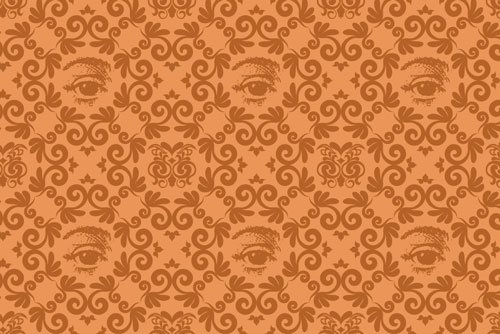
Fig. #3. Jennifer Linton. Detail from the Disobedient Dollhouse, 2009-10, mixed media.
The structural features belonging to my Disobedient Dollhouse, while not as malevolent as those of the House of Usher, share some of the qualities of anthropomorphism and otherworldliness with its literary antecedent. Reminiscent of the “eye-like” windows of Poe’s creation, the windows featured on all of my exterior-facing walls are comprised of a stylized stained-glass pomegranate design that closely resembles the slit-shaped eye of a cat. These “cat’s eye” windows – all of them grouped in pairs – are most clearly evident from the brick exterior of the dollhouse, where they stare out, unblinking, at the viewer. Additionally, a repeating pattern of disembodied eyes gaze outward from the wallpaper of the kitchen (fig. #3), suggesting that the house itself bears witness to the strange events that are unfolding within. Upstairs on the wallpaper in the nursery, a legion of tiny, open mouths appear to silently scream in a gesture that mimics the endless squawking of the bird-children that inhabit this room. Much like the sentient house of Poe’s story, these anthropomorphic elements propose a house possessed of consciousness – one that not only contains supernatural events, but may also be the generator of them. The desired effect I aim to achieve is a disquieting exchange between the Dollhouse and the viewer, as the walls of the dollhouse uncannily return their gaze.
The crowning glory of any Gothic house is, of course, the attic. Similar to its close relative the cellar, the attic is a mysterious and seldom-used room where items – both material and psychological – are stowed away. The attic located within Bachelard’s oneiric house is a place of light and rationality, whereas he characterizes his cellar as the “dark entity of the house” that “partakes of subterranean forces” of the irrational, unconscious mind. In an inversion of Bachelard’s house, the attic that tops my Dollhouse is a shadowy place that offers a single window through which the dark interior may be viewed. Following the convention of most contemporary dollhouses, a cellar room is not represented in my Dollhouse, although the small cupboard door beneath the stairs – through which vine-like tentacles emerge from darkness – seem to hint at the “subterranean forces” present in Bachelard’s cellar. Peering through the attic window, the viewer encounters a snake-tentacled monster with a single, gigantic eye returning their gaze (fig. #4). This strange Cyclops is positioned slightly off-centre and is thus partially obscured by the outer wall, the bars of window frame, and the darkness within. The very purposeful positioning of this creature follows the time-tested horror film adage that “a monster you can’t see is scarier than one you can”, granting the viewer only enough information to understand that something sinister lurks within this space.

Fig. #4. Jennifer Linton. Detail from the Disobedient Dollhouse, 2009-10, mixed media.
The attic is the only enclosed room within my Dollhouse, allowing a very limited access to its interior. As such, it is the most private and mysterious of all the rooms. If I imagine myself descending from the attic onto the second story of my Dollhouse, where the nursery and the bedroom are located, the level of privacy compared to the attic decreases. While a bedroom is generally considered a very private and intimate space, the contents of my bedroom are fully on display, thus negating privacy. One of the crucial features of a dollhouse is the lack of complete enclosure of the miniature, thereby admitting access to its interior. This access facilitates play in a children’s dollhouse, and allows for display in the dollhouse designed for adults. Whereas the ground floor and second story of my Dollhouse adopt this convention of display, the enclosed attic rejects it. Whatever monsters and dark, troubling secrets hide within its shadowy corners, the attic will not reveal too readily. In this regard, the attic is the most “disobedient” of all the rooms.
The dusty and cobwebbed attic, dark and infrequently visited, provides the optimal place in which to discard the disused, unwanted, and the surplus. It can supply storage space for the cherished items of the past, no longer in use, as well as a hiding place for family secrets and other psychologically troubling material. The attic is a quintessentially ‘gothic’ space, where suppressed secrets threaten to rise up like a vengeful ghost. Given that my Disobedient Dollhouse is a Victorian-themed dollhouse, it is not difficult to imagine all of the wild, violent passions forbidden by that era’s strict social codes might be banished into the hidden corners of this room.
Concealed family secrets that slowly reveal themselves, threatening to unravel the apparent order of the household and causing a “…forced reckoning with a long buried piece of family history” is a classically Gothic trope. Like the ‘sentient house’, whose malevolence has assumed solid form within the structure of the house itself, the Gothic ‘family secret’ often physically manifests as an individual, or a ghost. In Poe’s Fall of the House of Usher, the ghost of Madeline Usher rises from the family crypt – after having been interred there whilst still alive – and claims her deadly vengeance upon her brother Roderick. In Charlotte Brontë’s novel Jane Eyre, the violently insane Bertha Mason has been imprisoned in the attic of Thornfield Hall, literally bound by chains and guarded. Described as a “beast”, a “wild animal”, a “monster”, and likened to “the foul German spectre – the vampire”, the insane first wife of Edward Rochester represents the darkest and most dangerous of family secrets.
Literary critics Sandra Gilbert and Susan Gubar, in their study of women writers entitled Madwoman in the Attic, draw a provocative parallel between the characters of Jane and Bertha in Brontë’s classic novel. They suggest that Bertha represents the “truest and darkest double” of Jane, embodying all of the wild, destructive passions that the genteel Jane consciously rejects. She can be likened to the wild, tangled vines that grow spontaneously from the chairs and bedposts in my Dollhouse, or the snakes that magically slither out from the folds of the bed sheet. Forced to dwell in the shadows of the attic for years, she reemerges into the light with an unchecked fury. The wild randomness of her actions, much like my snakes and vines, disrupt the social niceties occurring elsewhere in the house, serving as a forceful reminder that hidden secrets will inevitably “see the light of day”, and that the repressed will always return.
Related articles
- Preface & Chapter One: A Sense of Nostalgia (jenniferlintonart.wordpress.com)


 Lady Lazarus