“Your mother ate my dog!”: Lady Lazarus’s favourite ‘Mommies of Horror’.

“Definition of  Freudian slip: when you say one thing, but meant your mother.” –an old joke, as immortalized in Urban Dictionary.

Ever since the days of Sigmund Freud, mothers have endured the brunt of blame for the neuroses of their offspring. The psychologically-complex relationship between mother and child served as the dramatic foil against which the existential angst of Shakespeare’s melancholic Hamlet played out, not to mention innumerable tales of dysfunctional families in horror fiction. There are countless examples of horror movie villains, like Jason Voorhees from the Friday the 13th series, who have a rather intense and, um, complicated relationship with their mother. In these films, the character of the mother is the creator — both literally and metaphorically — of the monster. Even though Mother’s Day is still several months away, let’s pay homage to the most memorable mothers in cinematic horror.

Margaret White (Piper Laurie) presses her traumatized daughter against her "dirty pillows" in De Palma's "Carrie."

1. The abusive Margaret White (Piper Laurie) from Brian De Palma’s Carrie (1976) torments her teenage daughter with her ferocious piety. Unfortunately for Mrs. White, her daughter happens to possess telekinetic powers and a strong desire to attend her high school prom. When the latter proves disastrous, and Carrie finds herself soaked in pigs blood, things go from bad to worse. Convinced that she is “possessed by Satan,” Margaret stabs her daughter in the back before being summarily dispatched by a shower of kitchen knives flung at her by Carrie’s telekinesis. The knives pin Mrs. White against the kitchen door frame in the highly appropriate cruciform stance, offering horror fans one of the most memorable and satisfying death scenes in the genre.

Vera "Mum" Cosgrove gets bitten by the nasty Sumatran Rat-Monkey in Peter Jackson's "Dead/Alive".

2. Long before he ventured into the realm of Orcs and Hobbits, New Zealand director Peter Jackson was much beloved in the horror genre for his “splatter” films. His infamous 1992 horror-comedy Braindead (released in North America as Dead Alive) still holds the title for being one of the bloodiest, goriest zombies films to date. Even highly adept and accomplished splatter-gore directors like Takashi Miike don’t quite attain Jackson’s zany, hilarious, and way over-the-top levels of gore. As if in counterbalance to the excessive gore, Jackson’s Braindead offers an equally excessive character in Vera Cosgrove. She epitomizes the thoroughly controlling, ball-busting mother who simply cannot allow potential happiness to enter the life of her beleaguered son. Once “Mum” is bitten by the Sumatran Rat-Monkey and infected with the virus that transforms her into a zombie, Jackson revels in the sadistic pleasure of having various parts of her matronly body impaled, injected, dismembered, consumed, and otherwise compromised. Packed with many memorable quotes, including “I kick ass for God!” and, one of my favourites, “Your mother ate my dog!”, Braindead is a gloriously gory, campy romp. Just don’t watch it soon after eating.

Nola (Samantha Eggers) gives her newborn a clean -- with her tongue -- in Cronenberg's "The Brood."

3. Procreation doesn’t get more bestial than in David Cronenberg’s 1979 Canadian horror classic The Brood. Samantha Eggars (best known for her role as TV-mom to Sarah Michelle Gellar in Buffy the Vampire Slayer) plays Nola Carveth, a mentally-ill patient who opts for an experimental, and highly controversial, psychotherapy treatment. This unorthodox  “psychoplasmics” treatment causes the patient’s mental illness to manifest physically on their bodies — in the case of Nola, she parthenogenetically births strange, mutated children. This film has all the themes that typify a Cronenberg film: abjection, body horror, bizarre sexuality, and an anxiety/horror over female biology and reproduction. A degree of sympathy exists for Nola, as she’s evidently the victim of childhood abuse perpetrated by her cruel and self-centred mother, although this sympathy soon diminishes once it is revealed that Nola is, herself, abusing her daughter Candice. The ‘birthing’ scene, where Nola licks her offspring clean in the manner of a mother cat, is classic Cronenberg.

Walerian Borowczyk’s “Contes immoraux”: The bloodthirsty Countess meets European softcore cinema.

A bevy of naked beauties in Walerian Borowczyk's "Contes immoraux" (1974).

Walerian Borowczyk (1923-2006) was a Polish filmmaker who was, in the early years of his career, the creator of astounding stop-motion animations. Nightmarish and surreal in nature, animated short films such as Renaissance (1963) and Jeux des anges (1964) brought Borowczyk critical acclaim in the rarefied world of avant-garde filmmaking. Commercial success, however, eluded him until his venture into live-action cinema with his infamous art-house-meets-softcore films of the 1970’s. A consummate provocateur, Borowczyk challenged his audience with Contes immoraux (‘Immoral Tales’, 1974) and La bête (‘The Beast’, 1975) — films which some critics derided as “contentless pornography” due to their wholesale preoccupation with nudity and sexuality. While the charge of “pornography” is not entirely unwarranted, I would maintain that Borowczyk’s meticulously-detailed set design, careful art direction and signature surreal style elevate films such as Contes immoraux from mere “sexploitation” to softcore cinema with considerable artistic merit.

Now, don’t get me wrong — from a straightforward “is this movie good or not?” perspective, Borowczyk’s Contes immoraux is not an especially good film. What dialogue there is — and there’s mercifully little — is completely inane. The action is glacially slow, due in part to a camera that lingers incessantly over the bushy nether regions of naked girls. It is ironic, then, that as a purely softcore film Contes immoraux also falters. By the standards of contemporary pornography, Borowczyk’s film is rather too tame to satisfy current erotic appetites. It’s all breasts, bums and bush, and precious little sex. Thus, we are left with a paradoxical film that is neither artful enough for the art-house, nor raunchy enough to function as pornography.

Film still from "Contes immoraux". Paloma Picasso stars as Erzsébet Báthory, the notorious 15th-century Hungarian countess who allegedly bathed in the blood of young women as a means to preserve her youthful appearance.

What the films of Borowczyk do possess, however, are stunning visuals that perfectly synthesize elements of the erotic with the grotesque. Given his early animations, which were bizarre and nightmarish, it is not at all surprising that Borowczyk would continue his exploration of the grotesque in later work like Contes immoraux and La bête. A primary example of this is the Erzsébet Báthory segment of Contes immoraux, the third and most accomplished segment of his four-part erotic anthology. Set in 1610, this segment stars Paloma Picasso (the daughter of Pablo) in the role of Countess Elizabeth Báthory, the notorious 15th-century Hungarian noblewoman legendary for her cruelty and sadism. Amongst her many reputed atrocities were the infamous ‘bloodbaths’, in which the Countess would soak in her victim’s blood in order to retain her youth and beauty. Borowczyk downplays the savagery of the Báthory legend, and instead offers up a positively demure Countess. The segment opens with the round-up of the nearby village girls by the Countess’s henchmen. The next several minutes are dedicated to extended scenes of the girls bathing and generally frolicking in the shower stalls of the Báthory castle. There’s virtually no dialogue, focusing all of our attention on the sumptuous colour palette and beautifully-composed camera shots. After the frivolity of the showers, the naked girls are lead en masse into a large bedchamber. Elizabeth Báthory reappears, wearing a gossamer white dressing-gown, adorned with lace and pearls. The crowd of girls approach the Countess and stroke her pearl-encrusted gown admiringly. Rapidly, however, the scene transforms from sultry to savage, as the girls begin to violently tear at the dress, ripping it to shreds. They fight amongst each other over the pearls that fall, and the once sexy scene of nubile young girls turns into a bloody, animal rampage.

The 'bloodbath' of the Countess.

The scene quickly cuts to a close-up of the bloodbath of the Countess. The white limbs of Paloma Picasso fill the screen as she luxuriates in her bath, twisting back and forth in the frothy red. The heightened aestheticism, with the rich, vibrant red blood against white skin, cleverly undercuts the grotesque/horror aspects of the ‘bloodbath’ and the mass-murder that occurred (off-screen) in the previous scene.

The films of Walerian Borowczyk are not widely available, but cinephiles and film geeks can likely find these in the better “alternative” video stores or at midnight screenings in rep cinemas.

Horror Films 101: Overlooked and Obscure Gems of Horror Cinema.

1. Director Bob Clark’s debut feature was the campy and extraordinarily low-budget zombie film Children Shouldn’t Play With Dead Things (1972). A theatre group is brought to a graveyard located on a remote island by its flamboyant and eccentric director Alan. With the aid of a magical grimoire, Alan performs a necromantic ritual as some sort of elaborate sick joke, presumably at the expense of both his frightened comrades, as well as the deceased buried on the island. His violation of the dead is further compounded when, disappointed by the seeming failure of his ritual, he opts to desecrate a grave — exhuming a corpse named Orville with whom he amuses himself. Needless to say, when the dead finally do rise from their graves, they’re out for bloody vengeance. A strange and darkly comedic film, Children Shouldn’t Play With Dead Things has a slow build that rewards its audience with a satisfyingly creepy ending.

2. The post-Vietnam/Watergate/Charlie Mansion paranoia of 1970’s America played out in that decade’s horror films. Beginning with seminal genre films like Roman Polanski’s Rosemary’s Baby (1968), terror was primarily psychological in nature. Claustrophobia, paranoia and mental illness are themes central to 1977’s The Sentinel, a horror film populated by Satanists and other strange, eerie characters. A beautiful but mentally fragile NYC fashion model moves into a furnished Brooklyn brownstone, unaware that the reason for the remarkably cheap rent is the “portal to Hell” that exists in her building. While an impressive list of American actors — including John Carradine, Burgess Meredith, José Ferrer, Christopher Walken, Jeff Goldblum, Beverly D’Angelo, Ava Gardner and Tom Berenger — appear throughout, its the creepy, nightmarish atmosphere which elevate this film from your typical ’70s Satanic-horror fodder. The film is controversial for its inclusion of physically deformed people to portray the ‘souls of the damned’, a choice by director Michael Winner which does seem exploitative even as it is effectively off-putting.

The creepy cast of 1977’s “The Sentinel.”

3. Hong Kong director Fruit Chan serves up a dubious feast in Dumplings (2004). Originally released in a reduced, 37-minute long form on the pan-Asian horror omnibus “Three… Extremes” DVD, Chan’s film has been reissued in its original, 91-minute length with additional subplot and alternate ending. In Dumplings, the aging actress Mrs. Li seeks out the dumplings of “Auntie Mei” that allegedly contain a secret ingredient which offers eternal youth. The nature of this “ingredient” is revealed early in the narrative, a fact which makes the desperate vanity of Mrs. Li all the more grisly. Darkly comedic in parts, Chan offers a tongue-in-cheek commentary on Chinese culinary culture and the socio-economic class divide still present in modern-day Hong Kong-Kowloon.

Mrs. Li (Miriam Yeung) consumes the titular “Dumplings” in Fruit Chan’s gruesome film.

Enhanced by Zemanta

Some girls are more lethal than others: that deadly ‘vagina dentata’ grin.

The wonderful closing shot of an empowered Dawn from Mitchell Lichtenstein's "Teeth." Incidentally, Mitchell is the son of famed American pop artist Roy Lichtenstein.

The vagina dentata is the myth of a woman that possesses a castrating ‘toothed vagina‘. This myth exists across many different cultures and seems to address a global anxiety amongst men over the ‘otherness’ of women’s bodies and sexuality. In the Freudian psychoanalytic model, the vagina dentata is emblematic of castration anxiety amongst very young boys who, upon their awareness of the biological difference between male and female genitalia, develop an unconscious and irrational fear that their own penis will be ‘removed.’ Of course, Freud’s theories have fallen out of favour in therapeutic practice over the past decades, owing to the fact that his views of both women and homosexuality are antiquated and obviously problematic. And yet, the myth of the vagina dentata continues to be pervasive in contemporary culture, albeit in a much more symbolic manner.

Mitchell Lichtenstein’s 2007 horror-comedy film Teeth employs the vagina dentata myth as a mischievously playful plot device. The main character Dawn unknowingly possesses a ‘toothed vagina.’ The reason for her biological abnormality is never explicitly given, although several panning camera shots of a power plant looming in the distance behind Dawn’s house — not to mention the cancer that plagues her sick mother —  suggest a mutation due to environmental pollutants. An unfortunate succession of events, including date rape and sexual abuse by a gynaecologist, transform the teenage Dawn from a virginal spokesperson for Christian abstinence to a sexual vigilante who wields her vagina dentata as a weapon of revenge. Although the premise feels a bit weak to carry a feature-length film, there’s still gory-fun to be had as the number of severed body parts predictably rise. Men will find this film squirm-inducing, for obvious reasons. Cross your legs and enjoy.

Kate Kretz. "Vagina Dentata Purse", 2002, hand sewn, hand dyed velvet, wire, thread, shaped shells, purse frame, 10 x 14 x 7".

Enhanced by Zemanta

Horror Films 101: Nothing says “Merry Christmas” like a creepy Canadian slasher flick.

An often overlooked classic, the 1974 Canadian film Black Christmas now enjoys a cult status amongst horror fans and critical acknowledgment as being the progenitor of  the “slasher” genre that dominated horror cinema in the late ’70s and throughout the 1980s. Directed by Bob Clark — best known for his raunchy teen sex comedy Porky’s (1982) — the film boasts an enviable list of talented Canadian actors: Margot Kidder, Keir Dullea (yes, that’s “Dave” from Stanley Kubrick’s 2001: A Space Odyssey), John Saxon and comedienne Andrea Martin. The film stars Olivia Hussey, a British actress who’s most frequently recognized for her role as “Juliet” in Franco Zeffirelli’s 1968 film adaptation of Shakespeare’s Romeo & Juliet. In Black Christmas, Hussey leaves the Elizabethan poetry behind and gets her “scream queen” on.

Lynne Griffin gets all wrapped up for the holidays in Bob Clark’s 1974 cult slasher film “Black Christmas.” Apologies in advance for the bad pun.

It’s important to note that Black Christmas predates the better known slasher films like John Carpenter’s Halloween (1978) and Sean S. Cunningham’s Friday the 13th (1980). Although the latter are arguably better films, they owe a great debt to Clark’s film. The quote below from Wikipedia concisely captures this film’s current cult status:

The film gained a fairly decent cult following over the years of its release, and has been praised by fans of the slasher film genre internationally. The Black Christmas fan site has considerably increased the film’s popularity over the years. The film ranked #87 on Bravo’s 100 Scariest Movie Moments for Lynne Griffin’s infamous plastic sheeting scene. During an interview regarding the film, Olivia Hussey met Steve Martin at an industry event and he brought up the fact that she starred in one of his favorite movies of all time. Hussey thought he might have referred to her work in Romeo & Juliet, but was surprised to hear from Martin that it was Black Christmas, which he claimed to have seen 25 times.

Below is a wonderfully creepy clip, featuring an uncomfortably prolonged obscene phone call from the psycho-killer. There is a prodigious use of the word “c*nt” in the following sequence, so consider yourself warned. Oh, and Merry Christmas.

Enhanced by Zemanta

Horror Films 101: Movie moments that traumatized my childhood.

A still from the animated film version of “Watership Down,” showing the last, terrified moments of a rabbit’s life.

1. The destruction of the rabbit warren and wholesale slaughter of its occupants in the 1978 film adaptation of the Richard Adams novel Watership Down. The filmmakers did not shy away from the darker shadings of Adams’s novel,  and the violence contained in the source material appears, quite graphically at times, on screen. The scene of the warren destruction is rendered in an abstracted fashion, but is nonetheless effective in conveying the horror of the rabbit massacre. Walt Disney, this ain’t.

The ‘demon face’ was that of Eileen Dietz, who also starred in Happy Days and General Hospital. Oh, what a little make-up and effective editing can do.

2. The freaky demon face that flashes on-screen in William Friedkin’s 1973 horror classic The Exorcist. In the (far superior) original theatrical release of the film, this ‘demon face’ only appears twice: once, during the nightmare sequence of Father Karras, where he envisions his elderly mother standing at the top of a stairway leading down to the NYC subway; and lastly, during Regan’s exorcism. Each time, the face only flashes on-screen for mere seconds — just enough time to burn onto your retina and torment you for the rest of your days. According to the trivia section of imdb.com, the ‘demon face’ was supplied by the actress Eileen Dietz, who also stood in as a body-double for Linda Blair in a couple of scenes. In the  director’s cut of the film (released in 2000), the face appears with considerably greater frequency, diluting its impact.

“Let me in, Mark…screeeetch….screeeetch…let me in…”

3. The vampire kid scratching on his friend’s bedroom window from the 1979 made-for-TV adaptation of Stephen King’s novel Salem’s Lot. Director Tobe Hooper, best known for his masterpiece of the macabre The Texas Chainsaw Massacre, fully understands the dark, seedy underbelly that lies just beneath the surface of small town, white-picket-fence America. Few directors — other than, perhaps, David Lynch — have as great an insight into the ‘suburban Gothic’. The vampire of Hooper’s film is not a romantic seducer but, in keeping with the German Expressionist tradition of F. W. Murnau’s Nosferatu, he’s a ghoulish, hideous monster with a taste for the blood of children. This scene with the undead child paying a nighttime visit to his former playmate scared the bejeezus out of me when I was a kid. It was, in part, the awful sound that his fingernails made as he scratched the glass, beckoning to his friend to open the window.

4. Ben Gardners’s head suddenly appearing through the smashed hull of his sunken boat in Steven Spielberg’s 1975 masterpiece Jaws. Even though, as an audience member, you know exactly what Richard Dreyfuss is about to stumble across, I betcha it’ll still make you jump.

5. The terrifying tale of Large Marge from Tim Burton’s 1985 Pee-wee’s Big Adventure. No, seriously. It’s a creepy — and classically Tim Burton — moment. Just tell ’em Large Marge sent ya.

Lady Lazarus’s Halloween List: Top 10 Best Horror Films of the 2000s.

The past decade of the 2000s — or the Naughts, if you prefer — were an especially good one for the genre of horror. On television, we were treated to blood-soaked series like Dexter and True Blood, and in the movie theatres, the vampires and zombies ran amok. As is customary this time of year, I like to compile a film-geek list relating to horror. Halloween shall soon be upon us, my deadlings. Let’s revel in the macabre and spooky.

Below are my picks for the past decade’s best offerings in cinematic horror.

Shauna Macdonald in “The Descent,” a horror film by Neil Marshall set in the Appalachian Mountains.

1. The Descent (2005). Directed by Neil Marshall. An exceptionally attractive team of female ‘extreme’ spelunkers are coerced by one of their members to venture into a series of previously unexplored caves. So begins the ill-fated journey of The Descent, one that starts with squirm-inducing claustrophobia and eventually leads to the discovery of something much, much more sinister — and deadly.

2. Låt den rätte komma in (2008). English title: Let the Right One In. Director: Tomas Alfredson. Have not seen the recent English-language remake of this stellar coming-of-age vampire story and, quite frankly, I don’t feel the need. This one got it right. From its very first frame, you can feel the tangible ache of loneliness in the main characters, as well as the relentless cold of the Swedish winter.

3. [REC] (2007), Directors: Jaume Balagueró and Paco Plaza. The first two-thirds of this film were somewhat underwhelming for me. Sure, it was a serviceable, well-crafted ‘documentary’-style zombie film, but I’d seen many of its kind before. And then, the main characters unlock the door to that mysterious, (supposedly) uninhabited penthouse apartment. At that moment, this film transformed from a decent zombie-flick into something almost sublime.

The main character Alison is harassed by a vengeful (and apparently indestructible) Gypsy woman in Raimi's 'Drag Me To Hell.' Someone call the Roma People's Deflamation League.

4. Drag Me To Hell (2009). Director: Sam Raimi. A thoroughly enjoyable, gross, hilarious and, at times, truly scary film from the master of the comedy-horror, Sam Raimi. Watch for the scene with the animatronic goat. Hysterical.

5. Ichi the Killer (2001). Director: Takashi Miike. Just when you think that the saturation point for bloody splatter-gore has been reached, along come Japanese directors like Miike to push the limits beyond all previous imaginings. This film, along with Miike’s 1999 offering Audition, is completely unhinged. My major misgiving with Ichi the Killer is its graphic and highly sexualized violence toward women. Misogyny is a regrettably common characteristic in many of this genre’s films — particularly from countries such as Japan. All the same, I would recommend this film to the seasoned horror fan, simply on the basis of its insanity.

The character Kakihara admires the handiwork of Ichi in Miike's 'Ichi the Killer'.

6. À l’intérieur (2007), English title: Inside. Directors: Julien Maury and Alexandre Bustillo. This past decade has witnessed the growth of a strong horror-film industry in France, a country not previously known for films in this genre. Dubbed by some in the media as ‘New French Extremity,’ films such as Maury and Bastillo’s À l’intérieur confront the viewer with images of intense ‘body horror.’  The alone and heavily pregnant Sarah battles with an insane, homicidal intruder wielding impossibly-sharp — and profoundly effective — tailor scissors.

7. Ginger Snaps (2000). Director: John Fawcett. The mythology of the werewolf gets a modern feminist overhaul in this Canadian horror franchise. The hormone-induced lunacy of puberty is cleverly aligned with lycanthropy when the titular Ginger begins menstruation around the same time as she’s bitten by a ‘big dog’ in the forest surrounding her suburban home. It’s hard not to love a film that has as it’s tagline: “She’s got the curse.” Incidentally, the sequel Ginger Snaps 2: Unleashed (2004) was surprisingly good. The third installment, Ginger Snaps Back: The Beginning should be encased in cement, tossed down a mine shaft, and buried for eternity.

One of the feigned 'death scenes' staged by the Fitzgerald sisters. Kids these days.

One of the feigned 'death scenes' staged by the Fitzgerald sisters in 'Ginger Snaps'. Kids these days.

8. Ju-on (2003). English title The Grudge. Director: Takashi Shimizu. Hands-down, my favourite amongst all of the J-horror films I’ve seen over the past decade. And I’ve seen quite a few. The English-language remake is laughable by comparison. Avoid it and seek out the original Japanese film.

9. El orfanato (2007). English title: The Orphanage. Director: Juan Antonio Bayona. With contemporary French horror-film directors so successfully flooding the cinema with blood and viscera, it’s a rare treat to view a relatively subtle, classic ghost story like Bayona’s El orfanato. One of the very few horror films at which I openly wept. The ending is heartbreaking, and wonderful.

Autocannibalism + feminism combine in Marina de Van's disturbing 'In My Skin.'

10. Dans ma peau (2002), English title: In My Skin. Directed, written by and starring Marina de Van, this is a strange, atmospheric and generally overlooked gem of New French Extremity. The main character Esther develops an erotically-charged, cannibalistic fixation with her own body after being disfigured in a freak accident. Ponderously slow in parts, it does offer a unique and interesting premise.

Honourable Mentions:

1. Pontypool (2009). Director: Bruce McDonald.

2. Død snø (2009). English title “Dead Snow.”

3. Bakjwi (2009). English title “Thirst”. Director: Park Chan-Wook

4. Grindhouse Presents: Planet Terror (2007), Dir. Robert Rodriguez.

5. 28 Days Later (2002), Dir. Danny Boyle.

Horror Films 101: Favourite death scenes.

For the past three years, it’s been a pre-Halloween tradition of mine that I compile a geekish list relating to horror films. I’m presently working on 2010’s Halloween list. Doubtless, you are all aquiver with anticipation. Just to whet your ghoulish appetite, here’s a repost of the list I originally created on Facebook last Halloween listing my “Top 5 Favourite Death Scenes from a Horror Film.” Enjoy. Note: NOT FOR THE SQUEAMISH.

5. The death sequence that appears in the first 15 minutes of Dario Argento’s Suspiria is fantastically operatic in its baroque excess. Argento blows his cinematic load early, though, as the rest of this cult classic is fairly lacklustre. The music provided by the Italian prog-rock outfit Goblin, however, is wonderful and fittingly creepy.

4. The death of Captain Rhodes in George A. Romero’s Day of the Dead. This character was such a tightly-wound military jerk-off that you couldn’t help but cheer when the zombies finally got a hold of him.

3. Udo Kier plays a pale, sickly Count Dracula in search of “wergin” blood in Paul Morissey’s adaptation of the legendary vampire story, the Andy Warhol produced Blood for Dracula. Dracula meets his final comeuppance at the end of Joe Dallesandro’s axe in a scene of hilarious, way over-the-top gore. Couldn’t find the entire scene on Youtube but here’s a nifty mash-up with the Pixies that features the end sequence.

2. Final death scene in 1958’s The Horror of Dracula. I adore the films of Britain’s Hammer Studios, a.k.a. the “Hammer Horrors.” Christopher Lee stars as Dracula and Peter Cushing as his earthly nemesis, Van Helsing. Many a Saturday afternoon of my youth was spent watching these classic horror films. The video clip below is of regrettably poor quality, but it’s a fantastic sequence.

1. John Hurt births an alien at the dinner table in Ridley Scott’s Alien. Oh, c’mon, who hasn’t seen this famous sequence?

The horror films I probably won’t watch, and why.

The viewing of a good horror film can, at times, be likened to an amusement park ride. There’s suspense, action, usually a few laughs, and more than a few moments that’ll make you shriek or jump in your seat. At its conclusion, when the evil characters receive their final comeuppance, you’re rewarded with a heady chemical cocktail of endorphins. Thanks for riding Satanic Cannibal Cheerleaders from Outer Space, kids. Please exit to your right.

As a horror film aficionado, I’ve watched and thoroughly enjoyed films that featured copious amounts of gore. I would not classify myself as a gorehound, but neither do I shy away from imagery I know to be disturbing or taboo in nature. These are, after all, the mainstay of horror cinema.

That being said, I do have my limits. Blood, gore and flesh-eating zombies are one thing. Cruelty and sadism that serves no greater purpose in a film than base titillation — that’s quite another. And that is where I draw the metaphoric line in the sand. Whereas the gruesomely authentic torture scenes in Guillermo del Toro’s Pan’s Labyrinth were unpleasant to view, these scenes provided an important counterpoint to Ofelia’s dark fantasy world in which she sought refuge from the very real brutality of her step-father. Torture for its own sake, however, is something I prefer not to witness.

I have compiled a list of films that, quite frankly, I doubt I will ever watch. Then again, never say never…

Film still from “Cannibal Holocaust.”

1. Ruggero Deodato’s infamous Cannibal Holocaust (1980). Filmed with handheld 16mm cameras in a cinéma vérité documentary-style that proved so convincing that the Italian authorities seized it and charged Deodato with making an actual snuff film. No actors were harmed in the making of this film, but several animals (including an unsuspecting sea turtle) were literally butchered and dismembered before the camera. I don’t need to see that. I don’t need to see a woman raped, tortured and impaled to death on a stake, either.

Film still from Pasolini’s “Salò or the 120 Days of Sodom”

2. Salò or the 120 Days of Sodom (1975) directed by the Italian poet, filmmaker and famed provocateur Pier Paolo Pasolini. There’s much critical praise amongst cinema’s illuminati for the films of Pasolini. This one, his last and most controversial offering, was based upon the writings of the Marquis de Sade and Dante’s Inferno. While not officially a horror film, it includes scenes of torture, sadism and sexual depravity so thoroughly disturbing that, according to Wikipedia, “Salò was named the 65th scariest film ever made by the Chicago Film Critics Association in 2006.” Pasolini takes his audience on a merciless and unblinking trip through the Circles of Hell. Suffice to say, the Circe de Merde sounds like an especially unpleasant place.

3. The August Underground Trilogy (August Underground 2002, Mordum 2003, Penance 2007) created by the Pittsburgh-based film production/special effects/design company Toetag Pictures. These are simulated snuff films that, based solely on their description, read like a game of one-upmanship amongst gorehounds. One can just imagine the filmmakers snickering: “Does your film have rape, murder, dismemberment, necrophilia, pedophilia and infanticide? ‘Cause ours sure does…(snicker).” A big, juvenile gross-out contest that I can live without experiencing, thanks.

4. The mondo-style films Faces of Death (1978), and it’s imitators Faces of Gore and Traces of Death. See above.

Gratuitous rape scene from “Irreversible.”

5. Irreversible (2002) directed by Gaspar Noé. A cheap trick by a cheap director who opts for the shock-value and little else. Pass.

The Abject, the Grotesque and the Uncanny; an excerpt

A continuation from my previous post, The Gothic House.

This was all so strange and uncanny that a dreadful fear came upon me.”
— The character of Jonathan Harker from Bram Stoker’s 1897 novel Dracula.

Any analysis of the term ‘gothic’ will inevitably conjure its related terminologies: the ‘abject’, the ‘grotesque’, and the ‘uncanny’. By its very nature, the Gothic contains elements of each of these terms, although it maintains a separate and very distinct character. All three of these terms find a varying degree of expression within my Disobedient Dollhouse. The first term ‘the abject’ was coined by the psychoanalyst Julia Kristeva in her seminal essay entitled Powers of Horror: An Essay on Abjection. Abjection is primarily concerned with societal taboos surrounding the materiality of the body, and the horror that arises from exposure to bodily excretions such as blood, pus and feces. For example, the horror associated with blood is a central theme to Bram Stoker’s Dracula, the classic Victorian Gothic novel in which the legend of the vampire is powerfully invoked. In Powers of Horror, Kristeva classifies the corpse as representing the utmost in abjection: “[The corpse] is death infecting life. […] Imaginary uncanniness and real threat, it beckons to us and ends up engulfing us.” When confronted with a corpse, we are forced to address our own mortality and the inevitable corruption of our own bodies.
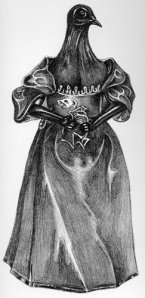
Fig. #5 - Lithograph from "The Disobedient Dollhouse", Jennifer Linton, mixed media installation, 2009-10.

The abject is clearly present within my Disobedient Dollhouse. A group of dead mice hang by their tails inside a kitchen cabinet, presumably providing a food source for the other inhabitants of the Dollhouse. A sinister bird-headed woman stands before the cabinet, clutching the tiny, skeletal remains of a rodent-like creature (fig. #5) While this scene does not contain any signs of blood or viscera, these small rodent corpses offer the presence of violent death, thus contributing to an atmosphere of abject horror within this Victorian-style dollhouse kitchen. Although animal and not human, these tiny corpses nevertheless serve as potent reminders of our own eventual demise.

While elements of abjection are undeniable within my Dollhouse, the second terminology related to the Gothic – the term ‘grotesque’ – has played a significantly greater role in the development of my imagery for this project. The term ‘grotesque’ originated in the ancient Roman period and relates to fanciful, decorative flourishes in art and architecture. Grotesque art involves the fantastic, ugly and bizarre, and its subjects are frequently mythological creatures and other strange, physically malformed monsters. The bizarre, anthropomorphic creatures that populate Lewis Carroll’s children’s novel Alice’s Adventures in Wonderland are a primary example of ‘the grotesque’ in literature. Carroll’s novel has also proved a valuable source of inspiration for the fantastic hybrid creatures that inhabit my Disobedient Dollhouse. In fact, the only human figure that appears in my Dollhouse is a character loosely based on Carroll’s Alice. This character – ostensibly a self-portrait as I served as the model – appears twice, once as the beleaguered ‘nanny’ in the nursery, and again as the ‘cook’ in the kitchen. The ‘nanny’, gazing down with quiet stoicism at the squawking bird-infant cradled in her arms, was based upon a

Fig. #6. John Tenniel. Illustration for Lewis Carroll’s "Alice’s Adventures in Wonderland", 1865, wood engraving.

19th century illustration for Carroll’s novel by John Tenniel depicting Alice holding a bonneted baby pig (fig. #6). The monstrous brood housed inside my nursery – heads tilted up with beaks wide open, their arms thrust outwards in a gesture of relentless, constant need – represent every parent’s nightmare of unending responsibility. The parental anxiety symbolized by this scene has been tempered, however, by an element of the absurd. Much like the ridiculously grotesque image of the bonneted pig held by Alice, my bird-headed children are designed to elicit equal measures of pathos, humour and horror. My nursery most assuredly conveys parental anxiety, but it does so with tongue firmly planted in cheek.

Grotesque art revels in the absurd, championing a fantasy world of the irrational over the rigid strictures of realism. One tactic employed by Lewis Carroll to create the ‘grotesque’ in Alice was his effective play with scale, a scheme that underscored the absurdity of his Wonderland. Alice experiences a succession of physical transformations when, enticed by the label on a mysterious bottle that reads ‘DRINK ME’, she consumes its contents only to magically shrink in size:

“It was all very well to say ‘Drink me,’ but the wise little Alice was not going to do that in a hurry. ‘No, I’ll look first,’ she said, ‘and see whether it’s marked “poison” or not’… […] However, this bottle was not marked ‘poison,’ so Alice ventured to taste it, and […] she very soon finished it off. ‘What a curious feeling!’ said Alice; ‘I must be shutting up like a telescope.’ And so it was indeed: she was now only ten inches high, and her face brightened up at the thought that she was now the right size for going through the little door into that lovely garden.”

After her initial transformation, Alice consumes a cake labeled ‘EAT ME’ and shoots upwards in the opposite direction, growing large so suddenly that she becomes trapped within the house.

As the sudden alteration of a person’s size is impossible without the intervention of magic, this change in scale is both fantastic and absurd in nature. Alice’s transformation from miniature to gigantic in Carroll’s novel provides clear evidence of the absurd, even comical, possibilities of this play with scale. This does not, however, necessarily apply to an object. The miniature furniture contained within a dollhouse, for instance, does not appear absurd or grotesque due to its strict adherence to a standard scale. In fact, the adherence to scale is one of the most fundamental principles of any dollhouse. Any object within this miniature world that deviates from the standard scale appears strangely incongruous in relation to its surroundings. Susan Stewart, in her analysis of the dollhouse, quotes the author Arthur Benson from his introduction to The Book of the Queen’s Dolls’ House:

“The scale of one inch to one foot being precisely maintained throughout…thus there is nothing of the grotesque absurdity of a scene that does not resemble life and has only the interest of caricature.”

The accuracy of scale within a dollhouse creates a sense of realism. Hence, when a deviation from scale occurs, the illusion of reality is severely comprised.
Similar to Carroll, I have adopted elements of ‘the grotesque’ in my Disobedient Dollhouse by playing with the scale of objects. In fact, several deviations in scale exist.  In the kitchen, in the guise of the household cook, I attempt to wield a gigantic eggbeater that stands as tall as my miniature self (fig. #7).  The exaggerated difference in size – plus the fact that, undaunted, I continue to struggle with the giant kitchen utensil – heightens the grotesque absurdity of this scene.
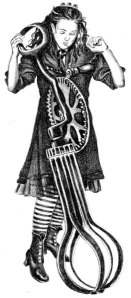
Fig. #7 - Lithograph from "The Disobedient Dollhouse", Jennifer Linton, mixed media installation, 2009-10.

One creature that appears repeatedly throughout my Dollhouse is the insect. Changing the size of the insect, as well as the context in which the insect is received, is a simple gesture that invokes ‘the grotesque’. Initially, I drew these insects to actual scale from specimens found in a local museum. When placed on the walls of my Dollhouse, however, these same insects suddenly appear gigantic in relation to the miniature scale therein. This change of context – from a normal sized insect in our world to a gigantic one in the miniature world – alters the perception of these creatures from ordinary to grotesque. When these same insects are scaled up, appearing as giants that loom over the viewer within the gallery space, this encounter with the grotesque is further intensified. As the contents of the Disobedient Dollhouse emerge into the surrounding exhibition space, the viewer becomes immersed in its fantastic world – no longer a mere observer but a full participant in its alternate reality.

The repetition of the insects and change of their scale harkens back to my earlier analogy of the Russian matryoshka nesting doll – a doll within a doll, each one a slightly smaller version of the larger doll that contains it – an analogy suggestive of an almost endless replication. By playing with scale, I allude to the infinity of repeated space, an infinity that is only truly attainable in my ‘house of dreams.’

An encounter with giant insects on a gallery wall – insects made strange by the fact of their surprising scale – can be classified as an encounter with ‘the uncanny’, the third and final of the terminologies related to ‘the Gothic.’ Our present day understanding of the term ‘the uncanny’ has been largely shaped by the psychoanalytic viewpoint of Sigmund Freud’s 1919 seminal essay entitled “The Uncanny”. In his essay, Freud defines the uncanny experience as: “that class of the frightening which leads back to something long known to us, once very familiar.” To experience something as ‘foreign, and yet familiar’ may result in feelings of discomfort and alienation. In this regard, the concept of ‘the uncanny’ is closely related to Julia Kristeva’s theory of abjection – in which the human corpse can be simultaneously experienced as alien (the abject) but also felt to be strangely familiar (an individual, now deceased). Freud situated ‘the uncanny’ in the realm of the repressed: “[The uncanny] is in reality nothing new or alien, but something which is familiar and old – established in the mind and become alienated from it only through the process of repression.” According to the Freudian psychoanalytic model, the process of repression involves the rejection and subsequent suppression of troubling impulses and desires. The concept of repression closely relates to the suppressed ‘family secret’ frequently found within the Gothic narrative. Whereas the Gothic ‘family secret’ manifests in the guise of a vengeful ghost, repressed desire assumes the form of the uncanny person or object.

In his essay “The Uncanny,” Freud analyzes the etymology of ‘unheimlich,’ the German word for ‘uncanny.’ His analysis proposes a strong linkage of ‘the uncanny’ to the domestic setting of the home. The German term das Heimlich signifies that which feels homely, comfortable and familiar. The inversion of this term, das Unheimlich, negates this feeling of comfort and suggests an estrangement or feeling ‘not at home,’ literally ‘unhomely.’ Through the process of repression, the safe haven of the home becomes ‘self-haunted’ by ghosts of the unconscious, a phenomenon that transforms the otherwise comfortable and familiar setting into a place that feels inexorably strange.

In his catalogue essay for the exhibition Gothic mounted at the ICA Boston in 1997, curator Christoph Grunenberg reflects on the nature of the uncanny:

“The invasion of the private and secure sphere of the home by some unknown evil force exemplifies the conflict between interior and exterior world, between individual and society, and between the intra- and intersubjective. Ultimately, the uncanny describes the return of repressed events, memories, and fantasies – the encounter with one’s own most intimate fears…”

The “private and secure sphere” of the home becomes the site of internal conflict, where the repressed are stowed away in hidden rooms, behind locked doors, in attics, closets and cupboards. Ultimately resisting suppression, the repressed reemerge as the ‘uncanny’ and transform the home into a strange and frightening place.

The ‘uncanny’ appears throughout my Disobedient Dollhouse in the strange and otherworldly transformations. The bed – that most psychologically potent of symbols – literally boils over with desire and sprouts flowers from the elongated bedposts. Snakes emanate from the tousled bed sheet and slither across the floor, penetrating the wooden floorboards and sinking into the room beneath. These uncanny transformations hint at a secret world of sublimated desire, resistant to the forces of repression that are compelled to hide them away. Like the ‘madwoman in the attic’ of Charlotte Brontë’s Jane Eyre, they periodically escape imprisonment, only to wreck havoc in the realm of the conscious.

Enhanced by Zemanta