Horror Films 101: Nothing says “Merry Christmas” like a creepy Canadian slasher flick.

An often overlooked classic, the 1974 Canadian film Black Christmas now enjoys a cult status amongst horror fans and critical acknowledgment as being the progenitor of  the “slasher” genre that dominated horror cinema in the late ’70s and throughout the 1980s. Directed by Bob Clark — best known for his raunchy teen sex comedy Porky’s (1982) — the film boasts an enviable list of talented Canadian actors: Margot Kidder, Keir Dullea (yes, that’s “Dave” from Stanley Kubrick’s 2001: A Space Odyssey), John Saxon and comedienne Andrea Martin. The film stars Olivia Hussey, a British actress who’s most frequently recognized for her role as “Juliet” in Franco Zeffirelli’s 1968 film adaptation of Shakespeare’s Romeo & Juliet. In Black Christmas, Hussey leaves the Elizabethan poetry behind and gets her “scream queen” on.

Lynne Griffin gets all wrapped up for the holidays in Bob Clark’s 1974 cult slasher film “Black Christmas.” Apologies in advance for the bad pun.

It’s important to note that Black Christmas predates the better known slasher films like John Carpenter’s Halloween (1978) and Sean S. Cunningham’s Friday the 13th (1980). Although the latter are arguably better films, they owe a great debt to Clark’s film. The quote below from Wikipedia concisely captures this film’s current cult status:

The film gained a fairly decent cult following over the years of its release, and has been praised by fans of the slasher film genre internationally. The Black Christmas fan site has considerably increased the film’s popularity over the years. The film ranked #87 on Bravo’s 100 Scariest Movie Moments for Lynne Griffin’s infamous plastic sheeting scene. During an interview regarding the film, Olivia Hussey met Steve Martin at an industry event and he brought up the fact that she starred in one of his favorite movies of all time. Hussey thought he might have referred to her work in Romeo & Juliet, but was surprised to hear from Martin that it was Black Christmas, which he claimed to have seen 25 times.

Below is a wonderfully creepy clip, featuring an uncomfortably prolonged obscene phone call from the psycho-killer. There is a prodigious use of the word “c*nt” in the following sequence, so consider yourself warned. Oh, and Merry Christmas.

Enhanced by Zemanta

…to which Red Riding Hood replied, “I prefer my men hairy, but housebroken.”

Amanda Seyfried stars in Catherine Hardwicke’s latest cinematic offering "Red Riding Hood" (2010). Seems a lot like Hardwicke's other franchise "Twilight," only with more fur.

The popular children’s story Little Red Riding Hood began, as many such fables do, as a cautionary tale aimed specifically at young girls. The red-hooded protagonist is instructed by her mother “not to stray from the path” as she ventures forth to deliver food to her ailing grandmother who lives alone in the woods. Along the way, she famously encounters the Big Bad Wolf —  and thus begins a succession of overtly sexual metaphors. In the earliest known printed version of this story, authored by Charles Perrault, the disguised Wolf tricks Red Riding Hood into removing her clothes and climbing into bed with him, at which point he “falls upon” her and she is devoured. To ensure that the moral of his tale was not lost upon his young readers, Perrault offered this sermon at the end of his text:

From this story one learns that children, especially young lasses, pretty, courteous and well-bred, do very wrong to listen to strangers, And it is not an unheard thing if the Wolf is thereby provided with his dinner. I say Wolf, for all wolves are not of the same sort; there is one kind with an amenable disposition — neither noisy, nor hateful, nor angry, but tame, obliging and gentle, following the young maids in the streets, even into their homes. Alas! Who does not know that these gentle wolves are of all such creatures the most dangerous!

Well, so much for subtlety. Thus, from it’s earliest incarnation, this was a moralizing tale that warned young girls not to succumb to wild, carnal desire. Modern interpretations of this story, however, replace the traditionally naïve heroine with an empowered one. The best known of these ‘revisionist’ versions is Angela Carter’s 1979 short story The Company of Wolves, in which the Wolf is reconfigured as a werewolf — a wolfman seducer with whom Red Riding Hood engages in consensual sex. Carter’s version of the sexually-awakened heroine was adapted to screen by Irish filmmaker Neil Jordan in 1984. Jordan’s The Company of Wolves is a gorgeous — though flawed — gem of a film. Although the narrative of Jordan’s film wanders to the brink of incoherence, the journey is a visually rewarding one. My favourite scene from The Company of Wolves is the initial meeting between Rosalind (the Red Riding Hood character) and the elegant, mysterious Huntsman whom she encounters in the forest. Admittedly, the guy who portrays the Huntsman was not cast for his stellar acting ability. But then, who’s looking at his acting…?

Horror Films 101: Movie moments that traumatized my childhood.

A still from the animated film version of “Watership Down,” showing the last, terrified moments of a rabbit’s life.

1. The destruction of the rabbit warren and wholesale slaughter of its occupants in the 1978 film adaptation of the Richard Adams novel Watership Down. The filmmakers did not shy away from the darker shadings of Adams’s novel,  and the violence contained in the source material appears, quite graphically at times, on screen. The scene of the warren destruction is rendered in an abstracted fashion, but is nonetheless effective in conveying the horror of the rabbit massacre. Walt Disney, this ain’t.

The ‘demon face’ was that of Eileen Dietz, who also starred in Happy Days and General Hospital. Oh, what a little make-up and effective editing can do.

2. The freaky demon face that flashes on-screen in William Friedkin’s 1973 horror classic The Exorcist. In the (far superior) original theatrical release of the film, this ‘demon face’ only appears twice: once, during the nightmare sequence of Father Karras, where he envisions his elderly mother standing at the top of a stairway leading down to the NYC subway; and lastly, during Regan’s exorcism. Each time, the face only flashes on-screen for mere seconds — just enough time to burn onto your retina and torment you for the rest of your days. According to the trivia section of imdb.com, the ‘demon face’ was supplied by the actress Eileen Dietz, who also stood in as a body-double for Linda Blair in a couple of scenes. In the  director’s cut of the film (released in 2000), the face appears with considerably greater frequency, diluting its impact.

“Let me in, Mark…screeeetch….screeeetch…let me in…”

3. The vampire kid scratching on his friend’s bedroom window from the 1979 made-for-TV adaptation of Stephen King’s novel Salem’s Lot. Director Tobe Hooper, best known for his masterpiece of the macabre The Texas Chainsaw Massacre, fully understands the dark, seedy underbelly that lies just beneath the surface of small town, white-picket-fence America. Few directors — other than, perhaps, David Lynch — have as great an insight into the ‘suburban Gothic’. The vampire of Hooper’s film is not a romantic seducer but, in keeping with the German Expressionist tradition of F. W. Murnau’s Nosferatu, he’s a ghoulish, hideous monster with a taste for the blood of children. This scene with the undead child paying a nighttime visit to his former playmate scared the bejeezus out of me when I was a kid. It was, in part, the awful sound that his fingernails made as he scratched the glass, beckoning to his friend to open the window.

4. Ben Gardners’s head suddenly appearing through the smashed hull of his sunken boat in Steven Spielberg’s 1975 masterpiece Jaws. Even though, as an audience member, you know exactly what Richard Dreyfuss is about to stumble across, I betcha it’ll still make you jump.

5. The terrifying tale of Large Marge from Tim Burton’s 1985 Pee-wee’s Big Adventure. No, seriously. It’s a creepy — and classically Tim Burton — moment. Just tell ’em Large Marge sent ya.

Lady Lazarus’s Halloween List: Top 10 Best Horror Films of the 2000s.

The past decade of the 2000s — or the Naughts, if you prefer — were an especially good one for the genre of horror. On television, we were treated to blood-soaked series like Dexter and True Blood, and in the movie theatres, the vampires and zombies ran amok. As is customary this time of year, I like to compile a film-geek list relating to horror. Halloween shall soon be upon us, my deadlings. Let’s revel in the macabre and spooky.

Below are my picks for the past decade’s best offerings in cinematic horror.

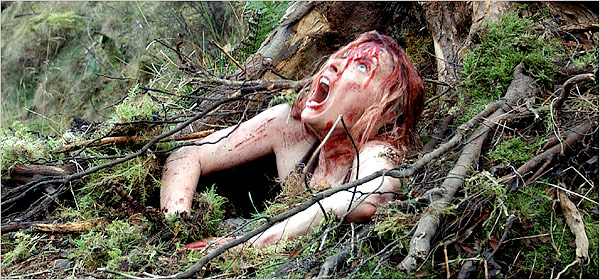
Shauna Macdonald in “The Descent,” a horror film by Neil Marshall set in the Appalachian Mountains.

1. The Descent (2005). Directed by Neil Marshall. An exceptionally attractive team of female ‘extreme’ spelunkers are coerced by one of their members to venture into a series of previously unexplored caves. So begins the ill-fated journey of The Descent, one that starts with squirm-inducing claustrophobia and eventually leads to the discovery of something much, much more sinister — and deadly.

2. Låt den rätte komma in (2008). English title: Let the Right One In. Director: Tomas Alfredson. Have not seen the recent English-language remake of this stellar coming-of-age vampire story and, quite frankly, I don’t feel the need. This one got it right. From its very first frame, you can feel the tangible ache of loneliness in the main characters, as well as the relentless cold of the Swedish winter.

3. [REC] (2007), Directors: Jaume Balagueró and Paco Plaza. The first two-thirds of this film were somewhat underwhelming for me. Sure, it was a serviceable, well-crafted ‘documentary’-style zombie film, but I’d seen many of its kind before. And then, the main characters unlock the door to that mysterious, (supposedly) uninhabited penthouse apartment. At that moment, this film transformed from a decent zombie-flick into something almost sublime.

The main character Alison is harassed by a vengeful (and apparently indestructible) Gypsy woman in Raimi's 'Drag Me To Hell.' Someone call the Roma People's Deflamation League.

4. Drag Me To Hell (2009). Director: Sam Raimi. A thoroughly enjoyable, gross, hilarious and, at times, truly scary film from the master of the comedy-horror, Sam Raimi. Watch for the scene with the animatronic goat. Hysterical.

5. Ichi the Killer (2001). Director: Takashi Miike. Just when you think that the saturation point for bloody splatter-gore has been reached, along come Japanese directors like Miike to push the limits beyond all previous imaginings. This film, along with Miike’s 1999 offering Audition, is completely unhinged. My major misgiving with Ichi the Killer is its graphic and highly sexualized violence toward women. Misogyny is a regrettably common characteristic in many of this genre’s films — particularly from countries such as Japan. All the same, I would recommend this film to the seasoned horror fan, simply on the basis of its insanity.

The character Kakihara admires the handiwork of Ichi in Miike's 'Ichi the Killer'.

6. À l’intérieur (2007), English title: Inside. Directors: Julien Maury and Alexandre Bustillo. This past decade has witnessed the growth of a strong horror-film industry in France, a country not previously known for films in this genre. Dubbed by some in the media as ‘New French Extremity,’ films such as Maury and Bastillo’s À l’intérieur confront the viewer with images of intense ‘body horror.’  The alone and heavily pregnant Sarah battles with an insane, homicidal intruder wielding impossibly-sharp — and profoundly effective — tailor scissors.

7. Ginger Snaps (2000). Director: John Fawcett. The mythology of the werewolf gets a modern feminist overhaul in this Canadian horror franchise. The hormone-induced lunacy of puberty is cleverly aligned with lycanthropy when the titular Ginger begins menstruation around the same time as she’s bitten by a ‘big dog’ in the forest surrounding her suburban home. It’s hard not to love a film that has as it’s tagline: “She’s got the curse.” Incidentally, the sequel Ginger Snaps 2: Unleashed (2004) was surprisingly good. The third installment, Ginger Snaps Back: The Beginning should be encased in cement, tossed down a mine shaft, and buried for eternity.

One of the feigned 'death scenes' staged by the Fitzgerald sisters. Kids these days.

One of the feigned 'death scenes' staged by the Fitzgerald sisters in 'Ginger Snaps'. Kids these days.

8. Ju-on (2003). English title The Grudge. Director: Takashi Shimizu. Hands-down, my favourite amongst all of the J-horror films I’ve seen over the past decade. And I’ve seen quite a few. The English-language remake is laughable by comparison. Avoid it and seek out the original Japanese film.

9. El orfanato (2007). English title: The Orphanage. Director: Juan Antonio Bayona. With contemporary French horror-film directors so successfully flooding the cinema with blood and viscera, it’s a rare treat to view a relatively subtle, classic ghost story like Bayona’s El orfanato. One of the very few horror films at which I openly wept. The ending is heartbreaking, and wonderful.

Autocannibalism + feminism combine in Marina de Van's disturbing 'In My Skin.'

10. Dans ma peau (2002), English title: In My Skin. Directed, written by and starring Marina de Van, this is a strange, atmospheric and generally overlooked gem of New French Extremity. The main character Esther develops an erotically-charged, cannibalistic fixation with her own body after being disfigured in a freak accident. Ponderously slow in parts, it does offer a unique and interesting premise.

Honourable Mentions:

1. Pontypool (2009). Director: Bruce McDonald.

2. Død snø (2009). English title “Dead Snow.”

3. Bakjwi (2009). English title “Thirst”. Director: Park Chan-Wook

4. Grindhouse Presents: Planet Terror (2007), Dir. Robert Rodriguez.

5. 28 Days Later (2002), Dir. Danny Boyle.

Horror Films 101: Favourite death scenes.

For the past three years, it’s been a pre-Halloween tradition of mine that I compile a geekish list relating to horror films. I’m presently working on 2010’s Halloween list. Doubtless, you are all aquiver with anticipation. Just to whet your ghoulish appetite, here’s a repost of the list I originally created on Facebook last Halloween listing my “Top 5 Favourite Death Scenes from a Horror Film.” Enjoy. Note: NOT FOR THE SQUEAMISH.

5. The death sequence that appears in the first 15 minutes of Dario Argento’s Suspiria is fantastically operatic in its baroque excess. Argento blows his cinematic load early, though, as the rest of this cult classic is fairly lacklustre. The music provided by the Italian prog-rock outfit Goblin, however, is wonderful and fittingly creepy.

4. The death of Captain Rhodes in George A. Romero’s Day of the Dead. This character was such a tightly-wound military jerk-off that you couldn’t help but cheer when the zombies finally got a hold of him.

3. Udo Kier plays a pale, sickly Count Dracula in search of “wergin” blood in Paul Morissey’s adaptation of the legendary vampire story, the Andy Warhol produced Blood for Dracula. Dracula meets his final comeuppance at the end of Joe Dallesandro’s axe in a scene of hilarious, way over-the-top gore. Couldn’t find the entire scene on Youtube but here’s a nifty mash-up with the Pixies that features the end sequence.

2. Final death scene in 1958’s The Horror of Dracula. I adore the films of Britain’s Hammer Studios, a.k.a. the “Hammer Horrors.” Christopher Lee stars as Dracula and Peter Cushing as his earthly nemesis, Van Helsing. Many a Saturday afternoon of my youth was spent watching these classic horror films. The video clip below is of regrettably poor quality, but it’s a fantastic sequence.

1. John Hurt births an alien at the dinner table in Ridley Scott’s Alien. Oh, c’mon, who hasn’t seen this famous sequence?

The horror films I probably won’t watch, and why.

The viewing of a good horror film can, at times, be likened to an amusement park ride. There’s suspense, action, usually a few laughs, and more than a few moments that’ll make you shriek or jump in your seat. At its conclusion, when the evil characters receive their final comeuppance, you’re rewarded with a heady chemical cocktail of endorphins. Thanks for riding Satanic Cannibal Cheerleaders from Outer Space, kids. Please exit to your right.

As a horror film aficionado, I’ve watched and thoroughly enjoyed films that featured copious amounts of gore. I would not classify myself as a gorehound, but neither do I shy away from imagery I know to be disturbing or taboo in nature. These are, after all, the mainstay of horror cinema.

That being said, I do have my limits. Blood, gore and flesh-eating zombies are one thing. Cruelty and sadism that serves no greater purpose in a film than base titillation — that’s quite another. And that is where I draw the metaphoric line in the sand. Whereas the gruesomely authentic torture scenes in Guillermo del Toro’s Pan’s Labyrinth were unpleasant to view, these scenes provided an important counterpoint to Ofelia’s dark fantasy world in which she sought refuge from the very real brutality of her step-father. Torture for its own sake, however, is something I prefer not to witness.

I have compiled a list of films that, quite frankly, I doubt I will ever watch. Then again, never say never…

Film still from “Cannibal Holocaust.”

1. Ruggero Deodato’s infamous Cannibal Holocaust (1980). Filmed with handheld 16mm cameras in a cinéma vérité documentary-style that proved so convincing that the Italian authorities seized it and charged Deodato with making an actual snuff film. No actors were harmed in the making of this film, but several animals (including an unsuspecting sea turtle) were literally butchered and dismembered before the camera. I don’t need to see that. I don’t need to see a woman raped, tortured and impaled to death on a stake, either.

Film still from Pasolini’s “Salò or the 120 Days of Sodom”

2. Salò or the 120 Days of Sodom (1975) directed by the Italian poet, filmmaker and famed provocateur Pier Paolo Pasolini. There’s much critical praise amongst cinema’s illuminati for the films of Pasolini. This one, his last and most controversial offering, was based upon the writings of the Marquis de Sade and Dante’s Inferno. While not officially a horror film, it includes scenes of torture, sadism and sexual depravity so thoroughly disturbing that, according to Wikipedia, “Salò was named the 65th scariest film ever made by the Chicago Film Critics Association in 2006.” Pasolini takes his audience on a merciless and unblinking trip through the Circles of Hell. Suffice to say, the Circe de Merde sounds like an especially unpleasant place.

3. The August Underground Trilogy (August Underground 2002, Mordum 2003, Penance 2007) created by the Pittsburgh-based film production/special effects/design company Toetag Pictures. These are simulated snuff films that, based solely on their description, read like a game of one-upmanship amongst gorehounds. One can just imagine the filmmakers snickering: “Does your film have rape, murder, dismemberment, necrophilia, pedophilia and infanticide? ‘Cause ours sure does…(snicker).” A big, juvenile gross-out contest that I can live without experiencing, thanks.

4. The mondo-style films Faces of Death (1978), and it’s imitators Faces of Gore and Traces of Death. See above.

Gratuitous rape scene from “Irreversible.”

5. Irreversible (2002) directed by Gaspar Noé. A cheap trick by a cheap director who opts for the shock-value and little else. Pass.

Surrealism, alter-egos and private mythologies; conclusion.

The concluding chapter of my essay on the Gothic aesthetic and my thesis project The Disobedient Dollhouse. These excerpts from my thesis began with The Gothic House and The Abject…, respectively.

“In 1930, after having furiously and methodically composed my
novel ‘La femme 100 têtes’ I was visited almost daily by Loplop,
Bird Superior, a private phantom very much attached and devoted to me.”
— Max Ernst

Fig. #8. Jennifer Linton. Detail from the “Disobedient Dollhouse”, 2009-10, lithograph.

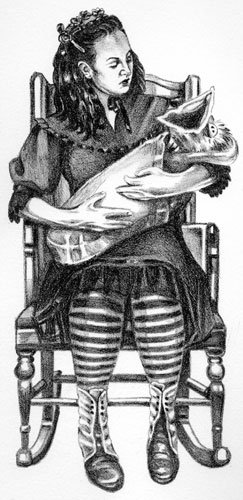
Poised amongst the brood of bird-children sits the nanny, a character within my Disobedient Dollhouse that was modeled after myself. Downstairs in the kitchen, a second version of ‘myself’ cast as the household cook struggles with an absurdly large cooking utensil. These characters are the result of an amalgamation of Gothic heroines I have borrowed from sources such as Charlotte Brontë’s Jane Eyre and, most especially, Lewis Carroll’s Alice from Alice’s Adventures in Wonderland. Costumed in a fashion reminiscent of a Victorian girl, my ribbon bonnet, puffed sleeves and crinolined skirt (fig. #8) recall the famous wood engravings of Alice by British illustrator John Tenniel. By incorporating my own image into these characters, I have effectively embedded myself within this miniature world. This role-playing is one of the creative strategies I employ in order to generate a private mythology.

Throughout my visual art practice, I have used various legends and myths as cultural ready-mades into which I introduce my own personal symbolism and meanings. Over the years, these pre-existing myths have been absorbed into my artistic lexicon, contributing to a complex language of symbols by which I construct a private mythology. Myths supply an accessible and universal narrative to which I can attach my idiosyncratic story.

Fig. #9. Jennifer Linton. “The Bitter Seed”, 2000, coloured pencil and ink on Mylar.

Renowned scholar and mythologist Joseph Campbell describes one of the goals of myth as “…effecting a reconciliation of the individual consciousness with the universal will.” Similarly, in his essay “The Expressive Fallacy” Hal Foster cites Nietzsche’s discussion of an artist’s use of myth to express an interior world: “The whole notion of an ‘inner experience’ enters our consciousness only after it has found a language that the individual understands – i.e., a translation of a situation into a familiar situation…” The “language” to which Nietzsche refers can be interpreted as “mythology” which provides a universal narrative to which all cultures, no matter how disparate, have access. The “inner experience” may be read as the personal, psychological or emotional world that the artist seeks to materialize through the use of myth. In short, myths connect us to each other by anchoring the idiosyncrasy of the individual to a universally shared point of reference.

The construction of a private mythology is a procedure that allows an artist to explore deeply personal and intimate subject matter while simultaneously maintaining a level of psychological distance. In my own work, I employ the strategy of role-playing as a means to address autobiographical content. In an earlier body of work entitled The Bitter Seed (fig. #9), I combined images of myself as a child with the character of Persephone, a heroine borrowed from Greco-Roman mythology. By adopting the role of Persephone, I universalized the idiosyncratic – depersonalizing the personal content. This process provides a psychological distance while simultaneously rendering the work more readily accessible to the viewer.
The mythological character Persephone has supplied my artwork with its most recurrent of symbols: the pomegranate. My series The Bitter Seed took its name from the pomegranate seed that Persephone was forced to eat, thus sealing her fate as the goddess whose annual death and rebirth would usher in the changing seasons:

“Persephone was the daughter of Zeus and Demeter, the goddess of agriculture. Hades, the lord of the Underworld, surprised Persephone one day while she was picking flowers and carried her off to be his bride. Demeter, the distraught mother, threatens to destroy all mortal men by causing an endless drought unless her daughter is returned. Zeus, who is the king of the gods at Olympus, commands Hermes to fetch Persephone from the realm of Hades. The wise Hades chooses to obey the command of Zeus; however, before Persephone is returned, he tricks her into eating a seed from a pomegranate. This deception is later revealed when Demeter asks her daughter ‘…have you eaten any food while you were below? If you have not, even though you have been in the company of loathsome Hades, you will live with me and your father…but if you have…you will return again beneath the depths of the earth and live there a third of the year; the other two-thirds of the time you will spend with me…’”

To the ancient Greeks, the myth of Demeter and Persephone served to explain the death and regeneration of plant life each year. Persephone personified the cycle of the seasons through her annual sacrifice.
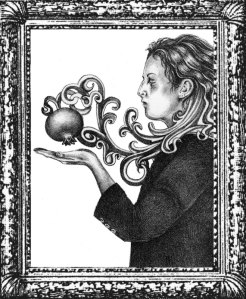
Fig. #10. Jennifer Linton. Detail from the “Disobedient Dollhouse”, 2009-10, lithograph and digital image.

A pomegranate motif appears repeatedly throughout my Dollhouse. A highly stylized version of this fruit is featured in all of the stained-glass windows, and pomegranates adorn the wallpaper of the bedroom and the head and footboard of the bed. Two of the framed, miniature pictures that hang on the bedroom wall also contain the pomegranate. One of these framed pictures features a self-portrait, in which the curly locks of my hair transform into undulating, snake-like vines (fig. #10). These vines terminate in a single pomegranate, delicately suspended above my open palm. This self-portrait, however, makes only a vague reference to the pomegranate from the Persephone myth. Within the narrative of my current project, I no longer inhabit the role of this Greco-Roman goddess. The pomegranate serves not as a symbol of sexual subjugation – as it does within the Persephone myth – but rather as a symbol of female empowerment. The partially opened vulviform shape evident on the pomegranates throughout the Dollhouse make the linkage to female sexuality quite explicit.

Whenever an artist includes self-portraiture, the temptation for the viewer is to read autobiographical content into the work. Such is the case in my work, although this content is largely mediated through my use of symbolism and mythology. The grotesque and dreamlike imagery of the Disobedient Dollhouse obscures any straightforward reading of autobiography, softening the distinction between ‘the invented’ and ‘the real’ elements. The dark, psychologically tumultuous material that the Gothic would seek to conceal, and the Freudian psychoanalytic model to repress, my Dollhouse opts to place on display, albeit cloaked in myth and symbolism.

Blurring the boundaries between ‘the invented’ and ‘the real’ through the creation of a private mythology was a strategy often employed by artists who subscribed to the idiom of Surrealism. The fantastic and frequently grotesque imagery of Surrealist art closely relate to my Dollhouse’s otherworldly and Gothic-inspired content. In fact, the aims of Surrealism – to question rationality and uncover sublimated fears and desires – seem to echo the urge of Gothic novelists like Brontë to expose the concealed darkness of the human psyche. “Surrealism and the Gothic share a decisively anti-Modernist stance,” wrote curator Christoph Grunenberg, “rejecting Modernism’s emphasis on order, rationality, and purity.” One of the most ‘gothic’ practitioners of Surrealism – and an artist whose work was dedicated to the manufacture of a private mythology – was the visual artist Max Ernst.

The collage-based books and graphic work created by Ernst possess an especially heightened quality of the Gothic. To a large extent, this quality derives from the source material Ernst used to construct his collages, which included wood-engraved illustrations taken from 19th century French popular fiction. The subject matter of these ‘pulp’ fiction books and periodicals generally involved:

“…torrid love, torture, crimes passionels and the subsequent incarcerations and executions (by guillotine), hatreds and jealousies among the very wealthy and the very indigent…”

These are the same dramatic, sinister and darkly romantic themes that typify Gothic fiction. Ernst’s disjointed juxtapositions only served to amplify the already emotionally charged content of his source material.

Fig. #11. Max Ernst. Illustration from the novel “Une Semaine de Bonté”, 1933, engraving based on collage.

One of Ernst’s most famous collage novels is Une Semaine de Bonté (fig. #11), in which the days of the week are represented by seven seemingly arbitrary “deadly elements” such as the “Lion of Belfort,” bats, serpents and dragons, and the mythological character of Oedipus. It is in the latter chapter concerned with Oedipus that the bird-headed creature named ‘Loplop’ first makes his entrance into Ernst’s novel. The hybrid bird-man Loplop was a creation with which Ernst closely identified. His identification to the bird-headed man prompted many of his contemporaries to view Loplop as the artist’s alter-ego, an association that Ernst strengthened through his writing in Notes pour une biographie. Ernst frequently mixed actual autobiography with his Surrealist art, making it impossible to distinguish between the artist’s life and his wildly inventive stories. In one such account, Ernst forges a strong link between his early life and his artistic creation Loplop:

“1906. Head Bird Hornebom. A friend by the name of Hornebom, an intelligent, piebald, faithful bird dies during the night; the same night a baby, number six, enters life. Confusion in the brain of this otherwise quite healthy boy – a kind of interpretation mania, as if newborn innocence, sister Loni, had in her lust for life taken possession of the vital fluids of his favorite bird. The crisis is soon overcome. Yet in the boy’s mind there remains a voluntary if irrational confounding of the images of human beings with birds and other creatures; and this is reflected in the emblems of his art.”

Ernst’s motivation behind this conflation of his art and autobiography remains unclear. While writers such as Werner Spies describe Loplop as an “autobiographically tinged bird-creature”, there remains a degree of mystery surrounding Ernst’s personal attachment to his alter-ego. His complex vocabulary of recurrent symbols and characters, including the omnipresent Loplop, may have been more the result of a Surrealist intellectual game than a deeply personal expression of psychological catharsis. Driven by a fascination with psychoanalysis, Surrealist artists like Ernst frequently engaged in game-playing as a means to access the random machinations of the unconscious mind. The technique of collage was particularly well-suited to this end. Thus, Ernst’s juxtaposition of disparate images, such as a male figure topped with a bird’s head, could well be the result of his Surrealist investigations into randomness. Regardless, inspired by the psychoanalytic writings of Freud, his private myth-making created a forum in which he unearthed and explored the repressed material of the human psyche.

The bird-headed women that populate my Disobedient Dollhouse can be viewed as the great-granddaughters of Loplop. Female counterparts to Ernst’s invariably male creation, they inhabit a similarly enigmatic role. While it is enticing to read these bird-women as extensions of myself, this close association remains ambiguous. My own image is represented in the appearance of the ‘nanny’ and ‘cook’ characters. Cast in these roles, my social status within this world appears subservient to the two bird-headed women, one of whom leisurely plays at the piano. Has my character/s been enslaved by these menacing creatures and forced to care for their offspring while they lounge? Given my real-life status as artist, wife, and mother, one could easily attach this autobiographical reading. Caution should be exercised, however, to interpret these images too literally. Similar to the private myth-making of Max Ernst, my work contains as much theatrical artifice as it does legitimate psychological exploration. Steeped in dramatic excess, my Dollhouse is self-consciously prone to hyperbole.

The genesis of my bird-women has little to do with Surrealist explorations of the unconscious mind, but instead, are visual evidence of my recent interest in dioramas. In fact, the figure of the bird-woman holding the skeletal rodent was not only the very first image I created for this project, but she derived entirely from a taxidermy diorama I viewed online at the A Case of Curiosities web site. Anthropomorphic taxidermy dioramas were a strange passion of the Victorians. Walter Potter, one of that era’s most celebrated practitioners of this macabre art form, was renowned for his complex and large scale tableaux such as his Kittens’ Tea & Croquet Party (fig. #12). The ghoulish spectacle of Potter’s taxidermy dioramas neatly encapsulates the type of grotesque art to which I am drawn as an artist, and therefore, it is not the least bit surprising that these provided the creative ‘jumping-off point’ for my dollhouse project.

The hybrid bird-women and host of other grotesques that populate my Disobedient Dollhouse represent the wild, unruly and random elements of the psyche that stubbornly resist the process of repression. The nostalgic impulse that seeks to construct a too-perfect version of the past – one that suppresses the ‘dark family secret’ or other psychologically troubling material – is thwarted by these defiant monsters. The idyllic view of domesticity generated by nostalgia rejects the ugly, soiled, imperfect and dissonant. This romanticized construction is illusory and cannot be maintained. Shaken to its very foundations by the uncanny creatures that swarm its interiors, it will inevitably falter and collapse like the ill-fated House of Usher.

Epilogue: A Perverse Thrill

“Who has not a hundred times, found himself committing a vile or silly action, for no other reason than because he knows he should not?”
— Edgar Allan Poe

The music builds to a crescendo that ends in a sudden, resounding crash, followed by silence. “She’s dead”, pronounces Dr. Markway after he grasps the arm that dangles limply from the open car window. This is the dramatic finale of Robert Wise’s 1963 film The Haunting, in which the character of Nell meets her end in a fatal car accident on the grounds of Hill House, remaining forever as the caretaker of the vindictive ghost who haunts the nursery in this classically Gothic house. “It was what [Nell] wanted, to stay here…” explains the clairvoyant Theo, “…she had no place else to go. The house belongs to her now, too…maybe she’s happier.”

Moviegoers have flocked, myself included, to horror films like The Haunting in order to vicariously experience the eerie and macabre. What is it about these frightening experiences that we find so intriguing? Much like the malevolent spirit of Hill House that beckoned to Nell, we feel urged by an inexplicable force to seek out the locked doors, hidden rooms and dark, mysterious corners of the Gothic house. The more we have been instructed by the rationality of science to reject the nonsensical, the superstitious, the absurd and otherworldly, the more we seem compelled to seek these out. The shadowy interiors of these cinematic and literary haunted houses have significantly shaped the construction of my oneiric house, the one that I dream with the endless doors and secret passageways. They also inform the grotesquery of my Disobedient Dollhouse. Rather than reject the absurd and uncanny, my Dollhouse celebrates it.

Enhanced by Zemanta

The Gothic House; an excerpt

The following text is an excerpt from my Master’s thesis written, in part, on the topic of the Gothic aesthetic. I felt that this chapter of the paper might be of particular interest to those that read this blog. The “Disobedient Dollhouse” project to which I make reference was the visual art component of my MFA thesis. To view images from this project, click on the Gallery page located above the header of this blog. Enjoy.

“It was an evil house from the beginning – a house that was born bad.”
— The character of Dr. John Markway from Robert Wise’s 1963 film The Haunting

I confess to being an avid fan of gothic horror films and ghost stories, a confession that may not seem overly surprising given the content of my work both past and present. The castles and aristocratic manors that I mentioned earlier as being critical to the formation of my ‘house of dreams’ arise from these sources (fig. #2). The heightened theatricality of a medieval cathedral, castle or historic manor has been incorporated into my oneiric house and translated into its endless doors and dark, secret passageways. The term ‘gothic’ that I use to specify a certain subgenre of horror fiction refers not to the tribes of ancient Germanic people from whom the name originally derived, nor is it related to the medieval art that also bears this name. Instead, the term derives from a chiefly British literary genre of the 18th and 19th centuries, originating with Horace Walpole’s 1764 novel entitled, appropriately enough, The Castle of Otranto: A Gothic Story. Gothic literature combined elements of both horror and romanticism and its themes typically involve death, ghosts, the supernatural, transgression, patriarchy and the female heroine. Much like the staged interior of a dollhouse, the Gothic novel reflected a similar tendency towards the staged and theatrical. Gilda Williams, editor of the contemporary art anthology The Gothic, described ‘Gothic’ as “a studied, adopted stance,” that is “cultured, sensual and affected”, a description that concisely captures the Gothic’s propensity for dramatic hyperbole.

Fig. #2. Film still from Robert Wise’s 1963 The Haunting.

A central motif to the Gothic narrative is the house, especially one haunted by ghosts – both literal and metaphoric – and the disturbing family secret that has been shut away in an underground crypt, a dark attic, or behind hidden doors. Beginning with Walpole’s The Castle of Otranto, the genre has maintained a continual fascination with architecture. Perched on a hilltop overlooking a grey and perpetually soggy landscape, the dilapidated old aristocratic manor provided the Gothic narrative with its characteristic atmosphere of gloom and foreboding. Not merely a setting for the narrative to unfold, the Gothic house was frequently cast as a character itself, imbued with an uncanny – and often malevolent – sentience. This notion of a sentient house that is, by virtue of some inexplicable phenomenon arising from its very construction, a conscious being, is best exemplified by Edgar Allan Poe’s The Fall of the House of Usher in which the titular house claims the lives of the family that dwell within it. In Poe’s short story, the character of Roderick Usher believes that his family home is sentient through some mysterious combination of masonry and vegetation, and that the illness which plague both he and his sister Madeline have been caused by this house. Poe’s use of adjectives such as “eye-like” to describe the windows belonging to the House of Usher bestow an anthropomorphic quality to the structure, a quality which further underscores the notion of a sentient house:

“I reined my horse to the precipitous brink of a black and lurid tarn that lay in unruffled lustre by the dwelling, and gazed down – but with a shudder even more thrilling than before – upon the remodelled and inverted images of the grey sedge, and the ghastly tree-stems, and the vacant and eye-like windows.”

In the dramatic conclusion, the moral and spiritual decay of the Usher family physically manifests in the destruction of the house itself – the building literally splits in two and sinks into the surrounding landscape.

Fig. #3. Jennifer Linton. Detail from the Disobedient Dollhouse, 2009-10, mixed media.

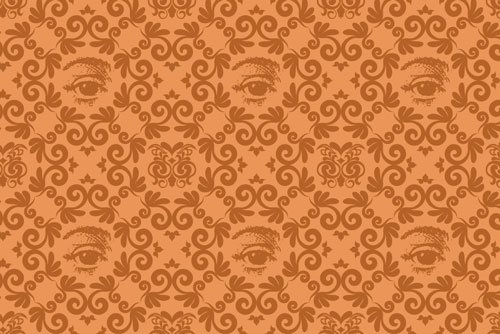
The structural features belonging to my Disobedient Dollhouse, while not as malevolent as those of the House of Usher, share some of the qualities of anthropomorphism and otherworldliness with its literary antecedent. Reminiscent of the “eye-like” windows of Poe’s creation, the windows featured on all of my exterior-facing walls are comprised of a stylized stained-glass pomegranate design that closely resembles the slit-shaped eye of a cat. These “cat’s eye” windows – all of them grouped in pairs – are most clearly evident from the brick exterior of the dollhouse, where they stare out, unblinking, at the viewer. Additionally, a repeating pattern of disembodied eyes gaze outward from the wallpaper of the kitchen (fig. #3), suggesting that the house itself bears witness to the strange events that are unfolding within. Upstairs on the wallpaper in the nursery, a legion of tiny, open mouths appear to silently scream in a gesture that mimics the endless squawking of the bird-children that inhabit this room. Much like the sentient house of Poe’s story, these anthropomorphic elements propose a house possessed of consciousness – one that not only contains supernatural events, but may also be the generator of them. The desired effect I aim to achieve is a disquieting exchange between the Dollhouse and the viewer, as the walls of the dollhouse uncannily return their gaze.

The crowning glory of any Gothic house is, of course, the attic. Similar to its close relative the cellar, the attic is a mysterious and seldom-used room where items – both material and psychological – are stowed away. The attic located within Bachelard’s oneiric house is a place of light and rationality, whereas he characterizes his cellar as the “dark entity of the house” that “partakes of subterranean forces” of the irrational, unconscious mind. In an inversion of Bachelard’s house, the attic that tops my Dollhouse is a shadowy place that offers a single window through which the dark interior may be viewed. Following the convention of most contemporary dollhouses, a cellar room is not represented in my Dollhouse, although the small cupboard door beneath the stairs – through which vine-like tentacles emerge from darkness – seem to hint at the “subterranean forces” present in Bachelard’s cellar. Peering through the attic window, the viewer encounters a snake-tentacled monster with a single, gigantic eye returning their gaze (fig. #4). This strange Cyclops is positioned slightly off-centre and is thus partially obscured by the outer wall, the bars of window frame, and the darkness within. The very purposeful positioning of this creature follows the time-tested horror film adage that “a monster you can’t see is scarier than one you can”, granting the viewer only enough information to understand that something sinister lurks within this space.

Fig. #4. Jennifer Linton. Detail from the Disobedient Dollhouse, 2009-10, mixed media.

The attic is the only enclosed room within my Dollhouse, allowing a very limited access to its interior. As such, it is the most private and mysterious of all the rooms. If I imagine myself descending from the attic onto the second story of my Dollhouse, where the nursery and the bedroom are located, the level of privacy compared to the attic decreases. While a bedroom is generally considered a very private and intimate space, the contents of my bedroom are fully on display, thus negating privacy. One of the crucial features of a dollhouse is the lack of complete enclosure of the miniature, thereby admitting access to its interior. This access facilitates play in a children’s dollhouse, and allows for display in the dollhouse designed for adults. Whereas the ground floor and second story of my Dollhouse adopt this convention of display, the enclosed attic rejects it. Whatever monsters and dark, troubling secrets hide within its shadowy corners, the attic will not reveal too readily. In this regard, the attic is the most “disobedient” of all the rooms.

The dusty and cobwebbed attic, dark and infrequently visited, provides the optimal place in which to discard the disused, unwanted, and the surplus. It can supply storage space for the cherished items of the past, no longer in use, as well as a hiding place for family secrets and other psychologically troubling material. The attic is a quintessentially ‘gothic’ space, where suppressed secrets threaten to rise up like a vengeful ghost. Given that my Disobedient Dollhouse is a Victorian-themed dollhouse, it is not difficult to imagine all of the wild, violent passions forbidden by that era’s strict social codes might be banished into the hidden corners of this room.

Concealed family secrets that slowly reveal themselves, threatening to unravel the apparent order of the household and causing a “…forced reckoning with a long buried piece of family history” is a classically Gothic trope. Like the ‘sentient house’, whose malevolence has assumed solid form within the structure of the house itself, the Gothic ‘family secret’ often physically manifests as an individual, or a ghost. In Poe’s Fall of the House of Usher, the ghost of Madeline Usher rises from the family crypt – after having been interred there whilst still alive – and claims her deadly vengeance upon her brother Roderick. In Charlotte Brontë’s novel Jane Eyre, the violently insane Bertha Mason has been imprisoned in the attic of Thornfield Hall, literally bound by chains and guarded. Described as a “beast”, a “wild animal”, a “monster”, and likened to “the foul German spectre – the vampire”, the insane first wife of Edward Rochester represents the darkest and most dangerous of family secrets.

Literary critics Sandra Gilbert and Susan Gubar, in their study of women writers entitled Madwoman in the Attic, draw a provocative parallel between the characters of Jane and Bertha in Brontë’s classic novel. They suggest that Bertha represents the “truest and darkest double” of Jane, embodying all of the wild, destructive passions that the genteel Jane consciously rejects. She can be likened to the wild, tangled vines that grow spontaneously from the chairs and bedposts in my Dollhouse, or the snakes that magically slither out from the folds of the bed sheet. Forced to dwell in the shadows of the attic for years, she reemerges into the light with an unchecked fury. The wild randomness of her actions, much like my snakes and vines, disrupt the social niceties occurring elsewhere in the house, serving as a forceful reminder that hidden secrets will inevitably “see the light of day”, and that the repressed will always return.

Enhanced by Zemanta

Horror Films 101: The Vampiress.

Carmilla, illustration from The Dark Blue by D. H. Friston, 1872

The vampiress. The very word itself is seductive. From its first syllable vamp we arrive at the image of the aggressively sensual woman, the predatory femme fatale. Then, as if to underscore her dangerous nature, the word ends with an echoic warning: esssssss. The hiss of a snake.

She’s lurked in the shadows of our collective unconscious for just under 150 years. The legend of the female vampire, as we presently know her, began with Joseph Sheridan Le Fanu’s 1872 Gothic novella Carmilla, a story that predated Bram Stoker’s Dracula by twenty-five years. Le Fanu’s novella was influential not only on Stoker’s masterpiece, but serves to this day as the source chiefly consulted for the vampiress. Much like her male counterpart, the female vampire is a captivating creature possessed of unearthly powers and the ability to shape-shift into various forms. Almost invariably, she is lesbian or bisexual. It is this latter characteristic which makes her an especially compelling figure. Embodying the male heterosexual fantasy of the ‘femme’ lesbian, her predatory seduction of women is inevitably thwarted by the male hero wielding a pointed, and most assuredly phallic, stake.

OK, I’ll spare you my feminist/queer politics tirade. We’re all grown-ups here. Let’s leave the sexual politics aside — though it does warrant a passing mention — and check out some of my all-time favourite films featuring the female vampire.

1. Roger Vadim’s 1960 vampire film Et mourir de plaisir (translates literally to ‘And to die of pleasure’ but released under the considerably less evocative English title Blood and Roses) is perhaps one of the most stylish and artful treatments of the Carmilla story. Impressionistic and dreamlike, it’s impossibly convoluted plot and bevy of look-alike Gallic beauties make it a gorgeous mess of a film.

2. Britain’s Hammer Studios released The Vampire Lovers in 1970 during a period of increased competition in the market, prompting some film studios to add more graphic content in order to attract an audience. They found it in this softcore account of female vampirism. The cheekbones are high and the bosoms heaving in this campy classic. Ingrid Pitt stars as the sultry Marcilla and Peter Cushing cashes a paycheque in this slap-n-tickle vampire romp.

3. Let’s Scare Jessica to Death (1971) is chaste by comparison to The Vampire Lovers. The emphasis of the film rests on story and atmosphere rather than bosoms or gore. Contrary to its title, it’s not especially scary. It does, however, have one memorably creepy scene that involves the female vampire emerging out of a lake.

4. Tony Scott’s The Hunger (1983) opens with a near-perfect sequence that interweaves an eventful trip home from a Goth nightclub with Bauhaus’s Peter Murphy and a violent monkey attack in a research facility. Stylish and profoundly erotic, it’s a clever update to the mythology of the female vampire. Oh, and it features David Bowie. And Susan Sarandon’s breasts.

5. Although she’s only an ancillary character in Dracula (1979), the appearance of Mina as a vampire is an effectively creepalicious moment in this otherwise lacklustre version of the Dracula story. This scene also boasts Donald Pleasence and Laurence Olivier (??!!) in the role of Van Helsing.

Horror Films 101: The Creature Feature.

Yes, the focus of this blog is contemporary art of the creepy and/or uncanny variety. Primarily. It’s not a big thematic leap from creepy art to creepy cinema, and that’s where I’d like to begin this post on a much-loved subgenre of the horror film: the monster movie (a.k.a. the ‘creature feature’).

Now, for the purposes of the geekish list I shall inflict upon you shortly, I’ll reveal the parameters used for my definition of “movie monster.” First and foremost, the movie monster is not a human being. This immediately disqualifies the psychotic serial killer and, an argument can be made, it also precludes the vampire, werewolf, zombie, mummy and Frankenstein’s monster. In addition to their humanoid (or formerly human) status, the latter group are also so popular in the horror genre that each deserve their own list. Let’s leave the vampires and werewolves on their pedestals in the Horror Movie Hall of Fame and seek out the rarer of beasts.

The second criteria used to form my list is that these monsters must have made an indelible impression on me as a horror film aficionado. Mine is a purely subjective and personal list of favourite movie monsters. They are not listed in any particular order:

1. The hairy, ape-like giants from the 1966 daikaiju eiga or “giant monster movie” called War of the Gargantuas. Your typical drive-in fodder, Japanese monster B-movie with bad dubbing and guys in costumes trampling tiny models of Tokyo — all the same, it left a lasting impression on me. The gentle, brown-coloured Gargantua named Sanda and his evil, people-eating brother, the green Gaira, battle it out throughout this campy flick. The memorable scene for myself was the image of a small, half-submerged boat which had, the scene prior, contained two young Japanese lovers. The boat is now empty and filled with blood. The camera slowly pans to the shore where the giant Gaira sleeps off his, um, recent meal. Here’s a hilarious review posted on YouTube that neatly summarizes this campy romp:

2. The dismembered hand that stalks Christopher Lee in the 1965 Dr. Terror’s House of Horrors. Granted, I’m already bending my “no humans” rule for this inclusion. It’s not a human as such, it’s…um, a severed appendage. An extraordinarily tenacious severed appendage, as it turns out, that’s determined to avenge the suicide of it’s former owner. Christopher Lee plays an arrogant art critic who cruelly dismisses the work of a painter. The painter gets even by humiliating the critic publicly. In a fit of violent rage, Lee chases him down with his car, crushing the painter’s hand beneath a wheel of his car. The despondent artist commits suicide, and there after his severed hand torments Lee. The image of the hand slooooowly crawling after Lee is equal parts creepy and giggle-inducing, which is a large part of this film’s appeal. Sure it’s silly, but it’s also a striking visual:

3. The titular creatures from the 1972 TV horror classic Gargoyles. Given its vintage and it’s made-for-TV production values, the make-up and special effects were surprisingly impressive. (BTW, I’m amazed just how many of these obscure horror gems have found their way into YouTube — viva la Internet!)

4. The stop-motion animated monsters of Ray Harryhausen. This renowned special effects master worked on several notable films including The 7th Voyage of Sinbad (1958), Jason and the Argonauts (1963) and Clash of the Titans (1981). While these films would be more properly categorized as science-fiction/fantasy than horror, the monsters contained therein are unrivaled in any genre. My personal favourites include Medusa from Clash of the Titans and, most especially, the Cyclops from The 7th Voyage of Sinbad.

5. And last, but certainly not least…the dreaded flying monkeys from the Wizard of Oz. Merciful God in heaven…the horror…the horror…

OK, that’s it for now. Night-night, kiddies. Sleep tight.

YWU5RS2MWHDZ