Cannibals, werewolves and tentacles: The web searches that bring you here.

Blog statistics are a fascinating gateway into the collective unconscious. While the identities of those who’ve visited my blog remain anonymous, their mouse clicks remain on record and provide an insight into the topics that interest them most. What occupies people’s thoughts during those moments of procrastination when they are not writing that report for their boss or essay for that class? Cannibals, apparently. More specifically, Ruggero Deodato’s 1980 horror film Cannibal Holocaust, a film that’s still considered controversial after 32 years and, likely due to its continued notoriety, received the most “hits” on my blog. If they’re not seeking information on cannibal films, people are looking into the Canadian teenage werewolves of Ginger Snaps which, as far as I’m concerned, is a much better use of their time.

Periodically, I will write about topics other than horror films, though these topics are as equally strange and macabre. Heinrich Hoffmann’s darkly comedic children’s book Der Struwwelpeter (1845) has garnered a great deal of interest on my blog, as well as the eroticized anatomical art of Jacques D’Agoty and anatomists of the 18th-century. The mythological vagina dentata and Japanese ‘tentacle erotica’ draw a fair amount of interest, as one might expect.

Celebrities and famous artists predictably top my statistics tally. People have searched on marquee names from art history including Marcel Duchamp, Max Ernst, Odilon Redon, and Hannah Wilke (though the latter is lesser known), as well as contemporary visual artists Loretta Lux, Marcel Dzama and Shary Boyle. And, 45 years after her death, Jayne Mansfield still attracts a large amount of attention. I only wrote about her in a post last week, and she’s #22 on the list of “all-time” top searches. Of course, her story is a ‘perfect storm’ for achieving immortality on the Internet: a beautiful, buxom starlet, who reportedly dabbled in Satanism, died young and in most grisly manner (depending on which account you read, she was either scalped or decapitated in a car accident). We are, as a species, a ghoulish bunch.

Here’s the top 30 searches, according to WordPress:

cannibal holocaust 577
ginger snaps 287
holocaust 279
struwwelpeter 253
loretta lux 247
odilon redon 246
max ernst 246
vagina dentata 184
daguerreotype 123
tentacle erotica 109
cannibal 97
jennifer linton alphabet series 94
walerian borowczyk 91
max ernst collage 84
der struwwelpeter 78
hannah wilke 70
contes immoraux 67
drag me to hell 56
agoty angel 49
anatomical art 46
jayne mansfield 45
marcel dzama 43
the descent 40
macabre art 37
drag me to hell old lady 37
best animated movies of all time………… 33
holocaust pictures 33
redon 33
irreversible 28

Now, get back to work…

p.s. One of the funniest web searches I’ve seen to date would be this one: “horror movie with a women who seducing and kill men with her vagina.” Hey, who am I to judge? Incidentally, there is such a film — not surprisingly, it’s Japanese and called Killer Pussy. You’re welcome.

The Devil and Jayne Mansfield.

Photograph of Jayne Mansfield supposedly participating in a Satanic ritual with the creator of the Church of Satan, Anton LaVey. Publicity stunt? Most definitely.

“If you’re going to do something wrong, do it big, because the punishment is the same either way.” — Jayne Mansfield (1933 – 1967).

Long before Paris Hilton and Kim Kardashian, there was the original publicity-seeking, trash-talking sex symbol, Jayne Mansfield. Notorious for her openly naughty behaviour and 40D-21-36 physique, the shrewd career woman Mansfield seldom missed an opportunity to dismiss her Hollywood rivals, namely Marilyn Monroe and Mamie Van Doren. Of the media’s constant comparison of Mansfield to her blonde bombshell competitors, she famously remarked: “I don’t know why you people [the press] like to compare me to Marilyn or that girl, what’s her name, Kim Novak. Cleavage, of course, helped me a lot to get where I am. I don’t know how they got there.” Meee-ow, Ms. Mansfield.

Since her gruesome death by car accident in 1967, many legends have emerged around Jayne Mansfield. One of these concern her supposed relationship with Anton LaVey, the American founder of the Church of Satan and author of The Satanic Bible. As with many legends, this one was most assuredly manufactured:

LEGEND: Jayne Mansfield, Hollywood sex symbol and actress, was a card-carrying Satanist and had an affair with Anton LaVey.

REALITY: Publicity agent Tony Kent, an associate of Ed Webber, arranged the meeting between Mansfield and Anton LaVey as a publicity stunt. LaVey was smitten with the actress. Mansfield, who made no secret of her many affairs, denied knowing LaVey intimately, and no associate of hers has ever confirmed any supposed romance. In a 1967 interview she said, “He had fallen in love with me and wanted to join my life with his. It was a laugh.” According to LaVey’s publicist Edward Webber, Mansfield would ridicule her Satanic suitor by calling from her Los Angeles home and seductively teasing him while her friends listened in on the conversation. LaVey’s public claims that he had an affair with Mansfield began only after Mansfield’s death in an automobile accident, which he also claimed was the result of a curse he had placed on her lover Sam Brody.

SOURCES: Edward Webber (interview by Aquino 6/2/91); interview with Mansfield quoted in Jayne Mansfield by May Mann, Pocket Books, 1974.

Satanist or not, I find it difficult not to adore Mansfield’s calculated naughtiness and shameless self-promotion. She knew fully well what the public wanted, and she served them up with a wink and a plunging neckline. I also love the fact that she totally dissed the head of the Church of Satan — talk about having real chutzpah. Here’s Mansfield performing a kooky little “hula dance”, for your viewing pleasure:

Horror Films 101: Summer viewing suggestions from Lady Lazarus.

The dog days of Summer are now upon us, but don’t let those increased hours of daylight discourage our mutual reveling in the dark & macabre.  Summer is the perfect time of the year to relax, disengage your critical thought and wallow in the raunchy, gory, completely tasteless absurdity of horror & exploitation films. For the bookish crowd, there are “Summer Reading” lists offered annually by media sources such as Toronto Life and CBC Radio. Now, don’t get me wrong —  I do love to curl up with a good book whenever the opportunity presents itself. Film geek that I am, however, I derive greater enjoyment from seeking out and viewing obscure, bizarre and, um, not-exactly-high-brow films — such as the films I list below. If your taste in film is rather like mine, then track these films down as a “Summer Viewing” project. You probably won’t find these titles in your local Blockbuster video store, though. If you’re successful in locating any of these, then cue the DVD, pull the curtains, and embrace their insanity. Then tell me what you thought in the Comments section at the end of this post.

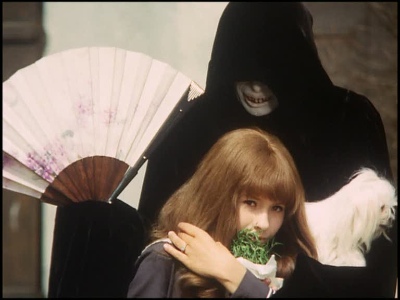
Valerie embraced by the 'Polecat' vampire-like creature, who's also the town's high priest and possibly her father (??!!) in "Valerie and her Week of Wonders" (1970).

1. Valerie and her Week of Wonders (Czech: Valerie a týden divů) is a 1970 film from the former Czechoslovakia, directed by Jaromil Jireš. This is the most “artful” of the films that appear on this list and, even though the print I viewed was of very poor quality, the stellar cinematography clearly stood out. The film is a dark, coming-of-age fairytale as only the Czechs could envision. The titular heroine, 13-year-old Valerie, grapples with her burgeoning sexuality, as well as the many priests, vampires, men and women who attempt to seduce and/or kill her. Fortunately for young Valerie, she possesses magical earrings which, when placed in her mouth, rescue her from impending death — which happens with great frequency throughout the film. Disjointed and surreal, you’ll hurt your brain if you try to make sense of the proceedings. Characters often change appearance and, as in the case of the ‘Polecat’, occupy shifting and ambiguous roles. Is he a priest? A vampire? Valerie’s father? A weasel? All of the above? Yes. Don’t worry about it, just enjoy the many beautiful images and the hazy, dreamlike pace of this film.

Christina Lindberg stars as Frigga, the vengeful one-eyed prostitute in "Thriller -- A Cruel Picture."

2. Thriller — A Cruel Picture (Swedish: Thriller – en grym film, also known as They Call Her One Eye, Hooker’s Revenge and simply Thriller) is a 1973 Swedish exploitation film. The film follows the typical Rape-Revenge formula: the heroine suffers tragedy and physical degradation until the latter half of the film, when she exacts bloody revenge on those who’ve abused her. (Read my earlier post on the Rape-Revenge film for my thoughts on this exploitation subgenre.) The teenage Frigga — who has been rendered mute by the childhood trauma of sexual abuse — is kidnapped by the local pimp and forced into both heroin addiction and prostitution. When she is initially non-compliant, Frigga has one of her eyes cut out with a scalpel in a brief but grisly scene that reputedly employed an actual cadaver as a body-double. From then on, she silently endures abuse from her clients while she saves up her portion of the financial transactions. She packs her Mondays (her one day-off work) with karate class, rifle-shooting and driving-really-super-fast class, as she secretly plots her revenge. Montage after long montage, she finally dons a black leather trenchcoat, matching eye-patch, and a sawed-off shotgun, and pays a slow-motion visit to each of her (soon to be former) clients.

The film was marketed as the first film ever to be completely banned in Sweden, although the one that actually was first was Victor Sjöström’s The Gardener from 1912. It has received a cult following and was one of the inspirations behind Quentin Tarantino’s Kill Bill, specifically the character of Elle Driver (Daryl Hannah). In Daniel Ekeroth’s book on Swedish exploitation movies, Swedish Sensationsfilms: A Clandestine History of Sex, Thrillers, and Kicker Cinema, it is revealed that the producers took out a huge life insurance policy on star Christina Lindberg, as real ammunition was used in the action sequences, and that she was asked to inject saline solution during the drug scenes. — from Wikipedia.

There's no joy in being dead, not even 'living death', as evidenced by the melancholic Catherine in Jean Rollin's "The Living Dead Girl" (1982). Oh, the existential angst of it all.

3. The Living Dead Girl (French: La Morte Vivante) is a 1982 campy classic from French fantastique director Jean Rollin. Reanimated by the spillage of a toxic waste goop on her corpse, the aristocratic Catherine discovers she has a new-found taste for human flesh. Like all of Rollin’s films, the aesthetics play a much more crucial role than the story or, indeed, the acting. His films are as gorgeous as they are completely ridiculous. The absurd plot devices — toxic goop dumped on (surprisingly well-preserved, two-year-old) corpse interred in family crypt — exist only to furnish Rollin with an excuse to create his signature erotic-grotesque imagery. Rollin’s The Living Dead Girl is splatter gore-meets-arthouse, served up with a little Jean-Paul Sartre on the side. The existentialist exchange that occurs between Catherine and her childhood friend Hélène is thoroughly hilarious:

Hélène: You were never dead. The dead don’t come back to life. You were put to sleep, drugged, driven mad or I don’t know what. I don’t understand. I never saw you dead, Catherine. They put an empty coffin in this crypt.

Catherine: No. I’m dead, Hélène. I know I am. Don’t you understand? I know I am!

Catherine and Hélène discuss the finer points of existence in "The Living Dead Girl."

Heady stuff, people. Heady stuff.

The magical worlds of Lotte Reiniger.

A still from Lotte Reiniger's "The Adventures of Prince Achmed" (1926), credited with being the first feature-length animation film.

Before there was Walt Disney, there was Lotte Reiniger. Born in Berlin in 1899, Reiniger pioneered new forms of paper cutout animation in the 1920’s. Inspired by shadow puppetry, Reiniger developed highly articulated paper puppets to be animated through stop-motion camera work. Her elegant paper silhouettes breathed life into the fairytale The Adventures of Prince Achmed (1926), a film that bears the distinction of being the first feature-length animation. Although she initially struggled to find a distributor, once Prince Achmed premiered at the Cannes Film Festival, it then became a critical and popular success.

Back-lit paper silhouettes are so closely associated with Reiniger that schools of animation will often refer to this type of work as the “Lotte Reiniger style.”

Horror Films 101: Harry Kümel’s “Daughters of Darkness” (1971)

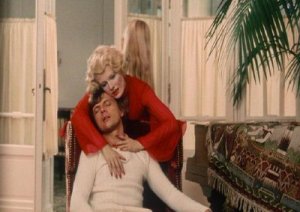
Delphine Seyrig channels Marlene Dietrich in her portrayal of the infamous Hungarian Countess Elizabeth Báthory.

If you’re a regular reader of this blog, then you are already familiar with my admiration — one might even say, obsession — for European horror films from the 1960’s and 70’s. What these films often lacked in budget, they more than made up for with stunning visuals and style. Of course, when you have a 1000+ years of art and culture sitting at your doorstep, it’s difficult not to look fabulous. Such is the case for Harry Kümel’s highly stylized erotic vampire film Daughters of Darkness (1971). From the architecture of the grand hotel on the Belgian seafront, to the shimmering sequins of Delphine Seyrig’s evening gown and the blonde waves of her 1930’s bob hairstyle, everything and everyone looks beautiful.

Author David Chute wrote an elegant summary of Daughters of Darkness for the recent Blu-Ray release of the Kümel classic which accurately captures the mood of the film:

Art-movie goddess Delphine Seyrig (Last Year at Marienbad) slinks through the plush Eurotrash settings as the deathless Elizabeth Bathory, Vampire Countess, in Harry Kümel’s minor Dutch classic of lesbian erotic-gothic. Blood mingles with water during the languorous shower scenes. Set at an upper-crust seaside resort, the 1971 film recounts Bathory’s plot to replace her current consort (Andrea Rau) with a fresher specimen, an abused newlywed whose brutal young husband is an inconvenience waiting to be eliminated. Although both the bi-sex and the neck-biting violence are tame by today’s standards, the film has a graceful, gliding sense of pace that gets under your skin; something unspeakably kinky always seems to be just about to happen. It never quite does, but the mood lingers. See it with someone you love–or would like to. –David Chute

Stefan (John Karlen) gets all hot and bothered as he and Elizabeth recount the many tortures inflicted upon the victims of the bloodthirsty Countess Báthory.

The phrase “…something unspeakably kinky always seems to be just about to happen…” instantly leapt out at me when I first read Chute’s summary, as this echoes my own experience with the film. If David Lynch had been making Eurotrash vampire films in the 1970’s, he’d probably make a film much like this one. From our first glimpse of the Countess, as she glides out from the backseat of her Bentley and up to the desk of the hotel concierge, there is an unmistakable atmosphere of kink. The camera tightly focuses on the gleaming patent leather of her high black boots as she steps from the car, an image that says fetish more than it does vampire. It is quickly apparent that the relationship between Elizabeth and her “secretary” Ilona has little to do with typing memos, and the scene in which Ilona crouches obediently at Elizabeth’s feet clearly establishes their dominant/submissive lifestyle arrangement. Of course, a bisexual female vampire with a taste for BDSM isn’t an entirely uncommon entity in the realms of horror fiction. The true wild card in Kümel’s film lies in the character of Stefan, the secretive husband prone to fits of violent rage. His rather prurient interest in sexual sadism becomes apparent when he recounts the legend of the bloodthirsty Countess Báthory, writhing with erotic pleasure as he describes the tortures inflicted upon her victims. Later in the film, he savagely beats his wife Valerie with his belt. And then there’s the whole matter of his “mother,” whom he’s mysteriously reluctant to introduce to his new bride. The scene below, where Stefan gives his ol’ Mum a call, is gloriously creepy:

My favourite moment of that scene is when the butler kneels down before Mother, and “Mother” reaches out to pet his bald head in the way one would a family dog. The butler reacts, but only mildly, before he walks away in silence. Kink abounds, but its only ever hinted at.

As the film nears its finale, the body count predictably rises. Ilona slips in the shower and falls upon a straight razor. The abusive Stefan gets his final comeuppance by way of a glass fruit bowl. Yes, fruit bowl. The Countess herself meets her end impaled on an unfortunately located tree branch as she is pitched from her crashing car. The sole survivor Valerie keeps the Báthory legend alive by donning Elizabeth’s fetching black PVC cape — complete with bat-wing trim and campy-vamp high collar — and seductively sidling up to a young couple.

The Rape-Revenge Girl, part deux.

Baise-moi, si vous plaît.

The sex-club massacre scene from "Baise-moi" (2000). In English, the film's title would be correctly translated as "Fuck me", and not "Rape me" under which it was originally released in North America.

When the French film Baise-moi was released in 2000, it garnered a great deal of media attention for its highly graphic violence and depictions of unsimulated sex. The film was banned in Ontario, initially because it was deemed too pornographic. The producers asked for it to be re-rated with a pornographic rating, only for it to be banned because there was too much violence for a pornographic film. It was finally passed with an “18A license” after — one assumes — some strategic edits being made. I caught up with the film on DVD that year, and have recently rewatched it online — you can find most of the film on Youtube, but hurry as it’s likely to be removed due to its content and copyright infringement. I came away from my recent viewing with these two impressions: firstly, that it is a far better film than I remember, and second, that I still don’t know what all the hullabaloo was about.

Here’s a quick synopsis: the main characters Nadine (Karen Bach) and Manu (Raffaëla Anderson) are women who live on the precarious fringe of a very disenfranchised lower-class in contemporary France. Nadine is a part-time prostitute involved with some very shady individuals, while the perpetually unemployed Manu spends much of her time trying to get stoned. When Manu is gang raped by a group of thugs, her brother — with whom she has a strangely complex and conflicted relationship — accuses her of “enjoying” the rape and calls her a “slut.” A physical struggle ensues, during which Manu grabs her brother’s handgun and shoots him dead. Meanwhile, Nadine has a violent scuffle with her female roommate that ends with her friend’s demise. So, a bad day for all parties involved. The women meet up at a railway station by pure coincidence, and the two decide to “go on the lamb” from the police that will soon pursue them. And thus famously begins their violent, drug-addled, pornographic and completely nihilistic crime spree.

Nadine pays homage to Travis Bickle's famous "Are you talking to me?" scene from Martin Scorsese's "Taxi Driver." No, seriously. Compare both scenes.

In my previous post on The Rape-Revenge Girl I discussed Meir Zarchi’s I Spit On Your Grave (1978) and how that film ultimately failed as a satisfying Rape-Revenge film. Where Zarchi’s film falters and, conversely, Baise-moi succeeds is in the depiction of rape. The protracted and rather gratuitous rape scenes in I Spit On Your Grave offer up much screaming, nakedness, and salacious close-ups of Jennifer Hill’s anguished face and bloodied body. While the audience understands that bloody vengeance will come before the credits roll, it’s not until after we all get a good, long look at Jennifer’s breasts. The whole deal feels exploitative. While the rape scene in Baise-moi is undeniably graphic — as it involves actual penetration — the filmmakers Virginie Despentes and Coralie Trinh Thi simultaneously reject the sadism inherent in a rape scene. Much to the dismay of one of her rapists, Manu stares ahead in a detached manner during her attack. She has recognized that although she’s powerless to prevent the assault, she can assert power through her refusal to “play” the role of the victim. The fact that her lack of response clearly annoys her rapist underscores the politics that inform the scene: that rape is about power, not sex.

Once Nadine and Manu are on the road, the film becomes a sort of X-rated buddy-flick. The sex is graphic, true, but no more so than anything you’ve seen in a standard, mainstream pornographic film. Much like films of that ilk, it’s also completely mechanical and nonerotic. The violence of the main characters is sudden, impulsive and seemingly fueled by a rage against society as a whole, which is partly the reason it all works so well. The scene of the bloody massacre that takes place within a sex club is positively operatic in its excessive violence. For no other reason, you should watch this film for that scene.

OK, I believe I’ve finished with my “female tropes in horror films” series of posts. Next up, I’ll write about the latest release from Pixar. No, not really.

Deviance, gender and the ‘aberrant female’ in horror, part IV.

The Rape-Revenge Girl.

Jennifer (Camille Keaton) exacts revenge on one of her rapists in ‘I Spit On Your Grave’ (1978).

Horror fiction tends to narrowly focus on two main themes: sex and death. (In fact, an argument can be made that most art is preoccupied with these two topics). A corollary subject that often arises from this thematic pairing is the violent cruelty of mankind that ultimately leads to sex and/or death. The writings of the Marquis de Sade and films of both Pasolini and Hanneke are almost entirely devoted to the examination of power dynamics and the innate viciousness of humanity. The reader/audience is also strongly implicated as willing participants in this parade of cruelty served up for our (presumably) voyeuristic consumption.

The Rape-Revenge scenario is the perfect encapsulation of this sex + death equation: a young, beautiful woman is sexually and physically brutalized, but survives to exact bloody vengeance upon her tormentor/s. This scenario is one that is strongly favoured by the various subgenres of exploitation cinema because its, well, basically lurid and exploitative. The most famous (or infamous, depending on your point-of-view) of the Rape-Revenge subgenre is Meir Zarchi’s Day of the Woman (1978), better known by its re-release title, I Spit on Your Grave. Now, let’s place this film in it’s proper context. Zarchi’s I Spit On Your Grave is a base, low-budget, and poorly acted film. It’s pure exploitation cinema, and a far cry from the critically-lauded work of Sade, Pasolini and Hanneke. That being said, it has been the subject of a great deal of feminist critical discourse since its release, with academics such as Carol Clover and Julie Bindel championing its “feminist” viewpoint.

The plot is threadbare. Jennifer Hills, an aspiring writer from “the big city”, seeks solitude in a rental cottage so that she may focus on her craft. The local country bumpkins have different plans for Ms. Hills, however, for no apparent reason other than the fact that she’s young, pretty and unaccompanied. They systematically terrorize, gang rape, and then murder their victim. Or so they believe. Jennifer survives her attack, and returns for revenge. One by one, her former tormentors are dispatched in ever increasingly gruesome ways and we, the audience, cheer her on through this exercise in catharsis.

Dude, rape victims don’t generally seduce their rapists into bathtubs after the attack. Darwinism claims yet another deserved victim.

I had two major misgivings with Zarchi’s I Spit On Your Grave. I’ll list them in point form.

1. One is forced to sit through a protracted series of rapes before we arrive at the satisfaction of revenge. This is the ‘Faustian bargain’ to which we females tacitly agree when viewing such films: howls of naked protest from the heroine in Act One, to be followed by bloody vengeance. The quotient of rape-to-revenge in Zarchi’s film is too much rape, not enough revenge. At least, the deaths of Jennifer’s rapists were not violent and/or gory enough for my — admittedly, gruesome — taste. The only death scene that worked for me was the castration-in-the-bathtub scene. Gallons of fake blood, off-screen howls and much left to the imagination of the viewer make this scene an effective one.

2. The rapists are portrayed as complete imbeciles, with one of them a mildly retarded, Gomer Pyle-like character. Did Zarchi intend this as a further insult-to-injury for poor Jennifer Hills? That an independent, educated woman like her could be bested by this group of inbreds? The convincing performance of Camille Keaton in the infamous ‘sodomy scene’ is completely undercut by the spastic gyrations of her attacker. What the hell is the actor doing back there? Was he directed to look that ridiculous? Even during a scene as horrendous as this, I could not suppress my laughter.

Where is the ‘deviance’ and the ‘aberrant female’ in all this, you ask? Carol Clover wrote in the third chapter of her 1992 book Men, Women, and Chainsaws that she can “appreciate, however grudgingly, the way in which [the movie’s] brutal simplicity exposes a mainspring of popular culture.” Women are typically cast as victims in exploitation films, and their suffering has become a form of sadistic entertainment. Zarchi’s film attempts to address this issue. Rather than rely on the sporadic justice of the judiciary system, Jennifer Hills takes matters into her own hands. She embodies the rage we feel against the cruel reality of rape, and we sit through her violation in order to experience the vicarious thrill of revenge without ever getting our hands bloodied.

While Zarchi’s I Spit On Your Grave doesn’t entirely work for me as a satisfying Rape-Revenge film, my next post will focus on a film in this genre that does work: the equally controversial French film Baise-moi (2000).

Next post–>

Deviance, gender and the ‘aberrant female’ in horror, part III.

The Lesbian Vampire.

Theodora: Is this another one of your crazy ideas?
Eleanor: I’m not crazy!
Theodora: Crazy as a loon! You really expect me to believe that you’re sane and the rest of the world is mad?
Eleanor: Well why not? The world is full of inconsistencies. Full of unnatural beings, nature’s mistakes they call you for instance!

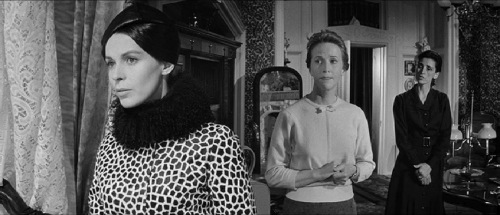
The text above is dialogue from Robert Wise’s film The Haunting (1963) in which Dr. Markway, a researcher into paranormal activity, has assembled a group to investigate the reputed haunting of the gothic New England mansion Hill House. Amongst the group are the clairvoyant Theodora, a bold, outspoken woman who exudes worldly sophistication, and Eleanor, an awkward spinster who’s spent most of her adult life caring for her sick mother. In spite of their differences, Theodora befriends the mousy Eleanor, and there’s even the hint of romantic interest — however unlikely — emanating from Theodora. Director Robert Wise and screenwriter Nelson Gidding conceived of the Theodora character as lesbian, which would be one of the earliest appearances of a queer character in cinematic horror. Of course, the social climate of the early 1960’s meant that references to Theodora’s sexual orientation were all very codified and subtle, but Eleanor’s accusation of  “…unnatural beings…” and “nature’s mistakes…” allude not only to Theo’s preference in romantic partners, but they clearly establish homosexuality as an indication of deviance and ‘unnaturalness’.

Claire Bloom stars as Theodora (far left), Julie Harris as Eleanor (centre) and Rosalie Crutchley as the stony and gloriously creepy groundskeeper Mrs. Dudley in Robert Wise’s “The Haunting” (1963).

As was discussed in my earlier post on gender & the slasher film, queerness and the fluidity of gender identity in horror fiction is frequently a sign of mental illness. The cross-dressing serial killer — Norman Bates, for instance — and the homicidal, lovesick lesbian from Aja’s Haute Tension are examples of blurred gender boundaries being symptomatic of mental instability. While the character of Theodora in Wise’s The Haunting is not portrayed as violent nor mentally ill, her lesbianism marks her as ‘unnatural’ as the haunted Hill House in which the drama unfolds. This notion is certainly ironic given that it is the socially-awkward Eleanor, and not Theodora, who stands out as “the one who doesn’t belong” within the group.

“Hey! That’s not my neck!” Vampire love bite from “Twins of Evil” (1971).

This takes us to the third most common female trope in horror fiction: the Lesbian, and specifically the Lesbian Vampire. Why vampire, you ask? Simple. This trope has its roots in Joseph Sheridan le Fanu’s novella Carmilla (1872) about the predatory love of a female vampire for a young woman. Le Fanu’s novella was influential not only on Bram Stoker’s Dracula — which it predated by 25 years — but serves to this day as the source chiefly consulted for the female vampire. (See my post on The Vampiress for more on this topic). The reason for the popularity of the Lesbian Vampire seems fairly straightforward: titillation, pure and simple. Wikipedia sums this up neatly:

This was a way to hint at or titillate with the taboo idea of lesbianism in a fantasy context outside the heavily censored realm of social realism (Weiss 1993). Also, the conventions of the vampire genre — specifically, the mind control exhibited in many such films — allow for a kind of forced seduction of presumably straight women or girls by lesbian vampires.

In the early 1970’s, Britian’s Hammer Studios created the much beloved Karnstein Trilogy, a series of lesbian vampire films very loosely based on Le Fanu’s novella: The Vampire Lovers (1970), Lust for a Vampire (1971) and Twins of Evil (1971). I’ve only seen the first film, which stars the iconic ‘Hammer Girl’ Ingrid Pitt and is quite giggle-worthy. File under ‘guilty pleasure.’

For the most part, the Lesbian Vampire is more softcore than horror, and bears little resemblance to the gender-bending serial killers mentioned earlier. What they do have in common, however, is the demarcation of Otherness — even the racy, breast-biting vampire of Twins of Evil is ultimately portrayed as ‘aberrant’ and ‘deviant.’

In Part IV of this series of posts, I’ll address the Rape-Revenge Girl.

Next post –>

Mother’s Day REPOST: “Your mother ate my dog!”

“Definition of  Freudian slip: when you say one thing, but meant your mother.” –an old joke, as immortalized in Urban Dictionary.

Ever since the days of Sigmund Freud, mothers have endured the brunt of blame for the neuroses of their offspring. The psychologically-complex relationship between mother and child served as the dramatic foil against which the existential angst of Shakespeare’s melancholic Hamlet played out, not to mention innumerable tales of dysfunctional families in horror fiction. There are countless examples of horror movie villains, like Jason Voorhees from the Friday the 13th series, who have a rather intense and, um, complicated relationship with their mother. In these films, the character of the mother is the creator — both literally and metaphorically — of the monster. Let’s honour Mother’s Day by paying homage to the most memorable mothers in cinematic horror.

Margaret White (Piper Laurie) presses her traumatized daughter against her “dirty pillows” in De Palma’s “Carrie.”

1. The abusive Margaret White (Piper Laurie) from Brian De Palma’s Carrie (1976) torments her teenage daughter with her ferocious piety. Unfortunately for Mrs. White, her daughter happens to possess telekinetic powers and a strong desire to attend her high school prom. When the latter proves disastrous, and Carrie finds herself soaked in pigs blood, things go from bad to worse. Convinced that she is “possessed by Satan,” Margaret stabs her daughter in the back before being summarily dispatched by a shower of kitchen knives flung at her by Carrie’s telekinesis. The knives pin Mrs. White against the kitchen door frame in the highly appropriate cruciform stance, offering horror fans one of the most memorable and satisfying death scenes in the genre.

Vera “Mum” Cosgrove gets bitten by the nasty Sumatran Rat-Monkey in Peter Jackson’s “Braindead”.

2. Long before he ventured into the realm of Orcs and Hobbits, New Zealand director Peter Jackson was much beloved in the horror genre for his “splatter” films. His infamous 1992 horror-comedy Braindead (released in North America as Dead Alive) still holds the title for being one of the bloodiest, goriest zombies films to date. Even highly adept and accomplished splatter-gore directors like Takashi Miike don’t quite attain Jackson’s zany, hilarious, and way over-the-top levels of gore. As if in counterbalance to the excessive gore, Jackson’s Braindead offers an equally excessive character in Vera Cosgrove. She epitomizes the thoroughly controlling, ball-busting mother who simply cannot allow potential happiness to enter the life of her beleaguered son. Once “Mum” is bitten by the Sumatran Rat-Monkey and infected with the virus that transforms her into a zombie, Jackson revels in the sadistic pleasure of having various parts of her matronly body impaled, injected, dismembered, consumed, and otherwise compromised. Packed with many memorable quotes, including “I kick ass for The Lord!” and, one of my favourites, “Your mother ate my dog!”, Braindead is a gloriously gory, campy romp. Just don’t watch it soon after eating.

Nola (Samantha Eggers) gives her newborn a clean — with her tongue — in Cronenberg’s “The Brood.”

3. Procreation doesn’t get more bestial than in David Cronenberg’s 1979 Canadian horror classic The Brood. Samantha Eggars (best known for her role as TV-mom to Sarah Michelle Gellar in Buffy the Vampire Slayer) plays Nola Carveth, a mentally-ill patient who opts for an experimental, and highly controversial, psychotherapy treatment. This unorthodox  “psychoplasmics” treatment causes the patient’s mental illness to manifest physically on their bodies — in the case of Nola, she parthenogenetically births strange, mutated children. This film has all the themes that typify a Cronenberg film: abjection, body horror, bizarre sexuality, and an anxiety/horror over female biology and reproduction. A degree of sympathy exists for Nola, as she’s evidently the victim of childhood abuse perpetrated by her cruel and self-centred mother, although this sympathy soon diminishes once it is revealed that Nola is, herself, abusing her daughter Candice. The ‘birthing’ scene, where Nola licks her offspring clean in the manner of a mother cat, is classic Cronenberg.

Deviance, gender and the ‘aberrant female’ in horror, part II.

The Final Girl and The Slut.

Cécile De France as the chainsaw-wielding Marie in “Haute Tension” (2003).

SPOILER ALERT: Major plot points of Aja’s Haute Tension are discussed, so if you haven’t seen it yet, go watch it first.

In my previous post on Deviance, gender and the ‘aberrant female’, part I, I identified two of the most common female tropes in horror cinema: the Final Girl and her counterpoint, the Slut. These two form a polarity necessary to the moral undertone of the ‘slasher’ horror film: the virtuous Final Girl survives to confront and (usually) destroy her tormentor, while the Slut provides titillation by disrobing and being sexual, offering up a canvas of eroticized female flesh that the (invariably) male serial killer can cut, slash, mutilate and otherwise penetrate. American film theorist Carol Clover, who coined the term ‘Final Girl’ in her 1992 book Men, Women, and Chain Saws: Gender in the Modern Horror Film, writes on the integral role the Final Girl plays in the slasher genre:

The image of the distressed female most likely to linger in memory is the image of the one who did not die: the survivor, or Final Girl. She is the one who encounters the mutilated bodies of her friends and perceives the full extent of the preceding horror and of her own peril; who is chased, cornered, wounded; whom we see scream, stagger, fall, rise, and scream again. She is abject terror personified. If her friend knew they were about to die only seconds before the event, the Final Girl lives with this knowledge for long minutes or hours. She alone looks death in the face, but she alone must also find the strength either to stay the killer long enough to be rescued (ending A) or to kill him herself (ending B). — Carol Clover, from Men, Women and Chain Saws: Gender in the Modern Horror Film, 1992.

The psychopathic urge that drives the serial killer to commit his atrocities is often imbued with a sexual energy. The killer is simultaneously attracted to, and repulsed by, the sexual desirability of his young female victims. As Clover points out, he is often depicted as “…a male whose masculinity, and sexuality more generally, are in crisis…”, with prime examples being the cross-dressing of Norman Bates in Hitchcock’s Psycho (1960), or Buffalo Bill in The Silence of the Lambs (1991). The serial killer’s fluid gender identity marks him as a sexual deviant — and deviance in horror fiction is indicative of that which causes fear and anxiety.

Marie hides from her Serial Killer Cliché in “Haute Tension” (2003).

This point brings us back to Alexandre Aja’s Haute Tension, in which one of the main female characters, Marie, is identified as lesbian. Her sexual orientation is relevant to the plot, as it supplies the motivation behind her actions. She harbours a secret passion for her friend Alexa who, evidently, is completely oblivious to Marie’s romantic feelings. When her friend’s family is brutally murdered and Alexa kidnapped by a male psychopathic killer, Marie quickly adopts the Final Girl role and leaps to her friend’s rescue. From the outset, Marie’s short, boyish hair, androgynous clothing and slim, tautly muscled body appears to conform to the masculinized tradition of the Final Girl. As the plot progresses, Marie is poised for her final confrontation with the killer: a large, stout middle-aged man dressed in grimy overalls, his physical appearance every bit a slasher film cliché as hers.

And then comes the Big Reveal. The clichéd male serial killer is exactly that. He is a creation of Marie’s imbalanced mind, as the surveillance camera at the gas station films Marie — and not the stout, grimy man — as she sinks an axe into the back of the unsuspecting male attendant. The Final Girl and the Serial Killer conflate into one: the homicidal, mentally-unstable lesbian. Is this depiction of a queer woman homophobic? There is, arguably, a trace of homophobia in Haute Tension, as Marie’s sexual orientation serves not only as a plot device, but clearly distinguishes her as ‘the Other’, the deviant that is to be feared. Of course, there is a well-established tradition of LGBT themes in horror fiction and the use of ‘queerness’ as a demarcation of Otherness, and this will be the topic of my next post…

Next post –>