Horror Films 101: Movie moments that traumatized my childhood.

A still from the animated film version of “Watership Down,” showing the last, terrified moments of a rabbit’s life.

1. The destruction of the rabbit warren and wholesale slaughter of its occupants in the 1978 film adaptation of the Richard Adams novel Watership Down. The filmmakers did not shy away from the darker shadings of Adams’s novel,  and the violence contained in the source material appears, quite graphically at times, on screen. The scene of the warren destruction is rendered in an abstracted fashion, but is nonetheless effective in conveying the horror of the rabbit massacre. Walt Disney, this ain’t.

The ‘demon face’ was that of Eileen Dietz, who also starred in Happy Days and General Hospital. Oh, what a little make-up and effective editing can do.

2. The freaky demon face that flashes on-screen in William Friedkin’s 1973 horror classic The Exorcist. In the (far superior) original theatrical release of the film, this ‘demon face’ only appears twice: once, during the nightmare sequence of Father Karras, where he envisions his elderly mother standing at the top of a stairway leading down to the NYC subway; and lastly, during Regan’s exorcism. Each time, the face only flashes on-screen for mere seconds — just enough time to burn onto your retina and torment you for the rest of your days. According to the trivia section of imdb.com, the ‘demon face’ was supplied by the actress Eileen Dietz, who also stood in as a body-double for Linda Blair in a couple of scenes. In the  director’s cut of the film (released in 2000), the face appears with considerably greater frequency, diluting its impact.

“Let me in, Mark…screeeetch….screeeetch…let me in…”

3. The vampire kid scratching on his friend’s bedroom window from the 1979 made-for-TV adaptation of Stephen King’s novel Salem’s Lot. Director Tobe Hooper, best known for his masterpiece of the macabre The Texas Chainsaw Massacre, fully understands the dark, seedy underbelly that lies just beneath the surface of small town, white-picket-fence America. Few directors — other than, perhaps, David Lynch — have as great an insight into the ‘suburban Gothic’. The vampire of Hooper’s film is not a romantic seducer but, in keeping with the German Expressionist tradition of F. W. Murnau’s Nosferatu, he’s a ghoulish, hideous monster with a taste for the blood of children. This scene with the undead child paying a nighttime visit to his former playmate scared the bejeezus out of me when I was a kid. It was, in part, the awful sound that his fingernails made as he scratched the glass, beckoning to his friend to open the window.

4. Ben Gardners’s head suddenly appearing through the smashed hull of his sunken boat in Steven Spielberg’s 1975 masterpiece Jaws. Even though, as an audience member, you know exactly what Richard Dreyfuss is about to stumble across, I betcha it’ll still make you jump.

5. The terrifying tale of Large Marge from Tim Burton’s 1985 Pee-wee’s Big Adventure. No, seriously. It’s a creepy — and classically Tim Burton — moment. Just tell ’em Large Marge sent ya.
Lady Lazarus’s Halloween List: Top 10 Best Horror Films of the 2000s.

The past decade of the 2000s — or the Naughts, if you prefer — were an especially good one for the genre of horror. On television, we were treated to blood-soaked series like Dexter and True Blood, and in the movie theatres, the vampires and zombies ran amok. As is customary this time of year, I like to compile a film-geek list relating to horror. Halloween shall soon be upon us, my deadlings. Let’s revel in the macabre and spooky.

Below are my picks for the past decade’s best offerings in cinematic horror.

Shauna Macdonald in “The Descent,” a horror film by Neil Marshall set in the Appalachian Mountains.

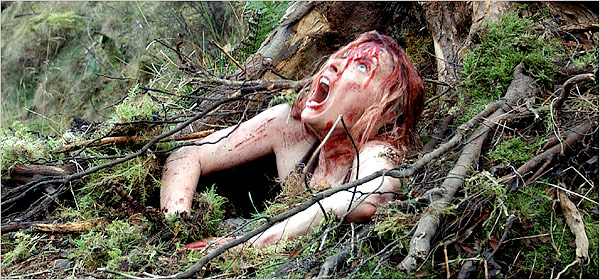
1. The Descent (2005). Directed by Neil Marshall. An exceptionally attractive team of female ‘extreme’ spelunkers are coerced by one of their members to venture into a series of previously unexplored caves. So begins the ill-fated journey of The Descent, one that starts with squirm-inducing claustrophobia and eventually leads to the discovery of something much, much more sinister — and deadly.

2. Låt den rätte komma in (2008). English title: Let the Right One In. Director: Tomas Alfredson. Have not seen the recent English-language remake of this stellar coming-of-age vampire story and, quite frankly, I don’t feel the need. This one got it right. From its very first frame, you can feel the tangible ache of loneliness in the main characters, as well as the relentless cold of the Swedish winter.

3. [REC] (2007), Directors: Jaume Balagueró and Paco Plaza. The first two-thirds of this film were somewhat underwhelming for me. Sure, it was a serviceable, well-crafted ‘documentary’-style zombie film, but I’d seen many of its kind before. And then, the main characters unlock the door to that mysterious, (supposedly) uninhabited penthouse apartment. At that moment, this film transformed from a decent zombie-flick into something almost sublime.

The main character Alison is harassed by a vengeful (and apparently indestructible) Gypsy woman in Raimi's 'Drag Me To Hell.' Someone call the Roma People's Deflamation League.

4. Drag Me To Hell (2009). Director: Sam Raimi. A thoroughly enjoyable, gross, hilarious and, at times, truly scary film from the master of the comedy-horror, Sam Raimi. Watch for the scene with the animatronic goat. Hysterical.

5. Ichi the Killer (2001). Director: Takashi Miike. Just when you think that the saturation point for bloody splatter-gore has been reached, along come Japanese directors like Miike to push the limits beyond all previous imaginings. This film, along with Miike’s 1999 offering Audition, is completely unhinged. My major misgiving with Ichi the Killer is its graphic and highly sexualized violence toward women. Misogyny is a regrettably common characteristic in many of this genre’s films — particularly from countries such as Japan. All the same, I would recommend this film to the seasoned horror fan, simply on the basis of its insanity.

The character Kakihara admires the handiwork of Ichi in Miike's 'Ichi the Killer'.

6. À l’intérieur (2007), English title: Inside. Directors: Julien Maury and Alexandre Bustillo. This past decade has witnessed the growth of a strong horror-film industry in France, a country not previously known for films in this genre. Dubbed by some in the media as ‘New French Extremity,’ films such as Maury and Bastillo’s À l’intérieur confront the viewer with images of intense ‘body horror.’  The alone and heavily pregnant Sarah battles with an insane, homicidal intruder wielding impossibly-sharp — and profoundly effective — tailor scissors.

7. Ginger Snaps (2000). Director: John Fawcett. The mythology of the werewolf gets a modern feminist overhaul in this Canadian horror franchise. The hormone-induced lunacy of puberty is cleverly aligned with lycanthropy when the titular Ginger begins menstruation around the same time as she’s bitten by a ‘big dog’ in the forest surrounding her suburban home. It’s hard not to love a film that has as it’s tagline: “She’s got the curse.” Incidentally, the sequel Ginger Snaps 2: Unleashed (2004) was surprisingly good. The third installment, Ginger Snaps Back: The Beginning should be encased in cement, tossed down a mine shaft, and buried for eternity.

One of the feigned 'death scenes' staged by the Fitzgerald sisters. Kids these days.

One of the feigned 'death scenes' staged by the Fitzgerald sisters in 'Ginger Snaps'. Kids these days.

8. Ju-on (2003). English title The Grudge. Director: Takashi Shimizu. Hands-down, my favourite amongst all of the J-horror films I’ve seen over the past decade. And I’ve seen quite a few. The English-language remake is laughable by comparison. Avoid it and seek out the original Japanese film.

9. El orfanato (2007). English title: The Orphanage. Director: Juan Antonio Bayona. With contemporary French horror-film directors so successfully flooding the cinema with blood and viscera, it’s a rare treat to view a relatively subtle, classic ghost story like Bayona’s El orfanato. One of the very few horror films at which I openly wept. The ending is heartbreaking, and wonderful.

Autocannibalism + feminism combine in Marina de Van's disturbing 'In My Skin.'

10. Dans ma peau (2002), English title: In My Skin. Directed, written by and starring Marina de Van, this is a strange, atmospheric and generally overlooked gem of New French Extremity. The main character Esther develops an erotically-charged, cannibalistic fixation with her own body after being disfigured in a freak accident. Ponderously slow in parts, it does offer a unique and interesting premise.

Honourable Mentions:

1. Pontypool (2009). Director: Bruce McDonald.

2. Død snø (2009). English title “Dead Snow.”

3. Bakjwi (2009). English title “Thirst”. Director: Park Chan-Wook

4. Grindhouse Presents: Planet Terror (2007), Dir. Robert Rodriguez.

5. 28 Days Later (2002), Dir. Danny Boyle.

Horror Films 101: Favourite death scenes.

For the past three years, it’s been a pre-Halloween tradition of mine that I compile a geekish list relating to horror films. I’m presently working on 2010’s Halloween list. Doubtless, you are all aquiver with anticipation. Just to whet your ghoulish appetite, here’s a repost of the list I originally created on Facebook last Halloween listing my “Top 5 Favourite Death Scenes from a Horror Film.” Enjoy. Note: NOT FOR THE SQUEAMISH.

5. The death sequence that appears in the first 15 minutes of Dario Argento’s Suspiria is fantastically operatic in its baroque excess. Argento blows his cinematic load early, though, as the rest of this cult classic is fairly lacklustre. The music provided by the Italian prog-rock outfit Goblin, however, is wonderful and fittingly creepy.

4. The death of Captain Rhodes in George A. Romero’s Day of the Dead. This character was such a tightly-wound military jerk-off that you couldn’t help but cheer when the zombies finally got a hold of him.

3. Udo Kier plays a pale, sickly Count Dracula in search of “wergin” blood in Paul Morissey’s adaptation of the legendary vampire story, the Andy Warhol produced Blood for Dracula. Dracula meets his final comeuppance at the end of Joe Dallesandro’s axe in a scene of hilarious, way over-the-top gore. Couldn’t find the entire scene on Youtube but here’s a nifty mash-up with the Pixies that features the end sequence.

2. Final death scene in 1958’s The Horror of Dracula. I adore the films of Britain’s Hammer Studios, a.k.a. the “Hammer Horrors.” Christopher Lee stars as Dracula and Peter Cushing as his earthly nemesis, Van Helsing. Many a Saturday afternoon of my youth was spent watching these classic horror films. The video clip below is of regrettably poor quality, but it’s a fantastic sequence.

1. John Hurt births an alien at the dinner table in Ridley Scott’s Alien. Oh, c’mon, who hasn’t seen this famous sequence?

The horror films I probably won’t watch, and why.

The viewing of a good horror film can, at times, be likened to an amusement park ride. There’s suspense, action, usually a few laughs, and more than a few moments that’ll make you shriek or jump in your seat. At its conclusion, when the evil characters receive their final comeuppance, you’re rewarded with a heady chemical cocktail of endorphins. Thanks for riding Satanic Cannibal Cheerleaders from Outer Space, kids. Please exit to your right.

As a horror film aficionado, I’ve watched and thoroughly enjoyed films that featured copious amounts of gore. I would not classify myself as a gorehound, but neither do I shy away from imagery I know to be disturbing or taboo in nature. These are, after all, the mainstay of horror cinema.

That being said, I do have my limits. Blood, gore and flesh-eating zombies are one thing. Cruelty and sadism that serves no greater purpose in a film than base titillation — that’s quite another. And that is where I draw the metaphoric line in the sand. Whereas the gruesomely authentic torture scenes in Guillermo del Toro’s Pan’s Labyrinth were unpleasant to view, these scenes provided an important counterpoint to Ofelia’s dark fantasy world in which she sought refuge from the very real brutality of her step-father. Torture for its own sake, however, is something I prefer not to witness.

I have compiled a list of films that, quite frankly, I doubt I will ever watch. Then again, never say never…

Film still from “Cannibal Holocaust.”

1. Ruggero Deodato’s infamous Cannibal Holocaust (1980). Filmed with handheld 16mm cameras in a cinéma vérité documentary-style that proved so convincing that the Italian authorities seized it and charged Deodato with making an actual snuff film. No actors were harmed in the making of this film, but several animals (including an unsuspecting sea turtle) were literally butchered and dismembered before the camera. I don’t need to see that. I don’t need to see a woman raped, tortured and impaled to death on a stake, either.

Film still from Pasolini’s “Salò or the 120 Days of Sodom”

2. Salò or the 120 Days of Sodom (1975) directed by the Italian poet, filmmaker and famed provocateur Pier Paolo Pasolini. There’s much critical praise amongst cinema’s illuminati for the films of Pasolini. This one, his last and most controversial offering, was based upon the writings of the Marquis de Sade and Dante’s Inferno. While not officially a horror film, it includes scenes of torture, sadism and sexual depravity so thoroughly disturbing that, according to Wikipedia, “Salò was named the 65th scariest film ever made by the Chicago Film Critics Association in 2006.” Pasolini takes his audience on a merciless and unblinking trip through the Circles of Hell. Suffice to say, the Circe de Merde sounds like an especially unpleasant place.

3. The August Underground Trilogy (August Underground 2002, Mordum 2003, Penance 2007) created by the Pittsburgh-based film production/special effects/design company Toetag Pictures. These are simulated snuff films that, based solely on their description, read like a game of one-upmanship amongst gorehounds. One can just imagine the filmmakers snickering: “Does your film have rape, murder, dismemberment, necrophilia, pedophilia and infanticide? ‘Cause ours sure does…(snicker).” A big, juvenile gross-out contest that I can live without experiencing, thanks.

4. The mondo-style films Faces of Death (1978), and it’s imitators Faces of Gore and Traces of Death. See above.

Gratuitous rape scene from “Irreversible.”

5. Irreversible (2002) directed by Gaspar Noé. A cheap trick by a cheap director who opts for the shock-value and little else. Pass.

Karen Black like me: when dolls attack.

Let’s face it, dolls are creepy. Horror fiction has always acknowledged this fact, and some of the earliest films in this genre have prominently featured the doll as an object of terror. One can relate this genre’s fascination with dolls to the psychological theory of the Uncanny as expressed by Ernst Jentsch in his 1906 essay, On the Psychology of the Uncanny:

Jentsch defines the Uncanny as: “doubts whether an apparently animate being is really alive; or conversely, whether a lifeless object might be, in fact, animate”[1]

Sigmund Freud later expanded on Jentsch’s concept in his 1919 essay “The Uncanny”, but this posting isn’t about psychoanalytic theory. It’s about some of my favourite horror films that feature dolls.

Of course, the Child’s Play series of films from the 1980’s immediately spring to mind, with their signature black humour, bad puns and sadistic doll-villain Chucky. To be honest, I’ve never been a big fan of that particular horror franchise.

I do, however, fondly recall a 1975 made-for-TV horror anthology Trilogy of Terror. The third story of this anthology, entitled “Amelia,” stars Karen Black — that darling of 1970s horror flicks — and involves a demonic Zuni fetish doll. And it’s one seriously pissed-off doll, too. Watch the clip below, because it’s likely to be the funniest thing you’ll see all year.

The next clip I want to include is a bit of a cheat. I’ve never actually seen this film, though I’ve viewed this trailer a number of times — and the trailer majorly creeps me out. Will definitely have the track down 1978’s Magic, a “terrifying love story” that starred Anthony Hopkins and Ann Margaret. Hopkins really must’ve been hitting the bottle hard when he took this role.

And lastly, an obscure little gem from Mexico called The Curse of the Doll People (1960). Midgets can be scary, too.

Horror Films 101: The Vampiress.

Carmilla, illustration from The Dark Blue by D. H. Friston, 1872

The vampiress. The very word itself is seductive. From its first syllable vamp we arrive at the image of the aggressively sensual woman, the predatory femme fatale. Then, as if to underscore her dangerous nature, the word ends with an echoic warning: esssssss. The hiss of a snake.

She’s lurked in the shadows of our collective unconscious for just under 150 years. The legend of the female vampire, as we presently know her, began with Joseph Sheridan Le Fanu’s 1872 Gothic novella Carmilla, a story that predated Bram Stoker’s Dracula by twenty-five years. Le Fanu’s novella was influential not only on Stoker’s masterpiece, but serves to this day as the source chiefly consulted for the vampiress. Much like her male counterpart, the female vampire is a captivating creature possessed of unearthly powers and the ability to shape-shift into various forms. Almost invariably, she is lesbian or bisexual. It is this latter characteristic which makes her an especially compelling figure. Embodying the male heterosexual fantasy of the ‘femme’ lesbian, her predatory seduction of women is inevitably thwarted by the male hero wielding a pointed, and most assuredly phallic, stake.

OK, I’ll spare you my feminist/queer politics tirade. We’re all grown-ups here. Let’s leave the sexual politics aside — though it does warrant a passing mention — and check out some of my all-time favourite films featuring the female vampire.

1. Roger Vadim’s 1960 vampire film Et mourir de plaisir (translates literally to ‘And to die of pleasure’ but released under the considerably less evocative English title Blood and Roses) is perhaps one of the most stylish and artful treatments of the Carmilla story. Impressionistic and dreamlike, it’s impossibly convoluted plot and bevy of look-alike Gallic beauties make it a gorgeous mess of a film.

2. Britain’s Hammer Studios released The Vampire Lovers in 1970 during a period of increased competition in the market, prompting some film studios to add more graphic content in order to attract an audience. They found it in this softcore account of female vampirism. The cheekbones are high and the bosoms heaving in this campy classic. Ingrid Pitt stars as the sultry Marcilla and Peter Cushing cashes a paycheque in this slap-n-tickle vampire romp.

3. Let’s Scare Jessica to Death (1971) is chaste by comparison to The Vampire Lovers. The emphasis of the film rests on story and atmosphere rather than bosoms or gore. Contrary to its title, it’s not especially scary. It does, however, have one memorably creepy scene that involves the female vampire emerging out of a lake.

4. Tony Scott’s The Hunger (1983) opens with a near-perfect sequence that interweaves an eventful trip home from a Goth nightclub with Bauhaus’s Peter Murphy and a violent monkey attack in a research facility. Stylish and profoundly erotic, it’s a clever update to the mythology of the female vampire. Oh, and it features David Bowie. And Susan Sarandon’s breasts.

5. Although she’s only an ancillary character in Dracula (1979), the appearance of Mina as a vampire is an effectively creepalicious moment in this otherwise lacklustre version of the Dracula story. This scene also boasts Donald Pleasence and Laurence Olivier (??!!) in the role of Van Helsing.

Horror Films 101: The Creature Feature.

Yes, the focus of this blog is contemporary art of the creepy and/or uncanny variety. Primarily. It’s not a big thematic leap from creepy art to creepy cinema, and that’s where I’d like to begin this post on a much-loved subgenre of the horror film: the monster movie (a.k.a. the ‘creature feature’).

Now, for the purposes of the geekish list I shall inflict upon you shortly, I’ll reveal the parameters used for my definition of “movie monster.” First and foremost, the movie monster is not a human being. This immediately disqualifies the psychotic serial killer and, an argument can be made, it also precludes the vampire, werewolf, zombie, mummy and Frankenstein’s monster. In addition to their humanoid (or formerly human) status, the latter group are also so popular in the horror genre that each deserve their own list. Let’s leave the vampires and werewolves on their pedestals in the Horror Movie Hall of Fame and seek out the rarer of beasts.

The second criteria used to form my list is that these monsters must have made an indelible impression on me as a horror film aficionado. Mine is a purely subjective and personal list of favourite movie monsters. They are not listed in any particular order:

1. The hairy, ape-like giants from the 1966 daikaiju eiga or “giant monster movie” called War of the Gargantuas. Your typical drive-in fodder, Japanese monster B-movie with bad dubbing and guys in costumes trampling tiny models of Tokyo — all the same, it left a lasting impression on me. The gentle, brown-coloured Gargantua named Sanda and his evil, people-eating brother, the green Gaira, battle it out throughout this campy flick. The memorable scene for myself was the image of a small, half-submerged boat which had, the scene prior, contained two young Japanese lovers. The boat is now empty and filled with blood. The camera slowly pans to the shore where the giant Gaira sleeps off his, um, recent meal. Here’s a hilarious review posted on YouTube that neatly summarizes this campy romp:

2. The dismembered hand that stalks Christopher Lee in the 1965 Dr. Terror’s House of Horrors. Granted, I’m already bending my “no humans” rule for this inclusion. It’s not a human as such, it’s…um, a severed appendage. An extraordinarily tenacious severed appendage, as it turns out, that’s determined to avenge the suicide of it’s former owner. Christopher Lee plays an arrogant art critic who cruelly dismisses the work of a painter. The painter gets even by humiliating the critic publicly. In a fit of violent rage, Lee chases him down with his car, crushing the painter’s hand beneath a wheel of his car. The despondent artist commits suicide, and there after his severed hand torments Lee. The image of the hand slooooowly crawling after Lee is equal parts creepy and giggle-inducing, which is a large part of this film’s appeal. Sure it’s silly, but it’s also a striking visual:

3. The titular creatures from the 1972 TV horror classic Gargoyles. Given its vintage and it’s made-for-TV production values, the make-up and special effects were surprisingly impressive. (BTW, I’m amazed just how many of these obscure horror gems have found their way into YouTube — viva la Internet!)

4. The stop-motion animated monsters of Ray Harryhausen. This renowned special effects master worked on several notable films including The 7th Voyage of Sinbad (1958), Jason and the Argonauts (1963) and Clash of the Titans (1981). While these films would be more properly categorized as science-fiction/fantasy than horror, the monsters contained therein are unrivaled in any genre. My personal favourites include Medusa from Clash of the Titans and, most especially, the Cyclops from The 7th Voyage of Sinbad.

5. And last, but certainly not least…the dreaded flying monkeys from the Wizard of Oz. Merciful God in heaven…the horror…the horror…

OK, that’s it for now. Night-night, kiddies. Sleep tight.

YWU5RS2MWHDZ