Surrealism, alter-egos and private mythologies; conclusion.

The concluding chapter of my essay on the Gothic aesthetic and my thesis project The Disobedient Dollhouse. These excerpts from my thesis began with The Gothic House and The Abject…, respectively.

“In 1930, after having furiously and methodically composed my
novel ‘La femme 100 têtes’ I was visited almost daily by Loplop,
Bird Superior, a private phantom very much attached and devoted to me.”
— Max Ernst

Fig. #8. Jennifer Linton. Detail from the “Disobedient Dollhouse”, 2009-10, lithograph.

Poised amongst the brood of bird-children sits the nanny, a character within my Disobedient Dollhouse that was modeled after myself. Downstairs in the kitchen, a second version of ‘myself’ cast as the household cook struggles with an absurdly large cooking utensil. These characters are the result of an amalgamation of Gothic heroines I have borrowed from sources such as Charlotte Brontë’s Jane Eyre and, most especially, Lewis Carroll’s Alice from Alice’s Adventures in Wonderland. Costumed in a fashion reminiscent of a Victorian girl, my ribbon bonnet, puffed sleeves and crinolined skirt (fig. #8) recall the famous wood engravings of Alice by British illustrator John Tenniel. By incorporating my own image into these characters, I have effectively embedded myself within this miniature world. This role-playing is one of the creative strategies I employ in order to generate a private mythology.

Throughout my visual art practice, I have used various legends and myths as cultural ready-mades into which I introduce my own personal symbolism and meanings. Over the years, these pre-existing myths have been absorbed into my artistic lexicon, contributing to a complex language of symbols by which I construct a private mythology. Myths supply an accessible and universal narrative to which I can attach my idiosyncratic story.

Fig. #9. Jennifer Linton. “The Bitter Seed”, 2000, coloured pencil and ink on Mylar.

Renowned scholar and mythologist Joseph Campbell describes one of the goals of myth as “…effecting a reconciliation of the individual consciousness with the universal will.” Similarly, in his essay “The Expressive Fallacy” Hal Foster cites Nietzsche’s discussion of an artist’s use of myth to express an interior world: “The whole notion of an ‘inner experience’ enters our consciousness only after it has found a language that the individual understands – i.e., a translation of a situation into a familiar situation…” The “language” to which Nietzsche refers can be interpreted as “mythology” which provides a universal narrative to which all cultures, no matter how disparate, have access. The “inner experience” may be read as the personal, psychological or emotional world that the artist seeks to materialize through the use of myth. In short, myths connect us to each other by anchoring the idiosyncrasy of the individual to a universally shared point of reference.

The construction of a private mythology is a procedure that allows an artist to explore deeply personal and intimate subject matter while simultaneously maintaining a level of psychological distance. In my own work, I employ the strategy of role-playing as a means to address autobiographical content. In an earlier body of work entitled The Bitter Seed (fig. #9), I combined images of myself as a child with the character of Persephone, a heroine borrowed from Greco-Roman mythology. By adopting the role of Persephone, I universalized the idiosyncratic – depersonalizing the personal content. This process provides a psychological distance while simultaneously rendering the work more readily accessible to the viewer.
The mythological character Persephone has supplied my artwork with its most recurrent of symbols: the pomegranate. My series The Bitter Seed took its name from the pomegranate seed that Persephone was forced to eat, thus sealing her fate as the goddess whose annual death and rebirth would usher in the changing seasons:

“Persephone was the daughter of Zeus and Demeter, the goddess of agriculture. Hades, the lord of the Underworld, surprised Persephone one day while she was picking flowers and carried her off to be his bride. Demeter, the distraught mother, threatens to destroy all mortal men by causing an endless drought unless her daughter is returned. Zeus, who is the king of the gods at Olympus, commands Hermes to fetch Persephone from the realm of Hades. The wise Hades chooses to obey the command of Zeus; however, before Persephone is returned, he tricks her into eating a seed from a pomegranate. This deception is later revealed when Demeter asks her daughter ‘…have you eaten any food while you were below? If you have not, even though you have been in the company of loathsome Hades, you will live with me and your father…but if you have…you will return again beneath the depths of the earth and live there a third of the year; the other two-thirds of the time you will spend with me…’”

To the ancient Greeks, the myth of Demeter and Persephone served to explain the death and regeneration of plant life each year. Persephone personified the cycle of the seasons through her annual sacrifice.

Fig. #10. Jennifer Linton. Detail from the “Disobedient Dollhouse”, 2009-10, lithograph and digital image.

A pomegranate motif appears repeatedly throughout my Dollhouse. A highly stylized version of this fruit is featured in all of the stained-glass windows, and pomegranates adorn the wallpaper of the bedroom and the head and footboard of the bed. Two of the framed, miniature pictures that hang on the bedroom wall also contain the pomegranate. One of these framed pictures features a self-portrait, in which the curly locks of my hair transform into undulating, snake-like vines (fig. #10). These vines terminate in a single pomegranate, delicately suspended above my open palm. This self-portrait, however, makes only a vague reference to the pomegranate from the Persephone myth. Within the narrative of my current project, I no longer inhabit the role of this Greco-Roman goddess. The pomegranate serves not as a symbol of sexual subjugation – as it does within the Persephone myth – but rather as a symbol of female empowerment. The partially opened vulviform shape evident on the pomegranates throughout the Dollhouse make the linkage to female sexuality quite explicit.

Whenever an artist includes self-portraiture, the temptation for the viewer is to read autobiographical content into the work. Such is the case in my work, although this content is largely mediated through my use of symbolism and mythology. The grotesque and dreamlike imagery of the Disobedient Dollhouse obscures any straightforward reading of autobiography, softening the distinction between ‘the invented’ and ‘the real’ elements. The dark, psychologically tumultuous material that the Gothic would seek to conceal, and the Freudian psychoanalytic model to repress, my Dollhouse opts to place on display, albeit cloaked in myth and symbolism.

Blurring the boundaries between ‘the invented’ and ‘the real’ through the creation of a private mythology was a strategy often employed by artists who subscribed to the idiom of Surrealism. The fantastic and frequently grotesque imagery of Surrealist art closely relate to my Dollhouse’s otherworldly and Gothic-inspired content. In fact, the aims of Surrealism – to question rationality and uncover sublimated fears and desires – seem to echo the urge of Gothic novelists like Brontë to expose the concealed darkness of the human psyche. “Surrealism and the Gothic share a decisively anti-Modernist stance,” wrote curator Christoph Grunenberg, “rejecting Modernism’s emphasis on order, rationality, and purity.” One of the most ‘gothic’ practitioners of Surrealism – and an artist whose work was dedicated to the manufacture of a private mythology – was the visual artist Max Ernst.

The collage-based books and graphic work created by Ernst possess an especially heightened quality of the Gothic. To a large extent, this quality derives from the source material Ernst used to construct his collages, which included wood-engraved illustrations taken from 19th century French popular fiction. The subject matter of these ‘pulp’ fiction books and periodicals generally involved:

“…torrid love, torture, crimes passionels and the subsequent incarcerations and executions (by guillotine), hatreds and jealousies among the very wealthy and the very indigent…”

These are the same dramatic, sinister and darkly romantic themes that typify Gothic fiction. Ernst’s disjointed juxtapositions only served to amplify the already emotionally charged content of his source material.

Fig. #11. Max Ernst. Illustration from the novel “Une Semaine de Bonté”, 1933, engraving based on collage.

One of Ernst’s most famous collage novels is Une Semaine de Bonté (fig. #11), in which the days of the week are represented by seven seemingly arbitrary “deadly elements” such as the “Lion of Belfort,” bats, serpents and dragons, and the mythological character of Oedipus. It is in the latter chapter concerned with Oedipus that the bird-headed creature named ‘Loplop’ first makes his entrance into Ernst’s novel. The hybrid bird-man Loplop was a creation with which Ernst closely identified. His identification to the bird-headed man prompted many of his contemporaries to view Loplop as the artist’s alter-ego, an association that Ernst strengthened through his writing in Notes pour une biographie. Ernst frequently mixed actual autobiography with his Surrealist art, making it impossible to distinguish between the artist’s life and his wildly inventive stories. In one such account, Ernst forges a strong link between his early life and his artistic creation Loplop:

“1906. Head Bird Hornebom. A friend by the name of Hornebom, an intelligent, piebald, faithful bird dies during the night; the same night a baby, number six, enters life. Confusion in the brain of this otherwise quite healthy boy – a kind of interpretation mania, as if newborn innocence, sister Loni, had in her lust for life taken possession of the vital fluids of his favorite bird. The crisis is soon overcome. Yet in the boy’s mind there remains a voluntary if irrational confounding of the images of human beings with birds and other creatures; and this is reflected in the emblems of his art.”

Ernst’s motivation behind this conflation of his art and autobiography remains unclear. While writers such as Werner Spies describe Loplop as an “autobiographically tinged bird-creature”, there remains a degree of mystery surrounding Ernst’s personal attachment to his alter-ego. His complex vocabulary of recurrent symbols and characters, including the omnipresent Loplop, may have been more the result of a Surrealist intellectual game than a deeply personal expression of psychological catharsis. Driven by a fascination with psychoanalysis, Surrealist artists like Ernst frequently engaged in game-playing as a means to access the random machinations of the unconscious mind. The technique of collage was particularly well-suited to this end. Thus, Ernst’s juxtaposition of disparate images, such as a male figure topped with a bird’s head, could well be the result of his Surrealist investigations into randomness. Regardless, inspired by the psychoanalytic writings of Freud, his private myth-making created a forum in which he unearthed and explored the repressed material of the human psyche.

The bird-headed women that populate my Disobedient Dollhouse can be viewed as the great-granddaughters of Loplop. Female counterparts to Ernst’s invariably male creation, they inhabit a similarly enigmatic role. While it is enticing to read these bird-women as extensions of myself, this close association remains ambiguous. My own image is represented in the appearance of the ‘nanny’ and ‘cook’ characters. Cast in these roles, my social status within this world appears subservient to the two bird-headed women, one of whom leisurely plays at the piano. Has my character/s been enslaved by these menacing creatures and forced to care for their offspring while they lounge? Given my real-life status as artist, wife, and mother, one could easily attach this autobiographical reading. Caution should be exercised, however, to interpret these images too literally. Similar to the private myth-making of Max Ernst, my work contains as much theatrical artifice as it does legitimate psychological exploration. Steeped in dramatic excess, my Dollhouse is self-consciously prone to hyperbole.

The genesis of my bird-women has little to do with Surrealist explorations of the unconscious mind, but instead, are visual evidence of my recent interest in dioramas. In fact, the figure of the bird-woman holding the skeletal rodent was not only the very first image I created for this project, but she derived entirely from a taxidermy diorama I viewed online at the A Case of Curiosities web site. Anthropomorphic taxidermy dioramas were a strange passion of the Victorians. Walter Potter, one of that era’s most celebrated practitioners of this macabre art form, was renowned for his complex and large scale tableaux such as his Kittens’ Tea & Croquet Party (fig. #12). The ghoulish spectacle of Potter’s taxidermy dioramas neatly encapsulates the type of grotesque art to which I am drawn as an artist, and therefore, it is not the least bit surprising that these provided the creative ‘jumping-off point’ for my dollhouse project.

The hybrid bird-women and host of other grotesques that populate my Disobedient Dollhouse represent the wild, unruly and random elements of the psyche that stubbornly resist the process of repression. The nostalgic impulse that seeks to construct a too-perfect version of the past – one that suppresses the ‘dark family secret’ or other psychologically troubling material – is thwarted by these defiant monsters. The idyllic view of domesticity generated by nostalgia rejects the ugly, soiled, imperfect and dissonant. This romanticized construction is illusory and cannot be maintained. Shaken to its very foundations by the uncanny creatures that swarm its interiors, it will inevitably falter and collapse like the ill-fated House of Usher.

Epilogue: A Perverse Thrill

“Who has not a hundred times, found himself committing a vile or silly action, for no other reason than because he knows he should not?”
— Edgar Allan Poe

The music builds to a crescendo that ends in a sudden, resounding crash, followed by silence. “She’s dead”, pronounces Dr. Markway after he grasps the arm that dangles limply from the open car window. This is the dramatic finale of Robert Wise’s 1963 film The Haunting, in which the character of Nell meets her end in a fatal car accident on the grounds of Hill House, remaining forever as the caretaker of the vindictive ghost who haunts the nursery in this classically Gothic house. “It was what [Nell] wanted, to stay here…” explains the clairvoyant Theo, “…she had no place else to go. The house belongs to her now, too…maybe she’s happier.”

Moviegoers have flocked, myself included, to horror films like The Haunting in order to vicariously experience the eerie and macabre. What is it about these frightening experiences that we find so intriguing? Much like the malevolent spirit of Hill House that beckoned to Nell, we feel urged by an inexplicable force to seek out the locked doors, hidden rooms and dark, mysterious corners of the Gothic house. The more we have been instructed by the rationality of science to reject the nonsensical, the superstitious, the absurd and otherworldly, the more we seem compelled to seek these out. The shadowy interiors of these cinematic and literary haunted houses have significantly shaped the construction of my oneiric house, the one that I dream with the endless doors and secret passageways. They also inform the grotesquery of my Disobedient Dollhouse. Rather than reject the absurd and uncanny, my Dollhouse celebrates it.

Enhanced by Zemanta

The Abject, the Grotesque and the Uncanny; an excerpt

A continuation from my previous post, The Gothic House.

This was all so strange and uncanny that a dreadful fear came upon me.”
— The character of Jonathan Harker from Bram Stoker’s 1897 novel Dracula.

Any analysis of the term ‘gothic’ will inevitably conjure its related terminologies: the ‘abject’, the ‘grotesque’, and the ‘uncanny’. By its very nature, the Gothic contains elements of each of these terms, although it maintains a separate and very distinct character. All three of these terms find a varying degree of expression within my Disobedient Dollhouse. The first term ‘the abject’ was coined by the psychoanalyst Julia Kristeva in her seminal essay entitled Powers of Horror: An Essay on Abjection. Abjection is primarily concerned with societal taboos surrounding the materiality of the body, and the horror that arises from exposure to bodily excretions such as blood, pus and feces. For example, the horror associated with blood is a central theme to Bram Stoker’s Dracula, the classic Victorian Gothic novel in which the legend of the vampire is powerfully invoked. In Powers of Horror, Kristeva classifies the corpse as representing the utmost in abjection: “[The corpse] is death infecting life. […] Imaginary uncanniness and real threat, it beckons to us and ends up engulfing us.” When confronted with a corpse, we are forced to address our own mortality and the inevitable corruption of our own bodies.

Fig. #5 - Lithograph from "The Disobedient Dollhouse", Jennifer Linton, mixed media installation, 2009-10.

The abject is clearly present within my Disobedient Dollhouse. A group of dead mice hang by their tails inside a kitchen cabinet, presumably providing a food source for the other inhabitants of the Dollhouse. A sinister bird-headed woman stands before the cabinet, clutching the tiny, skeletal remains of a rodent-like creature (fig. #5) While this scene does not contain any signs of blood or viscera, these small rodent corpses offer the presence of violent death, thus contributing to an atmosphere of abject horror within this Victorian-style dollhouse kitchen. Although animal and not human, these tiny corpses nevertheless serve as potent reminders of our own eventual demise.

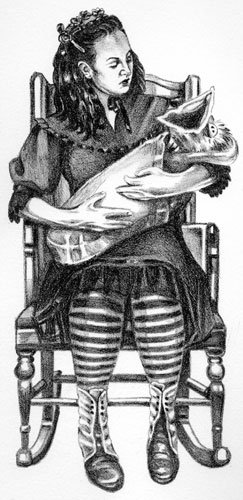
While elements of abjection are undeniable within my Dollhouse, the second terminology related to the Gothic – the term ‘grotesque’ – has played a significantly greater role in the development of my imagery for this project. The term ‘grotesque’ originated in the ancient Roman period and relates to fanciful, decorative flourishes in art and architecture. Grotesque art involves the fantastic, ugly and bizarre, and its subjects are frequently mythological creatures and other strange, physically malformed monsters. The bizarre, anthropomorphic creatures that populate Lewis Carroll’s children’s novel Alice’s Adventures in Wonderland are a primary example of ‘the grotesque’ in literature. Carroll’s novel has also proved a valuable source of inspiration for the fantastic hybrid creatures that inhabit my Disobedient Dollhouse. In fact, the only human figure that appears in my Dollhouse is a character loosely based on Carroll’s Alice. This character – ostensibly a self-portrait as I served as the model – appears twice, once as the beleaguered ‘nanny’ in the nursery, and again as the ‘cook’ in the kitchen. The ‘nanny’, gazing down with quiet stoicism at the squawking bird-infant cradled in her arms, was based upon a

Fig. #6. John Tenniel. Illustration for Lewis Carroll’s "Alice’s Adventures in Wonderland", 1865, wood engraving.

19th century illustration for Carroll’s novel by John Tenniel depicting Alice holding a bonneted baby pig (fig. #6). The monstrous brood housed inside my nursery – heads tilted up with beaks wide open, their arms thrust outwards in a gesture of relentless, constant need – represent every parent’s nightmare of unending responsibility. The parental anxiety symbolized by this scene has been tempered, however, by an element of the absurd. Much like the ridiculously grotesque image of the bonneted pig held by Alice, my bird-headed children are designed to elicit equal measures of pathos, humour and horror. My nursery most assuredly conveys parental anxiety, but it does so with tongue firmly planted in cheek.

Grotesque art revels in the absurd, championing a fantasy world of the irrational over the rigid strictures of realism. One tactic employed by Lewis Carroll to create the ‘grotesque’ in Alice was his effective play with scale, a scheme that underscored the absurdity of his Wonderland. Alice experiences a succession of physical transformations when, enticed by the label on a mysterious bottle that reads ‘DRINK ME’, she consumes its contents only to magically shrink in size:

“It was all very well to say ‘Drink me,’ but the wise little Alice was not going to do that in a hurry. ‘No, I’ll look first,’ she said, ‘and see whether it’s marked “poison” or not’… […] However, this bottle was not marked ‘poison,’ so Alice ventured to taste it, and […] she very soon finished it off. ‘What a curious feeling!’ said Alice; ‘I must be shutting up like a telescope.’ And so it was indeed: she was now only ten inches high, and her face brightened up at the thought that she was now the right size for going through the little door into that lovely garden.”

After her initial transformation, Alice consumes a cake labeled ‘EAT ME’ and shoots upwards in the opposite direction, growing large so suddenly that she becomes trapped within the house.

As the sudden alteration of a person’s size is impossible without the intervention of magic, this change in scale is both fantastic and absurd in nature. Alice’s transformation from miniature to gigantic in Carroll’s novel provides clear evidence of the absurd, even comical, possibilities of this play with scale. This does not, however, necessarily apply to an object. The miniature furniture contained within a dollhouse, for instance, does not appear absurd or grotesque due to its strict adherence to a standard scale. In fact, the adherence to scale is one of the most fundamental principles of any dollhouse. Any object within this miniature world that deviates from the standard scale appears strangely incongruous in relation to its surroundings. Susan Stewart, in her analysis of the dollhouse, quotes the author Arthur Benson from his introduction to The Book of the Queen’s Dolls’ House:

“The scale of one inch to one foot being precisely maintained throughout…thus there is nothing of the grotesque absurdity of a scene that does not resemble life and has only the interest of caricature.”

The accuracy of scale within a dollhouse creates a sense of realism. Hence, when a deviation from scale occurs, the illusion of reality is severely comprised.
Similar to Carroll, I have adopted elements of ‘the grotesque’ in my Disobedient Dollhouse by playing with the scale of objects. In fact, several deviations in scale exist.  In the kitchen, in the guise of the household cook, I attempt to wield a gigantic eggbeater that stands as tall as my miniature self (fig. #7).  The exaggerated difference in size – plus the fact that, undaunted, I continue to struggle with the giant kitchen utensil – heightens the grotesque absurdity of this scene.

Fig. #7 - Lithograph from "The Disobedient Dollhouse", Jennifer Linton, mixed media installation, 2009-10.

One creature that appears repeatedly throughout my Dollhouse is the insect. Changing the size of the insect, as well as the context in which the insect is received, is a simple gesture that invokes ‘the grotesque’. Initially, I drew these insects to actual scale from specimens found in a local museum. When placed on the walls of my Dollhouse, however, these same insects suddenly appear gigantic in relation to the miniature scale therein. This change of context – from a normal sized insect in our world to a gigantic one in the miniature world – alters the perception of these creatures from ordinary to grotesque. When these same insects are scaled up, appearing as giants that loom over the viewer within the gallery space, this encounter with the grotesque is further intensified. As the contents of the Disobedient Dollhouse emerge into the surrounding exhibition space, the viewer becomes immersed in its fantastic world – no longer a mere observer but a full participant in its alternate reality.

The repetition of the insects and change of their scale harkens back to my earlier analogy of the Russian matryoshka nesting doll – a doll within a doll, each one a slightly smaller version of the larger doll that contains it – an analogy suggestive of an almost endless replication. By playing with scale, I allude to the infinity of repeated space, an infinity that is only truly attainable in my ‘house of dreams.’

An encounter with giant insects on a gallery wall – insects made strange by the fact of their surprising scale – can be classified as an encounter with ‘the uncanny’, the third and final of the terminologies related to ‘the Gothic.’ Our present day understanding of the term ‘the uncanny’ has been largely shaped by the psychoanalytic viewpoint of Sigmund Freud’s 1919 seminal essay entitled “The Uncanny”. In his essay, Freud defines the uncanny experience as: “that class of the frightening which leads back to something long known to us, once very familiar.” To experience something as ‘foreign, and yet familiar’ may result in feelings of discomfort and alienation. In this regard, the concept of ‘the uncanny’ is closely related to Julia Kristeva’s theory of abjection – in which the human corpse can be simultaneously experienced as alien (the abject) but also felt to be strangely familiar (an individual, now deceased). Freud situated ‘the uncanny’ in the realm of the repressed: “[The uncanny] is in reality nothing new or alien, but something which is familiar and old – established in the mind and become alienated from it only through the process of repression.” According to the Freudian psychoanalytic model, the process of repression involves the rejection and subsequent suppression of troubling impulses and desires. The concept of repression closely relates to the suppressed ‘family secret’ frequently found within the Gothic narrative. Whereas the Gothic ‘family secret’ manifests in the guise of a vengeful ghost, repressed desire assumes the form of the uncanny person or object.

In his essay “The Uncanny,” Freud analyzes the etymology of ‘unheimlich,’ the German word for ‘uncanny.’ His analysis proposes a strong linkage of ‘the uncanny’ to the domestic setting of the home. The German term das Heimlich signifies that which feels homely, comfortable and familiar. The inversion of this term, das Unheimlich, negates this feeling of comfort and suggests an estrangement or feeling ‘not at home,’ literally ‘unhomely.’ Through the process of repression, the safe haven of the home becomes ‘self-haunted’ by ghosts of the unconscious, a phenomenon that transforms the otherwise comfortable and familiar setting into a place that feels inexorably strange.

In his catalogue essay for the exhibition Gothic mounted at the ICA Boston in 1997, curator Christoph Grunenberg reflects on the nature of the uncanny:

“The invasion of the private and secure sphere of the home by some unknown evil force exemplifies the conflict between interior and exterior world, between individual and society, and between the intra- and intersubjective. Ultimately, the uncanny describes the return of repressed events, memories, and fantasies – the encounter with one’s own most intimate fears…”

The “private and secure sphere” of the home becomes the site of internal conflict, where the repressed are stowed away in hidden rooms, behind locked doors, in attics, closets and cupboards. Ultimately resisting suppression, the repressed reemerge as the ‘uncanny’ and transform the home into a strange and frightening place.

The ‘uncanny’ appears throughout my Disobedient Dollhouse in the strange and otherworldly transformations. The bed – that most psychologically potent of symbols – literally boils over with desire and sprouts flowers from the elongated bedposts. Snakes emanate from the tousled bed sheet and slither across the floor, penetrating the wooden floorboards and sinking into the room beneath. These uncanny transformations hint at a secret world of sublimated desire, resistant to the forces of repression that are compelled to hide them away. Like the ‘madwoman in the attic’ of Charlotte Brontë’s Jane Eyre, they periodically escape imprisonment, only to wreck havoc in the realm of the conscious.

Enhanced by Zemanta

The Gothic House; an excerpt

The following text is an excerpt from my Master’s thesis written, in part, on the topic of the Gothic aesthetic. I felt that this chapter of the paper might be of particular interest to those that read this blog. The “Disobedient Dollhouse” project to which I make reference was the visual art component of my MFA thesis. To view images from this project, click on the Gallery page located above the header of this blog. Enjoy.

“It was an evil house from the beginning – a house that was born bad.”
— The character of Dr. John Markway from Robert Wise’s 1963 film The Haunting

I confess to being an avid fan of gothic horror films and ghost stories, a confession that may not seem overly surprising given the content of my work both past and present. The castles and aristocratic manors that I mentioned earlier as being critical to the formation of my ‘house of dreams’ arise from these sources (fig. #2). The heightened theatricality of a medieval cathedral, castle or historic manor has been incorporated into my oneiric house and translated into its endless doors and dark, secret passageways. The term ‘gothic’ that I use to specify a certain subgenre of horror fiction refers not to the tribes of ancient Germanic people from whom the name originally derived, nor is it related to the medieval art that also bears this name. Instead, the term derives from a chiefly British literary genre of the 18th and 19th centuries, originating with Horace Walpole’s 1764 novel entitled, appropriately enough, The Castle of Otranto: A Gothic Story. Gothic literature combined elements of both horror and romanticism and its themes typically involve death, ghosts, the supernatural, transgression, patriarchy and the female heroine. Much like the staged interior of a dollhouse, the Gothic novel reflected a similar tendency towards the staged and theatrical. Gilda Williams, editor of the contemporary art anthology The Gothic, described ‘Gothic’ as “a studied, adopted stance,” that is “cultured, sensual and affected”, a description that concisely captures the Gothic’s propensity for dramatic hyperbole.

Fig. #2. Film still from Robert Wise’s 1963 The Haunting.

A central motif to the Gothic narrative is the house, especially one haunted by ghosts – both literal and metaphoric – and the disturbing family secret that has been shut away in an underground crypt, a dark attic, or behind hidden doors. Beginning with Walpole’s The Castle of Otranto, the genre has maintained a continual fascination with architecture. Perched on a hilltop overlooking a grey and perpetually soggy landscape, the dilapidated old aristocratic manor provided the Gothic narrative with its characteristic atmosphere of gloom and foreboding. Not merely a setting for the narrative to unfold, the Gothic house was frequently cast as a character itself, imbued with an uncanny – and often malevolent – sentience. This notion of a sentient house that is, by virtue of some inexplicable phenomenon arising from its very construction, a conscious being, is best exemplified by Edgar Allan Poe’s The Fall of the House of Usher in which the titular house claims the lives of the family that dwell within it. In Poe’s short story, the character of Roderick Usher believes that his family home is sentient through some mysterious combination of masonry and vegetation, and that the illness which plague both he and his sister Madeline have been caused by this house. Poe’s use of adjectives such as “eye-like” to describe the windows belonging to the House of Usher bestow an anthropomorphic quality to the structure, a quality which further underscores the notion of a sentient house:

“I reined my horse to the precipitous brink of a black and lurid tarn that lay in unruffled lustre by the dwelling, and gazed down – but with a shudder even more thrilling than before – upon the remodelled and inverted images of the grey sedge, and the ghastly tree-stems, and the vacant and eye-like windows.”

In the dramatic conclusion, the moral and spiritual decay of the Usher family physically manifests in the destruction of the house itself – the building literally splits in two and sinks into the surrounding landscape.

Fig. #3. Jennifer Linton. Detail from the Disobedient Dollhouse, 2009-10, mixed media.

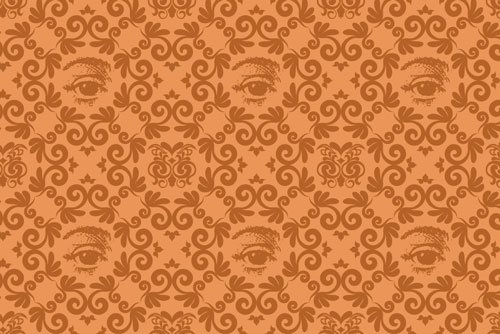
The structural features belonging to my Disobedient Dollhouse, while not as malevolent as those of the House of Usher, share some of the qualities of anthropomorphism and otherworldliness with its literary antecedent. Reminiscent of the “eye-like” windows of Poe’s creation, the windows featured on all of my exterior-facing walls are comprised of a stylized stained-glass pomegranate design that closely resembles the slit-shaped eye of a cat. These “cat’s eye” windows – all of them grouped in pairs – are most clearly evident from the brick exterior of the dollhouse, where they stare out, unblinking, at the viewer. Additionally, a repeating pattern of disembodied eyes gaze outward from the wallpaper of the kitchen (fig. #3), suggesting that the house itself bears witness to the strange events that are unfolding within. Upstairs on the wallpaper in the nursery, a legion of tiny, open mouths appear to silently scream in a gesture that mimics the endless squawking of the bird-children that inhabit this room. Much like the sentient house of Poe’s story, these anthropomorphic elements propose a house possessed of consciousness – one that not only contains supernatural events, but may also be the generator of them. The desired effect I aim to achieve is a disquieting exchange between the Dollhouse and the viewer, as the walls of the dollhouse uncannily return their gaze.

The crowning glory of any Gothic house is, of course, the attic. Similar to its close relative the cellar, the attic is a mysterious and seldom-used room where items – both material and psychological – are stowed away. The attic located within Bachelard’s oneiric house is a place of light and rationality, whereas he characterizes his cellar as the “dark entity of the house” that “partakes of subterranean forces” of the irrational, unconscious mind. In an inversion of Bachelard’s house, the attic that tops my Dollhouse is a shadowy place that offers a single window through which the dark interior may be viewed. Following the convention of most contemporary dollhouses, a cellar room is not represented in my Dollhouse, although the small cupboard door beneath the stairs – through which vine-like tentacles emerge from darkness – seem to hint at the “subterranean forces” present in Bachelard’s cellar. Peering through the attic window, the viewer encounters a snake-tentacled monster with a single, gigantic eye returning their gaze (fig. #4). This strange Cyclops is positioned slightly off-centre and is thus partially obscured by the outer wall, the bars of window frame, and the darkness within. The very purposeful positioning of this creature follows the time-tested horror film adage that “a monster you can’t see is scarier than one you can”, granting the viewer only enough information to understand that something sinister lurks within this space.

Fig. #4. Jennifer Linton. Detail from the Disobedient Dollhouse, 2009-10, mixed media.

The attic is the only enclosed room within my Dollhouse, allowing a very limited access to its interior. As such, it is the most private and mysterious of all the rooms. If I imagine myself descending from the attic onto the second story of my Dollhouse, where the nursery and the bedroom are located, the level of privacy compared to the attic decreases. While a bedroom is generally considered a very private and intimate space, the contents of my bedroom are fully on display, thus negating privacy. One of the crucial features of a dollhouse is the lack of complete enclosure of the miniature, thereby admitting access to its interior. This access facilitates play in a children’s dollhouse, and allows for display in the dollhouse designed for adults. Whereas the ground floor and second story of my Dollhouse adopt this convention of display, the enclosed attic rejects it. Whatever monsters and dark, troubling secrets hide within its shadowy corners, the attic will not reveal too readily. In this regard, the attic is the most “disobedient” of all the rooms.

The dusty and cobwebbed attic, dark and infrequently visited, provides the optimal place in which to discard the disused, unwanted, and the surplus. It can supply storage space for the cherished items of the past, no longer in use, as well as a hiding place for family secrets and other psychologically troubling material. The attic is a quintessentially ‘gothic’ space, where suppressed secrets threaten to rise up like a vengeful ghost. Given that my Disobedient Dollhouse is a Victorian-themed dollhouse, it is not difficult to imagine all of the wild, violent passions forbidden by that era’s strict social codes might be banished into the hidden corners of this room.

Concealed family secrets that slowly reveal themselves, threatening to unravel the apparent order of the household and causing a “…forced reckoning with a long buried piece of family history” is a classically Gothic trope. Like the ‘sentient house’, whose malevolence has assumed solid form within the structure of the house itself, the Gothic ‘family secret’ often physically manifests as an individual, or a ghost. In Poe’s Fall of the House of Usher, the ghost of Madeline Usher rises from the family crypt – after having been interred there whilst still alive – and claims her deadly vengeance upon her brother Roderick. In Charlotte Brontë’s novel Jane Eyre, the violently insane Bertha Mason has been imprisoned in the attic of Thornfield Hall, literally bound by chains and guarded. Described as a “beast”, a “wild animal”, a “monster”, and likened to “the foul German spectre – the vampire”, the insane first wife of Edward Rochester represents the darkest and most dangerous of family secrets.

Literary critics Sandra Gilbert and Susan Gubar, in their study of women writers entitled Madwoman in the Attic, draw a provocative parallel between the characters of Jane and Bertha in Brontë’s classic novel. They suggest that Bertha represents the “truest and darkest double” of Jane, embodying all of the wild, destructive passions that the genteel Jane consciously rejects. She can be likened to the wild, tangled vines that grow spontaneously from the chairs and bedposts in my Dollhouse, or the snakes that magically slither out from the folds of the bed sheet. Forced to dwell in the shadows of the attic for years, she reemerges into the light with an unchecked fury. The wild randomness of her actions, much like my snakes and vines, disrupt the social niceties occurring elsewhere in the house, serving as a forceful reminder that hidden secrets will inevitably “see the light of day”, and that the repressed will always return.

Enhanced by Zemanta

A Disquieting Beauty: the photography of Loretta Lux

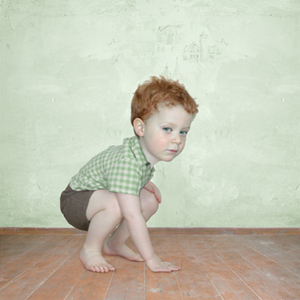
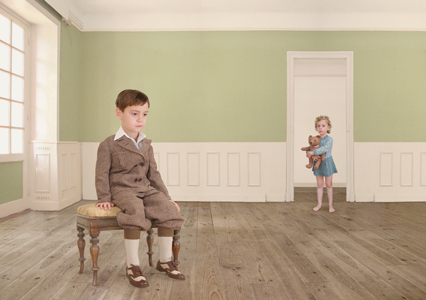
Study of a Boy 1, Loretta Lux, 2002.

It’s a given: babies and small children are cute. If ever there was a photographic image that possessed universal appeal, it is that of the child. Too young to have developed any sense of self-consciousness, they seem assured and wholly natural before the camera lens. That being said, there is no greater threat to the credibility of a fine art photographer than the use of the child as a subject. Photographs of cherubic babes are acceptable on your home mantle, but are they serious enough fodder for the lofty halls of the gallery or museum?

The meteoric rise and critical acclaim of photo-artist Loretta Lux answers my rhetorical question with a resounding “yes.” The German-born Lux combines painting with photography to create her quirky, signature portraits of children. She employs a subtle form of digital manipulation that seamlessly fuses her painted backdrops with the photographic foreground, resulting in images that appear just slightly “off” from straightforward portraiture. Her soft, diffuse light and muted colour palette give her children an otherworldly appearance, as if they were ghosts haunting long-abandoned houses. The nostalgic costumes in which her subjects are clothed serve to heighten this uncanny, ghost-like quality.

It is this tension between the beauty of the child and the strangeness of their environments that elevate Lux’s portraits above the Walmart-variety kitsch of, say, an Anne Geddes eggplant-baby, and offer up a compelling and unsentimental view of children and childhood.

The Green Room, Loretta Lux, 2005.

Der Struwwelpeter: family values with that delightfully Germanic edge.

Kids these days, they just don’t respect the rules of polite society. Those cornerstones of civilization — good manners, etiquette, and an attention to personal grooming — have fallen by the wayside in this era of “enlightened parenting”. Gone are the good ol’ days when you could terrify your kids into socially-acceptable behaviour.

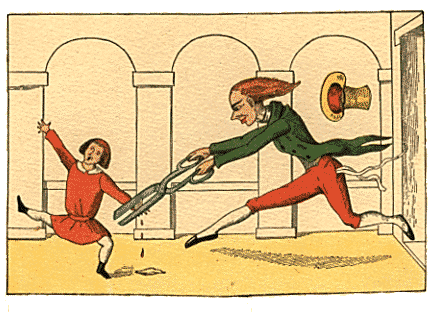
I propose that we rectify this situation. Tonight, when you tuck little Madison into her bed, rather than reach for that tired old copy of Goodnight Moon, you read her a story from Heinrich Hoffmann’s Der Struwwelpeter instead. Does little Maddie have a propensity for playing with matches? No problem. This issue is summarily addressed in The Dreadful Story of Pauline and the Matches, a cautionary tale that concludes with predictably tragic results. Does your princess continually suck her thumb? Reading her The Story of Little Suck-a-Thumb should effectively nip that bad habit in the bud.

The German children’s book Der Struwwelpeter was written by Heinrich Hoffmann in 1845 when the author couldn’t find any literature suitable to read to his young son. So popular was this book that Mark Twain created an English translation called Slovenly Peter in 1848. Amongst its many cautionary tales is the story of Kasper, a boy who chooses not to eat his soup and consequently wastes away and dies. My personal favourite is the aforementioned Suck-a-Thumb, in which a young boy refuses to heed the warnings of his mother and has his thumbs cut off by a ‘roving tailor’ with an enormous pair of scissors. (Now try sucking your thumb, kiddo).

Struwwelpeter has been republished in English by Dover this past year. Grab yourself and Maddie a copy before they disappear off bookstore shelves.

Addendum: Haunted Dollhouse Live Webcam!

Further to my previous post on haunted dollhouses, here’s a curiosity I unearthed yesterday: The Ghost Walk Dollhouse Live Cam. You can view, in real-time, the activities (or lack thereof) of the miniature inhabitants of a creepy dollhouse. Why is that mysterious group of dolls standing at the top of the stairs, you ask? Are they awaiting instructions from some sinister puppet master? And what lurks in the room at the bottom of the stairs? The answers to these questions seem elusive, but you just might find yourself staring at the 7-second refresh, nonetheless.

The Haunted Dollhouse.

Sarah Anne Johnson, “Upstairs Hallway”, 2009, Chromogenic Print from “House on Fire” series

There’s something inherently unnerving about a dollhouse. While we can easily admire and delight in its minuscule detail, this admiration is frequently accompanied by a sense of unease. This simultaneous intermingling of delight-with-unease is a manifestation of the uncanny — a sensation of anxiety experienced when one encounters “something familiar, yet foreign.” The dollhouse, with its miniaturized approximation of reality, recalls the familiar domestic setting of the home. At the same time, it falls short of appearing truly real. It’s the tension that exists within this disconnect — the miniature’s approximation of scaled-down reality with its inevitable failure — that contributes to our experience of the uncanny.

It is perhaps due to the uncanny nature of dollhouses that a curious subgenre has arisen — the haunted dollhouse. These are so popular that many web sites for dollhouse enthusiasts are now featuring “haunted dollhouse kits” for purchase. These range from kitschy, Halloween-variety spookiness to gloriously Gothic miniatures. Artists have, of course, also delved into this spooky realm. The chromogenic prints of Winnipeg-based visual artist Sarah Anne Johnson astutely edit out the campy cobwebs and, through her effective use of lighting and cropping, get straight at the mysterious elements of her miniature interiors. While it’s uncertain if Johnson would classify her dollhouse in the House on Fire series as haunted, it does strongly evoke some of the unnerving elements of the uncanny. I’m an immense fan of this series.

Sarah Anne Johnson, “Laundry Room,” 2009, Chromogenic Print, “House on Fire” series

Making art out of dead things, part II: The dioramas of Frederick Ruysch

In one of my earlier posts Making art out of dead things, I ruminated on the curious tradition of constructing art objects out of dead stuff. This ‘dead stuff’ ranged from taxidermic kittens and artfully-arranged insects to formaldehyde-preserved sharks and the bones of Italian monks. To this macabre list, I would now like to add the dioramas of the 18th-century Dutch anatomist Frederick Ruysch.

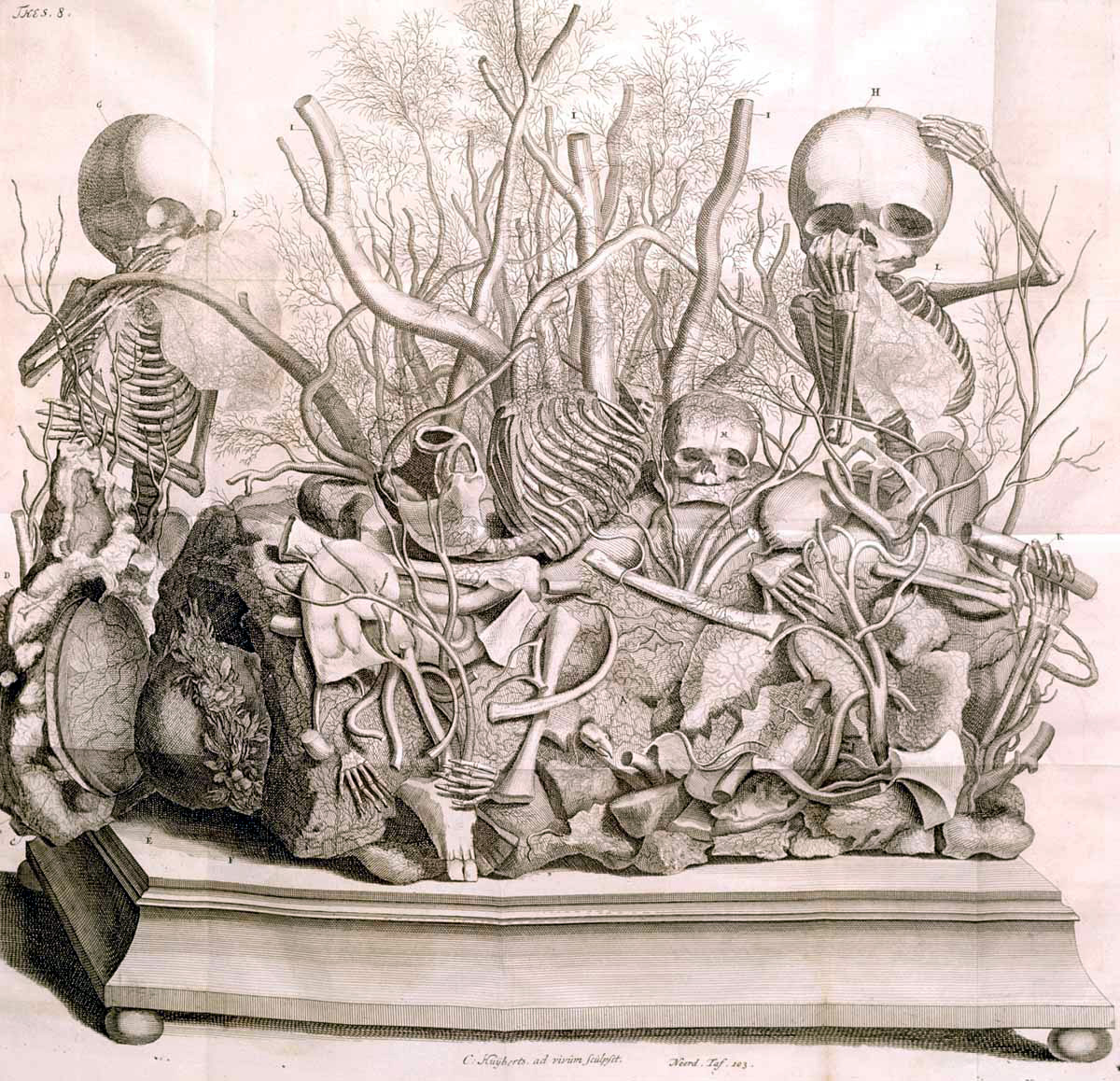
An engraving by Cornelius Huyberts of one of Frederick Ruysch's anatomical dioramas.

I first learned of Ruysch’s dioramas while conducting research for my Master’s thesis last year. One of my advisers, a professor of Anthropology at York University who shares my fascination with the unusual and bizarre, sent me a link to the Zymoglyphic Museum, a web site that contains a wealth of information on the curious intersection of art with science. According to this site, Frederick Ruysch (1638-1731) was a pioneer in preservation techniques for organs and tissue. In addition to his scientific achievements, he created a ‘museum of curosities’ that featured his anatomical dioramas of human fetal skeletons and other such bodily materials. Playing off the tradition of the memento mori, these melodramatic arrangements included skeletons weeping into ‘handkerchiefs’ made from papery-thin slices of brain tissue.

Here’s an excellent description of Ruysch’s strange assemblages from author Stephen Gould:

“Ruysch made about a dozen tableaux, constructed of human fetal skeletons with backgrounds of other body parts, on allegorical themes of death and the transiency of life…Ruysch built the ‘geological’ landscapes of these tableaux from gallstones and kidneystones, and ‘botanical’ backgrounds from injected and hardened major veins and arteries for “trees,” and more ramified tissue of lungs and smaller vessels for ‘bushes’ and ‘grass.’ The fetal skeletons, several per tableau, were ornamented with symbols of death and short life – hands may hold mayflies (which live but a day in their adult state); skulls bemoan their fate by weeping into ‘handkerchiefs’ made of elegantly injected mesentery or brain meninges; ‘snakes’ and ‘worms,’ symbols of corruption made of intestine, wind around pelvis and rib cage. Quotations and moral exhortations, emphasizing the brevity of life and the vanity of earthly riches, festooned the compositions. One fetal skeleton holding a string of pearls in its hand proclaims, ‘Why should I long for the things of this world?’ Another, playing a violin with a bow made of a dried artery, sings, ‘Ah fate, ah bitter fate.'”– Stephen Jay Gould in Finders, Keepers: Eight Collectors

To view more of Ruysch’s dioramas, as well as other curiosities, visit the Zymoglyphic Museum.

The macabre eroticism of the ‘Anatomical Angel’

Sex and Death. An alluring, if frequently controversial, coupling. The symbolically potent pairing of eroticism with the macabre has a long, well-established tradition across many different cultures. The artists of the Northern Renaissance in Europe gave us the now familiar Death and the Maiden motif with its inherently erotic subtext. In 1920-30s Japan, there was the emergence of ero guro — a literary and visual art form that combined eroticism with elements of the grotesque. The focus of this blog post, however, shall be on the curious convergence of the erotic with the grotesque/macabre in anatomical art produced during the Age of Enlightenment.

L'ange Anatomique by Jacques-Fabien Gautier d'Agoty, coloured mezzotint, 1746.

One of the best known of the 18th-century anatomical artists was Jacques Fabian Gautier D’Agoty. Renowned as a printmaker of exceptional technical skill, his image of a flayed woman entitled Anatomical Angel was viewed as highly controversial even during his lifetime. D’Agoty dubbed his image Anatomical Angel due to the flaps of skin pulled away from the cadaver’s back in a manner that suggests angel wings. Great attention has been devoted to the elegantly coiffed hair on her half-turned head. Her rosy cheek appears flush with life. D’Agoty’s aptly-titled Angel exists on a plane somewhere outside of death, rendering her an otherworldly creature.

Personally, I find D’Agoty’s Angel less erotic than she is aesthetic. One cannot, however, quickly dismiss the artist’s decision to depict a young, conventionally beautiful and, yes, sexually attractive woman. Of course, D’Agoty knew his audience: scientists and people in the medical field, all of whom would’ve been men.

Wax model with human hair and pearls in rosewood and Venetian glass case; Probably modeled by Clemente Susini (around 1790)

Let’s leave the Angel of D’Agoty and examine a comparable Italian wax anatomical sculpture entitled Anatomical Venus, dating from the last decade of the 18th-century. This exquisitely detailed sculpture, attributed to Clemente Susini, extracts the erotic elements that were merely a subtext in D’Agoty’s Angel and places them in the forefront. The languorous expression on the face of Susini’s Venus seems to evoke the petite mort of orgasm more than the morbidity of actual death. Similar to the aestheticism of D’Agoty, Susini styles his Venus with elaborately braided hair and an elegant pearl necklace. (Even in death, a girl must accessorize).

Anatomical Venus, wax model; probably modeled by Clemente Susini (around 1790)

For more views of Susini’s Anatomical Venus, as well as other examples of anatomical sculptures, visit Anatomical Theatre. Highly recommended, if predictably macabre.

My Alphabet of Anxieties & Desires: Book now available!

The twenty-six coloured pencil illustrations which comprise my Alphabet series took approximately four years to complete. Sandwiched between all that drawing was a pregnancy, (predictably followed by) childbirth, a year of full-time motherhood with two young children, and then two years of full-time graduate studies in Visual Arts. This project has been a long — very long — labour of love.

However, the long-promised book of this series is now available for purchase via Blurb.com. This is an extremely limited edition, as I’m only printing as many books as there are people who want them.

The book is 40 full-colour pages, printed on a premium matte paper with a perfect-bound softcover. There’s a short preface written by myself, and a thought-provoking foreword by Judith Mintz.

Price is $38.95 + taxes & shipping. You can order your book directly through Blurb.com. They ship internationally. If you click on the nifty widget below, you can view the first 25 pages. To view all of the illustrations from this series, visit my web site.

While this series was modeled after a child’s alphabet book, its contents are most assuredly adult in nature. Order this book for yourself, not your kid. “Nuff said.