Back in April of this year, I sat down with Elizabeth Fearon and Steve Armstrong to discuss my art practice. Here is the video of our hour long interview.
Art musings and other great profundities
Topics relating to visual art, either mine or someone else’s.
Toronto Alice update, January 2015.
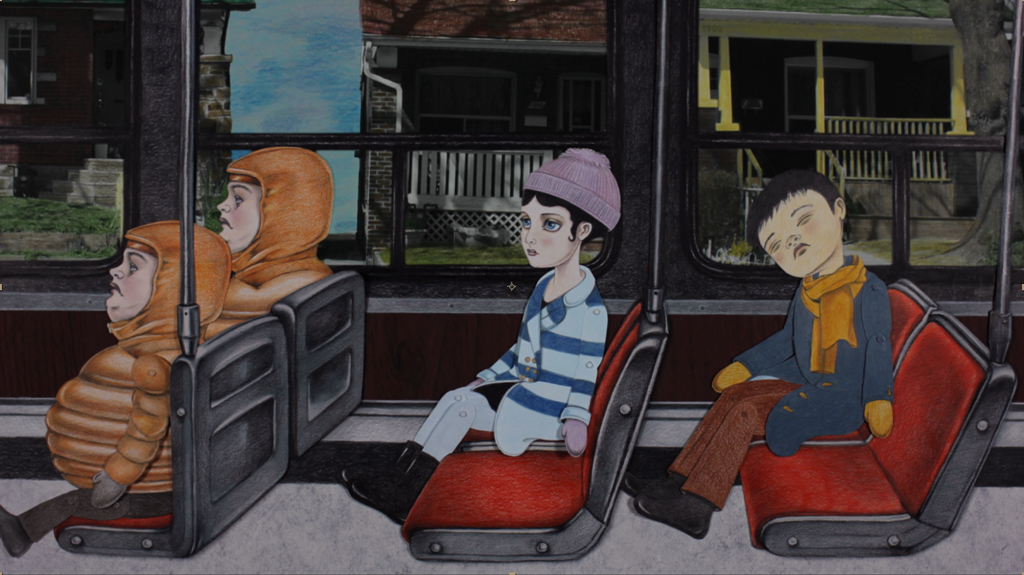
Baby, it’s cold outside. Good time of the year to hide out in one’s basement studio, making things move a little bit at a time. After a very busy Fall term at my teaching jobs, I’ve settled down a bit with a lighter course load for the Winter. This is very good news for my Toronto Alice animation project, which is now back in progress. Only 01:27 done thus far, but we’re getting there.
Lady Lazarus Blog: 2014 in review!
It was a record year at Lady Lazarus: dying is an art. I received 63,000 views, which makes 2014 my busiest year ever. Also nice to see that, according to the stats counter, the blog post that received the most visits was the one dedicated to my last animated project, Domestikia, Chapter 3: La Petite Mort. Yay!
The WordPress.com stats helper monkeys prepared a 2014 annual report for this blog.

Here’s an excerpt:
Madison Square Garden can seat 20,000 people for a concert. This blog was viewed about 63,000 times in 2014. If it were a concert at Madison Square Garden, it would take about 3 sold-out performances for that many people to see it.
Season’s Greetings from Lady Lazarus

Season’s Greetings from Lady Lazarus. And now, a photo of The Cure building a snowman, because Robert Smith. #gothsinthesnow.
Now you know your ABCs…

My illustrated alphabet book for adults, aptly titled My Alphabet of Anxieties & Desires, is available in soft cover and eBook format. Buy it for yourself or send it to someone you love (or want to) for Christmas. http://blur.by/12n9r1u.
Also available from the Apple store: https://itunes.apple.com/ca/book/id582540445
Happy Hallowe’en 2014!

Happy Hallowe’en, gentle readers! And now for something completely Gothic.
Annabel Lee
BY EDGAR ALLAN POE
It was many and many a year ago,
In a kingdom by the sea,
That a maiden there lived whom you may know
By the name of Annabel Lee;
And this maiden she lived with no other thought
Than to love and be loved by me.
I was a child and she was a child,
In this kingdom by the sea,
But we loved with a love that was more than love—
I and my Annabel Lee—
With a love that the wingèd seraphs of Heaven
Coveted her and me.
And this was the reason that, long ago,
In this kingdom by the sea,
A wind blew out of a cloud, chilling
My beautiful Annabel Lee;
So that her highborn kinsmen came
And bore her away from me,
To shut her up in a sepulchre
In this kingdom by the sea.
The angels, not half so happy in Heaven,
Went envying her and me—
Yes!—that was the reason (as all men know,
In this kingdom by the sea)
That the wind came out of the cloud by night,
Chilling and killing my Annabel Lee.
But our love it was stronger by far than the love
Of those who were older than we—
Of many far wiser than we—
And neither the angels in Heaven above
Nor the demons down under the sea
Can ever dissever my soul from the soul
Of the beautiful Annabel Lee;
For the moon never beams, without bringing me dreams
Of the beautiful Annabel Lee;
And the stars never rise, but I feel the bright eyes
Of the beautiful Annabel Lee;
And so, all the night-tide, I lie down by the side
Of my darling—my darling—my life and my bride,
In her sepulchre there by the sea—
In her tomb by the sounding sea.
Hallowe’en Night divination game.
This is a repost from OCTOBER 28, 2011.


Halloween is one of the oldest holidays still celebrated in modern times, and can be traced back to the Druids, a Celtic culture in Ireland, Britain and Northern Europe. Its roots lay in the feast of Samhain (pronounced SA-WIN), which was annually held on October 31st to honor the dead. Much like Christmas, the pagan traditions of Samhain were later co-opted by the Christian church and replaced by All Saints Day (Nov. 1) as a means to align the Christian feast with the already well-established pagan festival. According to Wikipedia, “The word Halloween is first attested in the 16th century and represents a Scottish variant of the fuller All-Hallows-Even (“evening”), that is, the night before All Hallows Day.” Hence, we have the modern day Hallowe’en.
In keeping with its pagan origins, a belief arose that during Halloween the barrier between the realms of the living and the dead are at their most permeable, allowing for dead spirits to enter our world. A corollary of this belief is the traditional Scottish practice of Halloween-night divination. Though little known these days, the practice of various forms of “divination games” during Halloween was wildly popular in the late 19th-century and early 20th-century, a popularity commemorated in the divination-themed Halloween greeting cards above. One of the most popular of these was a form of scrying or mirror divination, in which an unmarried woman was instructed to sit before a mirror in a darkened room on Halloween night. Purportedly, if she gazed long enough, she would see a vision of her future husband reflected in the mirror. If, however, she was to die unmarried, a skull would appear instead — which just seems incredibly creepy. A common thread exists between this Halloween practice and the Bloody Mary game, in which the participants dare each other to look into a mirror and repeat Mary’s name three times, thus possibly summoning the folkloric witch.
VAEFF 2014 in New York, recap.


At the beginning of October, I travelled to New York City to participate in the 2014 instalment of the Video Art & Experimental Film Festival. My short animated film Domestikia, Chapter 3: La Petite Mort screened both Thursday and Friday nights, with a filmmaker Q&A following the Friday screening. Above are a few photos from the event, and below a snippet from the festival review at the Videoart.net blog:
Over three nights in early October, as the New York fall seemed to be taking its grip on the city, filmmakers, artists and film enthusiasts huddled outside Tribeca Cinemas and engaged in animated exchanges and heated discussions – excitedly picking apart the films of this year’s Video Art and Experimental Film Festival. Now in its fourth year, the festival once again presented a challenging and arresting program of short films, showcasing the diversity of moving image work being created today.
[clip]
This process of breaking down unproductive delineations and creating a vocabulary with which to grapple with the question of what can be understood as video art was present throughout the festival, offering the entire program a palpable vigour, though it was perhaps Thursday night’s screening, playfully dubbed ‘Beauty, Sex, Shame’ which most captured the exciting landscape of video art today. Beginning with Rino Stefano Tagliafierro’s BEAUTY – an elegiac reimagining of classic paintings which delights in the effervescence of beauty, luring us in with its promises before revealing its inherent ephemerality and inevitable decay – the program examined the seductive nature of images, throwing light on the perpetually fraught relationship between sex and death. In its masterful re-appropriation of classic painting, Tagliafierro’s film set the tone for much of the program, as a common thread throughout the program was a kind of filmmaking which utilizes cinematic and art historical references with unabashed candor, repurposing familiar footage and well worn tropes to create refreshingly current work. With its knowing nods to the cinema of the French New Wave, Canada’s wonderfully tongue-in-cheek film, Crème Caramel, creates a highly stylized visual language allowing it to reference classic cinema, while simultaneously reconfiguring the often narrow view of sexuality and femininity which exists in these films. Similarly, Jennifer Linton’s Domestikia, Chapter 3: La Petite Mort – a surreal exploration of female sexuality – draws on a tradition of illustrated Japanese pornography often referred to as tentacle erotica, imbuing the film with an awareness of the inescapable darkness and perversion hiding beneath the glossy kind of beauty we are conditioned to consume.
[clip]
You can find the full review here, and more photographs from the festival here. Oh, and in case you don’t know already, I’m the dark princess dressed all in black.
The Toronto Raccoon.

Work-in-progress photo from my animation project “Toronto Alice” (ETA Spring 2015).
Any native of Toronto is well acquainted with our large and active population of urban raccoons. What many Torontonians may not know, however, is that Toronto is unique in Canada for its abundance of these intelligent — though often troublesome — critters.
Unlike cities such as Montreal, Edmonton, and Ottawa, Toronto winters are milder and we typically don’t get buried by the kind of snow that makes it hard for raccoons to forage. The city’s network of ravines also connects neighbourhoods, MacDonald says, which offers raccoons a safe place to retreat, if necessary. And unlike Vancouver (where, historically, there have been more condo buildings in the downtown), Toronto has residential neighbourhoods with leafy backyards, garages, and easy access to garbage. Urban raccoons have flourished here because of their ability to adapt to our environment, forage in our waste, and find shelter in easy-to-break-into older downtown homes.
— from http://www.chfi.com/2013/06/13/why-toronto-has-so-many-raccoons/
While indigenous to North American wooded areas, urban raccoons only exist in large populations in the cities Washington, DC, Chicago, and Toronto (see http://en.wikipedia.org/wiki/Raccoon#Urban_raccoons).
The gigantic raccoon pictured in the video still above hails from my upcoming animation project Toronto Alice. This creature is loosely based on the raccoon/s who habitually take a large crap on my back porch [grimace].
Update on “Toronto Alice” project.
Hello Gentle Readers. Hope you’re squeezing out every last bit of enjoyment from these last few weeks of summer. I’ve spent most my summer in my basement studio, working away on Toronto Alice — well, ok, I did go camping, too. I’m gearing up for the Fall semester at the schools at which I teach, so Alice will go on the back burner for a little while. ETA for completion is Spring 2015.
Thought I would share a few screen captures from the project thus far. Enjoy!


 Lady Lazarus