Lady Lazarus’s 2011 Halloween Party Movie Night: Scary Films for Kids.

OK, I admit it. It’s not even October, and I’m already planning out Halloween costumes for myself and my kids in eager anticipation of our favourite festive occasion. For the little ones, it’s all about spooky ‘make-believe’ and a prolonged sugar buzz. For the adults — those with and without children — it’s a culturally-acceptable opportunity to play masquerade and temporarily assume a different persona. And for those of us who revel in the macabre on a regular, year-round basis, it’s a chance to geek-out and make our ‘expert’ horror film recommendations for Halloween-themed movie nights.

Much like adults, children can vary widely in their tastes for, and tolerance of, scariness in films. Their reaction to such material can sometimes be unpredictable, but below I’ve listed a few spooky classics that should be age-appropriate for most children.

Scary films for kids:

1. Scooby-Doo And The… (series of DVDs, dating from the 2000’s-present). There are a number of direct-to-DVD, 90-minute movies featuring that super-sleuth canine Scooby-Doo and the Mystery Gang that even the youngest child in your family will enjoy. Some of the better spooky capers include Scooby-Doo And The Samurai Sword, Scooby-Doo and the Cyberchase, Scooby-Doo Camp Scare and Aloha Scooby-Doo! You can find most of these at your local DVD rental store or for purchase on Amazon. Recommended for age 4+

2. It’s the Great Pumpkin, Charlie Brown. A Halloween classic that’s appropriate for small kids. Recommended for age 3+

The Library Ghost (aka The Grey Lady) from "Ghostbusters" (1984). Could freak out very small kids, but a not-so-scary film for most.

3. Ghostbusters (1984). A couple of scenes might prove too frightening for very little ones, but on the whole a spooky-fun family film. Recommended for age 6+

4. Not too surprisingly, the gorgeously gothic creative efforts of Tim Burton features large on this list. Family-friendly Burton films include Beetlejuice (1988), and the animated feature-length films The Nightmare Before Christmas (1993) and The Corpse Bride (2005). I’ve shown the latter two films to my 4 and 6-year-old kids, and they reported that these were “a little too creepy” in parts. Use your own parental discretion, but I’d recommend these films for age 8+

The alternate-reality "spider Mom" from Coraline (2009).

5. Coraline (2009) has a very similar look-and-feel to the aforementioned Tim Burton animated films, and shares with these a creepiness that’s probably more appropriate for the 8+ crowd. All the same, a visually-stunning masterpiece of stop-motion animation that’s worthwhile for adults as well as children.

Quite frankly, I can’t wait until my kids are old enough to accompany their mother through a viewing of The Exorcist or a George A. Romero zombie gore-feast. Perhaps when they are around the age of 10…?

My next post will offer up suggestions for some adult-sized scares.
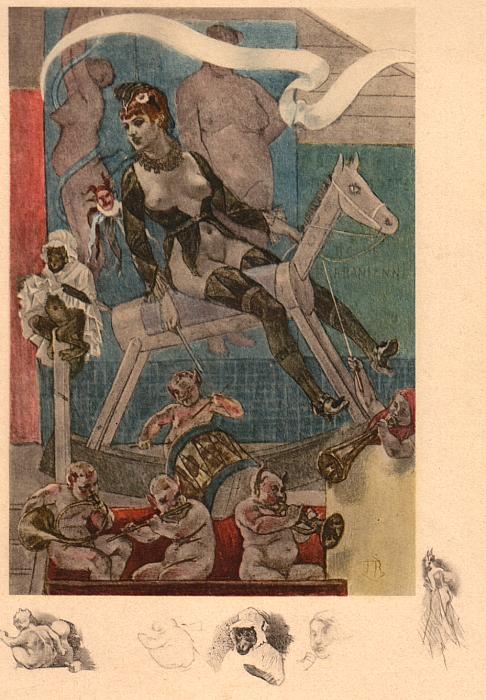
A Diabolical Decadence: Charles Baudelaire, Félicien Rops and the “Flowers of Evil.”

Come on my heart, cruel and insensible soul,
My darling tiger, beast with indolent airs;
I want to plunge for hours my trembling fingers
In your thick and heavy mane;

In your petticoats filled with your perfume
To bury my aching head,
And breathe, like a faded flower,
The sweet taste of my dead love.

I want to sleep, to sleep and not to live,
In a sleep as soft as death,
I shall cover with remorseless kisses
Your body beautifully polished as copper.

To swallow my appeased sobbing
I need only the abyss of your bed;
A powerful oblivion lives on your lips,
And all Lethe flows in your kisses.

I shall obey, as though predestined,
My destiny, that is now my delight;
Submissive martyr, innocent damned one,
My ardor inflames my torture,

And I shall suck, to drown my bitterness
The nepenthe and the good hemlock,
On the lovely tips of those jutting breasts
Which have never imprisoned love.

— Geoffrey Wagner, Selected Poems of Charles Baudelaire (NY: Grove Press, 1974). English translation of the poem Le Léthé by Charles Baudelaire from Fleurs du mal (1857).

Mysterious occult rituals, orgiastic parties and experiments with hallucinatory drugs: sounds like one of the notorious “acid test” road trips by Ken Kesey and the Merry Pranksters, right? While this does neatly summarize the wild merry-making of the Pranksters and the 1960’s hippie counterculture, what I’m describing above is instead the naughty behaviour of a much earlier group of non-conformists and bohemians: the Decadents of the late 19th-century.

Etching & aquatint by Félicien Rops (1896).

The Decadence Movement was a fin de siècle artistic and literary style of Western Europe, primarily France. Fin de siècle or “end of the century” refers to the latter two decades of the 19th-century that were characterized by boredom, cynicism, and pessimism as well as an anxiety over the change that is inevitable in the ending of a century. While the term “decadent” was originally applied as a pejorative by critics of the style, writers and artists such as Charles Baudelaire and Félicien Rops eagerly adopted this label as a further act of defiance against the restrictive social mores they perceived in contemporary European society. For the most part, the Decadents were influenced by the tradition of Gothic novels and by the poetry and fiction of Edgar Allan Poe, and were associated with (but distinct from) Symbolism. The progenitor of Decadence was Baudelaire, and his poetry collection Les Fleurs du mal (‘The Flowers of Evil’, 1857) is considered by literary historians as a seminal work of Decadent writing. Steeped in a fashionably brooding melancholia and an almost morbid eroticism, Baudelaire’s poetry was targeted by French censors for its bold lasciviousness:


The author and the publisher were prosecuted under the regime of the Second Empire as an outrage aux bonnes mœurs (trans. “an insult to public decency”). As a consequence of this prosecution, Baudelaire was fined 300 francs. Six poems from the work were suppressed and the ban on their publication was not lifted in France until 1949. These poems were “Lesbos”, “Femmes damnés (À la pâle clarté)” (or “Women Doomed (In the pale glimmer…)”), “Le Léthé” (or “Lethe”), “À celle qui est trop gaie” (or “To Her Who Is Too Gay”), “Les Bijoux” (or “The Jewels”), and ” Les “Métamorphoses du Vampire” (or “The Vampire’s Metamorphoses”). These were later published in Brussels in a small volume entitled Les Épaves (Jetsam). — from Wikipedia.

Lithograph known alternately as “Black Mass” or “Calvary”, by Félicien Rops.

The Belgian visual artist Félicien Rops met Baudelaire towards the end of the poet’s life, and this meeting had a great impact on the career of the young artist. An accomplished printmaker, Rops illustrated many literary works including Baudelaire’s Les Épaves, a selection of poems for which he created the frontispiece. Like the works of the authors whose poetry he illustrated, Rops work tends to mingle sex, death, and Satanic images. He held a lifelong fascination with the femme fatale, an image of womankind that served as a dark and sinister Muse to that generation of Decadent artists. Of his views of Woman, Félicien Rops wrote: “Therefore it is his era, the end of the 19th century, that he [the artist] expresses through his graphic work, structured mainly around the themes of love, suffering and death, with the central unifying theme of the woman, la femme fatale in the full meaning of the word. Through her he portrays his vision of his era. Woman is Satan’s accomplice, and becomes the supreme attraction which provokes the most extreme vices and torments in Man, a mere puppet.” (an English translation of a quote taken from the Museum of Félicien Rops web site.)

Counting myself amongst the legion of “Satan’s accomplices”, I can easily admire the lewd and grotesque aspects of Rops, even as he does occasionally verge on a kind of vulgar kitsch. The unabashed sexuality of Rops lends a quality of surprising modernity to the work and gives it a contemporary feel, even as it dates from well over 100 years ago.