The magical worlds of Lotte Reiniger.

A still from Lotte Reiniger's "The Adventures of Prince Achmed" (1926), credited with being the first feature-length animation film.

Before there was Walt Disney, there was Lotte Reiniger. Born in Berlin in 1899, Reiniger pioneered new forms of paper cutout animation in the 1920’s. Inspired by shadow puppetry, Reiniger developed highly articulated paper puppets to be animated through stop-motion camera work. Her elegant paper silhouettes breathed life into the fairytale The Adventures of Prince Achmed (1926), a film that bears the distinction of being the first feature-length animation. Although she initially struggled to find a distributor, once Prince Achmed premiered at the Cannes Film Festival, it then became a critical and popular success.

Back-lit paper silhouettes are so closely associated with Reiniger that schools of animation will often refer to this type of work as the “Lotte Reiniger style.”

Horror Films 101: Harry Kümel’s “Daughters of Darkness” (1971)

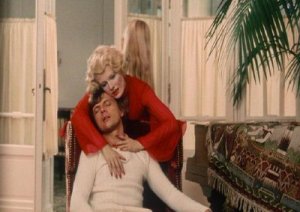
Delphine Seyrig channels Marlene Dietrich in her portrayal of the infamous Hungarian Countess Elizabeth Báthory.

If you’re a regular reader of this blog, then you are already familiar with my admiration — one might even say, obsession — for European horror films from the 1960’s and 70’s. What these films often lacked in budget, they more than made up for with stunning visuals and style. Of course, when you have a 1000+ years of art and culture sitting at your doorstep, it’s difficult not to look fabulous. Such is the case for Harry Kümel’s highly stylized erotic vampire film Daughters of Darkness (1971). From the architecture of the grand hotel on the Belgian seafront, to the shimmering sequins of Delphine Seyrig’s evening gown and the blonde waves of her 1930’s bob hairstyle, everything and everyone looks beautiful.

Author David Chute wrote an elegant summary of Daughters of Darkness for the recent Blu-Ray release of the Kümel classic which accurately captures the mood of the film:

Art-movie goddess Delphine Seyrig (Last Year at Marienbad) slinks through the plush Eurotrash settings as the deathless Elizabeth Bathory, Vampire Countess, in Harry Kümel’s minor Dutch classic of lesbian erotic-gothic. Blood mingles with water during the languorous shower scenes. Set at an upper-crust seaside resort, the 1971 film recounts Bathory’s plot to replace her current consort (Andrea Rau) with a fresher specimen, an abused newlywed whose brutal young husband is an inconvenience waiting to be eliminated. Although both the bi-sex and the neck-biting violence are tame by today’s standards, the film has a graceful, gliding sense of pace that gets under your skin; something unspeakably kinky always seems to be just about to happen. It never quite does, but the mood lingers. See it with someone you love–or would like to. –David Chute

Stefan (John Karlen) gets all hot and bothered as he and Elizabeth recount the many tortures inflicted upon the victims of the bloodthirsty Countess Báthory.

The phrase “…something unspeakably kinky always seems to be just about to happen…” instantly leapt out at me when I first read Chute’s summary, as this echoes my own experience with the film. If David Lynch had been making Eurotrash vampire films in the 1970’s, he’d probably make a film much like this one. From our first glimpse of the Countess, as she glides out from the backseat of her Bentley and up to the desk of the hotel concierge, there is an unmistakable atmosphere of kink. The camera tightly focuses on the gleaming patent leather of her high black boots as she steps from the car, an image that says fetish more than it does vampire. It is quickly apparent that the relationship between Elizabeth and her “secretary” Ilona has little to do with typing memos, and the scene in which Ilona crouches obediently at Elizabeth’s feet clearly establishes their dominant/submissive lifestyle arrangement. Of course, a bisexual female vampire with a taste for BDSM isn’t an entirely uncommon entity in the realms of horror fiction. The true wild card in Kümel’s film lies in the character of Stefan, the secretive husband prone to fits of violent rage. His rather prurient interest in sexual sadism becomes apparent when he recounts the legend of the bloodthirsty Countess Báthory, writhing with erotic pleasure as he describes the tortures inflicted upon her victims. Later in the film, he savagely beats his wife Valerie with his belt. And then there’s the whole matter of his “mother,” whom he’s mysteriously reluctant to introduce to his new bride. The scene below, where Stefan gives his ol’ Mum a call, is gloriously creepy:

My favourite moment of that scene is when the butler kneels down before Mother, and “Mother” reaches out to pet his bald head in the way one would a family dog. The butler reacts, but only mildly, before he walks away in silence. Kink abounds, but its only ever hinted at.

As the film nears its finale, the body count predictably rises. Ilona slips in the shower and falls upon a straight razor. The abusive Stefan gets his final comeuppance by way of a glass fruit bowl. Yes, fruit bowl. The Countess herself meets her end impaled on an unfortunately located tree branch as she is pitched from her crashing car. The sole survivor Valerie keeps the Báthory legend alive by donning Elizabeth’s fetching black PVC cape — complete with bat-wing trim and campy-vamp high collar — and seductively sidling up to a young couple.

The Rape-Revenge Girl, part deux.

Baise-moi, si vous plaît.
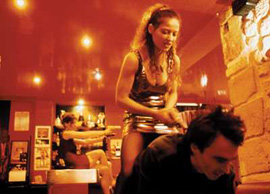
The sex-club massacre scene from "Baise-moi" (2000). In English, the film's title would be correctly translated as "Fuck me", and not "Rape me" under which it was originally released in North America.

When the French film Baise-moi was released in 2000, it garnered a great deal of media attention for its highly graphic violence and depictions of unsimulated sex. The film was banned in Ontario, initially because it was deemed too pornographic. The producers asked for it to be re-rated with a pornographic rating, only for it to be banned because there was too much violence for a pornographic film. It was finally passed with an “18A license” after — one assumes — some strategic edits being made. I caught up with the film on DVD that year, and have recently rewatched it online — you can find most of the film on Youtube, but hurry as it’s likely to be removed due to its content and copyright infringement. I came away from my recent viewing with these two impressions: firstly, that it is a far better film than I remember, and second, that I still don’t know what all the hullabaloo was about.

Here’s a quick synopsis: the main characters Nadine (Karen Bach) and Manu (Raffaëla Anderson) are women who live on the precarious fringe of a very disenfranchised lower-class in contemporary France. Nadine is a part-time prostitute involved with some very shady individuals, while the perpetually unemployed Manu spends much of her time trying to get stoned. When Manu is gang raped by a group of thugs, her brother — with whom she has a strangely complex and conflicted relationship — accuses her of “enjoying” the rape and calls her a “slut.” A physical struggle ensues, during which Manu grabs her brother’s handgun and shoots him dead. Meanwhile, Nadine has a violent scuffle with her female roommate that ends with her friend’s demise. So, a bad day for all parties involved. The women meet up at a railway station by pure coincidence, and the two decide to “go on the lamb” from the police that will soon pursue them. And thus famously begins their violent, drug-addled, pornographic and completely nihilistic crime spree.

Nadine pays homage to Travis Bickle's famous "Are you talking to me?" scene from Martin Scorsese's "Taxi Driver." No, seriously. Compare both scenes.

In my previous post on The Rape-Revenge Girl I discussed Meir Zarchi’s I Spit On Your Grave (1978) and how that film ultimately failed as a satisfying Rape-Revenge film. Where Zarchi’s film falters and, conversely, Baise-moi succeeds is in the depiction of rape. The protracted and rather gratuitous rape scenes in I Spit On Your Grave offer up much screaming, nakedness, and salacious close-ups of Jennifer Hill’s anguished face and bloodied body. While the audience understands that bloody vengeance will come before the credits roll, it’s not until after we all get a good, long look at Jennifer’s breasts. The whole deal feels exploitative. While the rape scene in Baise-moi is undeniably graphic — as it involves actual penetration — the filmmakers Virginie Despentes and Coralie Trinh Thi simultaneously reject the sadism inherent in a rape scene. Much to the dismay of one of her rapists, Manu stares ahead in a detached manner during her attack. She has recognized that although she’s powerless to prevent the assault, she can assert power through her refusal to “play” the role of the victim. The fact that her lack of response clearly annoys her rapist underscores the politics that inform the scene: that rape is about power, not sex.

Once Nadine and Manu are on the road, the film becomes a sort of X-rated buddy-flick. The sex is graphic, true, but no more so than anything you’ve seen in a standard, mainstream pornographic film. Much like films of that ilk, it’s also completely mechanical and nonerotic. The violence of the main characters is sudden, impulsive and seemingly fueled by a rage against society as a whole, which is partly the reason it all works so well. The scene of the bloody massacre that takes place within a sex club is positively operatic in its excessive violence. For no other reason, you should watch this film for that scene.

OK, I believe I’ve finished with my “female tropes in horror films” series of posts. Next up, I’ll write about the latest release from Pixar. No, not really.