Kids these days, they just don’t respect the rules of polite society. Those cornerstones of civilization — good manners, etiquette, and an attention to personal grooming — have fallen by the wayside in this era of “enlightened parenting”. Gone are the good ol’ days when you could terrify your kids into socially-acceptable behaviour.
I propose that we rectify this situation. Tonight, when you tuck little Madison into her bed, rather than reach for that tired old copy of Goodnight Moon, you read her a story from Heinrich Hoffmann’s Der Struwwelpeter instead. Does little Maddie have a propensity for playing with matches? No problem. This issue is summarily addressed in The Dreadful Story of Pauline and the Matches, a cautionary tale that concludes with predictably tragic results. Does your princess continually suck her thumb? Reading her The Story of Little Suck-a-Thumb should effectively nip that bad habit in the bud.
The German children’s book Der Struwwelpeterwas written by Heinrich Hoffmann in 1845 when the author couldn’t find any literature suitable to read to his young son. So popular was this book that Mark Twain created an English translation called Slovenly Peter in 1848. Amongst its many cautionary tales is the story of Kasper, a boy who chooses not to eat his soup and consequently wastes away and dies. My personal favourite is the aforementioned Suck-a-Thumb, in which a young boy refuses to heed the warnings of his mother and has his thumbs cut off by a ‘roving tailor’ with an enormous pair of scissors. (Now try sucking your thumb, kiddo).
Struwwelpeter has been republished in English by Dover this past year. Grab yourself and Maddie a copy before they disappear off bookstore shelves.
Further to my previous post on haunted dollhouses, here’s a curiosity I unearthed yesterday: The Ghost Walk Dollhouse Live Cam. You can view, in real-time, the activities (or lack thereof) of the miniature inhabitants of a creepy dollhouse. Why is that mysterious group of dolls standing at the top of the stairs, you ask? Are they awaiting instructions from some sinister puppet master? And what lurks in the room at the bottom of the stairs? The answers to these questions seem elusive, but you just might find yourself staring at the 7-second refresh, nonetheless.
Sarah Anne Johnson, “Upstairs Hallway”, 2009, Chromogenic Print from “House on Fire” series
There’s something inherently unnerving about a dollhouse. While we can easily admire and delight in its minuscule detail, this admiration is frequently accompanied by a sense of unease. This simultaneous intermingling of delight-with-unease is a manifestation of the uncanny — a sensation of anxiety experienced when one encounters “something familiar, yet foreign.” The dollhouse, with its miniaturized approximation of reality, recalls the familiar domestic setting of the home. At the same time, it falls short of appearing truly real. It’s the tension that exists within this disconnect — the miniature’s approximation of scaled-down reality with its inevitable failure — that contributes to our experience of the uncanny.
It is perhaps due to the uncanny nature of dollhouses that a curious subgenre has arisen — the haunted dollhouse. These are so popular that many web sites for dollhouse enthusiasts are now featuring “haunted dollhouse kits” for purchase. These range from kitschy, Halloween-variety spookiness to gloriously Gothic miniatures. Artists have, of course, also delved into this spooky realm. The chromogenic prints of Winnipeg-based visual artist Sarah Anne Johnson astutely edit out the campy cobwebs and, through her effective use of lighting and cropping, get straight at the mysterious elements of her miniature interiors. While it’s uncertain if Johnson would classify her dollhouse in the House on Fire series as haunted, it does strongly evoke some of the unnerving elements of the uncanny. I’m an immense fan of this series.
Sarah Anne Johnson, “Laundry Room,” 2009, Chromogenic Print, “House on Fire” series
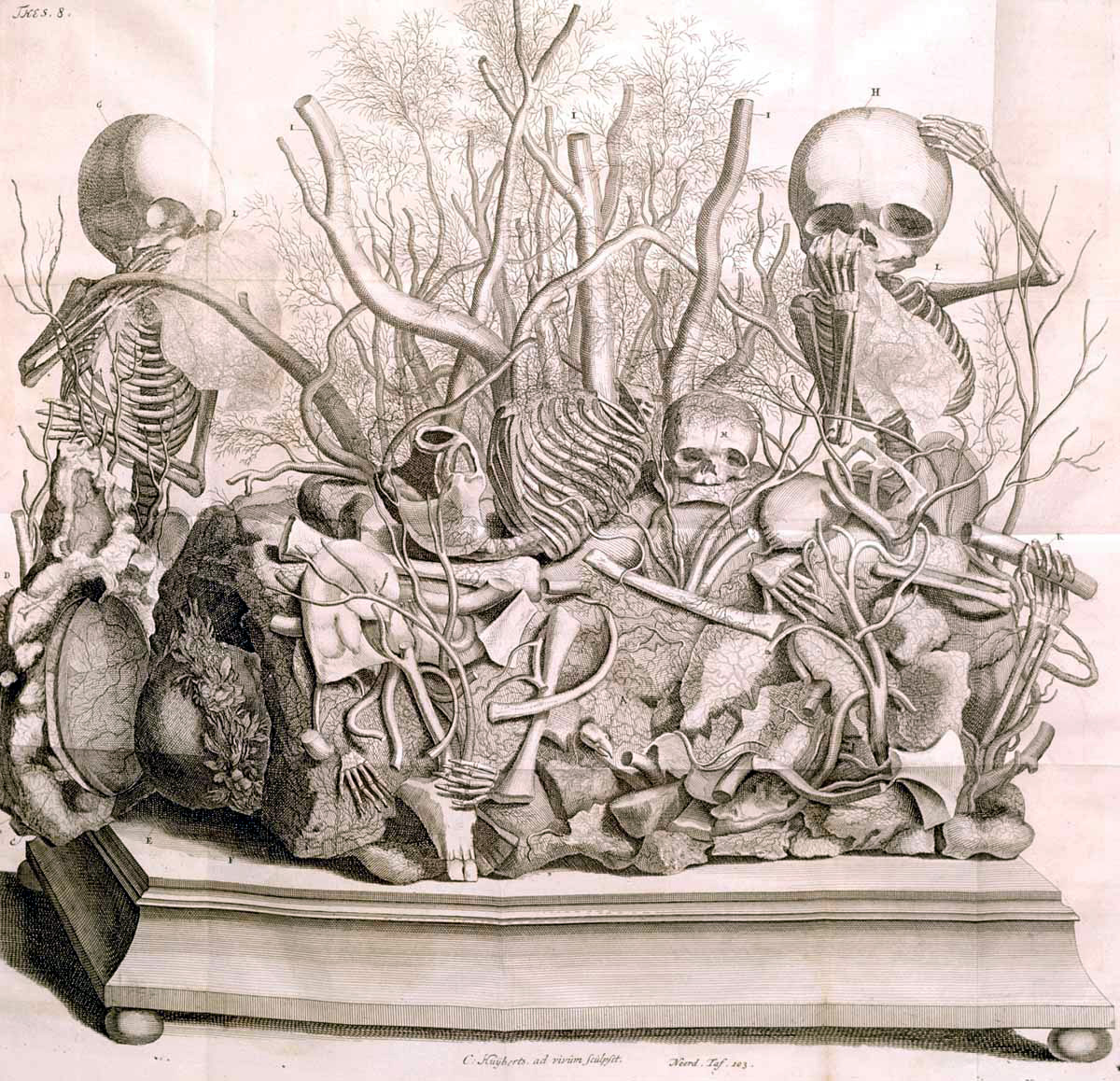
In one of my earlier posts Making art out of dead things, I ruminated on the curious tradition of constructing art objects out of dead stuff. This ‘dead stuff’ ranged from taxidermic kittens and artfully-arranged insects to formaldehyde-preserved sharks and the bones of Italian monks. To this macabre list, I would now like to add the dioramas of the 18th-century Dutch anatomist Frederick Ruysch.
An engraving by Cornelius Huyberts of one of Frederick Ruysch's anatomical dioramas.
I first learned of Ruysch’s dioramas while conducting research for my Master’s thesis last year. One of my advisers, a professor of Anthropology at York University who shares my fascination with the unusual and bizarre, sent me a link to the Zymoglyphic Museum, a web site that contains a wealth of information on the curious intersection of art with science. According to this site, Frederick Ruysch (1638-1731) was a pioneer in preservation techniques for organs and tissue. In addition to his scientific achievements, he created a ‘museum of curosities’ that featured his anatomical dioramas of human fetal skeletons and other such bodily materials. Playing off the tradition of the memento mori, these melodramatic arrangements included skeletons weeping into ‘handkerchiefs’ made from papery-thin slices of brain tissue.
Here’s an excellent description of Ruysch’s strange assemblages from author Stephen Gould:
“Ruysch made about a dozen tableaux, constructed of human fetal skeletons with backgrounds of other body parts, on allegorical themes of death and the transiency of life…Ruysch built the ‘geological’ landscapes of these tableaux from gallstones and kidneystones, and ‘botanical’ backgrounds from injected and hardened major veins and arteries for “trees,” and more ramified tissue of lungs and smaller vessels for ‘bushes’ and ‘grass.’ The fetal skeletons, several per tableau, were ornamented with symbols of death and short life – hands may hold mayflies (which live but a day in their adult state); skulls bemoan their fate by weeping into ‘handkerchiefs’ made of elegantly injected mesentery or brain meninges; ‘snakes’ and ‘worms,’ symbols of corruption made of intestine, wind around pelvis and rib cage. Quotations and moral exhortations, emphasizing the brevity of life and the vanity of earthly riches, festooned the compositions. One fetal skeleton holding a string of pearls in its hand proclaims, ‘Why should I long for the things of this world?’ Another, playing a violin with a bow made of a dried artery, sings, ‘Ah fate, ah bitter fate.'”– Stephen Jay Gould in Finders, Keepers: Eight Collectors
To view more of Ruysch’s dioramas, as well as other curiosities, visit the Zymoglyphic Museum.
Carmilla, illustration from The Dark Blue by D. H. Friston, 1872
The vampiress. The very word itself is seductive. From its first syllable vamp we arrive at the image of the aggressively sensual woman, the predatory femme fatale. Then, as if to underscore her dangerous nature, the word ends with an echoic warning: esssssss. The hiss of a snake.
She’s lurked in the shadows of our collective unconscious for just under 150 years. The legend of the female vampire, as we presently know her, began with Joseph Sheridan Le Fanu’s 1872 Gothic novella Carmilla, a story that predated Bram Stoker’s Dracula by twenty-five years. Le Fanu’s novella was influential not only on Stoker’s masterpiece, but serves to this day as the source chiefly consulted for the vampiress. Much like her male counterpart, the female vampire is a captivating creature possessed of unearthly powers and the ability to shape-shift into various forms. Almost invariably, she is lesbian or bisexual. It is this latter characteristic which makes her an especially compelling figure. Embodying the male heterosexual fantasy of the ‘femme’ lesbian, her predatory seduction of women is inevitably thwarted by the male hero wielding a pointed, and most assuredly phallic, stake.
OK, I’ll spare you my feminist/queer politics tirade. We’re all grown-ups here. Let’s leave the sexual politics aside — though it does warrant a passing mention — and check out some of my all-time favourite films featuring the female vampire.
1. Roger Vadim’s 1960 vampire film Et mourir de plaisir (translates literally to ‘And to die of pleasure’ but released under the considerably less evocative English title Blood and Roses) is perhaps one of the most stylish and artful treatments of the Carmilla story. Impressionistic and dreamlike, it’s impossibly convoluted plot and bevy of look-alike Gallic beauties make it a gorgeous mess of a film.
2. Britain’s Hammer Studios released The Vampire Lovers in 1970 during a period of increased competition in the market, prompting some film studios to add more graphic content in order to attract an audience. They found it in this softcore account of female vampirism. The cheekbones are high and the bosoms heaving in this campy classic. Ingrid Pitt stars as the sultry Marcilla and Peter Cushing cashes a paycheque in this slap-n-tickle vampire romp.
3. Let’s Scare Jessica to Death (1971) is chaste by comparison to The Vampire Lovers. The emphasis of the film rests on story and atmosphere rather than bosoms or gore. Contrary to its title, it’s not especially scary. It does, however, have one memorably creepy scene that involves the female vampire emerging out of a lake.
4. Tony Scott’s The Hunger (1983) opens with a near-perfect sequence that interweaves an eventful trip home from a Goth nightclub with Bauhaus’s Peter Murphy and a violent monkey attack in a research facility. Stylish and profoundly erotic, it’s a clever update to the mythology of the female vampire. Oh, and it features David Bowie. And Susan Sarandon’s breasts.
5. Although she’s only an ancillary character in Dracula (1979), the appearance of Mina as a vampire is an effectively creepalicious moment in this otherwise lacklustre version of the Dracula story. This scene also boasts Donald Pleasence and Laurence Olivier (??!!) in the role of Van Helsing.
Sex and Death. An alluring, if frequently controversial, coupling. The symbolically potent pairing of eroticism with the macabre has a long, well-established tradition across many different cultures. The artists of the Northern Renaissance in Europe gave us the now familiar Death and the Maiden motif with its inherently erotic subtext. In 1920-30s Japan, there was the emergence of ero guro — a literary and visual art form that combined eroticism with elements of the grotesque. The focus of this blog post, however, shall be on the curious convergence of the erotic with the grotesque/macabre in anatomical art produced during the Age of Enlightenment.
L'ange Anatomique by Jacques-Fabien Gautier d'Agoty, coloured mezzotint, 1746.
One of the best known of the 18th-century anatomical artists was Jacques Fabian Gautier D’Agoty. Renowned as a printmaker of exceptional technical skill, his image of a flayed woman entitled Anatomical Angel was viewed as highly controversial even during his lifetime. D’Agoty dubbed his image Anatomical Angel due to the flaps of skin pulled away from the cadaver’s back in a manner that suggests angel wings. Great attention has been devoted to the elegantly coiffed hair on her half-turned head. Her rosy cheek appears flush with life. D’Agoty’s aptly-titled Angel exists on a plane somewhere outside of death, rendering her an otherworldly creature.
Personally, I find D’Agoty’s Angel less erotic than she is aesthetic. One cannot, however, quickly dismiss the artist’s decision to depict a young, conventionally beautiful and, yes, sexually attractive woman. Of course, D’Agoty knew his audience: scientists and people in the medical field, all of whom would’ve been men.
Wax model with human hair and pearls in rosewood and Venetian glass case; Probably modeled by Clemente Susini (around 1790)
Let’s leave the Angel of D’Agoty and examine a comparable Italian wax anatomical sculpture entitled Anatomical Venus, dating from the last decade of the 18th-century. This exquisitely detailed sculpture, attributed to Clemente Susini, extracts the erotic elements that were merely a subtext in D’Agoty’s Angel and places them in the forefront. The languorous expression on the face of Susini’s Venus seems to evoke the petite mort of orgasm more than the morbidity of actual death. Similar to the aestheticism of D’Agoty, Susini styles his Venus with elaborately braided hair and an elegant pearl necklace. (Even in death, a girl must accessorize).
For more views of Susini’s Anatomical Venus, as well as other examples of anatomical sculptures, visit Anatomical Theatre. Highly recommended, if predictably macabre.
Yes, the focus of this blog is contemporary art of the creepy and/or uncanny variety. Primarily. It’s not a big thematic leap from creepy art to creepy cinema, and that’s where I’d like to begin this post on a much-loved subgenre of the horror film: the monster movie (a.k.a. the ‘creature feature’).
Now, for the purposes of the geekish list I shall inflict upon you shortly, I’ll reveal the parameters used for my definition of “movie monster.” First and foremost, the movie monster is not a human being. This immediately disqualifies the psychotic serial killer and, an argument can be made, it also precludes the vampire, werewolf, zombie, mummy and Frankenstein’s monster. In addition to their humanoid (or formerly human) status, the latter group are also so popular in the horror genre that each deserve their own list. Let’s leave the vampires and werewolves on their pedestals in the Horror Movie Hall of Fame and seek out the rarer of beasts.
The second criteria used to form my list is that these monsters must have made an indelible impression on me as a horror film aficionado. Mine is a purely subjective and personal list of favourite movie monsters. They are not listed in any particular order:
1. The hairy, ape-like giants from the 1966 daikaijueiga or “giant monster movie” called War of the Gargantuas. Your typical drive-in fodder, Japanese monster B-movie with bad dubbing and guys in costumes trampling tiny models of Tokyo — all the same, it left a lasting impression on me. The gentle, brown-coloured Gargantua named Sanda and his evil, people-eating brother, the green Gaira, battle it out throughout this campy flick. The memorable scene for myself was the image of a small, half-submerged boat which had, the scene prior, contained two young Japanese lovers. The boat is now empty and filled with blood. The camera slowly pans to the shore where the giant Gaira sleeps off his, um, recent meal. Here’s a hilarious review posted on YouTube that neatly summarizes this campy romp:
2. The dismembered hand that stalks Christopher Lee in the 1965 Dr. Terror’s House of Horrors. Granted, I’m already bending my “no humans” rule for this inclusion. It’s not a human as such, it’s…um, a severed appendage. An extraordinarily tenacious severed appendage, as it turns out, that’s determined to avenge the suicide of it’s former owner. Christopher Lee plays an arrogant art critic who cruelly dismisses the work of a painter. The painter gets even by humiliating the critic publicly. In a fit of violent rage, Lee chases him down with his car, crushing the painter’s hand beneath a wheel of his car. The despondent artist commits suicide, and there after his severed hand torments Lee. The image of the hand slooooowly crawling after Lee is equal parts creepy and giggle-inducing, which is a large part of this film’s appeal. Sure it’s silly, but it’s also a striking visual:
3. The titular creatures from the 1972 TV horror classic Gargoyles. Given its vintage and it’s made-for-TV production values, the make-up and special effects were surprisingly impressive. (BTW, I’m amazed just how many of these obscure horror gems have found their way into YouTube — viva la Internet!)
4. The stop-motion animated monsters of Ray Harryhausen. This renowned special effects master worked on several notable films including The 7th Voyage of Sinbad (1958), Jason and the Argonauts (1963) and Clash of the Titans (1981). While these films would be more properly categorized as science-fiction/fantasy than horror, the monsters contained therein are unrivaled in any genre. My personal favourites include Medusa from Clash of the Titans and, most especially, the Cyclops from The 7th Voyage of Sinbad.
5. And last, but certainly not least…the dreaded flying monkeys from the Wizard of Oz. Merciful God in heaven…the horror…the horror…
OK, that’s it for now. Night-night, kiddies. Sleep tight.
 Kids these days, they just don’t respect the rules of polite society. Those cornerstones of civilization — good manners, etiquette, and an attention to personal grooming — have fallen by the wayside in this era of “enlightened parenting”. Gone are the good ol’ days when you could terrify your kids into socially-acceptable behaviour.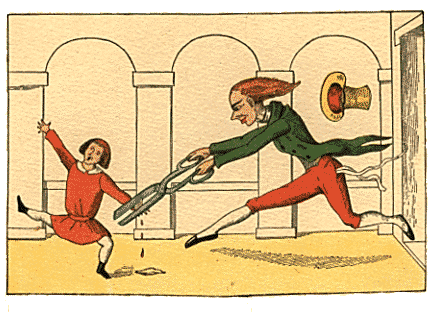




 Lady Lazarus