REPOST: Nothing says “Merry Christmas” like a creepy Canadian slasher flick.

A repost of last year’s blog entry on Bob Clark’s Black Christmas, with an added paragraph and one or two spoilers.

An often overlooked classic, the 1974 Canadian film Black Christmas now enjoys a cult status amongst horror fans and critical acknowledgment as being the progenitor of  the “slasher” genre that dominated horror cinema in the late ’70s and throughout the 1980s. Directed by Bob Clark — best known for his raunchy teen sex comedy Porky’s (1982) — the film boasts an enviably list of talented Canadian actors: Margot Kidder, Keir Dullea, John Saxon and comedienne Andrea Martin. The film stars Olivia Hussey, a British actress who’s most frequently recognized for her role as “Juliet” in Franco Zeffirelli’s 1968 film adaptation of Shakespeare’s Romeo & Juliet. In Black Christmas, Hussey leaves the Elizabethan poetry behind and gets her “scream queen” on.

Getting all wrapped up for the holidays in Bob Clark's 1974 cult slasher film "Black Christmas." Apologies in advance for the bad pun.

Getting all wrapped up for the holidays in Bob Clark's 1974 cult slasher film "Black Christmas."

It’s important to note that Black Christmas predates the better known slasher films like John Carpenter’s Halloween (1978) and Sean S. Cunningham’s Friday the 13th (1980), and they owe a great debt to Clark’s film. The quote below from Wikipedia concisely captures this film’s cult status:

The film gained a fairly decent cult following over the years of its release, and has been praised by fans of the slasher film genre internationally. The Black Christmas fan site has considerably increased the film’s popularity over the years. The film ranked #87 on Bravo’s 100 Scariest Movie Moments for Lynne Griffin’s infamous plastic sheeting scene. During an interview regarding the film, Olivia Hussey met Steve Martin at an industry event and he brought up the fact that she starred in one of his favorite movies of all time. Hussey thought he might have referred to her work in Romeo & Juliet, but was surprised to hear from Martin that it was Black Christmas, which he claimed to have seen 25 times.

What Black Christmas possessed — and what later films in the slasher genre often lacked — was the element of suspense. Rather than rely on the crude shock tactics of gore, Clark torques up the tension by placing the insane homicidal intruder inside the sorority house right at the opening of the film — and then keeps him there, undiscovered by the house’s other occupants. Only the audience is aware that the killer, and a couple of his victims, are stowed away in the attic. The fact that the events in the film happen over Christmas provides the killer (and Clark) the opportunity to surreptitiously dispatch a number of sorority sisters on an ordinarily bustling — but now slowly emptying — college campus as it shuts down over the holidays.

Below is a wonderfully creepy clip, featuring an uncomfortably prolonged obscene phone call from the psycho-killer. There is a prodigious use of the word “c*nt” in the following sequence, so consider yourself warned. Oh, and Merry Christmas.

Cannibals, werewolves and tentacles: The web searches that bring you here.

Blog statistics are a fascinating gateway into the collective unconscious. While the identities of those who’ve visited my blog remain anonymous, their mouse clicks remain on record and provide an insight into the topics that interest them most. What occupies people’s thoughts during those moments of procrastination when they are not writing that report for their boss or essay for that class? Cannibals, apparently. More specifically, Ruggero Deodato’s 1980 horror film Cannibal Holocaust, a film that’s still considered controversial after 32 years and, likely due to its continued notoriety, received the most “hits” on my blog. If they’re not seeking information on cannibal films, people are looking into the Canadian teenage werewolves of Ginger Snaps which, as far as I’m concerned, is a much better use of their time.

Periodically, I will write about topics other than horror films, though these topics are as equally strange and macabre. Heinrich Hoffmann’s darkly comedic children’s book Der Struwwelpeter (1845) has garnered a great deal of interest on my blog, as well as the eroticized anatomical art of Jacques D’Agoty and anatomists of the 18th-century. The mythological vagina dentata and Japanese ‘tentacle erotica’ draw a fair amount of interest, as one might expect.

Celebrities and famous artists predictably top my statistics tally. People have searched on marquee names from art history including Marcel Duchamp, Max Ernst, Odilon Redon, and Hannah Wilke (though the latter is lesser known), as well as contemporary visual artists Loretta Lux, Marcel Dzama and Shary Boyle. And, 45 years after her death, Jayne Mansfield still attracts a large amount of attention. I only wrote about her in a post last week, and she’s #22 on the list of “all-time” top searches. Of course, her story is a ‘perfect storm’ for achieving immortality on the Internet: a beautiful, buxom starlet, who reportedly dabbled in Satanism, died young and in most grisly manner (depending on which account you read, she was either scalped or decapitated in a car accident). We are, as a species, a ghoulish bunch.

Here’s the top 30 searches, according to WordPress:

cannibal holocaust 577
ginger snaps 287
holocaust 279
struwwelpeter 253
loretta lux 247
odilon redon 246
max ernst 246
vagina dentata 184
daguerreotype 123
tentacle erotica 109
cannibal 97
jennifer linton alphabet series 94
walerian borowczyk 91
max ernst collage 84
der struwwelpeter 78
hannah wilke 70
contes immoraux 67
drag me to hell 56
agoty angel 49
anatomical art 46
jayne mansfield 45
marcel dzama 43
the descent 40
macabre art 37
drag me to hell old lady 37
best animated movies of all time………… 33
holocaust pictures 33
redon 33
irreversible 28

Now, get back to work…

p.s. One of the funniest web searches I’ve seen to date would be this one: “horror movie with a women who seducing and kill men with her vagina.” Hey, who am I to judge? Incidentally, there is such a film — not surprisingly, it’s Japanese and called Killer Pussy. You’re welcome.

Mother’s Day REPOST: “Your mother ate my dog!”

“Definition of  Freudian slip: when you say one thing, but meant your mother.” –an old joke, as immortalized in Urban Dictionary.

Ever since the days of Sigmund Freud, mothers have endured the brunt of blame for the neuroses of their offspring. The psychologically-complex relationship between mother and child served as the dramatic foil against which the existential angst of Shakespeare’s melancholic Hamlet played out, not to mention innumerable tales of dysfunctional families in horror fiction. There are countless examples of horror movie villains, like Jason Voorhees from the Friday the 13th series, who have a rather intense and, um, complicated relationship with their mother. In these films, the character of the mother is the creator — both literally and metaphorically — of the monster. Let’s honour Mother’s Day by paying homage to the most memorable mothers in cinematic horror.

Margaret White (Piper Laurie) presses her traumatized daughter against her “dirty pillows” in De Palma’s “Carrie.”

1. The abusive Margaret White (Piper Laurie) from Brian De Palma’s Carrie (1976) torments her teenage daughter with her ferocious piety. Unfortunately for Mrs. White, her daughter happens to possess telekinetic powers and a strong desire to attend her high school prom. When the latter proves disastrous, and Carrie finds herself soaked in pigs blood, things go from bad to worse. Convinced that she is “possessed by Satan,” Margaret stabs her daughter in the back before being summarily dispatched by a shower of kitchen knives flung at her by Carrie’s telekinesis. The knives pin Mrs. White against the kitchen door frame in the highly appropriate cruciform stance, offering horror fans one of the most memorable and satisfying death scenes in the genre.

Vera “Mum” Cosgrove gets bitten by the nasty Sumatran Rat-Monkey in Peter Jackson’s “Braindead”.

2. Long before he ventured into the realm of Orcs and Hobbits, New Zealand director Peter Jackson was much beloved in the horror genre for his “splatter” films. His infamous 1992 horror-comedy Braindead (released in North America as Dead Alive) still holds the title for being one of the bloodiest, goriest zombies films to date. Even highly adept and accomplished splatter-gore directors like Takashi Miike don’t quite attain Jackson’s zany, hilarious, and way over-the-top levels of gore. As if in counterbalance to the excessive gore, Jackson’s Braindead offers an equally excessive character in Vera Cosgrove. She epitomizes the thoroughly controlling, ball-busting mother who simply cannot allow potential happiness to enter the life of her beleaguered son. Once “Mum” is bitten by the Sumatran Rat-Monkey and infected with the virus that transforms her into a zombie, Jackson revels in the sadistic pleasure of having various parts of her matronly body impaled, injected, dismembered, consumed, and otherwise compromised. Packed with many memorable quotes, including “I kick ass for The Lord!” and, one of my favourites, “Your mother ate my dog!”, Braindead is a gloriously gory, campy romp. Just don’t watch it soon after eating.

Nola (Samantha Eggers) gives her newborn a clean — with her tongue — in Cronenberg’s “The Brood.”

3. Procreation doesn’t get more bestial than in David Cronenberg’s 1979 Canadian horror classic The Brood. Samantha Eggars (best known for her role as TV-mom to Sarah Michelle Gellar in Buffy the Vampire Slayer) plays Nola Carveth, a mentally-ill patient who opts for an experimental, and highly controversial, psychotherapy treatment. This unorthodox  “psychoplasmics” treatment causes the patient’s mental illness to manifest physically on their bodies — in the case of Nola, she parthenogenetically births strange, mutated children. This film has all the themes that typify a Cronenberg film: abjection, body horror, bizarre sexuality, and an anxiety/horror over female biology and reproduction. A degree of sympathy exists for Nola, as she’s evidently the victim of childhood abuse perpetrated by her cruel and self-centred mother, although this sympathy soon diminishes once it is revealed that Nola is, herself, abusing her daughter Candice. The ‘birthing’ scene, where Nola licks her offspring clean in the manner of a mother cat, is classic Cronenberg.

Deviance, gender and the ‘aberrant female’ in horror, part I.

The Final Girl and The Slut.

Unrequited lesbian love gone terribly, terribly wrong in Alexandre Aja’s “Haute Tension” (2003).

Recently, I settled down to watch Alexandre Aja’s Haute Tension (2003), a masterpiece of ‘New French Extremity‘ which had eluded me until now. Like many films of its pedigree, Haute Tension features sadistic sexuality, extreme violence, and generous amounts of gore. Without spoiling the end — as the real strength of this film lies near the end — there was also a clever plot twist that plays with gender and the roles typically associated with female characters in the genre. Women are still traditionally cast as victims in horror, and most particularly in the ‘slasher’ or serial-killer subgenre, so it is considered subversive when they are portrayed as the perpetrators of violence. In fact, it is so outside of the ‘norm’ that an additional reason is frequently given for the violent woman’s aberrant behaviour. In the 1978 ‘exploitation’ film I Spit On Your Grave, the motivation behind the female lead’s murderous rampage is revenge for her brutal gang rape. The homicidal intruder in À l’intérieur (2007) has been driven insane by her obsessive desire for a child. In Haute Tension, unrequited lesbian love factors into the killer’s actions. These various reasons — trauma, mental instability, and homosexuality — firmly place the behaviour of these women outside of ‘normal’ and in the realm of the deviant.

The depiction of deviance, women & gender in horror cinema is a big, big topic indeed — one that warrants more than one blog post. Let’s start by looking at two of the most common tropes in the horror genre:

Sigourney Weaver as Ripley in the Ridley Scott sci-fi/horror classic “Alien” (1979).

1. The ‘Final Girl’ or ‘The Virgin.’ She’s that pretty, but not too sexy, girl-next-door who just might have a boyfriend, but he’s never gotten passed First Base. In the formulaic ‘slasher’ film — a subgenre of horror that dominated the late 70’s and the decade of the 1980’s — she’s the only girl left standing at the finale. The slasher film is a modern-day cautionary tale, and the Final Girl is spared the violent deaths visited upon her sexier classmates by reason of her virtue. She is frequently characterized as tom-boyish, even androgynous. Ripley (Sigourney Weaver) from the Alien series is a prime example of the masculinized Final Girl. Recent horror cinema has reconfigured and, at times, even subverted the Final Girl: an argument can be made that Marie in Aja’s Haute Tension is a subversion of this trope (her very short boyish hair, her extreme athleticism, apparent heroism, and her sexual orientation).

Margot Kidder plays Barb, the drinking, smoking, sexually active Slut in Bob Clark’s “Black Christmas” (1974).

2. The Slut. She’s the counterpoint to the Final Girl, the girl in the film who engages in all sorts of nasty vice and most likely has a nasty attitude to match. According to the morality play/slasher film, she’s destined to meet a grisly end, probably twitching at the end of a pitchfork. A big, rigid pitchfork. The chain-smoking Barb (Margot Kidder) from Bob Clark’s genre-defining Black Christmas (1974) fits this role perfectly. While her lifestyle has her marked for an untimely death, she’s also the sororiety sister with the most moxy. (You can read more about Black Christmas in my earlier post on the film.)

Next post –>

“Your mother ate my dog!”: Lady Lazarus’s favourite ‘Mommies of Horror’.

“Definition of  Freudian slip: when you say one thing, but meant your mother.” –an old joke, as immortalized in Urban Dictionary.

Ever since the days of Sigmund Freud, mothers have endured the brunt of blame for the neuroses of their offspring. The psychologically-complex relationship between mother and child served as the dramatic foil against which the existential angst of Shakespeare’s melancholic Hamlet played out, not to mention innumerable tales of dysfunctional families in horror fiction. There are countless examples of horror movie villains, like Jason Voorhees from the Friday the 13th series, who have a rather intense and, um, complicated relationship with their mother. In these films, the character of the mother is the creator — both literally and metaphorically — of the monster. Even though Mother’s Day is still several months away, let’s pay homage to the most memorable mothers in cinematic horror.

Margaret White (Piper Laurie) presses her traumatized daughter against her "dirty pillows" in De Palma's "Carrie."

1. The abusive Margaret White (Piper Laurie) from Brian De Palma’s Carrie (1976) torments her teenage daughter with her ferocious piety. Unfortunately for Mrs. White, her daughter happens to possess telekinetic powers and a strong desire to attend her high school prom. When the latter proves disastrous, and Carrie finds herself soaked in pigs blood, things go from bad to worse. Convinced that she is “possessed by Satan,” Margaret stabs her daughter in the back before being summarily dispatched by a shower of kitchen knives flung at her by Carrie’s telekinesis. The knives pin Mrs. White against the kitchen door frame in the highly appropriate cruciform stance, offering horror fans one of the most memorable and satisfying death scenes in the genre.

Vera "Mum" Cosgrove gets bitten by the nasty Sumatran Rat-Monkey in Peter Jackson's "Dead/Alive".

2. Long before he ventured into the realm of Orcs and Hobbits, New Zealand director Peter Jackson was much beloved in the horror genre for his “splatter” films. His infamous 1992 horror-comedy Braindead (released in North America as Dead Alive) still holds the title for being one of the bloodiest, goriest zombies films to date. Even highly adept and accomplished splatter-gore directors like Takashi Miike don’t quite attain Jackson’s zany, hilarious, and way over-the-top levels of gore. As if in counterbalance to the excessive gore, Jackson’s Braindead offers an equally excessive character in Vera Cosgrove. She epitomizes the thoroughly controlling, ball-busting mother who simply cannot allow potential happiness to enter the life of her beleaguered son. Once “Mum” is bitten by the Sumatran Rat-Monkey and infected with the virus that transforms her into a zombie, Jackson revels in the sadistic pleasure of having various parts of her matronly body impaled, injected, dismembered, consumed, and otherwise compromised. Packed with many memorable quotes, including “I kick ass for God!” and, one of my favourites, “Your mother ate my dog!”, Braindead is a gloriously gory, campy romp. Just don’t watch it soon after eating.
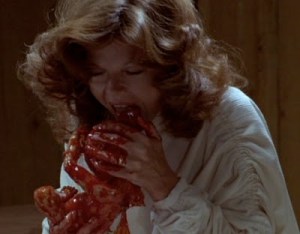
Nola (Samantha Eggers) gives her newborn a clean -- with her tongue -- in Cronenberg's "The Brood."

3. Procreation doesn’t get more bestial than in David Cronenberg’s 1979 Canadian horror classic The Brood. Samantha Eggars (best known for her role as TV-mom to Sarah Michelle Gellar in Buffy the Vampire Slayer) plays Nola Carveth, a mentally-ill patient who opts for an experimental, and highly controversial, psychotherapy treatment. This unorthodox  “psychoplasmics” treatment causes the patient’s mental illness to manifest physically on their bodies — in the case of Nola, she parthenogenetically births strange, mutated children. This film has all the themes that typify a Cronenberg film: abjection, body horror, bizarre sexuality, and an anxiety/horror over female biology and reproduction. A degree of sympathy exists for Nola, as she’s evidently the victim of childhood abuse perpetrated by her cruel and self-centred mother, although this sympathy soon diminishes once it is revealed that Nola is, herself, abusing her daughter Candice. The ‘birthing’ scene, where Nola licks her offspring clean in the manner of a mother cat, is classic Cronenberg.

Horror Films 101: Nothing says “Merry Christmas” like a creepy Canadian slasher flick.

An often overlooked classic, the 1974 Canadian film Black Christmas now enjoys a cult status amongst horror fans and critical acknowledgment as being the progenitor of  the “slasher” genre that dominated horror cinema in the late ’70s and throughout the 1980s. Directed by Bob Clark — best known for his raunchy teen sex comedy Porky’s (1982) — the film boasts an enviable list of talented Canadian actors: Margot Kidder, Keir Dullea (yes, that’s “Dave” from Stanley Kubrick’s 2001: A Space Odyssey), John Saxon and comedienne Andrea Martin. The film stars Olivia Hussey, a British actress who’s most frequently recognized for her role as “Juliet” in Franco Zeffirelli’s 1968 film adaptation of Shakespeare’s Romeo & Juliet. In Black Christmas, Hussey leaves the Elizabethan poetry behind and gets her “scream queen” on.

Lynne Griffin gets all wrapped up for the holidays in Bob Clark’s 1974 cult slasher film “Black Christmas.” Apologies in advance for the bad pun.

It’s important to note that Black Christmas predates the better known slasher films like John Carpenter’s Halloween (1978) and Sean S. Cunningham’s Friday the 13th (1980). Although the latter are arguably better films, they owe a great debt to Clark’s film. The quote below from Wikipedia concisely captures this film’s current cult status:

The film gained a fairly decent cult following over the years of its release, and has been praised by fans of the slasher film genre internationally. The Black Christmas fan site has considerably increased the film’s popularity over the years. The film ranked #87 on Bravo’s 100 Scariest Movie Moments for Lynne Griffin’s infamous plastic sheeting scene. During an interview regarding the film, Olivia Hussey met Steve Martin at an industry event and he brought up the fact that she starred in one of his favorite movies of all time. Hussey thought he might have referred to her work in Romeo & Juliet, but was surprised to hear from Martin that it was Black Christmas, which he claimed to have seen 25 times.

Below is a wonderfully creepy clip, featuring an uncomfortably prolonged obscene phone call from the psycho-killer. There is a prodigious use of the word “c*nt” in the following sequence, so consider yourself warned. Oh, and Merry Christmas.

Enhanced by Zemanta