A Diabolical Decadence: Charles Baudelaire, Félicien Rops and the “Flowers of Evil.”

Come on my heart, cruel and insensible soul,
My darling tiger, beast with indolent airs;
I want to plunge for hours my trembling fingers
In your thick and heavy mane;

In your petticoats filled with your perfume
To bury my aching head,
And breathe, like a faded flower,
The sweet taste of my dead love.

I want to sleep, to sleep and not to live,
In a sleep as soft as death,
I shall cover with remorseless kisses
Your body beautifully polished as copper.

To swallow my appeased sobbing
I need only the abyss of your bed;
A powerful oblivion lives on your lips,
And all Lethe flows in your kisses.

I shall obey, as though predestined,
My destiny, that is now my delight;
Submissive martyr, innocent damned one,
My ardor inflames my torture,

And I shall suck, to drown my bitterness
The nepenthe and the good hemlock,
On the lovely tips of those jutting breasts
Which have never imprisoned love.

— Geoffrey Wagner, Selected Poems of Charles Baudelaire (NY: Grove Press, 1974). English translation of the poem Le Léthé by Charles Baudelaire from Fleurs du mal (1857).

Mysterious occult rituals, orgiastic parties and experiments with hallucinatory drugs: sounds like one of the notorious “acid test” road trips by Ken Kesey and the Merry Pranksters, right? While this does neatly summarize the wild merry-making of the Pranksters and the 1960’s hippie counterculture, what I’m describing above is instead the naughty behaviour of a much earlier group of non-conformists and bohemians: the Decadents of the late 19th-century.

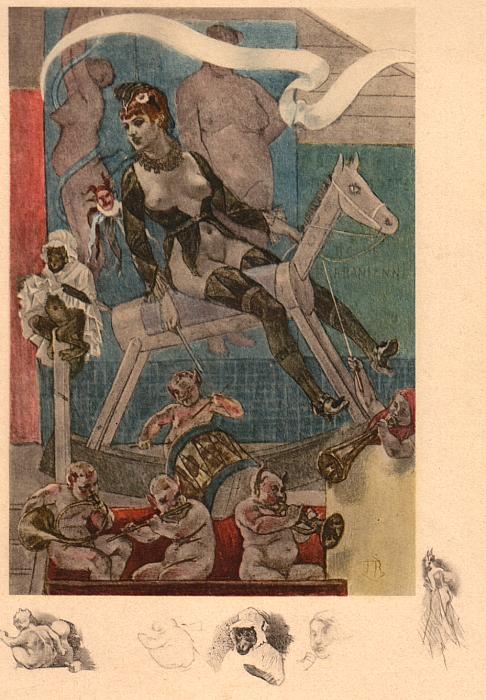
Etching & aquatint by Félicien Rops (1896).

The Decadence Movement was a fin de siècle artistic and literary style of Western Europe, primarily France. Fin de siècle or “end of the century” refers to the latter two decades of the 19th-century that were characterized by boredom, cynicism, and pessimism as well as an anxiety over the change that is inevitable in the ending of a century. While the term “decadent” was originally applied as a pejorative by critics of the style, writers and artists such as Charles Baudelaire and Félicien Rops eagerly adopted this label as a further act of defiance against the restrictive social mores they perceived in contemporary European society. For the most part, the Decadents were influenced by the tradition of Gothic novels and by the poetry and fiction of Edgar Allan Poe, and were associated with (but distinct from) Symbolism. The progenitor of Decadence was Baudelaire, and his poetry collection Les Fleurs du mal (‘The Flowers of Evil’, 1857) is considered by literary historians as a seminal work of Decadent writing. Steeped in a fashionably brooding melancholia and an almost morbid eroticism, Baudelaire’s poetry was targeted by French censors for its bold lasciviousness:


The author and the publisher were prosecuted under the regime of the Second Empire as an outrage aux bonnes mœurs (trans. “an insult to public decency”). As a consequence of this prosecution, Baudelaire was fined 300 francs. Six poems from the work were suppressed and the ban on their publication was not lifted in France until 1949. These poems were “Lesbos”, “Femmes damnés (À la pâle clarté)” (or “Women Doomed (In the pale glimmer…)”), “Le Léthé” (or “Lethe”), “À celle qui est trop gaie” (or “To Her Who Is Too Gay”), “Les Bijoux” (or “The Jewels”), and ” Les “Métamorphoses du Vampire” (or “The Vampire’s Metamorphoses”). These were later published in Brussels in a small volume entitled Les Épaves (Jetsam). — from Wikipedia.

Lithograph known alternately as “Black Mass” or “Calvary”, by Félicien Rops.

The Belgian visual artist Félicien Rops met Baudelaire towards the end of the poet’s life, and this meeting had a great impact on the career of the young artist. An accomplished printmaker, Rops illustrated many literary works including Baudelaire’s Les Épaves, a selection of poems for which he created the frontispiece. Like the works of the authors whose poetry he illustrated, Rops work tends to mingle sex, death, and Satanic images. He held a lifelong fascination with the femme fatale, an image of womankind that served as a dark and sinister Muse to that generation of Decadent artists. Of his views of Woman, Félicien Rops wrote: “Therefore it is his era, the end of the 19th century, that he [the artist] expresses through his graphic work, structured mainly around the themes of love, suffering and death, with the central unifying theme of the woman, la femme fatale in the full meaning of the word. Through her he portrays his vision of his era. Woman is Satan’s accomplice, and becomes the supreme attraction which provokes the most extreme vices and torments in Man, a mere puppet.” (an English translation of a quote taken from the Museum of Félicien Rops web site.)

Counting myself amongst the legion of “Satan’s accomplices”, I can easily admire the lewd and grotesque aspects of Rops, even as he does occasionally verge on a kind of vulgar kitsch. The unabashed sexuality of Rops lends a quality of surprising modernity to the work and gives it a contemporary feel, even as it dates from well over 100 years ago.

Goth like me; or, why does little Jenny mope in her bedroom all day, wearing black and writing bad poetry?

I have a theory that some people are simply born to be Goth. Long before I knew of such a subculture, I was, by virtue of natural inclination, compelled to seek out the dark, the morbid, and the theatrical. These are the mainstays of ‘the Gothic’, a darkly romantic movement within art, music, fiction and fashion.

My gateway music into all things Goth was The Cure’s 1989 album Disintegration, back in my undergraduate art school days — which is, as far as anyone is concerned, precisely the right place to discover the angst-ridden wails of Robert Smith. Similar bands, such as Bauhaus, Joy Division, and the Sisters of Mercy, soon followed. While I was not then– nor am presently — a daily devotee to dressing exclusively in the Goth style, I have held a continued fascination in all things related to the Goth subculture ever since those early, fateful days of art school.

Fashion is critical for the Goth, with adherence to a particular mode of dress strict, to the point of orthodoxy. There is, as it turns out, not one type of Goth, but several. These include the Classic Goth, the Romantigoth, the Cybergoth, Fetish Goth, Vampire Goth, Glitter (or Perky) Goth, Victorian Goth, Steampunk, Gothabilly, Gothic Lolita, and…well, the list is long, indeed. Below is a brief description of some of my personal favourite modes of Goth dress.

Classic (or Traditional) Goth

Siouxsie Sioux, lead singer of the seminal ’80’s Goth band Siouxsie & the Banshees, and the figurehead for the first generation of Goths.

The Goth subculture evolved from Punk in the early 1980s, with the London club The Batcave ostensibly functioning as its musical and stylistic home base. Famous club regulars included musicians such as Robert Smith, Siouxsie Sioux, Steve Severin, Marc Almond and Nick Cave. Collectively, their dark, moody and often somber music and penchant for theatricality shaped this new subculture, creating its very distinctive look and feel. While Punks were angry anarchists, Goths were melancholic fatalists.

The fashion of the Classic Goth was heavily influenced by British-based Punk. Fishnet, leather, and piercings were prominent, and the colour black was worn, head-to-toe, with slavish devotion. BDSM paraphernalia, such as black leather slave collars, corsets and harnesses, was also common. Hair was very big and very, very teased (it was the ’80s, after all) and make-up was heavy and often exaggerated. Trendsetters like Siouxsie Sioux served as models for the uniform of the Classic Goth female: black, spiky-teased hair, fishnet, leather, studded belts, wristbands and collars, dark, heavy eye make-up and thickly lined, deep red lips.

Victorian Goth

One of the biggest influences on Gothic fashion has been the imagery in Gothic literature and their movie counterparts, particular that of Victorian writers such as Edgar Allen Poe and Bram Stoker. Victorian fashions like corsets, lace, frock coats and pale skin are popular throughout the scene, but maybe none wear them with as much style as the Victorian Goth.

A Victorian Goth wearing a contemporary version of the Victorian “mourning dress”.

Like their Victorian role models, the Victorian Goths wish to convey an image of decorum and dignity. Clothes must be elegant and, for many, historically accurate. Ball dress and mourning garb are particularly prominent in the scene.

Victorian Goths may also indulge in activities that were popular in Victorian high society, including theatre, masquerades, tea parties and poetry. And, naturally, any kind of Dickensian or other Victorian festival that gives them an excuse to parade around in costume.

As for music, opera and classical are the true Victorian Gothic genres, but Victorian-inspired bands such as Rasputina are also acceptable.

Typical Steampunk outfit, complete with waist coat, pinstripes and the omnipresent goggles.

Steampunk

The antiquated, refined elegance of Victorian Goth and a rough, edgy futurism may seem a completely incompatible combination. But, thanks to a particular genre of fantasy, the two have been successfully wedded to create the Steampunk Goth.

Steampunk is, in essence, science fiction that takes place in the low-tech setting of the past — very often the Victorian era. In Steampunk, you may find steam-powered robots, clockwork computers and complex contraptions made from wood, brass and wheels. The merging of Victorian imagery with quirky technology is doubtlessly of huge appeal to many Goths, but perhaps the most important links between Steampunk and Goth culture are the Victorian writers who inspired the genre, including Mary Shelley and Edgar Allen Poe.

Steampunk Goth fashion is highly creative, incorporating elements that evoke Victorian technology such as clocks, keys and cogs. Although Steampunk is not a music scene, acts such as Rasputina, Emilie Autumn and Abney Park have all been cited as having Steampunk appeal.

Gothic Lolita

A Gothic Lolita proudly displays her subculture fashion sense in the Harajuku region of Tokyo.

While largely inspired by the Western Goth movement, the Gothic Lolita is a wholly Japanese creation. Inspired by Visual Kei and cosplay, the Lolita tries to closely emulate a demure, doll-like Victorian girl. Modesty and elegance are critical, and little or no skin should be exposed in Lolita costumes.

The Gothic Lolita is the darker sister of the frothy-pink Sweet Lolita, and typically dresses in a combination of black and white, or entirely in black. Eyes tend to be dark and smoky but, on the whole, make-up tends more towards the natural tones rather than the theatricality of Goth “white face” — which wouldn’t work on Asian skin, anyway.

This style has recently come full circle, with Westerners now borrowing fashion elements from the Japanese. Westernized versions of Lolita fashion tend to minimize the girlish frills and add an element of coquettish sex appeal.

A classic retro 1950’s “Gothabilly” look.

The Gothabilly

What do you get if you mix Elvis Presley, The Cramps, a bunch of old horror movies and a splash of lounge?  Bizarrely, you get Gothabilly – a rare and exotic breed of Goth with rather eclectic tastes in both music and wardrobe.

With styles originating from “Rockabilly” (American 1950s rock n roll) and “Psychobilly” (1980s punk with a heavy rockbilly influence), Gothabilly is visually and musically a play on retro, kitsch aesthetics – but with a dark twist.  Like Deathrock, which often shows many overlapping traits with Gothabilly, the  music and imagery is frequently tongue-in-cheek and deliberately cheesy.  As such, many Gothabilly bands sport such creative names as Nacho Knoche & The Hillbilly Zombies, Cult Of The Psychic Fetus, and Vampire Beach Babes.

Gothabillys tend to be some of the brighter Goths out there, with their vivid tattoos, cherry accessories and ubiquitous polka dot clothes.

Cannibals, werewolves and tentacles: The web searches that bring you here.

Blog statistics are a fascinating gateway into the collective unconscious. While the identities of those who’ve visited my blog remain anonymous, their mouse clicks remain on record and provide an insight into the topics that interest them most. What occupies people’s thoughts during those moments of procrastination when they are not writing that report for their boss or essay for that class? Cannibals, apparently. More specifically, Ruggero Deodato’s 1980 horror film Cannibal Holocaust, a film that’s still considered controversial after 32 years and, likely due to its continued notoriety, received the most “hits” on my blog. If they’re not seeking information on cannibal films, people are looking into the Canadian teenage werewolves of Ginger Snaps which, as far as I’m concerned, is a much better use of their time.

Periodically, I will write about topics other than horror films, though these topics are as equally strange and macabre. Heinrich Hoffmann’s darkly comedic children’s book Der Struwwelpeter (1845) has garnered a great deal of interest on my blog, as well as the eroticized anatomical art of Jacques D’Agoty and anatomists of the 18th-century. The mythological vagina dentata and Japanese ‘tentacle erotica’ draw a fair amount of interest, as one might expect.

Celebrities and famous artists predictably top my statistics tally. People have searched on marquee names from art history including Marcel Duchamp, Max Ernst, Odilon Redon, and Hannah Wilke (though the latter is lesser known), as well as contemporary visual artists Loretta Lux, Marcel Dzama and Shary Boyle. And, 45 years after her death, Jayne Mansfield still attracts a large amount of attention. I only wrote about her in a post last week, and she’s #22 on the list of “all-time” top searches. Of course, her story is a ‘perfect storm’ for achieving immortality on the Internet: a beautiful, buxom starlet, who reportedly dabbled in Satanism, died young and in most grisly manner (depending on which account you read, she was either scalped or decapitated in a car accident). We are, as a species, a ghoulish bunch.

Here’s the top 30 searches, according to WordPress:

cannibal holocaust 577
ginger snaps 287
holocaust 279
struwwelpeter 253
loretta lux 247
odilon redon 246
max ernst 246
vagina dentata 184
daguerreotype 123
tentacle erotica 109
cannibal 97
jennifer linton alphabet series 94
walerian borowczyk 91
max ernst collage 84
der struwwelpeter 78
hannah wilke 70
contes immoraux 67
drag me to hell 56
agoty angel 49
anatomical art 46
jayne mansfield 45
marcel dzama 43
the descent 40
macabre art 37
drag me to hell old lady 37
best animated movies of all time………… 33
holocaust pictures 33
redon 33
irreversible 28

Now, get back to work…

p.s. One of the funniest web searches I’ve seen to date would be this one: “horror movie with a women who seducing and kill men with her vagina.” Hey, who am I to judge? Incidentally, there is such a film — not surprisingly, it’s Japanese and called Killer Pussy. You’re welcome.

The Devil and Jayne Mansfield.

Photograph of Jayne Mansfield supposedly participating in a Satanic ritual with the creator of the Church of Satan, Anton LaVey. Publicity stunt? Most definitely.

“If you’re going to do something wrong, do it big, because the punishment is the same either way.” — Jayne Mansfield (1933 – 1967).

Long before Paris Hilton and Kim Kardashian, there was the original publicity-seeking, trash-talking sex symbol, Jayne Mansfield. Notorious for her openly naughty behaviour and 40D-21-36 physique, the shrewd career woman Mansfield seldom missed an opportunity to dismiss her Hollywood rivals, namely Marilyn Monroe and Mamie Van Doren. Of the media’s constant comparison of Mansfield to her blonde bombshell competitors, she famously remarked: “I don’t know why you people [the press] like to compare me to Marilyn or that girl, what’s her name, Kim Novak. Cleavage, of course, helped me a lot to get where I am. I don’t know how they got there.” Meee-ow, Ms. Mansfield.

Since her gruesome death by car accident in 1967, many legends have emerged around Jayne Mansfield. One of these concern her supposed relationship with Anton LaVey, the American founder of the Church of Satan and author of The Satanic Bible. As with many legends, this one was most assuredly manufactured:

LEGEND: Jayne Mansfield, Hollywood sex symbol and actress, was a card-carrying Satanist and had an affair with Anton LaVey.

REALITY: Publicity agent Tony Kent, an associate of Ed Webber, arranged the meeting between Mansfield and Anton LaVey as a publicity stunt. LaVey was smitten with the actress. Mansfield, who made no secret of her many affairs, denied knowing LaVey intimately, and no associate of hers has ever confirmed any supposed romance. In a 1967 interview she said, “He had fallen in love with me and wanted to join my life with his. It was a laugh.” According to LaVey’s publicist Edward Webber, Mansfield would ridicule her Satanic suitor by calling from her Los Angeles home and seductively teasing him while her friends listened in on the conversation. LaVey’s public claims that he had an affair with Mansfield began only after Mansfield’s death in an automobile accident, which he also claimed was the result of a curse he had placed on her lover Sam Brody.

SOURCES: Edward Webber (interview by Aquino 6/2/91); interview with Mansfield quoted in Jayne Mansfield by May Mann, Pocket Books, 1974.

Satanist or not, I find it difficult not to adore Mansfield’s calculated naughtiness and shameless self-promotion. She knew fully well what the public wanted, and she served them up with a wink and a plunging neckline. I also love the fact that she totally dissed the head of the Church of Satan — talk about having real chutzpah. Here’s Mansfield performing a kooky little “hula dance”, for your viewing pleasure:

Horror Films 101: Summer viewing suggestions from Lady Lazarus.

The dog days of Summer are now upon us, but don’t let those increased hours of daylight discourage our mutual reveling in the dark & macabre.  Summer is the perfect time of the year to relax, disengage your critical thought and wallow in the raunchy, gory, completely tasteless absurdity of horror & exploitation films. For the bookish crowd, there are “Summer Reading” lists offered annually by media sources such as Toronto Life and CBC Radio. Now, don’t get me wrong —  I do love to curl up with a good book whenever the opportunity presents itself. Film geek that I am, however, I derive greater enjoyment from seeking out and viewing obscure, bizarre and, um, not-exactly-high-brow films — such as the films I list below. If your taste in film is rather like mine, then track these films down as a “Summer Viewing” project. You probably won’t find these titles in your local Blockbuster video store, though. If you’re successful in locating any of these, then cue the DVD, pull the curtains, and embrace their insanity. Then tell me what you thought in the Comments section at the end of this post.

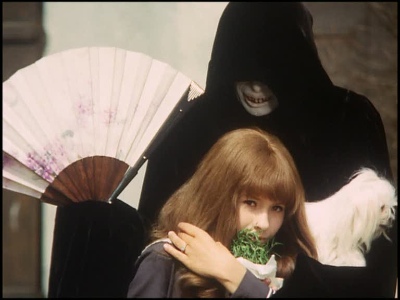
Valerie embraced by the 'Polecat' vampire-like creature, who's also the town's high priest and possibly her father (??!!) in "Valerie and her Week of Wonders" (1970).

1. Valerie and her Week of Wonders (Czech: Valerie a týden divů) is a 1970 film from the former Czechoslovakia, directed by Jaromil Jireš. This is the most “artful” of the films that appear on this list and, even though the print I viewed was of very poor quality, the stellar cinematography clearly stood out. The film is a dark, coming-of-age fairytale as only the Czechs could envision. The titular heroine, 13-year-old Valerie, grapples with her burgeoning sexuality, as well as the many priests, vampires, men and women who attempt to seduce and/or kill her. Fortunately for young Valerie, she possesses magical earrings which, when placed in her mouth, rescue her from impending death — which happens with great frequency throughout the film. Disjointed and surreal, you’ll hurt your brain if you try to make sense of the proceedings. Characters often change appearance and, as in the case of the ‘Polecat’, occupy shifting and ambiguous roles. Is he a priest? A vampire? Valerie’s father? A weasel? All of the above? Yes. Don’t worry about it, just enjoy the many beautiful images and the hazy, dreamlike pace of this film.

Christina Lindberg stars as Frigga, the vengeful one-eyed prostitute in "Thriller -- A Cruel Picture."

2. Thriller — A Cruel Picture (Swedish: Thriller – en grym film, also known as They Call Her One Eye, Hooker’s Revenge and simply Thriller) is a 1973 Swedish exploitation film. The film follows the typical Rape-Revenge formula: the heroine suffers tragedy and physical degradation until the latter half of the film, when she exacts bloody revenge on those who’ve abused her. (Read my earlier post on the Rape-Revenge film for my thoughts on this exploitation subgenre.) The teenage Frigga — who has been rendered mute by the childhood trauma of sexual abuse — is kidnapped by the local pimp and forced into both heroin addiction and prostitution. When she is initially non-compliant, Frigga has one of her eyes cut out with a scalpel in a brief but grisly scene that reputedly employed an actual cadaver as a body-double. From then on, she silently endures abuse from her clients while she saves up her portion of the financial transactions. She packs her Mondays (her one day-off work) with karate class, rifle-shooting and driving-really-super-fast class, as she secretly plots her revenge. Montage after long montage, she finally dons a black leather trenchcoat, matching eye-patch, and a sawed-off shotgun, and pays a slow-motion visit to each of her (soon to be former) clients.

The film was marketed as the first film ever to be completely banned in Sweden, although the one that actually was first was Victor Sjöström’s The Gardener from 1912. It has received a cult following and was one of the inspirations behind Quentin Tarantino’s Kill Bill, specifically the character of Elle Driver (Daryl Hannah). In Daniel Ekeroth’s book on Swedish exploitation movies, Swedish Sensationsfilms: A Clandestine History of Sex, Thrillers, and Kicker Cinema, it is revealed that the producers took out a huge life insurance policy on star Christina Lindberg, as real ammunition was used in the action sequences, and that she was asked to inject saline solution during the drug scenes. — from Wikipedia.

There's no joy in being dead, not even 'living death', as evidenced by the melancholic Catherine in Jean Rollin's "The Living Dead Girl" (1982). Oh, the existential angst of it all.

3. The Living Dead Girl (French: La Morte Vivante) is a 1982 campy classic from French fantastique director Jean Rollin. Reanimated by the spillage of a toxic waste goop on her corpse, the aristocratic Catherine discovers she has a new-found taste for human flesh. Like all of Rollin’s films, the aesthetics play a much more crucial role than the story or, indeed, the acting. His films are as gorgeous as they are completely ridiculous. The absurd plot devices — toxic goop dumped on (surprisingly well-preserved, two-year-old) corpse interred in family crypt — exist only to furnish Rollin with an excuse to create his signature erotic-grotesque imagery. Rollin’s The Living Dead Girl is splatter gore-meets-arthouse, served up with a little Jean-Paul Sartre on the side. The existentialist exchange that occurs between Catherine and her childhood friend Hélène is thoroughly hilarious:

Hélène: You were never dead. The dead don’t come back to life. You were put to sleep, drugged, driven mad or I don’t know what. I don’t understand. I never saw you dead, Catherine. They put an empty coffin in this crypt.

Catherine: No. I’m dead, Hélène. I know I am. Don’t you understand? I know I am!

Catherine and Hélène discuss the finer points of existence in "The Living Dead Girl."

Heady stuff, people. Heady stuff.

The magical worlds of Lotte Reiniger.

A still from Lotte Reiniger's "The Adventures of Prince Achmed" (1926), credited with being the first feature-length animation film.

Before there was Walt Disney, there was Lotte Reiniger. Born in Berlin in 1899, Reiniger pioneered new forms of paper cutout animation in the 1920’s. Inspired by shadow puppetry, Reiniger developed highly articulated paper puppets to be animated through stop-motion camera work. Her elegant paper silhouettes breathed life into the fairytale The Adventures of Prince Achmed (1926), a film that bears the distinction of being the first feature-length animation. Although she initially struggled to find a distributor, once Prince Achmed premiered at the Cannes Film Festival, it then became a critical and popular success.

Back-lit paper silhouettes are so closely associated with Reiniger that schools of animation will often refer to this type of work as the “Lotte Reiniger style.”

Horror Films 101: Harry Kümel’s “Daughters of Darkness” (1971)

Delphine Seyrig channels Marlene Dietrich in her portrayal of the infamous Hungarian Countess Elizabeth Báthory.

If you’re a regular reader of this blog, then you are already familiar with my admiration — one might even say, obsession — for European horror films from the 1960’s and 70’s. What these films often lacked in budget, they more than made up for with stunning visuals and style. Of course, when you have a 1000+ years of art and culture sitting at your doorstep, it’s difficult not to look fabulous. Such is the case for Harry Kümel’s highly stylized erotic vampire film Daughters of Darkness (1971). From the architecture of the grand hotel on the Belgian seafront, to the shimmering sequins of Delphine Seyrig’s evening gown and the blonde waves of her 1930’s bob hairstyle, everything and everyone looks beautiful.

Author David Chute wrote an elegant summary of Daughters of Darkness for the recent Blu-Ray release of the Kümel classic which accurately captures the mood of the film:

Art-movie goddess Delphine Seyrig (Last Year at Marienbad) slinks through the plush Eurotrash settings as the deathless Elizabeth Bathory, Vampire Countess, in Harry Kümel’s minor Dutch classic of lesbian erotic-gothic. Blood mingles with water during the languorous shower scenes. Set at an upper-crust seaside resort, the 1971 film recounts Bathory’s plot to replace her current consort (Andrea Rau) with a fresher specimen, an abused newlywed whose brutal young husband is an inconvenience waiting to be eliminated. Although both the bi-sex and the neck-biting violence are tame by today’s standards, the film has a graceful, gliding sense of pace that gets under your skin; something unspeakably kinky always seems to be just about to happen. It never quite does, but the mood lingers. See it with someone you love–or would like to. –David Chute

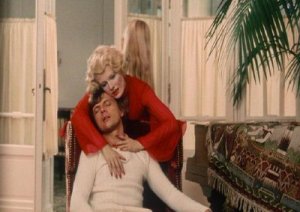
Stefan (John Karlen) gets all hot and bothered as he and Elizabeth recount the many tortures inflicted upon the victims of the bloodthirsty Countess Báthory.

The phrase “…something unspeakably kinky always seems to be just about to happen…” instantly leapt out at me when I first read Chute’s summary, as this echoes my own experience with the film. If David Lynch had been making Eurotrash vampire films in the 1970’s, he’d probably make a film much like this one. From our first glimpse of the Countess, as she glides out from the backseat of her Bentley and up to the desk of the hotel concierge, there is an unmistakable atmosphere of kink. The camera tightly focuses on the gleaming patent leather of her high black boots as she steps from the car, an image that says fetish more than it does vampire. It is quickly apparent that the relationship between Elizabeth and her “secretary” Ilona has little to do with typing memos, and the scene in which Ilona crouches obediently at Elizabeth’s feet clearly establishes their dominant/submissive lifestyle arrangement. Of course, a bisexual female vampire with a taste for BDSM isn’t an entirely uncommon entity in the realms of horror fiction. The true wild card in Kümel’s film lies in the character of Stefan, the secretive husband prone to fits of violent rage. His rather prurient interest in sexual sadism becomes apparent when he recounts the legend of the bloodthirsty Countess Báthory, writhing with erotic pleasure as he describes the tortures inflicted upon her victims. Later in the film, he savagely beats his wife Valerie with his belt. And then there’s the whole matter of his “mother,” whom he’s mysteriously reluctant to introduce to his new bride. The scene below, where Stefan gives his ol’ Mum a call, is gloriously creepy:

My favourite moment of that scene is when the butler kneels down before Mother, and “Mother” reaches out to pet his bald head in the way one would a family dog. The butler reacts, but only mildly, before he walks away in silence. Kink abounds, but its only ever hinted at.

As the film nears its finale, the body count predictably rises. Ilona slips in the shower and falls upon a straight razor. The abusive Stefan gets his final comeuppance by way of a glass fruit bowl. Yes, fruit bowl. The Countess herself meets her end impaled on an unfortunately located tree branch as she is pitched from her crashing car. The sole survivor Valerie keeps the Báthory legend alive by donning Elizabeth’s fetching black PVC cape — complete with bat-wing trim and campy-vamp high collar — and seductively sidling up to a young couple.

The Rape-Revenge Girl, part deux.

Baise-moi, si vous plaît.

The sex-club massacre scene from "Baise-moi" (2000). In English, the film's title would be correctly translated as "Fuck me", and not "Rape me" under which it was originally released in North America.

When the French film Baise-moi was released in 2000, it garnered a great deal of media attention for its highly graphic violence and depictions of unsimulated sex. The film was banned in Ontario, initially because it was deemed too pornographic. The producers asked for it to be re-rated with a pornographic rating, only for it to be banned because there was too much violence for a pornographic film. It was finally passed with an “18A license” after — one assumes — some strategic edits being made. I caught up with the film on DVD that year, and have recently rewatched it online — you can find most of the film on Youtube, but hurry as it’s likely to be removed due to its content and copyright infringement. I came away from my recent viewing with these two impressions: firstly, that it is a far better film than I remember, and second, that I still don’t know what all the hullabaloo was about.

Here’s a quick synopsis: the main characters Nadine (Karen Bach) and Manu (Raffaëla Anderson) are women who live on the precarious fringe of a very disenfranchised lower-class in contemporary France. Nadine is a part-time prostitute involved with some very shady individuals, while the perpetually unemployed Manu spends much of her time trying to get stoned. When Manu is gang raped by a group of thugs, her brother — with whom she has a strangely complex and conflicted relationship — accuses her of “enjoying” the rape and calls her a “slut.” A physical struggle ensues, during which Manu grabs her brother’s handgun and shoots him dead. Meanwhile, Nadine has a violent scuffle with her female roommate that ends with her friend’s demise. So, a bad day for all parties involved. The women meet up at a railway station by pure coincidence, and the two decide to “go on the lamb” from the police that will soon pursue them. And thus famously begins their violent, drug-addled, pornographic and completely nihilistic crime spree.

Nadine pays homage to Travis Bickle's famous "Are you talking to me?" scene from Martin Scorsese's "Taxi Driver." No, seriously. Compare both scenes.

In my previous post on The Rape-Revenge Girl I discussed Meir Zarchi’s I Spit On Your Grave (1978) and how that film ultimately failed as a satisfying Rape-Revenge film. Where Zarchi’s film falters and, conversely, Baise-moi succeeds is in the depiction of rape. The protracted and rather gratuitous rape scenes in I Spit On Your Grave offer up much screaming, nakedness, and salacious close-ups of Jennifer Hill’s anguished face and bloodied body. While the audience understands that bloody vengeance will come before the credits roll, it’s not until after we all get a good, long look at Jennifer’s breasts. The whole deal feels exploitative. While the rape scene in Baise-moi is undeniably graphic — as it involves actual penetration — the filmmakers Virginie Despentes and Coralie Trinh Thi simultaneously reject the sadism inherent in a rape scene. Much to the dismay of one of her rapists, Manu stares ahead in a detached manner during her attack. She has recognized that although she’s powerless to prevent the assault, she can assert power through her refusal to “play” the role of the victim. The fact that her lack of response clearly annoys her rapist underscores the politics that inform the scene: that rape is about power, not sex.

Once Nadine and Manu are on the road, the film becomes a sort of X-rated buddy-flick. The sex is graphic, true, but no more so than anything you’ve seen in a standard, mainstream pornographic film. Much like films of that ilk, it’s also completely mechanical and nonerotic. The violence of the main characters is sudden, impulsive and seemingly fueled by a rage against society as a whole, which is partly the reason it all works so well. The scene of the bloody massacre that takes place within a sex club is positively operatic in its excessive violence. For no other reason, you should watch this film for that scene.

OK, I believe I’ve finished with my “female tropes in horror films” series of posts. Next up, I’ll write about the latest release from Pixar. No, not really.

Deviance, gender and the ‘aberrant female’ in horror, part IV.

The Rape-Revenge Girl.

Jennifer (Camille Keaton) exacts revenge on one of her rapists in ‘I Spit On Your Grave’ (1978).

Horror fiction tends to narrowly focus on two main themes: sex and death. (In fact, an argument can be made that most art is preoccupied with these two topics). A corollary subject that often arises from this thematic pairing is the violent cruelty of mankind that ultimately leads to sex and/or death. The writings of the Marquis de Sade and films of both Pasolini and Hanneke are almost entirely devoted to the examination of power dynamics and the innate viciousness of humanity. The reader/audience is also strongly implicated as willing participants in this parade of cruelty served up for our (presumably) voyeuristic consumption.

The Rape-Revenge scenario is the perfect encapsulation of this sex + death equation: a young, beautiful woman is sexually and physically brutalized, but survives to exact bloody vengeance upon her tormentor/s. This scenario is one that is strongly favoured by the various subgenres of exploitation cinema because its, well, basically lurid and exploitative. The most famous (or infamous, depending on your point-of-view) of the Rape-Revenge subgenre is Meir Zarchi’s Day of the Woman (1978), better known by its re-release title, I Spit on Your Grave. Now, let’s place this film in it’s proper context. Zarchi’s I Spit On Your Grave is a base, low-budget, and poorly acted film. It’s pure exploitation cinema, and a far cry from the critically-lauded work of Sade, Pasolini and Hanneke. That being said, it has been the subject of a great deal of feminist critical discourse since its release, with academics such as Carol Clover and Julie Bindel championing its “feminist” viewpoint.

The plot is threadbare. Jennifer Hills, an aspiring writer from “the big city”, seeks solitude in a rental cottage so that she may focus on her craft. The local country bumpkins have different plans for Ms. Hills, however, for no apparent reason other than the fact that she’s young, pretty and unaccompanied. They systematically terrorize, gang rape, and then murder their victim. Or so they believe. Jennifer survives her attack, and returns for revenge. One by one, her former tormentors are dispatched in ever increasingly gruesome ways and we, the audience, cheer her on through this exercise in catharsis.

Dude, rape victims don’t generally seduce their rapists into bathtubs after the attack. Darwinism claims yet another deserved victim.

I had two major misgivings with Zarchi’s I Spit On Your Grave. I’ll list them in point form.

1. One is forced to sit through a protracted series of rapes before we arrive at the satisfaction of revenge. This is the ‘Faustian bargain’ to which we females tacitly agree when viewing such films: howls of naked protest from the heroine in Act One, to be followed by bloody vengeance. The quotient of rape-to-revenge in Zarchi’s film is too much rape, not enough revenge. At least, the deaths of Jennifer’s rapists were not violent and/or gory enough for my — admittedly, gruesome — taste. The only death scene that worked for me was the castration-in-the-bathtub scene. Gallons of fake blood, off-screen howls and much left to the imagination of the viewer make this scene an effective one.

2. The rapists are portrayed as complete imbeciles, with one of them a mildly retarded, Gomer Pyle-like character. Did Zarchi intend this as a further insult-to-injury for poor Jennifer Hills? That an independent, educated woman like her could be bested by this group of inbreds? The convincing performance of Camille Keaton in the infamous ‘sodomy scene’ is completely undercut by the spastic gyrations of her attacker. What the hell is the actor doing back there? Was he directed to look that ridiculous? Even during a scene as horrendous as this, I could not suppress my laughter.

Where is the ‘deviance’ and the ‘aberrant female’ in all this, you ask? Carol Clover wrote in the third chapter of her 1992 book Men, Women, and Chainsaws that she can “appreciate, however grudgingly, the way in which [the movie’s] brutal simplicity exposes a mainspring of popular culture.” Women are typically cast as victims in exploitation films, and their suffering has become a form of sadistic entertainment. Zarchi’s film attempts to address this issue. Rather than rely on the sporadic justice of the judiciary system, Jennifer Hills takes matters into her own hands. She embodies the rage we feel against the cruel reality of rape, and we sit through her violation in order to experience the vicarious thrill of revenge without ever getting our hands bloodied.

While Zarchi’s I Spit On Your Grave doesn’t entirely work for me as a satisfying Rape-Revenge film, my next post will focus on a film in this genre that does work: the equally controversial French film Baise-moi (2000).

Next post–>