Goth version of “‘Twas the Night Before Christmas”.

Viva la Google. Discovered this little gem via the search engine. No author’s name is attached to it, but here is the originating web site. Silly fun, so I thought I’d share it with you. Assuming the world doesn’t come to an abrupt end on December 21st as per the Mayan predictions, have a good holiday everyone! — Lady Lazarus.

Have a dreary Gothic Christmas and a wretched New Year.

Have a dreary Gothic Christmas and a wretched New Year.

With somber and tormented apologies to Clement C. Moore:

‘Twas the night before Christmas, and all through our house
was blasting the “St. Vitus Dance” by Bauhaus;
Torn fishnets were draped on my forearms with care,
And two cans of Aquanet applied to my hair;
My thoughts were of graveyards, and horror and dread,
Black visions of pain and despair in my head;
And Bianca, whose face was as pale as the moon,
Had thrown up her arm for this evening’s swoon,
When out by the gravestones there came such a clatter,
I sprang from the coffin to find out the matter.

Away to the window I flew like a ghost,
Expecting to find a dark devilish host.
The moon on the breast of the uncaring snow
Threw ominous shadows on objects below,
When, before my tormented eyes did traverse,
But a gorgeous black Crane & Breed carved-panel hearse,
With a gaunt, shrouded driver, who filled me with fear,
And eight skeletal creatures that might have been deer.
More rapid than vultures his coursers they came,
And his deep Andrew Eldritch voice called them by name;

Now, Murphy! Now, Morgoth! Now, Torment and Woe!
On, Dreadful! On, Lovecraft! Mephisto and Poe!
To the top of the gravestones where fog wisps its breath!
With a weight on my soul I consign you to death!

As dead leaves that before hellish hurricanes fly,
When they flutter like giant bats’ wings to the sky,
So up to the crypt-top the coursers they leapt,
While dearest Bianca, like death, still but slept.
And then, to my horror, I heard on the roof
The clicking and scratching of each bone-white hoof.
As I drew in my arm, and was whirling around,
Down the ebony chimney he came without sound.

He was clad all in black, and he looked oh-so-goth,
A billowy ensemble of crushed velvet cloth;
His boots were knee-high, quite buckled and zipped,
And the Spandex and fishnets ’round his legs were ripped.
His eyes glowed with bluish fire, deathly and cold,
A black eye-liner’d face neither youthful nor old.
A broad lipless mouth drawn with torment and hurt,
And his sorrowful face was as white as my shirt.

A smoldering cigarette tight in his grasp,
Its smoke curling eerily ’round his cloak clasp;
His gaunt frame was topped with long ebon hair,
And a sharp scent of brimstone and cloves choked the air.
His arms were outspread in the shape of a cross,
And I quailed when I saw him, feeling sorrow and loss;
He narrowed his eyes with a twist of his head,
And I felt the full weight of his angst and dread.

He spoke not a word, but went straight to his task,
Left some Dead Can Dance CD’s; before I could ask,
A single tear fell across his aquiline nose,
And then, like an angel, up the chimney he rose;
He sprang to his hearse, to his team he then hissed,
And away they all drifted like early dawn’s mist.
But I heard him intone, ere he vanished from sight,
“Gothic Christmas to all, and to all a good fright!”

“Ero guro nansensu”: the dark, disturbed grandchildren of Japan’s era of decadence.

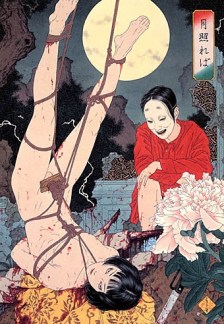
An illustration by Takato Yamamoto, a contemporary Japanese devotee of

An illustration by Takato Yamamoto, a contemporary Japanese artist working in the “ero guro” style.

Ero guro nansensu (a wasei-eigo term that literally means “erotic-grotesque-nonsense”) was a media-driven cultural phenomenon that originated in 1920–1930 Japan. The social climate of Tokyo between the two World Wars can be closely compared to that of Berlin’s Weimar era, with its famous hedonism and nihilistic world view amongst its artists and bohemian fringe. In his essay “Deviance and Social Darwinism in Edogawa Rampo’s Erotic-Grotesque Thriller Koto no Ōni” (2001), Stanford University professor Jim Reichert characterized ero guro as a “prewar, bourgeois cultural phenomenon that devoted itself to explorations of the deviant, the bizarre, and the ridiculous.” The art of ero guro puts its focus on eroticism, sexual corruption, decadence and the grotesque. While ero guro is a specific movement, many of its components can be found throughout Japanese history and culture. In fact, there is a well-established tradition in Japanese ukiyo-e (woodblock prints) of shunga depicting decapitations and acts of violence from Japanese history such as rape, bondage and erotic crucifixion.

Takato Yamamoto.

Takato Yamamoto.

This tradition of morbid eroticism continues in the work of contemporary Japanese illustrators and manga artists Takato Yamamoto and Suehiro Maruo. An obvious and immediate connection can be traced from the aforementioned ukiyo-e prints to Takato Yamamoto’s delicate colour palette and rendering style. Even as his dreamlike scenes reveal bondage and torture, his protagonists — often naked, effeminate boys — are frequently shown staring off in a calm, eerily detached manner. Yamamoto leaves his narratives deliberately opaque: it’s difficult to decipher whether these young boys are willing participants in these sinister proceedings, or have merely resigned themselves to their fate. The horror in Yamamoto’s art — while undeniably present — is tempered by the strange stillness of his scenes, as well as by his beautiful and virtuosic rendering.

The art of Suehiro Maruo.

The art of Suehiro Maruo.

The horror in Suehiro Maruo’s illustrations, on the other hand, is big, bold and shaded bright red. Adopting an illustrative style highly reminiscent of WWII-era Japanese propaganda posters (similar to the Soviet “socialist realism” style), Maruo’s images are typically gorier than those of Yamamoto, though these images are no less beautiful. His favourite motif is the young couple locked in an embrace, a romantic image that Maruo disrupts with the insertion of gore — as seen in the image on the left of the young soldier licking the eyeball of his sweetheart, whose face he’s so tenderly peeled away from her skull. Whereas Maruo’s illustrations tend to celebrate the more grotesque elements of ero guro, they are typically tamer in their representations of sexuality in comparison to the raunchier Yamamoto.

My Alphabet of Anxieties & Desires: eBook version now available!

My full-colour “alphabet book for adults” entitled My Alphabet of Anxieties & Desires is now available as an eBook for your iPad, iPhone or iPod Touch. All twenty-six letters of the Roman alphabet are rendered in original illustrations, all of which address either an “anxiety” or a “desire.” There’s also a preface written by myself, plus a foreword by gender-studies academic and PhD-candidate, Judith Mintz. All this for the princely sum of .99 cents (US).

You can purchase your copy at Blurb. The eBook can also be purchased in the iTunes bookstore: http://itunes.apple.com/ca/book/id582540445

The printed version of the book is available for $29.99 US.

Giant insects swarm the Art Gallery of Peterborough!

Quick and dirty snapshot of the installation in-progress.

My installation The Disobedient Dollhouse will pay a visit to the Art Gallery of Peterborough, starting this month. This exhibition will also screen my 2-minute stop-motion animation Domestikia: The Incident in the Nursery. Exhibition runs from November 9 – January 6, 2013. The opening reception will take place Friday November 16, 7 – 9 pm. Visit the web site of the AGP for details and/or directions.

Happy Hallowe’en from Lady Lazarus!

Myself, possessed by the ghoulish spirit of Halloween. Boo!

Halloween is one of the oldest holidays still celebrated in modern times, and can be traced back to the Druids, a Celtic culture in Ireland, Britain and Northern Europe. Its roots lay in the feast of Samhain (pronounced SA-WIN), which was annually held on October 31st to honor the dead. Much like Christmas, the pagan traditions of Samhain were later co-opted by the Christian church and replaced by All Saints Day (Nov. 1) as a means to align the Christian feast with the already well-established pagan festival. According to Wikipedia, “The word Halloween is first attested in the 16th century and represents a Scottish variant of the fuller All-Hallows-Even (“evening”), that is, the night before All Hallows Day.” Hence, we have the modern day Hallowe’en.

“Domestikia, Chapter 3: The Little Death”: I had a dream like that once…

Trying different heads.

One of the activities that keeps me busy these days — other than teaching, of course — is applying to grant programs. This is a long, tedious, and painful process that I submit to only grudgingly. It’s also, unfortunately, a necessary one. As part of the application process, I’ve been forced to cobble together a storyboard for my proposed animation project. This is yet another ‘necessary task’ that I perform grudgingly — being a naturally lazy creature, I’ve never done one before — though the benefits of having a storyboard are immediate and the process certainly worthwhile.

I don’t want to reveal all of my storyboard just yet, but here’s a sneak peak. Below the storyboard sample is my artist’s statement/project proposal, which might prove insightful to those of you who follow the development of my animations.

My current series of stop-motion animations entitled Domestikia developed directly out of a previous sculptural-installation project, in which I constructed a three-dimensional dollhouse from paper and lithographic prints. This project, entitled The Disobedient Dollhouse, employed the setting of a Victorian-themed dollhouse as a means to critique the sentimentality of nostalgia, as well as the tiny, precious model of perfect domesticity that the dollhouse itself proposes. A dollhouse is a gendered space, one specifically codified as feminine – it is therefore a highly suitable space in which to focus attention on women’s roles within the home. Furthermore, the strange, hybrid creatures and giant insects that populated my Dollhouse hinted at a dark, secret fantasy world churning just beneath the veneer of domestic perfection.

As previously stated, the Domestikia animation series began as an expansion of the narratives that originally appeared in The Disobedient Dollhouse project. For instance, the bird-headed children and Nanny (a self-portrait) featured in Domestikia: The Incident in the Nursery first existed as a paper diorama inside The Disobedient Dollhouse. The medium of stop-motion animation enabled me to — quite literally — bring that nursery scene alive. In addition to the scenes and narratives, the look and style of my Dollhouse has also carried over into my animations. Like the hand-drawn lithographs I created for the Dollhouse, the paper cutouts and articulated paper puppets from Domestikia possess the same grainy, textured quality of the lithographic crayon.

Similar to the other Domestikia films, the proposed project Domestikia, Chapter 3: The Little Death will employ the technique known as ‘cutout animation’, one of the earliest forms of stop-motion that uses flat characters and backgrounds cut from paper. The technical limitations of paper puppets, with their characteristically stiff and unnatural movements, make cutout animation particularly well suited to animations whose themes involve fantasy, surrealism, dreams, and that which otherwise lacks realism. Rather than being a technical limitation, the anti-realism of the paper cutout serves to amplify the strangeness of the events that happen throughout Domestikia – which is precisely why I’ve chosen to work with this technique. In Domestikia, Chapter 3: The Little Death, my plan is to further expand the technical and aesthetic possibilities of the paper cutout.

The storyline of Domestikia traces a series of strange, otherworldly events that take place within an imaginary dollhouse. The connecting thread between each narrative is the continual appearance of a butterfly, a creature that acts as a sort of ‘agent of chaos’, disrupting the daily domestic routines of the miniature household. In Domestikia, Chapter 6: An Unfortunate Incident Involving Her Hat, the appearance of the butterfly in the opening scene foreshadows the strangeness of subsequent events, in which the morning routine of dressing goes terribly wrong when a hat decides to grow out of control. The butterfly departs the scene, and in Domestikia: The Incident in the Nursery, it appears once more to disrupt the daily proceedings – this time, rousing an infant recently rocked to sleep by the Nanny, creating a cacophony of screams. The butterfly is once again featured in my proposed project, entitled Domestikia, Chapter 3: The Little Death. In this latest installment of the Domestikia series, the ‘little death’ of the title refers simultaneously to the metamorphosis process of the butterfly, as well as to ‘la petite mort’ of orgasm, as the butterfly is shown to have originated from an amorous encounter between Madelaine and her octopod lover. The ‘little death’ also refers to the literal building up, and subsequent dismantling of the Madelaine paper puppet when she is ‘lovingly dismembered’ by the octopus. Ostensibly, Domestikia, Chapter 3 is about shifts in identity that occur as one’s role in life changes: from individual, to couple, to parent. In short, sometimes it is necessary to ‘die’ in order to reinvent oneself.

Lady Lazarus’s Halloween Party Movie Night, 2012 Edition.

Hello, my darklings! The leaves are down, the sweaters are on, and it’s that time of the year that Lady Lazarus carefully crafts a list of horror films to whet your pre-Halloween appetites. Traditionally, I’ve had a theme for each Halloween list, such as “Best Horror Films of the 2000s” or “Favourite Horror-Comedies“, but this year I thought I’d open up and share with you, plain and simple, the horror films I’ve been watching of late. Some are new, and some are just new to me. Perhaps there’ll be a discovery or two for your own ghoulish viewing pleasure.

Isabelle Adjani proclaims “[He] is very tired. He made love to me all night” in Andrzej Zulawski’s challenging film  Possession (1981)

1. I first learned of Andrzej Zulawski’s cult classic Possession (1981) through the writings of Canada’s First Lady of Horror Kier-La Janisse, who’s an enthusiastic champion of this film. Equal parts arthouse, domestic drama, and gory supernatural-horror, this film defies any attempt at easy categorization. Ostensibly an unflinching gaze at a marriage in turmoil, the film ultimately — and quite surprisingly — veers into the realm of abjection, absurdity and visceral horror. Isabelle Adjani plays her character’s descent into madness to the hilt, earning her the Best Actress award at the Cannes Festival for Possession in 1981. Sam Neill turns in a strong — if affected and somewhat stylized — performance as her estranged husband. I don’t want to give away any of the plot points, as the film works best the less you know about it. If you like your horror with a big dash of the unexpected, then you’ll probably enjoy this one. If you just want to see some naked coeds get sliced, steer clear.

Investigating a strange noise, Samantha ventures upstairs with a kitchen knife in Ti West’s “The House of the Devil” (2009).

2. I had heard many good things about Ti West’s The House of the Devil (2009) and, fortunately, those things turned out to be true. This is an accomplished psychological-horror in the vein of Polanski’s Rosemary’s Baby, where the terror builds on a slow-boil. What’s that, you say? You’ve been invited to babysit for creepy strangers in an isolated, in-the-middle-of-nowhere house? Why, sure. You need the money, and what could possibly go wrong? Let’s suspend that disbelief and just roll with it, ’cause it’s a fun, suspenseful ride. Kudos go to the art direction and costume design, as The House of the Devil boasts the most authentic recreation of that 1980s-look that I’ve personally viewed on film. Nice little cameo by that darling of ’80s horror, Dee Wallace (The Hills Have Eyes and The Howling).

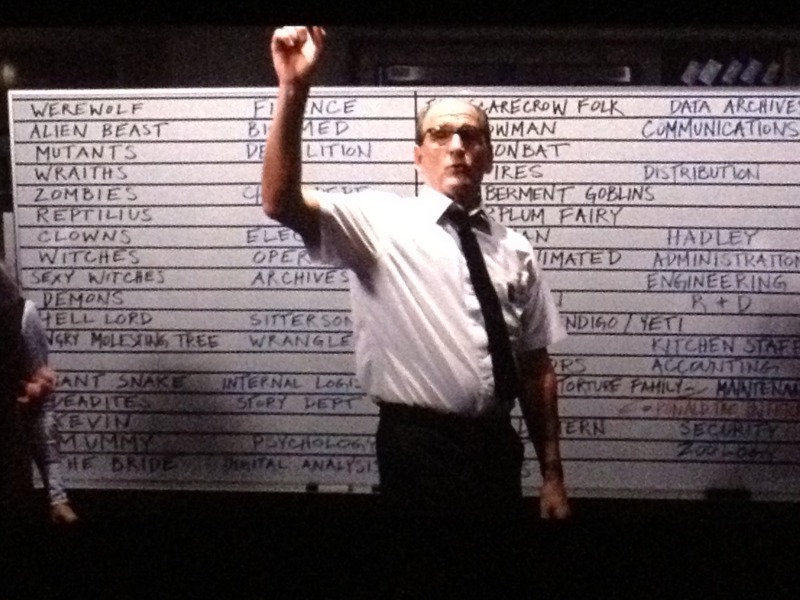
3. Oh, Joss Whedon. You don’t always hit it out of the park, but when you do…wow! Admittedly, taking the piss out of the slasher-horror is a little like shooting fish in a barrel and, yes, this is well-trodden ground that the Scream franchise visited sixteen years ago. All the same, Cabin in the Woods (2012) seems fresh and original, and is heaps of fun with a clever twist or two. Again, I don’t want to spoil the surprise, so I’ll simply end with —  zombie redneck torture family.*

Placing the bets in “Cabin in the Woods” (2012).

*SPOILER ALERT. Wanna know what all the various beasties and baddies were in Cabin in the Woods? Click here.

4. The horror genre has traditionally loved the anthology format. This love affair possesses a kind of logic. If one particular scenario doesn’t frighten you, then perhaps the next one will do the trick — after all, fear can be very subjective. One of the major pitfalls of anthologies is that they’re often hit-or-miss in terms of ratio of success. Such is the case with the 2012 ‘found-footage’ anthology V/H/S which, although it’s initial premise seemed promising, suffered from it’s weaker components. The first 35-minutes of hand-held shaky-cam is nauseating to the point of being almost unwatchable, though this does improve with the subsequent stories. The best offerings in this anthology were the fourth story of a couple communicating via FaceTime, and the final segment — created by a team of directors out of L.A. who call themselves Radio Silence — which follows a group of guys trying to find a Halloween party.

The rationale for the found-footage actually makes sense in one of the stronger offerings in V/H/S (2012).

Happy Halloween, everyone!

“Look at you, don’t you look like Siouxsie Sioux.”

Oh, baby, look at you
Don’t you look like Siouxsie Sioux
How long’d it take to get that way
What a terrible waste of energy
You wear black clothes say you’re poetic
The sad truth is you’re just pathetic
[…] Don’t try to tell me that you’re an intellectual
Cause you’re just another boring bisexual
[…] 80 pounds of make up on your art school skin
80 points of I.Q. located within

–Selected lyrics from the song “Instant Club Hit (You’ll Dance to Anything)” (1987) by the American satirical punk rock band, the Dead Milkmen.

Funny guys, those Dead Milkmen. That song made me laugh back in the day, even as it did thoroughly insult my tribe. Mind you, Siouxsie Sioux became a Goth fashion icon with an indisputable legacy of music and style…the Dead Milkmen, not so much. At the end of the day, the art school kids came out on top.

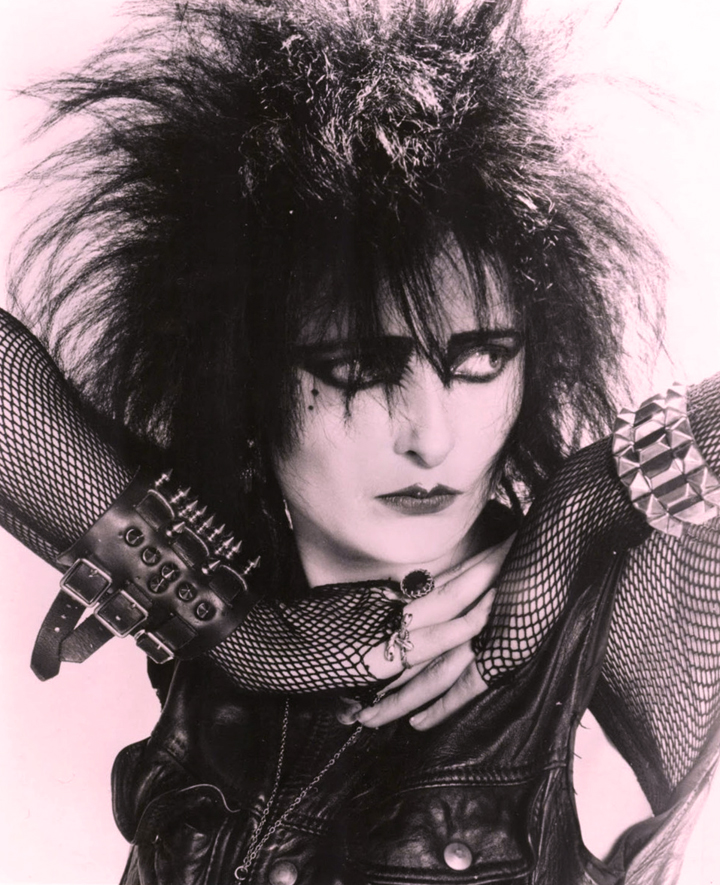
That classic look of Siouxsie Sioux.

It’s early September so — of course — I’m already thinking about Halloween and my possible costume options. That’s just how I roll, gentle readers. As you’ve no doubt already guessed, I’m considering a transformation into Siouxsie — by which I mean ‘Classic Goth’ Siouxsie, back in her early days with The Banshees. So, what does an outfit like that entail?

Without a doubt, one of the essential elements to the successful deployment of the ‘Siouxsie-look’ is heavy, dramatic make-up. Her signature style, which paired a pale complexion with dark, exaggerated eyes, derived from a few different sources: the actresses of the silent film era — most notably, the Cleopatra as portrayed by exotic screen siren Theda Bara — and the mask-like appearance of Japanese kabuki theatre. To begin, whitened your skin tone with a powder one or two shades lighter than your usual. Once you’ve attained that perfectly pallid, cadaver-like complexion, you can reach for your black kohl eye pencil. Now the fun really starts. OK…I’ve decided not to bore you with detailed, step-by-step instructions on makeup application, as there’s many video tutorials out there showing precisely how to achieve this ‘Siouxsie-look’ with cosmetics. Here’s one if you’re interested. Suffice to say, the process involves a shitload of eyeliner and eyeshadow, dark-red lipstick and some precision work with lip liner. If you closely resemble Cleopatra when all this is done, you’re on the right track.

Ok, the hair. A big bird’s nest of black, backcombed hair. I’m not entirely confident that I’ll be able to achieve this hairstyle with my naturally curly hair, but I’ll give it a try. Perhaps with enough backcombing and hard-as-shellac hairspray, this’ll work. Either that, or I’ll borrow a black wig.

Fishnets, studded wristbands, leather and a lot of hairspray.

The clothes should be — what else? — black. The Classic Goth look borrowed heavily from late-1970’s British Punk, so lots of fishnet, combat boots, studded wristbands and collars, leather, PVC and/or vinyl. The London-based punk fashion shop SEX, co-owned by Vivienne Westwood and Malcolm McLaren, was fundamental to the development of the Classic Goth look. According to Wikipedia, SEX sold fetish and bondage wear supplied by existing specialist labels such as Atomage, She-And-Me and London Leatherman, as well as designs by McLaren and Westwood. Siouxsie Sioux, incidentally, was a shop regular.

Here’s a trick I learned the other day: take an old pair of fishnet pantyhose and cut off both feet. Then, cut out the crotch and pull over your head. Place arms in the (former) stocking legs and — viola! — instant fishnet shirt.

So, that’s it. I’m either going to dress-up as Siouxsie for Halloween, or a zombie. Or….Zombie Siouxsie.

Animaldiçoados/Animacursed 2012

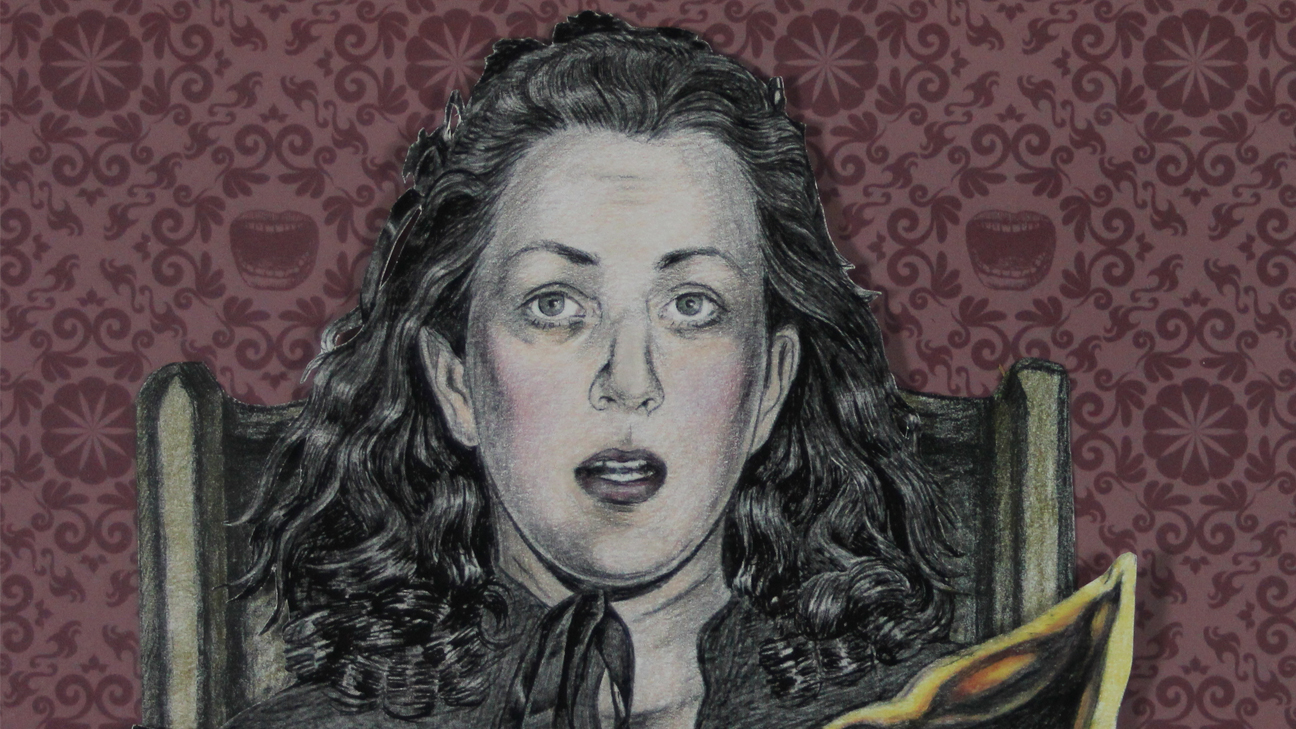
Film still from “Domestikia: The Incident in the Nursery”, 2012, stop-motion animation done with paper cutouts and puppets.

It’s official. My animated short film Domestikia: The Incident in the Nursery has been selected under the International category for Animaldiçoados/Animacursed 2012, a film festival in Rio de Janeiro that features horror, suspense, and “other cursed” genres of animation. Mine is probably under the “other cursed” or possibly the “WTF” category, should they have one of those.

Visit the festival web site (in Portuguese, of course) and check out the selected films. Pretty solid programming! Amazingly enough, I’m sharing screen time with Julia Pott (see my last blog entry When I grow up, I want to make films like Julia). Not sure how that happened.