Lady Lazarus: 2012 in review.

Wow! This blog Lady Lazarus: dying is an art received exactly 47,512 visits in 2012. That’s pretty impressive for a personal blog fuelled by the writing powers of just one individual. Many thanks to those amongst you who “follow” me and add your comments to my posts. It takes at least two to make a conversation, so keep those comments coming in 2013. This blog is a pure labour of love, and I plan to keep it that way. The drive that keeps me researching and writing about all things dark and macabre is a genuine, unslakable curiosity. I’m just a big nerd that way.

The WordPress.com stats helper monkeys prepared a 2012 annual report for this blog.

Here’s an excerpt:

4,329 films were submitted to the 2012 Cannes Film Festival. This blog had 47,000 views in 2012. If each view were a film, this blog would power 11 Film Festivals

Click here to see the complete report.

Goth version of “‘Twas the Night Before Christmas”.

Viva la Google. Discovered this little gem via the search engine. No author’s name is attached to it, but here is the originating web site. Silly fun, so I thought I’d share it with you. Assuming the world doesn’t come to an abrupt end on December 21st as per the Mayan predictions, have a good holiday everyone! — Lady Lazarus.

Have a dreary Gothic Christmas and a wretched New Year.

Have a dreary Gothic Christmas and a wretched New Year.

With somber and tormented apologies to Clement C. Moore:

‘Twas the night before Christmas, and all through our house
was blasting the “St. Vitus Dance” by Bauhaus;
Torn fishnets were draped on my forearms with care,
And two cans of Aquanet applied to my hair;
My thoughts were of graveyards, and horror and dread,
Black visions of pain and despair in my head;
And Bianca, whose face was as pale as the moon,
Had thrown up her arm for this evening’s swoon,
When out by the gravestones there came such a clatter,
I sprang from the coffin to find out the matter.

Away to the window I flew like a ghost,
Expecting to find a dark devilish host.
The moon on the breast of the uncaring snow
Threw ominous shadows on objects below,
When, before my tormented eyes did traverse,
But a gorgeous black Crane & Breed carved-panel hearse,
With a gaunt, shrouded driver, who filled me with fear,
And eight skeletal creatures that might have been deer.
More rapid than vultures his coursers they came,
And his deep Andrew Eldritch voice called them by name;

Now, Murphy! Now, Morgoth! Now, Torment and Woe!
On, Dreadful! On, Lovecraft! Mephisto and Poe!
To the top of the gravestones where fog wisps its breath!
With a weight on my soul I consign you to death!

As dead leaves that before hellish hurricanes fly,
When they flutter like giant bats’ wings to the sky,
So up to the crypt-top the coursers they leapt,
While dearest Bianca, like death, still but slept.
And then, to my horror, I heard on the roof
The clicking and scratching of each bone-white hoof.
As I drew in my arm, and was whirling around,
Down the ebony chimney he came without sound.

He was clad all in black, and he looked oh-so-goth,
A billowy ensemble of crushed velvet cloth;
His boots were knee-high, quite buckled and zipped,
And the Spandex and fishnets ’round his legs were ripped.
His eyes glowed with bluish fire, deathly and cold,
A black eye-liner’d face neither youthful nor old.
A broad lipless mouth drawn with torment and hurt,
And his sorrowful face was as white as my shirt.

A smoldering cigarette tight in his grasp,
Its smoke curling eerily ’round his cloak clasp;
His gaunt frame was topped with long ebon hair,
And a sharp scent of brimstone and cloves choked the air.
His arms were outspread in the shape of a cross,
And I quailed when I saw him, feeling sorrow and loss;
He narrowed his eyes with a twist of his head,
And I felt the full weight of his angst and dread.

He spoke not a word, but went straight to his task,
Left some Dead Can Dance CD’s; before I could ask,
A single tear fell across his aquiline nose,
And then, like an angel, up the chimney he rose;
He sprang to his hearse, to his team he then hissed,
And away they all drifted like early dawn’s mist.
But I heard him intone, ere he vanished from sight,
“Gothic Christmas to all, and to all a good fright!”

“Ero guro nansensu”: the dark, disturbed grandchildren of Japan’s era of decadence.

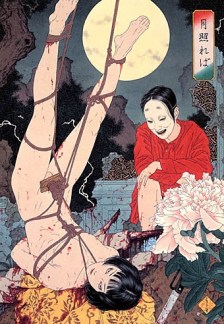
An illustration by Takato Yamamoto, a contemporary Japanese devotee of

An illustration by Takato Yamamoto, a contemporary Japanese artist working in the “ero guro” style.

Ero guro nansensu (a wasei-eigo term that literally means “erotic-grotesque-nonsense”) was a media-driven cultural phenomenon that originated in 1920–1930 Japan. The social climate of Tokyo between the two World Wars can be closely compared to that of Berlin’s Weimar era, with its famous hedonism and nihilistic world view amongst its artists and bohemian fringe. In his essay “Deviance and Social Darwinism in Edogawa Rampo’s Erotic-Grotesque Thriller Koto no Ōni” (2001), Stanford University professor Jim Reichert characterized ero guro as a “prewar, bourgeois cultural phenomenon that devoted itself to explorations of the deviant, the bizarre, and the ridiculous.” The art of ero guro puts its focus on eroticism, sexual corruption, decadence and the grotesque. While ero guro is a specific movement, many of its components can be found throughout Japanese history and culture. In fact, there is a well-established tradition in Japanese ukiyo-e (woodblock prints) of shunga depicting decapitations and acts of violence from Japanese history such as rape, bondage and erotic crucifixion.

Takato Yamamoto.

Takato Yamamoto.

This tradition of morbid eroticism continues in the work of contemporary Japanese illustrators and manga artists Takato Yamamoto and Suehiro Maruo. An obvious and immediate connection can be traced from the aforementioned ukiyo-e prints to Takato Yamamoto’s delicate colour palette and rendering style. Even as his dreamlike scenes reveal bondage and torture, his protagonists — often naked, effeminate boys — are frequently shown staring off in a calm, eerily detached manner. Yamamoto leaves his narratives deliberately opaque: it’s difficult to decipher whether these young boys are willing participants in these sinister proceedings, or have merely resigned themselves to their fate. The horror in Yamamoto’s art — while undeniably present — is tempered by the strange stillness of his scenes, as well as by his beautiful and virtuosic rendering.

The art of Suehiro Maruo.

The art of Suehiro Maruo.

The horror in Suehiro Maruo’s illustrations, on the other hand, is big, bold and shaded bright red. Adopting an illustrative style highly reminiscent of WWII-era Japanese propaganda posters (similar to the Soviet “socialist realism” style), Maruo’s images are typically gorier than those of Yamamoto, though these images are no less beautiful. His favourite motif is the young couple locked in an embrace, a romantic image that Maruo disrupts with the insertion of gore — as seen in the image on the left of the young soldier licking the eyeball of his sweetheart, whose face he’s so tenderly peeled away from her skull. Whereas Maruo’s illustrations tend to celebrate the more grotesque elements of ero guro, they are typically tamer in their representations of sexuality in comparison to the raunchier Yamamoto.