Halloween is one of the oldest holidays still celebrated in modern times, and can be traced back to the Druids, a Celtic culture in Ireland, Britain and Northern Europe. Its roots lay in the feast of Samhain (pronounced SA-WIN), which was annually held on October 31st to honor the dead. Much like Christmas, the pagan traditions of Samhain were later co-opted by the Christian church and replaced by All Saints Day (Nov. 1) as a means to align the Christian feast with the already well-established pagan festival. According to Wikipedia, “The word Halloween is first attested in the 16th century and represents a Scottish variant of the fuller All-Hallows-Even (“evening”), that is, the night before All Hallows Day.” Hence, we have the modern day Hallowe’en.
Month: October 2012
“Domestikia, Chapter 3: The Little Death”: I had a dream like that once…
One of the activities that keeps me busy these days — other than teaching, of course — is applying to grant programs. This is a long, tedious, and painful process that I submit to only grudgingly. It’s also, unfortunately, a necessary one. As part of the application process, I’ve been forced to cobble together a storyboard for my proposed animation project. This is yet another ‘necessary task’ that I perform grudgingly — being a naturally lazy creature, I’ve never done one before — though the benefits of having a storyboard are immediate and the process certainly worthwhile.
I don’t want to reveal all of my storyboard just yet, but here’s a sneak peak. Below the storyboard sample is my artist’s statement/project proposal, which might prove insightful to those of you who follow the development of my animations.
My current series of stop-motion animations entitled Domestikia developed directly out of a previous sculptural-installation project, in which I constructed a three-dimensional dollhouse from paper and lithographic prints. This project, entitled The Disobedient Dollhouse, employed the setting of a Victorian-themed dollhouse as a means to critique the sentimentality of nostalgia, as well as the tiny, precious model of perfect domesticity that the dollhouse itself proposes. A dollhouse is a gendered space, one specifically codified as feminine – it is therefore a highly suitable space in which to focus attention on women’s roles within the home. Furthermore, the strange, hybrid creatures and giant insects that populated my Dollhouse hinted at a dark, secret fantasy world churning just beneath the veneer of domestic perfection.
As previously stated, the Domestikia animation series began as an expansion of the narratives that originally appeared in The Disobedient Dollhouse project. For instance, the bird-headed children and Nanny (a self-portrait) featured in Domestikia: The Incident in the Nursery first existed as a paper diorama inside The Disobedient Dollhouse. The medium of stop-motion animation enabled me to — quite literally — bring that nursery scene alive. In addition to the scenes and narratives, the look and style of my Dollhouse has also carried over into my animations. Like the hand-drawn lithographs I created for the Dollhouse, the paper cutouts and articulated paper puppets from Domestikia possess the same grainy, textured quality of the lithographic crayon.
Similar to the other Domestikia films, the proposed project Domestikia, Chapter 3: The Little Death will employ the technique known as ‘cutout animation’, one of the earliest forms of stop-motion that uses flat characters and backgrounds cut from paper. The technical limitations of paper puppets, with their characteristically stiff and unnatural movements, make cutout animation particularly well suited to animations whose themes involve fantasy, surrealism, dreams, and that which otherwise lacks realism. Rather than being a technical limitation, the anti-realism of the paper cutout serves to amplify the strangeness of the events that happen throughout Domestikia – which is precisely why I’ve chosen to work with this technique. In Domestikia, Chapter 3: The Little Death, my plan is to further expand the technical and aesthetic possibilities of the paper cutout.
The storyline of Domestikia traces a series of strange, otherworldly events that take place within an imaginary dollhouse. The connecting thread between each narrative is the continual appearance of a butterfly, a creature that acts as a sort of ‘agent of chaos’, disrupting the daily domestic routines of the miniature household. In Domestikia, Chapter 6: An Unfortunate Incident Involving Her Hat, the appearance of the butterfly in the opening scene foreshadows the strangeness of subsequent events, in which the morning routine of dressing goes terribly wrong when a hat decides to grow out of control. The butterfly departs the scene, and in Domestikia: The Incident in the Nursery, it appears once more to disrupt the daily proceedings – this time, rousing an infant recently rocked to sleep by the Nanny, creating a cacophony of screams. The butterfly is once again featured in my proposed project, entitled Domestikia, Chapter 3: The Little Death. In this latest installment of the Domestikia series, the ‘little death’ of the title refers simultaneously to the metamorphosis process of the butterfly, as well as to ‘la petite mort’ of orgasm, as the butterfly is shown to have originated from an amorous encounter between Madelaine and her octopod lover. The ‘little death’ also refers to the literal building up, and subsequent dismantling of the Madelaine paper puppet when she is ‘lovingly dismembered’ by the octopus. Ostensibly, Domestikia, Chapter 3 is about shifts in identity that occur as one’s role in life changes: from individual, to couple, to parent. In short, sometimes it is necessary to ‘die’ in order to reinvent oneself.
Lady Lazarus’s Halloween Party Movie Night, 2012 Edition.
Hello, my darklings! The leaves are down, the sweaters are on, and it’s that time of the year that Lady Lazarus carefully crafts a list of horror films to whet your pre-Halloween appetites. Traditionally, I’ve had a theme for each Halloween list, such as “Best Horror Films of the 2000s” or “Favourite Horror-Comedies“, but this year I thought I’d open up and share with you, plain and simple, the horror films I’ve been watching of late. Some are new, and some are just new to me. Perhaps there’ll be a discovery or two for your own ghoulish viewing pleasure.

Isabelle Adjani proclaims “[He] is very tired. He made love to me all night” in Andrzej Zulawski’s challenging film Possession (1981)

Investigating a strange noise, Samantha ventures upstairs with a kitchen knife in Ti West’s “The House of the Devil” (2009).
2. I had heard many good things about Ti West’s The House of the Devil (2009) and, fortunately, those things turned out to be true. This is an accomplished psychological-horror in the vein of Polanski’s Rosemary’s Baby, where the terror builds on a slow-boil. What’s that, you say? You’ve been invited to babysit for creepy strangers in an isolated, in-the-middle-of-nowhere house? Why, sure. You need the money, and what could possibly go wrong? Let’s suspend that disbelief and just roll with it, ’cause it’s a fun, suspenseful ride. Kudos go to the art direction and costume design, as The House of the Devil boasts the most authentic recreation of that 1980s-look that I’ve personally viewed on film. Nice little cameo by that darling of ’80s horror, Dee Wallace (The Hills Have Eyes and The Howling).
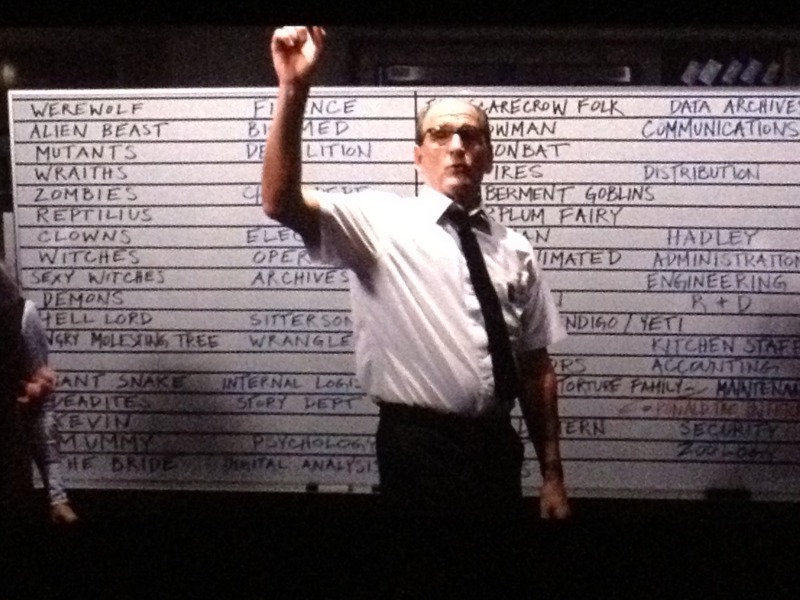
3. Oh, Joss Whedon. You don’t always hit it out of the park, but when you do…wow! Admittedly, taking the piss out of the slasher-horror is a little like shooting fish in a barrel and, yes, this is well-trodden ground that the Scream franchise visited sixteen years ago. All the same, Cabin in the Woods (2012) seems fresh and original, and is heaps of fun with a clever twist or two. Again, I don’t want to spoil the surprise, so I’ll simply end with — zombie redneck torture family.*
*SPOILER ALERT. Wanna know what all the various beasties and baddies were in Cabin in the Woods? Click here.
4. The horror genre has traditionally loved the anthology format. This love affair possesses a kind of logic. If one particular scenario doesn’t frighten you, then perhaps the next one will do the trick — after all, fear can be very subjective. One of the major pitfalls of anthologies is that they’re often hit-or-miss in terms of ratio of success. Such is the case with the 2012 ‘found-footage’ anthology V/H/S which, although it’s initial premise seemed promising, suffered from it’s weaker components. The first 35-minutes of hand-held shaky-cam is nauseating to the point of being almost unwatchable, though this does improve with the subsequent stories. The best offerings in this anthology were the fourth story of a couple communicating via FaceTime, and the final segment — created by a team of directors out of L.A. who call themselves Radio Silence — which follows a group of guys trying to find a Halloween party.
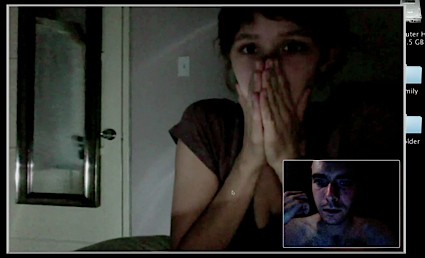
The rationale for the found-footage actually makes sense in one of the stronger offerings in V/H/S (2012).
Happy Halloween, everyone!