Hallowe’en Night divination game.

This slideshow requires JavaScript.

Halloween is one of the oldest holidays still celebrated in modern times, and can be traced back to the Druids, a Celtic culture in Ireland, Britain and Northern Europe. Its roots lay in the feast of Samhain (pronounced SA-WIN), which was annually held on October 31st to honor the dead. Much like Christmas, the pagan traditions of Samhain were later co-opted by the Christian church and replaced by All Saints Day (Nov. 1) as a means to align the Christian feast with the already well-established pagan festival. According to Wikipedia, “The word Halloween is first attested in the 16th century and represents a Scottish variant of the fuller All-Hallows-Even (“evening”), that is, the night before All Hallows Day.” Hence, we have the modern day Hallowe’en.

In keeping with its pagan origins, a belief arose that during Halloween the barrier between the realms of the living and the dead are at their most permeable, allowing for dead spirits to enter our world. A corollary of this belief is the traditional Scottish practice of Halloween-night divination. Though little known these days, the practice of various forms of “divination games” during Halloween was wildly popular in the late 19th-century and early 20th-century, a popularity commemorated in the divination-themed Halloween greeting cards above. One of the most popular of these was a form of scrying or mirror divination, in which an unmarried woman was instructed to sit before a mirror in a darkened room on Halloween night. Purportedly, if she gazed long enough, she would see a vision of her future husband reflected in the mirror. If, however, she was to die unmarried, a skull would appear instead — which just seems incredibly creepy. A common thread exists between this Halloween practice and the Bloody Mary game, in which the participants dare each other to look into a mirror and repeat Mary’s name three times, thus possibly summoning the folkloric witch.

Lady Lazarus’s 2011 Halloween Party Movie Night: ‘Pushing Boundaries.’

This is the follow-up post to Lady Lazarus’s 2011 Halloween Party Movie Night: ‘Ghoulish Delights.’

Pushing Boundaries.

Something you don’t want coming at you in the dark (and with that hammer) in REC and REC2.

1. The Spanish horror films [REC] (2007) and [REC]2 (2009) have proven to be a potent one-two punch in recent horror cinema. The second film is less of a sequel as a continuation of the first, with the action literally picking up where the first film ended. This is a very good thing, indeed, as the final third of [REC] set-up an unanticipated and fairly novel plot twist involving the Vatican, some dubious medical experiments, and a solitary priest living in the penthouse of the sealed-off, ‘zombie’-infested Madrid apartment building. It is this unique mashup of zombie-meets-supernatural thriller that makes the [REC] films standout from the recent overabundance of shaky-camera, faux found-footage style horror films. From what I’ve read, the shot-for-shot English language remake Quarantine (which I have not seen) altered the heavy Catholicism of the original Spanish film, replacing all those Virgin Marys with more generic, non-denominational Christian iconography. While the Catholicism would not have the same resonance for the multicultural, multi-faith English-speaking world as it would for the Latin, an easier and more obvious correlation exists between the flesh-eating ‘zombies’ and the characteristically morbid, blood-drenched imagery of Spanish Catholicism than it does for the more ‘sanitized’ versions of Christianity. The only disappointment I had with these films was the ending of [REC]2 which, as soon as a certain character reappears on the scene, is pretty much spelled out.

Catherine Begin as the diabolical Mademoiselle in “Martyrs” (2008).

2. I had purposely avoided Pascal Laugier’s Martyrs (2008) after reading the synopsis and questioning whether a plot that hinged upon the brutal and systematic abuse, torture and murder of young women was something I wanted to witness. After relenting and watching the film, I must admit that it pleasantly surprised me. Now, make no mistake — this is a troubling, violent, and gory film that boldly underscores the word extreme in the phrase ‘New French Extremity’, a category of recent French films in which Martyrs is often included. Much like the [REC] films above, Laugier’s Martyrs veers off in an unexpected and fascinating direction towards the end of the film, revealing a secret society of privileged individuals determined to discover — at any cost — the existence of an afterlife. The enigmatic ending will have you scratching your head for years to come.

3. Any film that re-imagines and updates the ‘slasher’ genre immediately gets my attention, as did Alexandre Aja’s superlative Haute Tension (2003). While some horror fans argue that the ‘big reveal’ in the film didn’t work, I give Aja credit for playing with the conventions of gender in the rigidly formulaic slasher genre. In one of my earlier posts, entitled Deviance, gender and the ‘aberrant female’ in horror, I wrote extensively on this film.

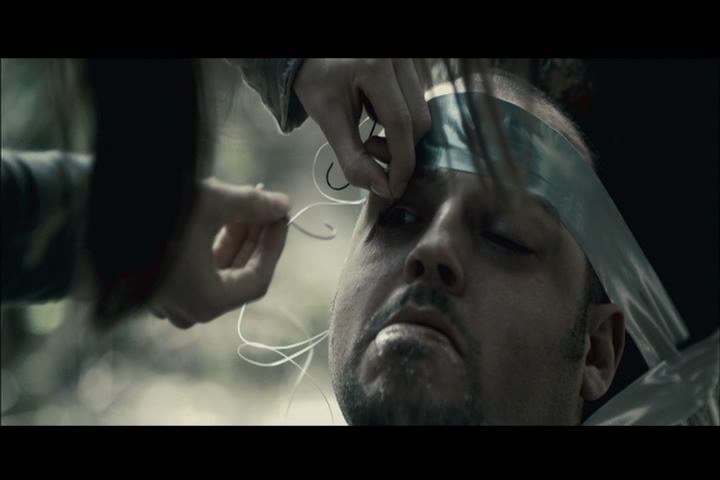
Nothing quite says “revenge” like a fish hook in the eyelid. Jennifer Hills is more of a badass in the 2010 remake of “I Spit On Your Grave.”

4. Like the dated sexual politics of the slasher film, the rape-revenge film is an exploitation subgenre also in need of an update. Much has changed in gender roles and equality since Meir Zarchi made his controversial 1978 cult film I Spit On Your Grave. The 2010 remake, which credits Zarchi as one of its producers, attempts to address some of the shortfalls of the original — at least, shortfalls in the eyes of this contemporary horror fan. In my earlier post Rape-Revenge Girl, I criticized Zarchi’s film for the rather unsatisfying revenge sequences. “The quotient of rape-to-revenge in Zarchi’s film is too much rape, not enough revenge,” I wrote, and “…the deaths of Jennifer’s rapists were not violent and/or gory enough for my — admittedly, gruesome — taste.” As if in direct response to my criticism, the 2010 remake offers up grisly and sickly-twisted revenge killings reminiscent of the stuff you’d find in “torture porn” films like Saw and Hostel. Admittedly, the whole transformation of Jennifer Hills from cheerful girl-next-door, to rape victim, to psychopathic and sadistic killer doesn’t work in any realm other than extreme, cathartic fantasy. Then again, if you’re opting to watch a film entitled I Spit On Your Grave, then you probably know what you’re in store for and will suspend your disbelief long enough to see the blood spill.

Lady Lazarus’s 2011 Halloween Party Movie Night: ‘Ghoulish Delights.’

Feel that crisp October chill in the air? That chill ushers in my favourite of the festive occasions: you guessed it, Halloween. If the spooky spirit of the season inspires you to celebrate all things horrific — or, like me, you celebrate such things on a regular basis — then below are some suggestions for Halloween-themed film viewing. I’ve grouped my suggestions into two distinct categories, and these I will separate across two blog posts. This first post offers up a small group of films I’ve labeled Ghoulish Delights. These are mainly campy, horror-comedy films best suited for Halloween party gatherings. Oh sure, there’s buckets of blood and disturbing scenes, but they’re all served-up with a big, mischievous wink. A follow-up post will address the second group, Pushing Boundaries, that will focus on horror films with considerable bite. These are films that either challenge or re-imagine standard narratives within the genre, or films that simply push the boundaries of taste and acceptability in contemporary horror.

Ghoulish Delights
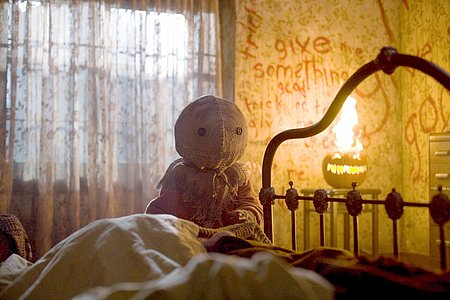
Michael Dougherty's sack cloth-headed horror mascot Sam (after 'Samhain', of course) from his little-known horror anthology "Trick r Treat" (2007).

1. A public release date fiasco on the part of Warner Bros. — that unfortunately resolved itself in Trick ‘r Treat (2007) being released direct-to-DVD two years after it initially screened at film festivals — essentially buried Michael Dougherty’s Halloween-themed horror anthology from the general public. However, thanks the internet and a dedicated horror-film blogger community, Trick ‘r Treat has gotten the love it so rightly deserves:

Despite only a handful of public screenings, the film has been reviewed extensively by online journalists and bloggers, especially in the genre/horror communities, and reviews are nearly unanimously positive. Dread Central gave it 5 out of 5 stars and stated “Trick ‘r Treat ranks alongside John Carpenter’s Halloween as traditional October viewing and I can’t imagine a single horror fan that won’t fall head over heels in love with it.”[3] The film earned 10 out of 10 from Ryan Rotten of ShockTilYouDrop.com.[4] It also earned an 8 out of 10 from Bloody Disgusting,[5] who later ranked the film ninth in their list of the ‘Top 20 Horror Films of the Decade’, with the article saying, “[It’s] so good that its lack of a theatrical release borders on the criminal.”[6] IGN attended a screening of the film and concluded, “This well-crafted Halloween horror tribute is a scary blast.”, rating it 8 out of 10 overall.[7] Based on 17 reviews collected by Rotten Tomatoes, the film has an overall “Fresh” approval rating from critics of 85%, with an average score of 7.7/10; the site’s critical consensus states “An deftly crafted tribute to Halloween legends, Trick ‘r’ Treat hits all the genre marks with gusto and old fashioned suspense.” — from Wikipedia.

Dougherty’s Trick ‘r Treat possesses the same irreverent black humour of horror-anthology franchises such as Creepshow and Tales From The Crypt, which gives the film a quality of both nostalgia and homage. Five interwoven tales of the macabre introduce us to the creepy Principal (played to the hilt by the gloriously creepy Dylan Baker), a self-conscious 22-year-old virgin portrayed by a pre-True Blood Anna Paquin, and a school bus packed with the vengeful ghosts of children in Halloween costumes. The one common element throughout all five stories is the presence of Sam, the mysterious and silent trick-or-treater who seems to embody the very spirit of Halloween.

2. I do love me some Bruce Campbell. This veteran actor of the B-horror genre — best known as Ash from Sam Raimi’s Evil Dead films — was perfectly cast as an old Elvis Presley in Don Coscarelli’s Bubba Ho-tep (2002). When a re-animated ancient Egyptian mummy suddenly appears in the nursing home in which Elvis lives, drastic action must be taken to destroy the creature and free the consumed souls of the nursing home’s elderly occupants. Serious fun.

He's back from the grave and ready to party in "Return of the Living Dead" (1985).

3. Have you ever wondered where that whole “zombies eating human brains” thing comes from? Nope, not from George A. Romero. The brain-eating zombie originated entirely from Dan O’Bannon’s Return of the Living Dead (1985).* In the words of one of the film’s reanimated dead, zombies seek out and devour human brains because “…it hurts to be dead…I can feel myself rotting” and “brains kill the pain”, however temporarily. So, there you have it. O’Bannon’s Return of the Living Dead is both a playful satire of, and a respectful homage to, earlier zombie films like those of Romero. Cheesy ’80s vintage camp in all the right places, this film boasts reasonably convincing zombies and the ‘scream queen’ actress Linnea Quigley, who spends almost her entire screen time completely naked save for a pair of blue stockings. Must’ve been a cold shoot for Ms. Quigley.

…and a couple of the usual suspects

4. Edgar Wright’s Shaun of the Dead (2004) is another — much, much better — satire/homage to the zombie horror genre. It’s such an exemplary horror-comedy that it’s pretty much a given, and I need not discuss it further here.

5. I mentioned Sam Raimi’s Drag Me To Hell (2009) in last year’s Halloween list, but the strength of this film cannot be overstated. A hilarious horror-comedy with some legitimate scares thrown in — an extraordinarily difficult balance to achieve and quite the accomplishment for Raimi, who adeptly showed us that he still knows how to do it.

*There was a single, zombie-eating-brains scene in Lucio Fulci’s City of the Living Dead (1980) but, to the best of my knowledge, this is the first film that truly places brain on the menu for the undead.