Deviance, gender and the ‘aberrant female’ in horror, part IV.

The Rape-Revenge Girl.

Jennifer (Camille Keaton) exacts revenge on one of her rapists in ‘I Spit On Your Grave’ (1978).

Horror fiction tends to narrowly focus on two main themes: sex and death. (In fact, an argument can be made that most art is preoccupied with these two topics). A corollary subject that often arises from this thematic pairing is the violent cruelty of mankind that ultimately leads to sex and/or death. The writings of the Marquis de Sade and films of both Pasolini and Hanneke are almost entirely devoted to the examination of power dynamics and the innate viciousness of humanity. The reader/audience is also strongly implicated as willing participants in this parade of cruelty served up for our (presumably) voyeuristic consumption.

The Rape-Revenge scenario is the perfect encapsulation of this sex + death equation: a young, beautiful woman is sexually and physically brutalized, but survives to exact bloody vengeance upon her tormentor/s. This scenario is one that is strongly favoured by the various subgenres of exploitation cinema because its, well, basically lurid and exploitative. The most famous (or infamous, depending on your point-of-view) of the Rape-Revenge subgenre is Meir Zarchi’s Day of the Woman (1978), better known by its re-release title, I Spit on Your Grave. Now, let’s place this film in it’s proper context. Zarchi’s I Spit On Your Grave is a base, low-budget, and poorly acted film. It’s pure exploitation cinema, and a far cry from the critically-lauded work of Sade, Pasolini and Hanneke. That being said, it has been the subject of a great deal of feminist critical discourse since its release, with academics such as Carol Clover and Julie Bindel championing its “feminist” viewpoint.

The plot is threadbare. Jennifer Hills, an aspiring writer from “the big city”, seeks solitude in a rental cottage so that she may focus on her craft. The local country bumpkins have different plans for Ms. Hills, however, for no apparent reason other than the fact that she’s young, pretty and unaccompanied. They systematically terrorize, gang rape, and then murder their victim. Or so they believe. Jennifer survives her attack, and returns for revenge. One by one, her former tormentors are dispatched in ever increasingly gruesome ways and we, the audience, cheer her on through this exercise in catharsis.

Dude, rape victims don’t generally seduce their rapists into bathtubs after the attack. Darwinism claims yet another deserved victim.

I had two major misgivings with Zarchi’s I Spit On Your Grave. I’ll list them in point form.

1. One is forced to sit through a protracted series of rapes before we arrive at the satisfaction of revenge. This is the ‘Faustian bargain’ to which we females tacitly agree when viewing such films: howls of naked protest from the heroine in Act One, to be followed by bloody vengeance. The quotient of rape-to-revenge in Zarchi’s film is too much rape, not enough revenge. At least, the deaths of Jennifer’s rapists were not violent and/or gory enough for my — admittedly, gruesome — taste. The only death scene that worked for me was the castration-in-the-bathtub scene. Gallons of fake blood, off-screen howls and much left to the imagination of the viewer make this scene an effective one.

2. The rapists are portrayed as complete imbeciles, with one of them a mildly retarded, Gomer Pyle-like character. Did Zarchi intend this as a further insult-to-injury for poor Jennifer Hills? That an independent, educated woman like her could be bested by this group of inbreds? The convincing performance of Camille Keaton in the infamous ‘sodomy scene’ is completely undercut by the spastic gyrations of her attacker. What the hell is the actor doing back there? Was he directed to look that ridiculous? Even during a scene as horrendous as this, I could not suppress my laughter.

Where is the ‘deviance’ and the ‘aberrant female’ in all this, you ask? Carol Clover wrote in the third chapter of her 1992 book Men, Women, and Chainsaws that she can “appreciate, however grudgingly, the way in which [the movie’s] brutal simplicity exposes a mainspring of popular culture.” Women are typically cast as victims in exploitation films, and their suffering has become a form of sadistic entertainment. Zarchi’s film attempts to address this issue. Rather than rely on the sporadic justice of the judiciary system, Jennifer Hills takes matters into her own hands. She embodies the rage we feel against the cruel reality of rape, and we sit through her violation in order to experience the vicarious thrill of revenge without ever getting our hands bloodied.

While Zarchi’s I Spit On Your Grave doesn’t entirely work for me as a satisfying Rape-Revenge film, my next post will focus on a film in this genre that does work: the equally controversial French film Baise-moi (2000).
Next post–>

Deviance, gender and the ‘aberrant female’ in horror, part III.

The Lesbian Vampire.

Theodora: Is this another one of your crazy ideas?
Eleanor: I’m not crazy!
Theodora: Crazy as a loon! You really expect me to believe that you’re sane and the rest of the world is mad?
Eleanor: Well why not? The world is full of inconsistencies. Full of unnatural beings, nature’s mistakes they call you for instance!

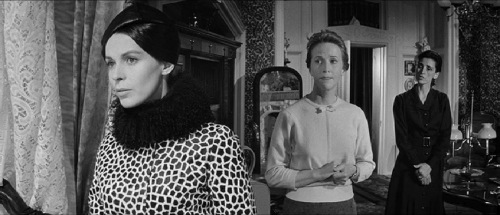
The text above is dialogue from Robert Wise’s film The Haunting (1963) in which Dr. Markway, a researcher into paranormal activity, has assembled a group to investigate the reputed haunting of the gothic New England mansion Hill House. Amongst the group are the clairvoyant Theodora, a bold, outspoken woman who exudes worldly sophistication, and Eleanor, an awkward spinster who’s spent most of her adult life caring for her sick mother. In spite of their differences, Theodora befriends the mousy Eleanor, and there’s even the hint of romantic interest — however unlikely — emanating from Theodora. Director Robert Wise and screenwriter Nelson Gidding conceived of the Theodora character as lesbian, which would be one of the earliest appearances of a queer character in cinematic horror. Of course, the social climate of the early 1960’s meant that references to Theodora’s sexual orientation were all very codified and subtle, but Eleanor’s accusation of  “…unnatural beings…” and “nature’s mistakes…” allude not only to Theo’s preference in romantic partners, but they clearly establish homosexuality as an indication of deviance and ‘unnaturalness’.

Claire Bloom stars as Theodora (far left), Julie Harris as Eleanor (centre) and Rosalie Crutchley as the stony and gloriously creepy groundskeeper Mrs. Dudley in Robert Wise’s “The Haunting” (1963).

As was discussed in my earlier post on gender & the slasher film, queerness and the fluidity of gender identity in horror fiction is frequently a sign of mental illness. The cross-dressing serial killer — Norman Bates, for instance — and the homicidal, lovesick lesbian from Aja’s Haute Tension are examples of blurred gender boundaries being symptomatic of mental instability. While the character of Theodora in Wise’s The Haunting is not portrayed as violent nor mentally ill, her lesbianism marks her as ‘unnatural’ as the haunted Hill House in which the drama unfolds. This notion is certainly ironic given that it is the socially-awkward Eleanor, and not Theodora, who stands out as “the one who doesn’t belong” within the group.

“Hey! That’s not my neck!” Vampire love bite from “Twins of Evil” (1971).

This takes us to the third most common female trope in horror fiction: the Lesbian, and specifically the Lesbian Vampire. Why vampire, you ask? Simple. This trope has its roots in Joseph Sheridan le Fanu’s novella Carmilla (1872) about the predatory love of a female vampire for a young woman. Le Fanu’s novella was influential not only on Bram Stoker’s Dracula — which it predated by 25 years — but serves to this day as the source chiefly consulted for the female vampire. (See my post on The Vampiress for more on this topic). The reason for the popularity of the Lesbian Vampire seems fairly straightforward: titillation, pure and simple. Wikipedia sums this up neatly:

This was a way to hint at or titillate with the taboo idea of lesbianism in a fantasy context outside the heavily censored realm of social realism (Weiss 1993). Also, the conventions of the vampire genre — specifically, the mind control exhibited in many such films — allow for a kind of forced seduction of presumably straight women or girls by lesbian vampires.

In the early 1970’s, Britian’s Hammer Studios created the much beloved Karnstein Trilogy, a series of lesbian vampire films very loosely based on Le Fanu’s novella: The Vampire Lovers (1970), Lust for a Vampire (1971) and Twins of Evil (1971). I’ve only seen the first film, which stars the iconic ‘Hammer Girl’ Ingrid Pitt and is quite giggle-worthy. File under ‘guilty pleasure.’

For the most part, the Lesbian Vampire is more softcore than horror, and bears little resemblance to the gender-bending serial killers mentioned earlier. What they do have in common, however, is the demarcation of Otherness — even the racy, breast-biting vampire of Twins of Evil is ultimately portrayed as ‘aberrant’ and ‘deviant.’

In Part IV of this series of posts, I’ll address the Rape-Revenge Girl.

Next post –>

Mother’s Day REPOST: “Your mother ate my dog!”

“Definition of  Freudian slip: when you say one thing, but meant your mother.” –an old joke, as immortalized in Urban Dictionary.

Ever since the days of Sigmund Freud, mothers have endured the brunt of blame for the neuroses of their offspring. The psychologically-complex relationship between mother and child served as the dramatic foil against which the existential angst of Shakespeare’s melancholic Hamlet played out, not to mention innumerable tales of dysfunctional families in horror fiction. There are countless examples of horror movie villains, like Jason Voorhees from the Friday the 13th series, who have a rather intense and, um, complicated relationship with their mother. In these films, the character of the mother is the creator — both literally and metaphorically — of the monster. Let’s honour Mother’s Day by paying homage to the most memorable mothers in cinematic horror.

Margaret White (Piper Laurie) presses her traumatized daughter against her “dirty pillows” in De Palma’s “Carrie.”

1. The abusive Margaret White (Piper Laurie) from Brian De Palma’s Carrie (1976) torments her teenage daughter with her ferocious piety. Unfortunately for Mrs. White, her daughter happens to possess telekinetic powers and a strong desire to attend her high school prom. When the latter proves disastrous, and Carrie finds herself soaked in pigs blood, things go from bad to worse. Convinced that she is “possessed by Satan,” Margaret stabs her daughter in the back before being summarily dispatched by a shower of kitchen knives flung at her by Carrie’s telekinesis. The knives pin Mrs. White against the kitchen door frame in the highly appropriate cruciform stance, offering horror fans one of the most memorable and satisfying death scenes in the genre.

Vera “Mum” Cosgrove gets bitten by the nasty Sumatran Rat-Monkey in Peter Jackson’s “Braindead”.

2. Long before he ventured into the realm of Orcs and Hobbits, New Zealand director Peter Jackson was much beloved in the horror genre for his “splatter” films. His infamous 1992 horror-comedy Braindead (released in North America as Dead Alive) still holds the title for being one of the bloodiest, goriest zombies films to date. Even highly adept and accomplished splatter-gore directors like Takashi Miike don’t quite attain Jackson’s zany, hilarious, and way over-the-top levels of gore. As if in counterbalance to the excessive gore, Jackson’s Braindead offers an equally excessive character in Vera Cosgrove. She epitomizes the thoroughly controlling, ball-busting mother who simply cannot allow potential happiness to enter the life of her beleaguered son. Once “Mum” is bitten by the Sumatran Rat-Monkey and infected with the virus that transforms her into a zombie, Jackson revels in the sadistic pleasure of having various parts of her matronly body impaled, injected, dismembered, consumed, and otherwise compromised. Packed with many memorable quotes, including “I kick ass for The Lord!” and, one of my favourites, “Your mother ate my dog!”, Braindead is a gloriously gory, campy romp. Just don’t watch it soon after eating.

Nola (Samantha Eggers) gives her newborn a clean — with her tongue — in Cronenberg’s “The Brood.”

3. Procreation doesn’t get more bestial than in David Cronenberg’s 1979 Canadian horror classic The Brood. Samantha Eggars (best known for her role as TV-mom to Sarah Michelle Gellar in Buffy the Vampire Slayer) plays Nola Carveth, a mentally-ill patient who opts for an experimental, and highly controversial, psychotherapy treatment. This unorthodox  “psychoplasmics” treatment causes the patient’s mental illness to manifest physically on their bodies — in the case of Nola, she parthenogenetically births strange, mutated children. This film has all the themes that typify a Cronenberg film: abjection, body horror, bizarre sexuality, and an anxiety/horror over female biology and reproduction. A degree of sympathy exists for Nola, as she’s evidently the victim of childhood abuse perpetrated by her cruel and self-centred mother, although this sympathy soon diminishes once it is revealed that Nola is, herself, abusing her daughter Candice. The ‘birthing’ scene, where Nola licks her offspring clean in the manner of a mother cat, is classic Cronenberg.